To save content items to your account,
please confirm that you agree to abide by our usage policies.
If this is the first time you use this feature, you will be asked to authorise Cambridge Core to connect with your account.
Find out more about saving content to .
To save content items to your Kindle, first ensure no-reply@cambridge.org
is added to your Approved Personal Document E-mail List under your Personal Document Settings
on the Manage Your Content and Devices page of your Amazon account. Then enter the ‘name’ part
of your Kindle email address below.
Find out more about saving to your Kindle.
Note you can select to save to either the @free.kindle.com or @kindle.com variations.
‘@free.kindle.com’ emails are free but can only be saved to your device when it is connected to wi-fi.
‘@kindle.com’ emails can be delivered even when you are not connected to wi-fi, but note that service fees apply.
Perovskite solar cells are at the edge of commercial success. Device efficiency records break at a regular pace, while stability and optimization are progressing rapidly. The first commercial products could reach the market within the next year, only a decade since perovskite photovoltaics were first discovered. MRS Bulletin presents coverage of the most recent impactful advances in the burgeoning field of perovskite research.
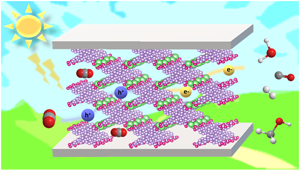
Light absorption in nanoparticles of semiconductors and metals excites electrons from ground states to high-energy levels, generating hot electrons with the addition of kinetic energy, and consequently, complimentary hot holes in the nanoparticles. These hot electrons are capable of injecting themselves into the empty antibonding orbitals of chemical bonds of reactant molecules adsorbed on the surface of the nanoparticles, thereby weakening the chemical bonds to trigger corresponding desirable chemical reactions. Hot-electron chemistry represents a fundamentally different mechanism of solar-to-chemical energy conversion compared to the traditional photochemistry that relies on the direct photo-excitation of electrons in reactant molecules and thermal catalysis. This issue of MRS Bulletin examines the generation and relaxation of hot electrons in typical nanoparticle systems, and the flow of hot electrons across the surfaces of the nanoparticles. The promise of hot-electron chemistry (and the complementary hot-hole chemistry) is supported by its application in many important reactions, including CO2 reduction, water splitting, hydrogenation, and coupling reactions, highlighting its great potential in achieving high energy-conversion efficiency and product selectivity.
Consumer electronics have caused an unsustainable amount of waste electrical and electronic equipment (WEEE). Organic electronics, by means of eco-design, represent an opportunity to manufacture compostable electronic devices.
Waste electrical and electronic equipment (WEEE), or e-waste, is defined as the waste of any device that uses a power source and that has reached its end of life. Disposing of WEEE at landfill sites has been identified as an inefficient solid waste processing strategy as well as a threat to human health and the environment. In the effort to mitigate the problem, practices such as (i) designing products for durability, reparability, and safe recycling, and (ii) promoting closed-loop systems based on systematic collection and reuse/refurbishment have been identified. In this perspective, we introduce a complementary route to making electronics more sustainable: organic electronics based on biodegradable materials and devices. Biodegradable organic electronics lie at the intersection of research in chemistry, materials science, device engineering, bioelectronics, microbiology, and toxicology. The design of organic electronics for standardized biodegradability will allow composting to be an end-of-life option.
Role of MOFs in CO2 chemical conversion; Photocatalytic and electrocatalytic CO2 reduction; Role of linkers and metals in CO2 chemical conversion; and MOF composites and films in CO2 conversion.
In this review, we analyze the emerging field of metal–organic frameworks (MOFs) as catalysts for chemical conversion of CO2, with examples ranging from heterogeneous CO2 organic transformation to heterogeneous CO2 hydrogenation, from photocatalytic to electrocatalytic CO2 reduction. We also discuss the role of MOF composites and films in CO2 transformation. Our goal is to have an instrument useful to identify the best MOFs for CO2 conversion.
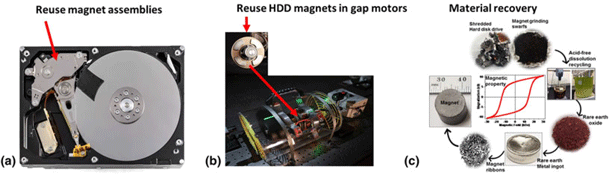
A case study of hard disk drives (HDDs) and rare-earth magnets is presented to show the use of decision support tools to identify and assess the barriers and opportunities for circular business models. Pilot demonstration projects, which showcased HDD circular recovery strategies, were useful as a low-risk opportunity for business model experimentation and to build trust among key supply chain actors.
A case study of hard disk drives and rare-earth magnets is presented to show the use of decision support tools (DSTs) to assess the complex interaction of variables that must be considered when demonstrating the viability of circular business models (CBMs). A mix of quantitative and qualitative DSTs such as life cycle assessment, techno-economic assessment, Ostrom's Framework for social-ecological systems, decision trees, and others were implemented by the iNEMI Value Recovery Project team to overcome many of the identified barriers to circular economy. The DSTs were used to guide stakeholder coordination, create and share environmental, logistical and financial data, and generate decision-making flowcharts which promote circular economic strategies. Demonstration projects were used as a low-risk opportunity for business model experimentation and to build trust among key supply chain actors. The tools highlighted by this case study could be useful for establishing or expanding CBMs for other electronic products or components, especially components containing critical materials.
The circular economy aspects of PET (polyethylene terephthalate) waste conversion into value-added products are discussed concerning different governmental policies and industrial protocol for plastic degradation.
The use of microbial enzymes such as PET hydrolase is discussed regarding PET (polyethylene terephthalate) degradation.
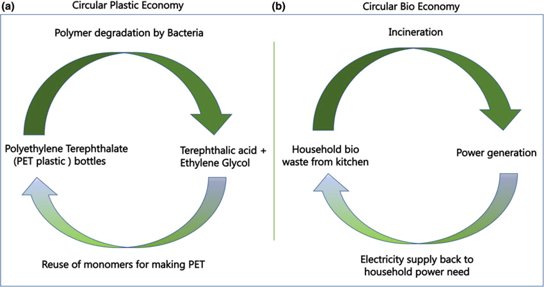
The primary purpose of this perspective is a critical analysis of the correlation of the current state-of-the-art rising circular economy platform enacted across the world with close looping of PET (polyethylene terephthalate)-based plastic polymer disposal and sustainable recycling and upcycling technology. The goal of the upcycling process is to get the low-cost value-added monomer than those obtained from the hydrocarbon industry from the sustainability prospect. A summary of the circular bio-economic opportunities has also been described. Next, how the PET hydrolase enzyme degrades the PET plastic is discussed. It is followed by an additional overview of the effect of the mutant enzyme for converting 90% of plastics into the terephthalate monomer. A site-directed mutagenesis procedure obtains this particular mutant enzyme. The diversity of different microbial organism for producing PET hydrolase enzyme is finally discussed with a suggested outlook of the circular economy goal from the viewpoint of plastic degradation objectives soon.
Environmental concerns deriving from fossil fuel dependency are driving an energy transition based on sustainable processes to make fuels and chemicals. Solar hydrogen is the pillar of this new green economy, but the technological readiness level of PV electrolysis and direct photoelectrochemical (PEC) electrolysis are still too low to allow broad commercialization. Direct conversion through PEC technology has more potential in the medium–long term but must be first guided by the scientific enhancements to improve device efficiencies. For this purpose, in situ and operando photoelectrochemistry will guide the discovery of new materials and processes to make solar fuels and chemicals in PEC cells.
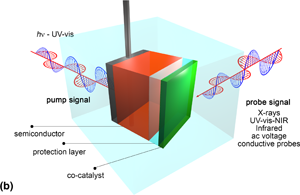
The use of advanced in situ and operando characterizations under working photoelectrochemical (PEC) conditions is reviewed here and anticipated to be a fundamental tool for achieving a basic understanding of new PEC processes and for enabling the large-scale development of PEC technology by 2050, thus delivering fuels and chemicals having zero (or negative) carbon footprint. Hydrogen from solar water splitting is the most popular solar fuel and can be mainly produced by indirect photovoltaic-driven electrolysis (PV electrolysis) and direct photoelectrochemistry. Although PV electrolysis has already been developed on a level of MW-scale pilot plants, PEC technology, which is much less mature, holds several advantages in the long term over PV-electrolysis systems. The key enabling feature to developing PEC technology is the improvement of the photoelectrode materials which are responsible for the absorption of light, and transport of the photo-generated charge carriers to drive the electrochemical surface reaction. These processes are often complex and multistep, spanning multiple timescales and following the simultaneous detection of photoelectrodes modification and formation of reaction intermediates/products can be achieved using eight well-known characterization techniques here presented.
Nanoscale materials that contain metallic components can be designed to have excellent light-harvesting capabilities, and can also be used to direct the flow of energy from incident photons into small molecules at or near the surface of metal nanoparticles. One promising route for energy flow is through so-called hot charge carriers, which are optically excited on metal nanoparticles and subsequently transferred to molecules/materials that share an interface with the metal. This article provides an overview of the fundamentals of hot-carrier generation and transfer, discusses both theoretical and experimental means for interrogating these processes, and discusses several potential societally important applications of hot-carrier-driven chemistry to solar fuels and sustainable chemistry.
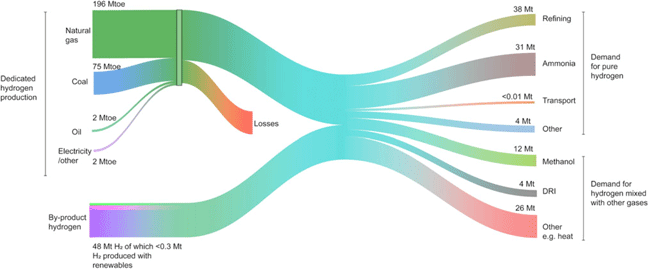
Hydrogen is often touted as the fuel of the future, but hydrogen is already an important feedstock for the chemical industry. This review highlights current means for hydrogen production and use, and the importance of progressing R&D along key technologies and policies to drive a cost reduction in renewable hydrogen production and enable the transition of chemical manufacturing toward green hydrogen as a feedstock and fuel.
The chemical industry is at the core of what is considered a modern economy. It provides commodities and important materials, e.g., fertilizers, synthetic textiles, and drug precursors, supporting economies and more broadly our needs. The chemical sector is to become the major driver for oil production by 2030 as it entirely relies on sufficient oil supply. In this respect, renewable hydrogen has an important role to play beyond its use in the transport sector. Hydrogen not only has three times the energy density of natural gas and using hydrogen as a fuel could help decarbonize the entire chemical manufacturing, but also the use of green hydrogen as an essential reactant at the basis of many chemical products could facilitate the convergence toward virtuous circles. Enabling the production of green hydrogen at cost could not only enable new opportunities but also strengthen economies through a localized production and use of hydrogen. Herein, existing technologies for the production of renewable hydrogen including biomass and water electrolysis, and methods for the effective storage of hydrogen are reviewed with an emphasis on the need for mitigation strategies to enable such a transition.
Circular energy transformation of Turkey is essential to strengthen the national energy security. Turkey will benefit from moving towards a circular economy.
Circular economy (CE) has gained much attention due to global warming and climate change which are the most serious issues faced in the world. The United Nations has been struggling with the issues regarding sustainable development by releasing some programs and legislations, which are mostly supported by the EU. The EU's CE including both economy and energy within the scope of low-carbon world is binding for Turkey's energy transition. Among renewables, solar energy preserved the leading capacity expansion with an increase of 98 GW in 2019 in the world. Solar photovoltaic (PV) has become a mainstream energy source among renewables. Since the PV installation has been growing all around the world, several countries especially China, Germany, and the UK pay special attention to a sustainable PV waste management concept. We present the special case of Turkey within the global CE along with the current status of renewable energy in the global energy transformation. Turkey's energy outlook and the EU's targets are reviewed, and the significant role of solar energy in the CE transition process of Turkey has been revealed. We suggested adding a vision of “More Circular” to her new energy policy “More Domestic, More Renewable.”
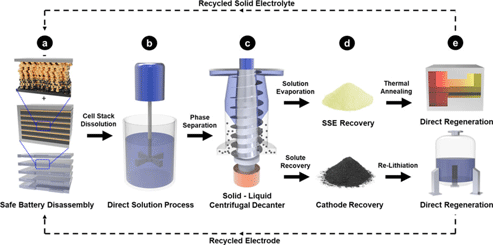
A scalable battery recycling strategy to recover and regenerate solid electrolytes and cathode materials in spent all solid-state batteries, reducing energy consumption and greenhouse gases.
With the rapidly increasing ubiquity of lithium-ion batteries (LIBs), sustainable battery recycling is a matter of growing urgency. The major challenge faced in LIB sustainability lies with the fact that the current LIBs are not designed for recycling, making it difficult to engineer recycling approaches that avoid breaking batteries down into their raw materials. Thus, it is prudent to explore new approaches to both fabricate and recycle next-generation batteries before they enter the market. Here, we developed a sustainable design and scalable recycling strategy for next-generation all solid-state batteries (ASSBs). We use the EverBatt model to analyze the relative energy consumption and environmental impact compared to conventional recycling methods. We demonstrate efficient separation and recovery of spent solid electrolytes and electrodes from a lithium metal ASSB and directly regenerate them into usable formats without damaging their core chemical structure. The recycled materials are then reconstituted to fabricate new batteries, achieving similar performance as pristine ASSBs, completing the cycle. This work demonstrates the first fully recycled ASSB and provides critical design consideration for future sustainable batteries.