To save content items to your account,
please confirm that you agree to abide by our usage policies.
If this is the first time you use this feature, you will be asked to authorise Cambridge Core to connect with your account.
Find out more about saving content to .
To save content items to your Kindle, first ensure no-reply@cambridge.org
is added to your Approved Personal Document E-mail List under your Personal Document Settings
on the Manage Your Content and Devices page of your Amazon account. Then enter the ‘name’ part
of your Kindle email address below.
Find out more about saving to your Kindle.
Note you can select to save to either the @free.kindle.com or @kindle.com variations.
‘@free.kindle.com’ emails are free but can only be saved to your device when it is connected to wi-fi.
‘@kindle.com’ emails can be delivered even when you are not connected to wi-fi, but note that service fees apply.
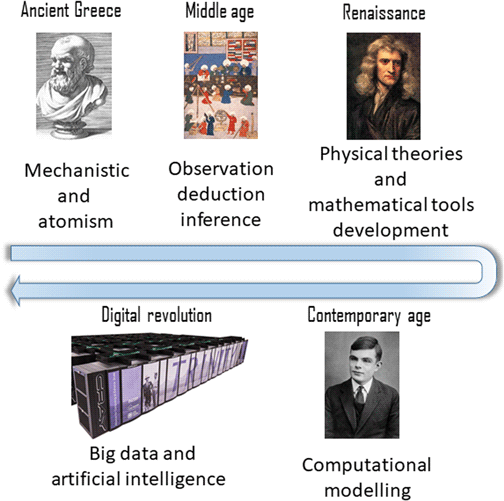
The paradigm of molecular discovery in the chemical and pharmaceutical industry has followed a repetitive succession of screening and synthesis, involving the analysis of individual molecules that were both natural and produced. This ability to generate and screen libraries of compounds has found an echo in solid-state physics with the demand to explore and produce new materials for testing. In response to this demand, a golden age of materials discovery is being developed, with progress on important areas of both basic science and device applications. The confluence of theoretical and simulation methods, together with the availability of computation resources, has established the “materials genome” approach that is used by a growing number of research groups around the world with the goal of innovating on materials through systematic discovery. In this Prospective, an overview of this group of methodologies in tackling the ever-increasing complexity of computational materials science simulations is provided. Computational simulation is highlighted as a major component of rational design and synthesis of new materials with targeted properties, describing progress on databases and large data treatment. Tools for new materials discovery, including progress on the deployment of new data repositories, the implementation of high-throughput simulation approaches, and the development of artificial intelligence algorithms, are discussed.
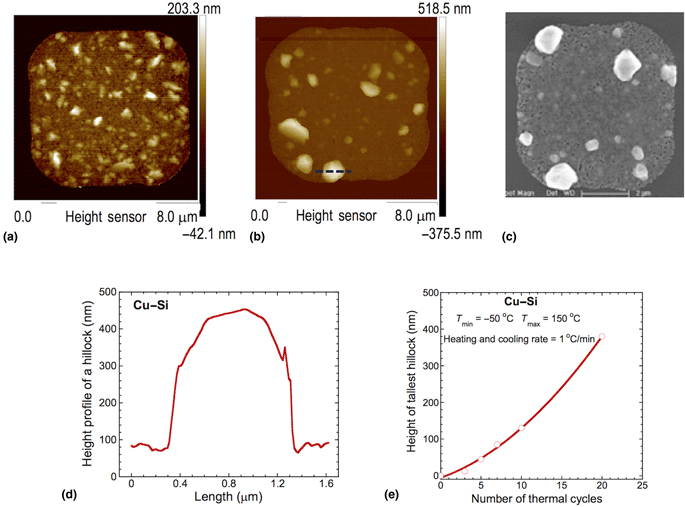
The authors report effects of placing a very thin metallic interlayer, such as W and Ni, in between the Cu film and the Si substrate on cyclic thermal stress-induced interfacial sliding and hillock growth in Cu. Cu–Si samples with no interlayer were the most prone to both interfacial sliding and hillock growth, whereas samples with the Ni interlayer were the most resistant against these deleterious phenomena. While the rate of interfacial sliding decreased with each consecutive thermal cycle, hillocks continued to grow undeterred. The obtained experimental results are discussed, considering the compressive stress field generated in the Cu film.
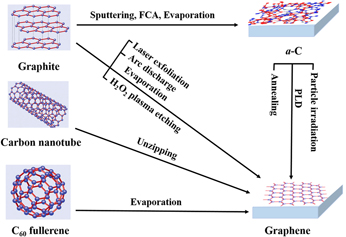
The unique properties of graphene have led to the use of this allotrope of carbon in a wide range of applications, including semiconductors, energy devices, diffusion barriers, heat spreaders, and protective overcoats. The synthesis of graphene by process methods that either directly or indirectly rely on physical vapor deposition, thermal annealing, laser irradiation, and ion/electron beam irradiation has drawn significant attention in recent years, mainly because they can provide high purity, low temperature, high throughput, and controllable growth of graphene on various substrates. This article provides a comprehensive assessment of these methods by grouping them into two main categories, i.e., indirect methods in which a carbon layer is first deposited on a substrate and then converted to graphene by some type of energetic post-treatment process and direct methods in which graphene is directly synthesized on a substrate surface by a process that uses a solid carbon source. The underlying growth mechanisms of these processes and the challenging issues that need to be overcome before further advances in graphene synthesis can occur are interpreted in the context of published results.
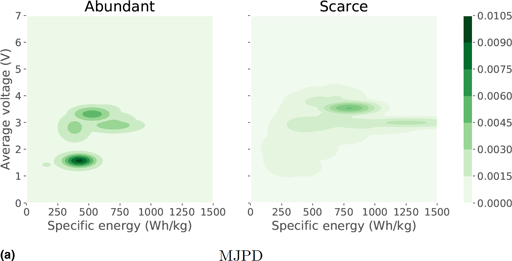
In many materials development projects, scientists and research heads make decisions to guide the project direction. For example, scientists may decide which processing steps to use, what elements to include in their material selection, or from what suppliers to source their materials. Research heads may decide whether to invest development effort in reducing the environmental impact or production cost of a material. When making these decisions, it would be helpful to know how those decisions affect the achievable performance of the materials under consideration. Often, these decisions are complicated by trade-offs in performance between competing properties. This paper presents an approach for visualizing and evaluating design spaces, where a design space is defined as the set of possible materials under consideration given specified constraints. This design space visualization approach is applied to two case studies with environmental impact motivations: one in biodegradability for solvents, and the other in sustainable materials sourcing for Li-ion batteries. The results demonstrate how this visualization approach can enable data-driven, quantitative decisions for project direction.
We show interlayer stacking shifts occur in transition metal dichalcogenides (TMD) bilayers due to the strain introduced during sample heating, and attributed to rippling of one layer relative to the other. The atomic structure of the interlayer stacking is studied using annular dark field scanning transmission electron microscopy with an in situ heating holder. Before heating, bilayers show uniform interlayer stacking of AA′ and AB. When heated, contrast change is seen and associated with interlayer stacking changes at the atomic scale due to ripples. When cooled down to room temperature, these contrast features disappear, confirming it is a reversible process that is not related to defects or vacancies. Because the bottom layer is attached to the in situ heating chip made from Si3N4 and the top layer is in contact with the underlying TMD layer with weak van der Waals interaction, the two layers experience different forces during thermal expansion.
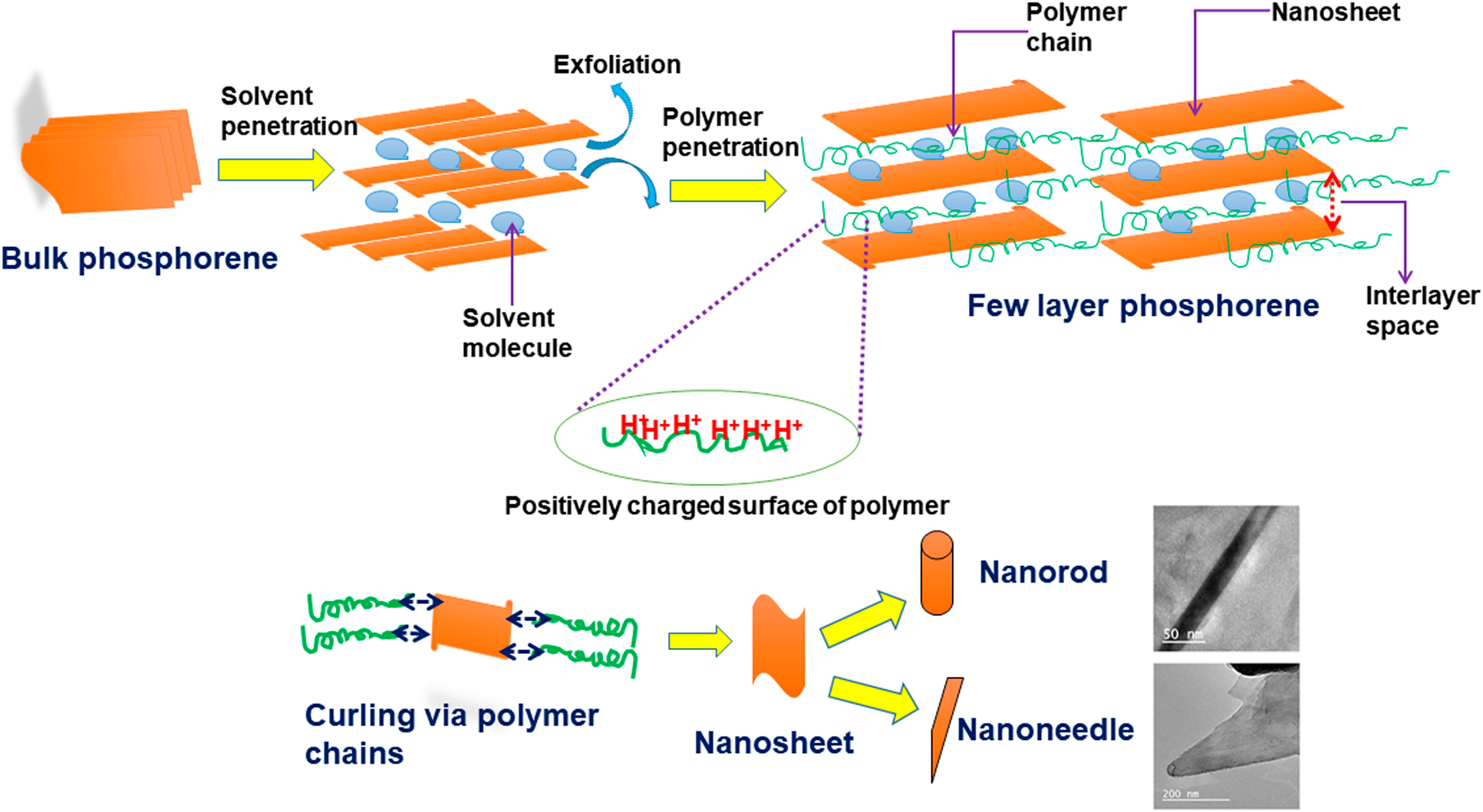
Structural evolution induced and driven by a dual system and simultaneous passivation of phosphorene are reported. Different nano-objects of phosphorene or black phosphorus (BP) are obtained using a new method of exfoliation, in which solvent and an ionic polymer are combined to weaken the van der Waals forces and to scissor the nanosheets. Nanoribbons, nanorods, and nanoneedles are obtained under mechanical force and ambient conditions. Ionic polymer chains assist in curling the monolayer or few-layer nanosheet. Nafion is chosen to exfoliate the bulk BP and induce a morphological transition in BP nanosheets. The exfoliation of BP nanosheets results into thin and specific structures such as nanosheets/rods/needles. The nanosheets of phosphorene are covered and passivated simultaneously by the polymeric sheath that protects the nanosheets from degradation or oxidation and can be integrated with a device directly without any further coating.
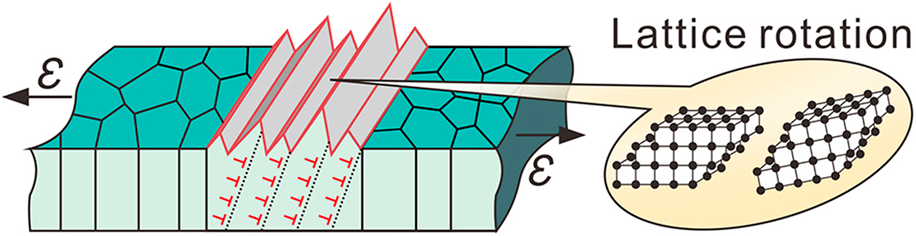
A detailed electron backscatter diffraction (EBSD) characterization was utilized to investigate abnormal grain growth behavior of nanocrystalline (NC) Au films constrained by a flexible substrate under cyclic loading. Abnormally grown grains (AGGs) in front of about 15 fatigue cracks were picked out to investigate the grain reorientation behavior during abnormal grain growth in the fatigue crack tip in the cyclically deformed thin films. It shows that the AGGs exhibited 〈001〉 orientation along the loading direction, whereas grains grown far away from fatigue cracks had no significant texture change. The cyclic cumulative shear strain was found to play a key role in grain reorientation. A lattice rotation model was proposed to elucidate the grain reorientation mechanism during abnormal grain growth. Such grain reorientation behavior of NC metals was found to provide an intrinsic resistance of the NC metals to fatigue damage.
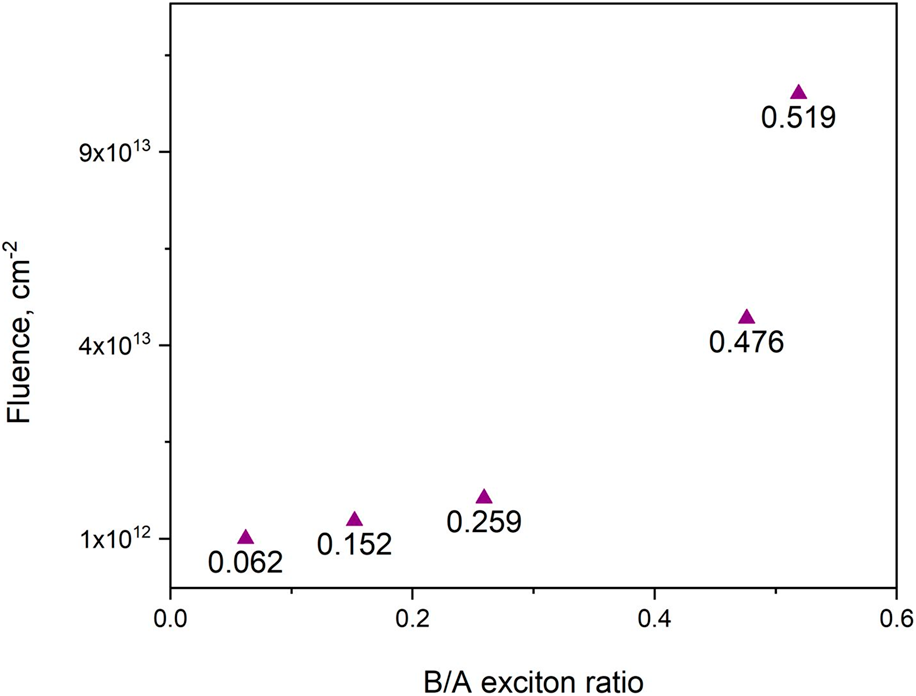
In this contribution, we use heavy ion irradiation and photoluminescence (PL) spectroscopy to demonstrate that defects can be used to tailor the optical properties of two-dimensional molybdenum disulfide (MoS2). Sonicated MoS2 flakes were deposited onto Si/SiO2 substrate and subjected to 3 MeV Au2+ ion irradiation at room temperature to fluences ranging from 1 × 10¹² to 1 × 1016 cm−2. We demonstrate that irradiation-induced defects can control optical excitations in the inner core shell of MoS2 by binding A1s- and B1s-excitons, and correlate the exciton peaks to the specific defects introduced with irradiation. The systematic increase of ion fluence produced different defect densities in MoS2, which were estimated using B/A exciton ratios and progressively increased with ion fluence. We show that up to the fluences of 1 × 1014 cm−2, the MoS2 lattice remains crystalline and defect densities can be controlled, whereas at higher fluences (≥1 × 1015 cm−2), the large number of introduced defects distorts the excitonic structure of the material. In addition to controlling excitons, defects were used to split bound and free trions, and we demonstrate that at higher fluences (1 × 1015 cm−2), both free and bound trions can be observed in the same PL spectrum. Most importantly, the lifetimes of these states exceed trion and exciton lifetimes in pristine MoS2, and PL spectra of irradiated MoS2 remains unchanged weeks after irradiation experiments. Thus, this work demonstrated the feasibility of engineering novel optical behaviors in low-dimensional materials using heavy ion irradiation. The insights gained from this study will aid in understanding the many-body interactions in low-dimensional materials and may ultimately be used to develop novel materials for optoelectronic applications.
In this paper, the atomic resolution high-angle annular dark-field scanning transmission electron microscope (HAADF-STEM) was used as the main research method. Using HAADF-STEM, two types of long-period stacking ordered structure (LPSO)—14H and 18R-LPSO—were observed in Mg96Gd2Y1Ni1 alloy, and the precipitates at various stages of aging were observed. Moreover, a type of rectangular β precipitates were found, and the atomic models of β precipitates along the [0001]Mg and ${\tf="TeXGyrePagella-Bold (TrueType)"\char9001} 11\bar 20\hbox{]}_{{\rm{Mg}}}$ directions were identified. At the aging peak stage, a three-dimensional network structure composed of LPSO/γ′ precipitates and β′ precipitates and β precipitates was observed. The hardness of the unaged homogenized Mg96Gd2Y1Ni1 alloy was only 87 HV and the hardness value of aging peak was 128.4 HV. Compared with the unaged alloy, the hardness of the peak-aged alloy increased by 47.59%. The composite strengthening of the three types of precipitates induced a significant strengthening to the alloy.
Titanium and its alloys are probably the most suitable materials for selective laser melting (SLM) additive manufacturing to process. However, the high cost of raw powder materials limits the industrial application of as-printed Ti products. In this study, we have formulated a cost-affordable Ti–TiB composite powder for SLM, to simultaneously achieve excellent mechanical performance and cost effectiveness. The optimization of the processing parameters will be shown to lead to high relative density (99.3%) for the as-printed Ti–TiB composites containing (0.5, 1, and 2 wt%) TiB2. Furthermore, by incorporating TiB2, the as-printed composites exhibit much improved fracture strength (up to 1813 MPa) and microhardness (up to 412 HV), among which the Ti–0.5 wt% TiB2 has demonstrated a great combination of strength (1007 and 1646 MPa as yield and fracture strengths, respectively) and tensile ductility (~8%). The solidification pathway for the Ti–TiB composite during SLM has been investigated, and the underlying mechanism for achieving high yield strength is discussed based on existing models for shear-lag strengthening, grain refinement, and dispersion strengthening.
Graphene is one of the most intensively studied materials, and has unusual electrical, mechanical and thermal properties, which provide almost unlimited potential applications. This book provides an introduction to the electrical and transport properties of graphene and other two-dimensional nanomaterials, covering ab-initio to multiscale methods. Updated from the first edition, the authors have added chapters on other two-dimensional materials, spin-related phenomena, and an improved overview of Berry phase effects. Other topics include powerful order N electronic structure, transport calculations, and ac transport and multiscale transport methodologies. Chapters are complemented with concrete examples and case studies, questions and exercises, detailed appendices and computational codes. It is a valuable resource for graduate students and researchers working in physics, materials science or engineering who are interested in the field of graphene-based nanomaterials.
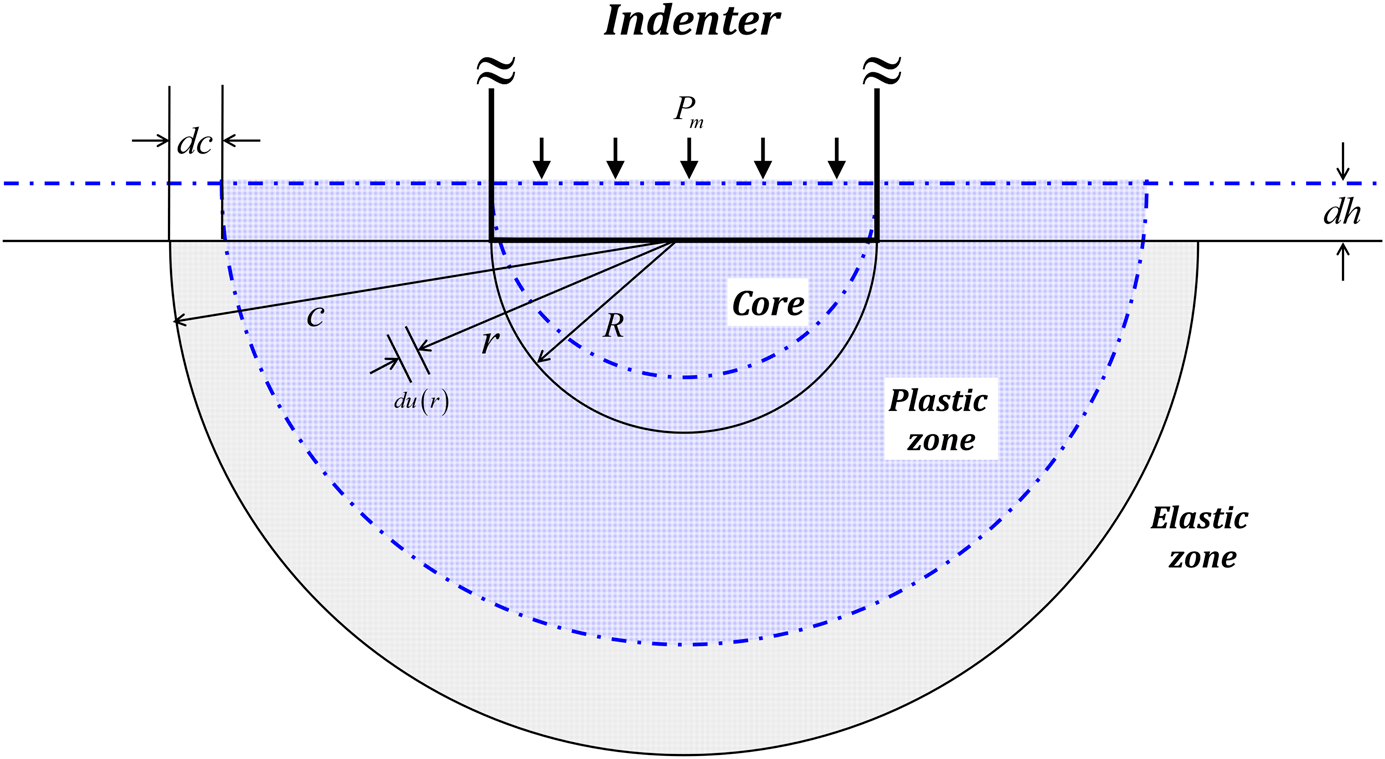
The tensile yield strength of high-density polyethylene using instrumented indentation tests with a flat-ended cylindrical indenter was evaluated. The variation in the field expressed by stress and strain beneath the flat-ended cylindrical indenter is investigated using a new expanding cavity model to study the relation between tension and indentation. This model starts from the separation of forces into the compressive force on the material and the frictional one, which is generated during indentation on the sides of indenter. The authors propose a method to correct the frictional force based on the saturation of indentation hardening and obtain load–depth curve with compressive component only. For conversion of indentation force and displacement, our new representation model is applied. By modifying Johnson's model, the new assumption of conservation of indentation plastic volume is suggested. This model proves and supports conventional relations of the strain rates between indentation and tension theoretically. These are verified through the experiments: instrumented indentation and uniaxial tensile test. The authors find a good agreement between the tensile yield strengths at various strain rates.
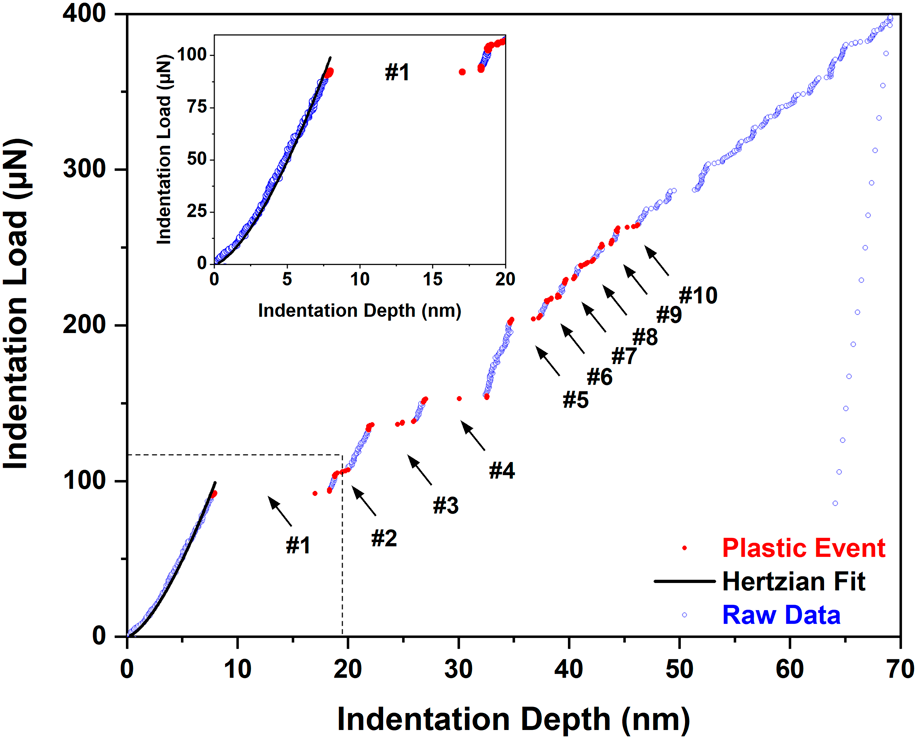
Nanoindentation and microcrystal deformation are two methods that allow probing size effects in crystal plasticity. In many cases of microcrystal deformation, scale-free and potentially universal intermittency of event sizes during plastic flow has been revealed, whereas nanoindentation has been mainly used to assess the stress statistics of the first pop-in. Here, we show that both methods of deformation exhibit fundamentally different event-size statistics obtained from plastic instabilities. Nanoindentation results in scale-dependent intermittent microplasticity best described by Weibull statistics (stress and magnitude of the first pop-in) and lognormal statistics (magnitude of higher-order pop-ins). In contrast, finite-volume microcrystal deformation of the same material exhibits microplastic event-size intermittency of truncated power-law type even when the same plastic volume as in nanoindentation is probed. Furthermore, we successfully test a previously proposed extreme-value statistics model that relates the average first critical stress to the shape and scale parameter of the underlying Weibull distribution.
The expressions for the elastic strain energy and its volumetric and deviatoric parts are derived for three-dimensional states of stress and strain. Betti's reciprocal theorem of linear elasticity is formulated, which yields the Maxwell coefficients, frequently used in structural mechanics. Castigliano's theorem is formulated and applied to axially loaded rods and trusses, twisted bars, and bent beams and frames. The principle of virtual work and the variational principle of linear elasticity are introduced. The differential equation of the deformed shape of the bent beam is derived from the consideration of the principle of virtual work. The approximate Rayleigh–Ritz method is introduced and applied to selected problems of structural mechanics. An introduction to the finite element method in the analysis of beam bending, torsion, and axial loading is then presented. The corresponding stiffness matrices and load vectors are derived for each element and are assembled into the global stiffness matrix and load vector of the entire structure.
Two-dimensional problems of plane stress and plane strain in polar coordinates, both axisymmetric and non-axisymmetric, are considered. Among axisymmetric problems, the bending of a curved beam by two end couples and the problem of a pressurized hollow disk or cylinder are analyzed. Among non-axisymmetric problems, solutions are derived for problems of bending of a curved cantilever beam by a vertical force, loading of a circular hole in an infinite medium,concentrated vertical and tangential forces at the boundary of a half-plane, and a semi-elliptical pressure distribution over the boundary of a half-space. The problems of diametral compression of a circular disk (Michell problem), stretching of a large plate weakened by a small circular hole (Kirsch problem), stretching of a large plate strengthened by a small circular inhomogeneity, and spinning of a circular disk are also analyzed and discussed. The chapter ends with an analysis of the stress field near a crack tip under symmetric and antisymmetric remote loadings, the stress and displacement fields around an edge dislocation in an infinite medium, and around a concentrated force in an infinite plate.
A brief coverage of the mechanics of contact problems is presented. The governing equations for three-dimensional axisymmetric elasticity problems in cylindrical coordinates are first formulated, which is followed by the solutions to classical problems of a concentrated force within an infinite medium (Kelvin problem), and a concentrated force at the boundary of a half-space (Boussinesq problem). The stress fields in a half-space loaded by an elliptical and a uniform pressure distribution over a circular portion of its boundary are presented. Indentation by a spherical ball and by a cylindrical circular indenter are analyzed. The second part of the chapter is devoted to Hertzian contact problems. The nonlinear force–displacement relation is derived for elastic contact of two spherical bodies pressed against each other by two opposite forces. The elastic contact of two circular cylinders is also considered. The contact pressure and the maximum shear stress are determined. The approach of the centers of the cylinders requires the consideration of the local contact stresses, as well as the stresses within the bulk of each cylinder.
The generalized Hooke's law is introduced, which represents six linear relations between the stress and strain components in the case of small elastic deformations. For isotropic materials, only two independent elastic constants appear in these stress–strain relations. Each longitudinal strain component depends linearly on the three orthogonal components of the normal stress; the relationship involves two constants: Young's modulus of elasticity and Poisson's coefficient of lateral contraction. Each shear strain component is proportional to the corresponding shear stress component; the shear modulus relates the two. The volumetric strain is proportional to the mean normal stress, with the elastic bulk modulus relating the two. The inverted form of the generalized Hooke's law is derived, which expresses the stress components as a linear combination of strain components. Lamé elastic constants appear in these relations. The Duhamel–Neumann law of linear thermoelasticity is formulated, which incorporates the effects of temperature on stresses and strains. The Beltrami–Michell compatibility equations with and without temperature effects are derived.
The analysis of normal and shear stresses in a cantilever beam bent by a transverse force is presented. The stress function is introduced and the governing Poisson-type partial differential equation and the accompanying boundary conditions are derived for simply and multiply connected cross sections of a prismatic beam. The exact solution to the boundary value problem is presented for circular, semi-circular, hollow-circular, elliptical, and rectangular cross sections. Approximate, but sufficiently accurate, formulas for shear stresses in thin-walled open and thin-walled closed cross sections, including multicell cross sections, are derived and applied to different profiles of interest in structural engineering. The determination of the shear center of thin-walled profiles, which is the point through which the transverse load must pass in order to have bending without torsion, is discussed in detail. The sectorial coordinate is introduced and conveniently used in this analysis. The formulas are derived with respect to the principal and non-principal centroidal axes of the cross section.