To save content items to your account,
please confirm that you agree to abide by our usage policies.
If this is the first time you use this feature, you will be asked to authorise Cambridge Core to connect with your account.
Find out more about saving content to .
To save content items to your Kindle, first ensure no-reply@cambridge.org
is added to your Approved Personal Document E-mail List under your Personal Document Settings
on the Manage Your Content and Devices page of your Amazon account. Then enter the ‘name’ part
of your Kindle email address below.
Find out more about saving to your Kindle.
Note you can select to save to either the @free.kindle.com or @kindle.com variations.
‘@free.kindle.com’ emails are free but can only be saved to your device when it is connected to wi-fi.
‘@kindle.com’ emails can be delivered even when you are not connected to wi-fi, but note that service fees apply.
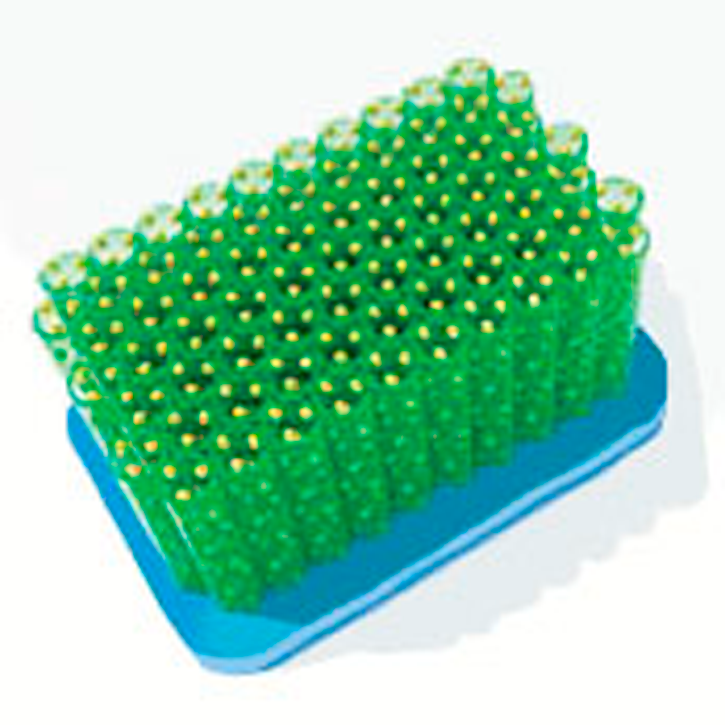
We report a significant advance in thermally insulating transparent materials: silica-based monoliths with controlled porosity which exhibit the transparency of windows in combination with a thermal conductivity comparable to aerogels.
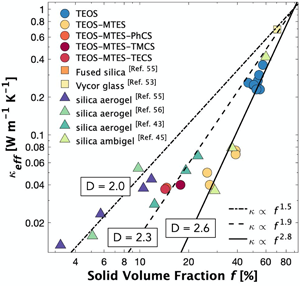
The lack of transparent, thermally insulating windows leads to substantial heat loss in commercial and residential buildings, which accounts for ~4.2% of primary US energy consumption annually. The present study provides a potential solution to this problem by demonstrating that ambiently dried silica aerogel monoliths, i.e., ambigels, can simultaneously achieve high optical transparency and low thermal conductivity without supercritical drying. A combination of tetraethoxysilane, methyltriethoxysilane, and post-gelation surface modification precursors were used to synthesize ambiently dried materials with varying pore fractions and pore sizes. By controlling the synthesis and processing conditions, 0.5–3 mm thick mesoporous monoliths with transmittance >95% and a thermal conductivity of 0.04 W/(m K) were produced. A narrow pore size distribution, <15 nm, led to the excellent transparency and low haze, while porosity in excess of 80% resulted in low thermal conductivity. A thermal transport model considering fractal dimension and phonon-boundary scattering is proposed to explain the low effective thermal conductivity measured. This work offers new insights into the design of transparent, energy saving windows.
A perspective on the current state of battery recycling and future improved designs to promote sustainable, safe, and economically viable battery recycling strategies for sustainable energy storage.
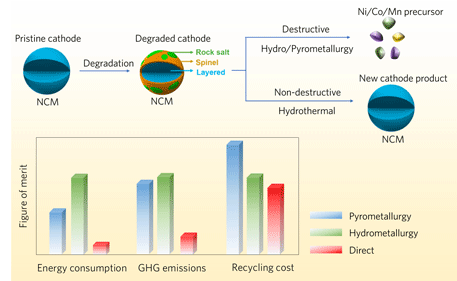
Recent years have seen the rapid growth in lithium-ion battery (LIB) production to serve emerging markets in electric vehicles and grid storage. As large volumes of these batteries reach their end of life, the need for sustainable battery recycling and recovery of critical materials is a matter of utmost importance. Global reserves for critical LIB elements such as lithium, cobalt, and nickel will soon be outstripped by growing cumulative demands. Despite advances in conventional recycling strategies such as pyrometallurgy and hydrometallurgy, they still face limitations in high energy consumption, high greenhouse gas emissions, as well as limited profitability. While new direct recycling methods are promising, they also face obstacles such as the lack of proper battery labeling, logistical challenges of inefficient spent battery collection, and components separation. Here, we discuss the importance of recovering critical materials, and how battery designs can be improved from the cell to module level in order to facilitate recyclability. The economic and environmental implications of various recycling approaches are analyzed, along with policy suggestions to develop a dedicated battery recycling infrastructure. We also discuss promising battery recycling strategies and how these can be applied to existing and future new battery chemistries.
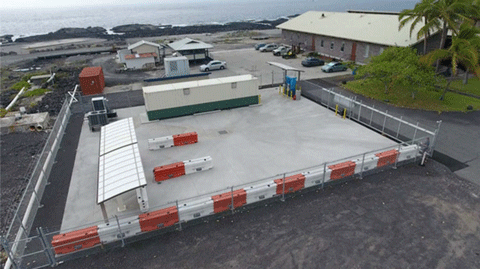
A 250kW hydrogen electrolysis facility was recently installed at the Natural Energy Laboratory of Hawaii Authority's (NELHA's) campus. This facility that will begin operation in 2020 to produce hydrogen for fuel cell buses on the island to demonstrate of the application of hydrogen to decarbonize transportation. Given the size of the electrolysis station, it has the potential to significantly increase electricity costs for the campus, which is subject to energy and peak demand charges from the local utility.
In this paper, we analyze the cost of hydrogen production at NELHA given the rate structure options available from the utility. Production costs are estimated using optimal versus constant scheduling of the facility to meet the buses’ demand. A model of the electrolysis station is used to capture changes in production efficiency over the power range in the optimization routine. The effects of combining the station and campus load versus standalone operation and increasing solar generation are also explored. The analyses surrounding this scenario show the importance of multiple factors on the potential profitability of hydrogen production in behind-the-meter applications and show trends that could have implications for other similar installations.
For energy storage to be part of the transmission solution, storage developers need to work with transmission owners and follow the Regional Transmission Organization (RTO) transmission planning protocols.
Federal Energy Regulatory Commission (FERC) Order 841 mostly treats Electric Storage Resource (ESR) as a generation asset. To date, no FERC order lays out a path for treating energy storage as a transmission asset. One of FERC-jurisdictional RTOs – Midcontinent Independent System Operator (MISO) – has sent a “storage as a transmission-only asset” proposal to FERC, which FERC did not reject but did not approve either. This MISO filing begs the question – how to treat energy storage as a transmission project? The industry needs to understand how RTO cost allocation works for new and existing transmission projects. To appreciate cost allocation, stakeholders need to grasp the fundamentals of transmission project categories. Because to put together a business case for storage, modeling is essential. And modeling for reliability and economic projects vary. Getting into the weeds of transmission planning is what it takes to treat storage as a transmission asset.
Photocatalytic hydrogen production from water is a facile and clean approach to convert rich solar energy into chemical fuel. Developing efficient and robust catalysts to accelerate water-splitting speed is key. Porphyrins exist widely in green plants and are a key photosensitizer to absorb and transfer light energy to other parts of the photosynthesis system of plants. They are considered an ideal model to construct artificial photocatalysts for hot-carrier-mediated hydrogen production. This article discusses recent achievements in constructing porphyrin-based photocatalysts for hydrogen production, including porphyrin molecules, self-assembled porphyrins, metal–organic frameworks, conjugated porphyrin polymers, and hybrid nanomaterial-based photocatalysts. The design and synthesis principles, structure–property relationships, as well as urgent issues to be solved in the future for every type of photocatalyst are also discussed.
The electrification of organic syntheses is a vividly growing research field and has attracted tremendous attention by the chemical industry. This review highlights aspects of electrosynthesis that are rarely addressed in other articles on the topic: the energy consumption and energy efficiency of technically relevant electro-organic syntheses.
Four examples on different scales are outlined.
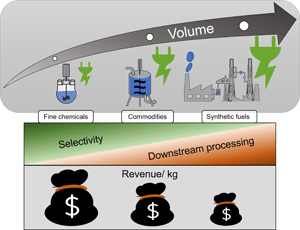
Electro-organic synthesis has experienced a renaissance within the past years. This review addresses the energy efficiency or energy demand of electrochemically driven transformations as it is a key parameter taken into account by, for example, decision makers in industry. The influential factors are illustrated that determine the energy efficiency and discussed what it takes for an electrochemical process to be classified as “energy efficient.” Typical advantages of electrosynthetic approaches are summarized and characteristic aspects regarding the efficiency of electro-organic processes, such as electric energy consumption, are defined. Technically well-implemented examples are described to illustrate the possible benefits of electrochemical approaches. Further, promising research examples are highlighted and show that the conversion of fine chemicals is rather attractive than the electrochemical generation of synthetic fuels.
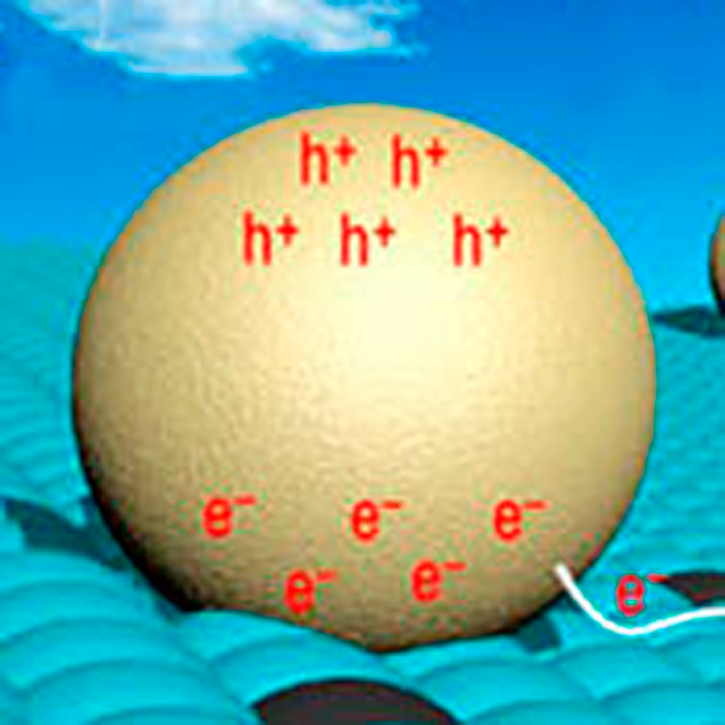
Understanding fundamental mechanisms for surface electronic excitation is of great importance in surface chemistry. Charge transport through metal–oxide interfaces plays a significant role in heterogeneous catalysis. Over the last several decades, a number of experimental and theoretical results suggest that this charge flow through metal–support interfaces leads to catalytic enhancement often observed in mixed catalysts. Direct measurement of charge flow on actual catalysts is a rather challenging task because it requires the use of an electronic circuit. This approach has been enabled by a catalytic nanodiode that is mainly composed of a catalytic metal and semiconducting oxides that form a Schottky contact. In this article, we describe the advances in this approach. We show that there is close connection between the phenomena of hot-electron creation and chemical reaction that occur at both gas–solid and liquid–solid interfaces. The intensity of hot-electron flow is well correlated with the turnover rates of corresponding reactions, which opens the possibility for developing new operando methodologies to monitor catalytic reactions as well as a novel scheme for the electronic control of chemical reactions.
Lack of data on available agriwaste by type of source, local variations in agricultural consumption, and the uncertain feasibility of industrial scaling, all contribute to the challenges of developing commercially viable agriwaste-to-resource building products. Materials Passports linked to Building Management Information systems are tools that can improve regional planning efforts and the coordination of sustainable supply chains focused on new product development and product stewardship.
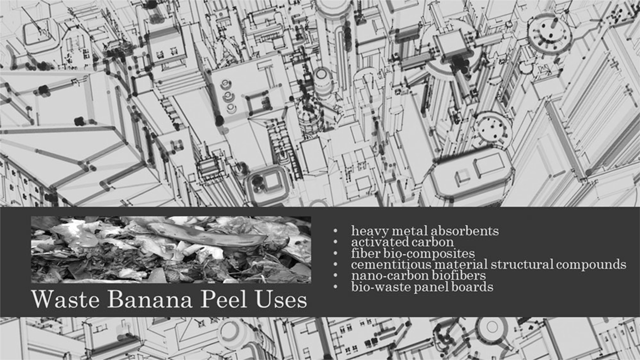
Globally, an estimated 3.5 kg per capita of daily agricultural waste is transferred to municipal landfills. Stated differently, 7.8 billion people generate 26.25 billion kg of daily agriwaste. Numerous studies established linkages between leachates from solid waste landfills, bioaccumulation of toxic chemicals, and greenhouse gas emissions that are a leading cause of climate change. Furthermore, raw material scarcity threatens to constrain economic growth and productivity. Sustainable circular economy practices focus on increased efficiency and a decoupling of wasted natural resource consumption from economic growth. Academic and industry researchers are focused on developing circular economy solutions that increase resource efficiency while decoupling wasted natural resource consumption from economic growth. Human acceptance and adaptation of technology are ideologically, culturally, and socio-technically dependent. Waste banana peels are used as an analytical scenario of how BIM modeling can improve the production of localized, affordable, and culturally appropriate building materials. Ideological and cultural norms are a precursor for socio-technical acceptance. Building material selection is examined from the perspective of complex factors creating uncertain economic valuations, and socio-cultural variations in the definition of waste. The objective of the research is to open multidisciplinary examination of the practices and choices that determine affordably safe building materials.
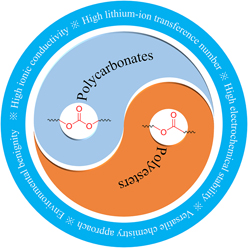
Solid polymer electrolytes are a crucial class of compounds in the next-generation solid-state lithium batteries featured by high safety and extraordinary energy density. This review highlights the importance of carbonyl-coordinating polymer-based solid polymer electrolytes in next-generation safe and high–energy density lithium metal batteries, unraveling their synthesis, sustainability, and electrochemical performance.
With the massive consumption of fossil fuel in vehicles nowadays, the resulted air pollution and greenhouse gases issue have now aroused the global interest on the replacement of the internal combustion engines with engine systems using renewable energy. Thus, the commercial electric vehicle market is growing fast. As the requirement for longer driving distances and higher safety in commercial electric vehicles becomes more demanding, great endeavors have been devoted to developing the next-generation solid-state lithium metal batteries using high-voltage cathode materials, e.g., high nickel (Ni) ternary active materials, LiCoO2, and spinel LiNi0.5Mn1.5O4. However, the most extensively investigated solid polymer electrolytes (SPEs) are based on polyether-based polymers, especially the archetypal poly(ethylene oxide), which are still suffering from low ionic conductivity (10−7 to 10−6 S/cm at room temperature), limited lithium ion transference number (<0.2), and narrow electrochemical stability window (<3.9 V), restricting this type of SPEs from realizing their full potential for the next-generation lithium-based energy storage technologies. As a promising class of alternative polymer hosts for SPEs, carbonyl-coordinating polymers have been extensively researched, exhibiting unique and promising electrochemical properties. Herein, the synthesis, sustainability, and electrochemical performance of carbonyl-coordinating SPEs for high-voltage solid-state lithium batteries will be reviewed.
Plasmonic nanostructures possess broadly tunable optical properties with catalytically active surfaces. They offer new opportunities for achieving efficient solar-to-chemical energy conversion. Plasmonic metal–semiconductor heterostructures have attracted heightened interest due to their capability of generating energetic hot electrons that can be collected to facilitate chemical reactions. In this article, we present a detailed survey of recent examples of plasmonic metal–semiconductor heterostructures for hot-electron-driven photochemistry, including plasmonic metal–oxide, plasmonic metal–two-dimensional materials, and plasmonic metal–metal–organic frameworks. We conclude with a discussion on the remaining challenges in the field and an outlook regarding future opportunities for designing high-performance plasmonic metal–semiconductor heterostructures for photochemistry.
Placing a large storage project at one transmission node influences the transmission flows in the model. Hence, planners need an approach that estimates future storage services and logically places storage at multiple transmission nodes.
In planning models, it is hard to forecast which service storage might provide at any given hour because storage provides a wide variety of services such as capacity benefit, peaker replacement, reduction in renewable energy curtailment, and ancillary services. But transmission planning models are required to address North American Electric Reliability Corporation (NERC) reliability standards and criteria, with assumptions for planned additions of generation, transmission, and demand response resources. Hence, planners must assume a basic set of services for storage resources.
And this paper outlines a suggested approach to site storage resources in planning models by focusing on the generator interconnection queue for utility-scale storage and energy-intensive industries for commercial and industrial customers.
The electric industry is transitioning to higher penetrations of renewables. Hundred per cent renewable penetration is no longer a pipe dream. Rather than by doubling down on existing renewable technologies, we can achieve it by cohesively focusing on the ‘needs’ and working on regulation (regulation should focus on holistic grid needs), operations (e.g., markets and balancing authority products), and innovation (e.g., newer technologies like hydrogen).
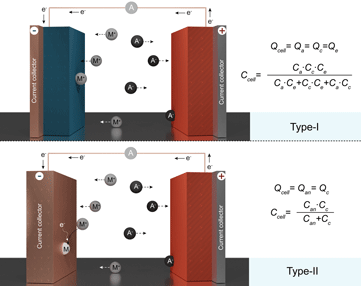
This perspective article summarizes the operational principles of dual-ion batteries and highlights the main issues in the interpretation and reporting of their electrochemical performance.
Secondary dual-ion batteries (DIBs) are emerging stationary energy storage systems that have been actively explored in view of their low cost, high energy efficiency, power density, and long cycling life. Nevertheless, a critical assessment of the literature in this field points to numerous inaccuracies and inconsistencies in reported performance, primarily caused by the exclusion of the capacity of used electrolytes and the use of non-charge-balanced batteries. Ultimately, these omissions have a direct impact on the assessment of the energy and power density of DIBs. Aiming to secure further advancement of DIBs, in this work, we critically review current research pursuits and summarize the operational mechanisms of such batteries. The particular focus of this perspective is put on highlighting the main issues in the interpretation and reporting of the electrochemical performance of DIBs. To this end, we survey the prospects of these stationary storage systems, emphasizing the practical hurdles that remain to be addressed.