To save content items to your account,
please confirm that you agree to abide by our usage policies.
If this is the first time you use this feature, you will be asked to authorise Cambridge Core to connect with your account.
Find out more about saving content to .
To save content items to your Kindle, first ensure no-reply@cambridge.org
is added to your Approved Personal Document E-mail List under your Personal Document Settings
on the Manage Your Content and Devices page of your Amazon account. Then enter the ‘name’ part
of your Kindle email address below.
Find out more about saving to your Kindle.
Note you can select to save to either the @free.kindle.com or @kindle.com variations.
‘@free.kindle.com’ emails are free but can only be saved to your device when it is connected to wi-fi.
‘@kindle.com’ emails can be delivered even when you are not connected to wi-fi, but note that service fees apply.
We report that the hydrogen de/resorption of the 2LiBH4+MgH2 system was modified by introducing Ni nanoparticles. Dehydrogenation analysis revealed that the first-step dehydrogenation, i.e., the decomposition of MgH2, can be significantly promoted by adding a small amount of Ni because of the catalytic effect. However, the improvement of the second-step dehydrogenation, corresponding to the decomposition of LiBH4, needs the addition of a large amount of Ni, resulting in the formation of a Mg–Ni–B ternary alloy. Furthermore, the presence of the Mg–Ni–B ternary alloy allowed an increased reversible H-capacity, in which about 5.3 wt% of hydrogen can be rehydrogenated under 400 °C and 55 bar hydrogen pressure over 10 h, which is higher than that of the pristine 2LiBH4+MgH2 system (4.4 wt%).
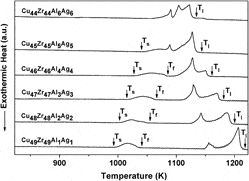
The compositional dependence of phase formation, thermal stability, and mechanical properties of (Cu0.5Zr0.5)100−x(Al0.5Ag0.5)x (x = 2, 4, 6, 8, 10, 12, 14, 16) bulk metallic glasses was studied. The Young’s modulus (85 ± 1 to 95 ± 1 GPa) and Vicker’s hardness (585 ± 7 to 627 ± 8 Hv) increased with increasing Al + Ag content from 8 to 16 at.%, respectively. The liquidus temperature decreased from 1210 ± 2 to 1110 ± 2 K with increasing Al + Ag content from 2 to 16 at.%. The starting temperature of the endothermic event related with transformation of the low-temperature equilibrium phases to CuZr parent phase increased from 997 ± 2 to 1043 ± 2 K, whereas the electronegativity difference for the (Cu0.5Zr0.5)100−x(Al0.5Ag0.5)x (x = 2, 4, 6, 8, 10, 12) alloys decreased from 0.2838 to 0.2713. The martensitic transformation temperatures decreased with increasing Al and Ag content for the (Cu0.5Zr0.5)100−x(Al0.5Ag0.5)x (x = 2, 4, 6, 8) alloys.
The preparation and characterization of Fe3O4 microtubes by a polymer-based template approach were described. Fe3O4 tubes with diameter of 600 ± 50 nm and an average tube thickness of about 50 nm were fabricated after removing the electrospun polystyrene fiber template. The microtubes were composed of individual Fe3O4 nanocrystals. The synthesis process was ambient, generalizable, inexpensive, and nontoxic. The magnetite tubes thus fabricated behave with a saturation magnetization of 37 emu/g measured in the vibrating sample magnetometer. The microtubes prepared in this way might find potential applications in catalysis, magnetic fluid, and biological field.
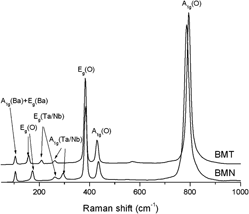
Near-stoichiometric compositions of Ba(B′1/3B″2/3)O3 (B′ = Mg, Co, or Zn and B″ = Nb or Ta) perovskite-type materials with nonstoichiometry on Ba and B′ positions were studied by room temperature Raman spectroscopy and transmission electron microscopy. The studied materials with 1:2 ratio of B-site cations belong to the family of perovskites that has tolerance factor larger than unity, indicating formation of a strained structure. This family of materials exhibits phase transition from a completely disordered phase having space group Pm-3m to a 1:2-ordered phase with space group P-3m1. Measured Raman spectra were attributed to the presence of 1:2-cation order and are characterized by the presence of seven modes, the strongest of which at 800 cm−1 originates from collective motion of oxygen octahedra. The appearance of a mode at 670 cm−1 in Co-containing samples was ascribed to the formation of a 1:1-ordered phase and was confirmed by selected-area electron diffraction.
The effect of the magnetic anisotropy and the dipolar interactions between NiFe magnetic layers and between nanowires on the magnetic properties of NiFe/Cu multilayered nanowire arrays electrodeposited into the nanopores of anodic aluminium oxide (AAO) templates with diameters of 35 and 200 nm has been studied. The variation of the aspect ratio (thickness/diameter) between the NiFe magnetic and Cu nonmagnetic layers influences the effective anisotropy field. The correlation between the measured hysteresis loops, with the applied field parallel and perpendicular to the multilayered nanowires’ axis, and the calculated effective anisotropy field, Heff, and saturation field, Hsat, shows that it is possible to tune the orientation of the magnetization axis with high accuracy. Two formulas, which include both the intra- and internanowire interactions, were proposed to calculate the saturation fields of multilayered nanowire arrays for the applied field parallel and perpendicular to the nanowires’ axis.
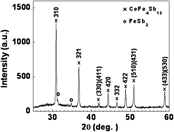
We studied nanoprecipitates (NPs) and defects in p-type filled skutterudite CeFe4Sb12 prepared by a nonequilibrium melt spinning plus spark plasma sintering method using transmission electron microscopy. NPs with mostly spherical shapes and different sizes (from several nanometers to several tens of nanometers) have been observed. Among these, two types of NPs were most commonly observed, Sb-rich superlattices and CeSb2. The Sb-rich superlattices with a periodicity of about 3.6 nm were induced by the ordering of excessive Sb atoms along the c-direction. These NPs typically share coherent interfaces with the surrounding matrix and induce anisotropic strain fields in the matrix. NPs with compositions close to CeSb2, on the other hand, have been shown to be much larger in size (∼30 nm) and have orthorhombic structures. Various defects were typically observed on the interfaces between these NPs and the matrix. The strain fields induced by these NPs are less distinct, possibly because part of the strain has been released by defect formation.
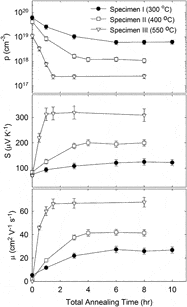
The influence of annealing time and annealing temperature under controlled partial pressure of selenium on the in-plane electrical transport properties of specimens of [(PbSe)0.99]1[WSe2]1 turbostratic nanolaminates was studied. The annealing treatments were found to be very effective in reducing carrier concentrations and improving carrier mobility in the annealed films, which is attributed to the reduction of compositional and structural defects. As a result, room temperature Hall mobilities greater than 60 cm2 V−1·s−1 are observed in spite of the small in-plane domain sizes (on the order of 10 nm) that are related to the turbostratic disorder. The technique appears promising for decreasing the concentration of kinetically trapped defects in these and related self-assembled nanostructures, a key challenge to evaluating the expected potential for controlling electrical and thermal transport properties via designed nanostructure in these and related materials.
In this work, we have systematically explored the influence of thermo-mechanical treatment on the precipitation behavior and its strengthening in Inconel 740, a relatively new Ni-based superalloy, using specimens on which different levels of stresses were applied at 700 °C. With increasing applied stress, fraction of gamma prime precipitates increased (without significant size change) and nanoindentation hardness was enhanced. The stress effects were discussed in terms of the free energy barrier for heterogeneous nucleation and the prevailing mechanisms of precipitation strengthening.
Various compositions of Li1-2xCaxSi2N3 (x = 0–0.2) were synthesized by the reaction of Li3N, Si3N4, and Ca3N2 at temperatures of 1873–2073 K. Ca was incorporated into the LiSi2N3 host lattice to form a solid solution of Li1-2xCaxSi2N3. The activation energy for ionic conduction was decreased and ionic conductivity at room temperature was enhanced by Ca doping. At 298 K, the ionic conductivity of densified Li1-2xCaxSi2N3 (x = 0.075) ceramic reached 1.6 × 10⁻⁵ S m−1, almost four orders of magnitude higher than that of densified Li1-2xCaxSi2N3 (x = 0) ceramic (3.1 × 10⁻⁹ S m−1). The change in the LiSi2N3 framework upon Ca doping decreased the interaction between the ions and increased the number of defects in the structure, making it easier for mobile Li+ ions to migrate. Moreover, the incorporation of aliovalent substitutional Ca2+ ions in the LiSi2N3 lattice is expected to create Li+ vacancies (VLi) for charge compensation (Li1-2xCaxVLiSi2N3), thereby increasing the number of mobile Li+ ions.
Hierarchical ZnO/Si nanoheterostructure was prepared by growing oriented ZnO nanowire bundles onto the top of nanoporous silicon pillar array (NSPA) via a self-catalytic thermal evaporation and vapor-phase transport method. Samples were carefully characterized using field emission scanning electron microscopy, x-ray diffraction, and luminescence spectroscopy. One ultraviolet, one blue-green, and two red emission bands were observed in ZnO/NSPA, and the emission mechanism is discussed by developing a model-based energy band diagram. The origins of the ultraviolet and blue-green photoluminescence (PL) bands were attributed to the emission from the band edge transition and surface states of oxygen vacancies of ZnO, while two red PL bands originated from NSPA and could be well explained by the quantum confinement-luminescence center model. The realization of such all solid and wide wavelength nanodevice might be both meaningful for developing new concept lighting devices and potentially extended to fabricate hierarchical Si-based nanoheterostructures in fabricating other optoelectronic nanodevices.
By measuring the ion concentration in a pressure-induced infiltration experiment on a hydrophobic Zeolite Socony Mobil-5, it is found that the nanopore wall has a strong ion repelling effect. When the initial ion concentration is relatively low, only water molecules can enter the nanopores. Once the initial ion concentration is relatively high, ions can infiltrate into the nanopores, but the effective ion concentration of the confined liquid is much lower.
The thermal transitions and the nonisothermal cold crystallization kinetics of poly(ethylene terephthalate) (PET) at constant heating rates were investigated using differential scanning calorimetry. It was found that the glass transition and crystallization temperature increased with the heating rates, while the melting temperature showed a little variation for the heating rates used. Crystallization and melting latent heats were remarkably constant, independent of the heating rate. Kinetics parameters were determined using Ozawa model. Two different kinetic regimes were identified, corresponding to primary and secondary crystallization, at low and high fractional crystallization, respectively, both following Ozawa’s model. Kinetics parameters were determined for the primary and secondary regimes; the pre-exponential constant (KT) and Ozawa’s exponent (m) decreased with increasing crystallization temperature. The combined kinetic parameter increased exponentially with temperature; activation energies were estimated using Arrhenius plots for the two PET crystallization regimes.
A facile ethylene glycol–based solvothermal method was developed for the synthesis of lanthanide orthovanadate LnVO4 (Ln = La, Pr, Nd, Sm, Eu, Gd, Tb, Dy, Ho, Y, Er, Tm, Yb, Lu) nanoparticles with relatively uniform size and morphologies. The LnVO4 nanoparticles ranged from 100 to 500 nm and changed from spheres to ellipses and platelet–shaped particles depending on the ionic size. Radius of the Ln ions affected crystal structure. The particles with larger ions form monoclinic-type structure for LaVO4 and with smaller ions form zircon-type structure for LnVO4 (Ln = Pr-Yb). A nucleation and aggregates formation mechanism of LnVO4 nanomaterials was proposed to illustrate the crystal growth. The morphologies of LnVO4 nanoparticles could be turned by pH value and molar ratio of reactants. Spherical LaVO4 and PrVO4 nanoparticles were obtained at pH 6, whereas elliptical nanoparticles were obtained at pH 3. Eu3+-, Dy3+-, and Sm3+-doped zircon-type YVO4 nanoparticles exhibit strong luminescence typical of doped ions.
By
A. A. Maradudin, University of California, Irvine, CA 92697 USA,
E. R. Méndez, División de Física Aplicada, Centro de Investigación Científica y de Educación Superior de Ensenada, Carretera Ensenada-Tijuana No. 3918, Ensenada, B. C., 22860, México,
T. A. Leskova, University of California, Irvine, CA 92697 USA
A reader of this book will quickly see that structured surfaces, whether deterministic or random, can reflect, transmit, refract, and amplify volume or surface electromagnetic waves in ways that naturally occurring surfaces cannot. They can also change the nature of an electromagnetic field incident on them. For example, they can change a beam with one intensity distribution into a beam with a different intensity distribution, or they can convert a plane wave into a beam. The use of structured surfaces, specifically randomly rough surfaces, to effect such transformations of optical fields is the subject of this chapter, where two examples of this use are presented, namely beam shaping and the formation of pseudo-nondiffracting beams.
The creation of optical elements that transform an electromagnetic beam with a specified transverse intensity distribution into a beam with a different specified transverse intensity distribution, especially those that transform a laser beam with a Gaussian intensity profile into a beam with a constant intensity profile – a flat top beam, has been studied theoretically and experimentally for many years [1–38]. The interest in beam shaping is due to a wide range of applications for beams with a variety of non-Gaussian intensity distributions. These applications include laser surgery [39], laser radar [40], laser microstructuring of materials [41], metal hardening [42], optical communication [43], and optical scanning [44], among others. Some of them and other applications of beam shaping are discussed in the recent book by Dickey et al. [45].
The structuring of a metal at nanoscale dimensions results in novel optical properties that are not present for bulk metals. Metallic photonic crystals, metal-based structures with periodicities on the scale of the wavelength of light, have attracted particular attention due to their unique optical properties. Among the approaches taken to prepare a three-dimensional photonic crystal is to take advantage of the self-assembly of spheres from a colloidal solution. Spherical colloidal particles of polymers or silica with diameters ranging from 20 nm up to 1 μm and larger, with low coefficients of variation in their diameter, are readily available. The methods of producing monodispersive colloids are well discussed in ref. [1]. The importance and interest of these particles lies in the fact that it is possible to induce them into a close-packed structure analogous to an ordinary close-packed crystal. There are several methods for self-assembly of colloidal spheres, in particular, sedimentation, evaporation, and electrophoresis. These close-packed arrays of uniform particles offer an attractive and, in principle, simple means to template the three-dimensional structure of a variety of materials.
Generally, self-assembly is restricted to the formation of close-packed two-dimensional or three-dimensional assemblies of colloidal particles. However, the low cost and availability of a relatively easy protocol to obtain this type of photonic crystals, artificial opals, make the self-assembly technique very attractive and widely used. The next step in the development of this technique to prepare metallic photonic crystal is to infiltrate the sample with some appropriate material, removing the original structure, and obtaining in this way inverted opals.
Surface plasmon polariton (SPP) modes have attracted much interest in recent years. Although known and studied for over 100 years [1–3], the dream of confining light to dimensions smaller than its propagating wavelength has led the way towards technological possibilities not previously addressed, such as optical circuitry within ultra small computer processors [4, 5], or small biochemical sensors [6, 7]. Confinement of light to sub-wavelength dimensions is also a possibility when one considers the field aspects of the electromagnetic waves near surfaces (near-field phenomena). Add to this the interest in materials and structures exhibiting a negative refractive index for the purpose of increasing the resolution of optical microscopy [8], and it is no wonder that the area of electromagnetic (EM) propagation in sub-wavelength structures is enjoying a renewed interest. Whether the far-field aspects of periodic resonating metallo-dielectric structures are the true manifestations of a negative refractive index or simply a unique, but already known, near-field dispersion phenomenon may be debated [9]. Nonetheless, the near-field aspects of periodic sub-wavelength metallo-dielectric structures, and especially recent advances in nano-fabrication of structures at dimensions smaller than optical wavelengths, deserve a closer look.
Artificial dielectrics (ADs) constitute a class of man-made materials: the effective permittivity and permeability of a given dielectric material may be altered by imbedding metallic or semiconductive structures on scales smaller than the propagating wavelength. For example, one may alter the equivalent capacitance and inductance of microwave waveguides by the addition of a pattern of fine metallic features along the waveguide axis.