To save content items to your account,
please confirm that you agree to abide by our usage policies.
If this is the first time you use this feature, you will be asked to authorise Cambridge Core to connect with your account.
Find out more about saving content to .
To save content items to your Kindle, first ensure no-reply@cambridge.org
is added to your Approved Personal Document E-mail List under your Personal Document Settings
on the Manage Your Content and Devices page of your Amazon account. Then enter the ‘name’ part
of your Kindle email address below.
Find out more about saving to your Kindle.
Note you can select to save to either the @free.kindle.com or @kindle.com variations.
‘@free.kindle.com’ emails are free but can only be saved to your device when it is connected to wi-fi.
‘@kindle.com’ emails can be delivered even when you are not connected to wi-fi, but note that service fees apply.
Nacre from mollusk shell is a high-performance natural composite composed of microscopic mineral tablets bonded by a tough biopolymer. Under tensile stress, the tablets slide on one another in a highly controlled fashion, which makes nacre 3000 times tougher than the mineral it is made of. Significant efforts have led to nacre-like materials, but none can yet match this amount of toughness amplification. This article presents the first synthetic material that successfully duplicates the mechanism of tablet sliding observed in nacre. Made of millimeter-size wavy poly-methyl-methacrylate tablets held by fasteners, this “model material” undergoes massive tablet sliding under tensile loading, accompanied by strain hardening. Analytical and finite element models successfully captured the salient deformation mechanisms in this material, enabling further design refinements and optimization. In addition, two new mechanisms were identified: the effect of free surfaces and “unzipping.” Both mechanisms may be relevant to natural materials such as nacre or bone.
This study investigated a fundamental aspect of thermoelastic martensitic transformations in different shape memory alloys by means of interrupted thermal analysis technique using differential scanning calorimetry (DSC). The objective of this study was to determine the true transformation temperature interval. It also provides the opportunity to further the discussion of time dependence of the transformations. The study applied a technique of thermal arrest amidst phase transformations. The transformation temperature intervals were found to be 8.4 and 12.9 K for the forward and reverse B2↔B19′ martensitic transformation in a near-equiatomic Ti-50.2 at.% Ni alloy and 14.7 and 12.8 K in a Ni-rich Ti-50.8 at.% Ni alloy and 7.3 and 9.1 K for the L21↔orthorhombic transformation in a Ni43Co7Mn39In11 alloy. These values were significantly smaller than those commonly reported in the literature. The experimental evidences also demonstrated that the apparent time dependences of the martensitic transformations manifested in DSC analysis were artifacts caused by instrumental thermal inertia.
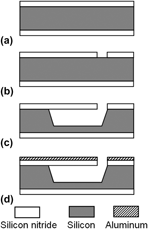
Microcantilevers fabricated by microelectromechanical system processes were used to study the residual stresses in the film/substrate systems. Aluminum films were deposited on silicon nitride substrates by thermal evaporation at room and elevated temperatures, and residual stresses were characterized from the deflection profiles of the Al/SiNx microcantilevers. The Al/SiNx microcantilever beam made of room-temperature-deposited Al film was found to deflect toward the substrate side, which in turn resulted in compressive residual stress in the film. In contrary, the microcantilever of Al film deposited at 105 °C was found to deflect toward the side of Al film when the thickness ratio of film to substrate was greater than 0.31 and the residual film stresses were tensile. The axes with zero bending strain component and zero stresses, i.e., the bending and the neutral axes in the film/substrate system were also investigated. The results can be applied to the arm of the atomic force microscope to characterize its deflection and stresses.
Skutterudites are among the most exciting thermoelectric (TE) materials that could be used for various intermediate temperature applications. This study summarized our recent work on n-type partially filled skutterudites. By combining theoretical and experimental approaches, we revealed the underlying mechanism of void filling in the intrinsic lattice voids in CoSb3. With that, the electronegativity selection rule is established for the current stable filled skutterudites and further used for the discovery of a few novel filled CoSb3 compounds. The correlation between the thermal/electrical transport properties and impurity fillers in n-type partially filled skutterudites was also carefully investigated. Our results provide fundamental understanding to how those filler impurities affect electronic structures and lattice dynamics. Based on these basic understanding on transport mechanisms and sophisticated strategy in materials synthesis, TE figure of merit for n-type materials were continually increased from 1.1 to 1.4 and then to 1.7 for single-, double-, and triple-filled skutterudites.
A single step gas phase method was developed to synthesize silica-coated iron oxide nanocomposite materials in a furnace aerosol reactor (FuAR) using premixed precursors. Synthesis of single component silica and magnetic iron oxide was studied to understand the decomposition mechanism of the precursors, identify the product crystal phase, and optimize the viable operating conditions for the controlled synthesis of nanocomposite material with desirable crystal phase, size, and morphology. The single component decomposition results are further extended to synthesize silica-coated magnetic iron oxide nanocomposite material using premixed precursor. A mechanism was proposed to explain the formation of SiO2-coated γ-Fe2O3 nanocomposite in a single step in a FuAR based on chemical kinetics and was verified by supporting characterization results. The synthesized magnetic γ-Fe2O3/SiO2 nanocomposite material was further tested for suspension stability, magnetic properties, and surface reactivity and was compared with uncoated γ-Fe2O3 nanoparticles to demonstrate improved surface properties.
To answer the fundamental questions of p-type skutterudites, systematical study on the influence of chemical composition on the electrical transport properties of RyFexCo4−xSb12 (R = Ce and Yb) has been carried out. By adjusting the filling fraction of fillers, the optimized electrical properties are obtained at the specific Fe content. It is found that the hole concentration increases with Fe content. Fe doping can also enhance the effective mass of holes significantly, which is beneficial for improving electrical performance. Because of the limit of electron supply, for trivalent Ce filling system CeyFexCo4−xSb12, the maximum figure of merit (ZT) value is achieved when Fe content is around x = 3, and for divalent Yb filling system YbyFexCo4−xSb12, the maximum ZT value is obtained even at lower Fe content. At high temperature above 700 K, the bipolar diffusion leads to great increase of total thermal conductivity and therefore deteriorates the thermoelectric properties.
In this study, compact Charpy impact testing was used to investigate the effect of processing history and dendrite morphology of bulk metallic glass matrix composites (BMGMCs) on impact toughness. Composite samples were fabricated via suction casting and semisolid forging, and the results were compared with crystalline alloys in the same geometry. A strong dependence on processing was observed, with samples exhibiting up to a 30-fold increase in impact toughness depending on processing and microstructure. Provided that attention is paid to processing techniques, BMGMCs are shown to have properties that equal or surpass some conventionally used crystalline alloys. These properties invite further exploration of these materials in structural applications.
We exploit a facile synthetic route to fabricate dendritic SnO2/TiO2 nanodentrites with a twofold point symmetry by a combination of vapor transport deposition method for the SnO2 nanowire backbones and subsequent hydrothermal heteroepitaxial growth of TiO2 nanorod branches. As a result of the good lattice matching and same rutile crystal structures between SnO2 and TiO2, an interface epitaxy is established accounting for the high symmetry. Proof-of-principle demonstration of the function in photoelectrochemical water splitting is presented.
The cathodic electrodeposition of crystalline ZnO nanowires and amorphous FeO(OH) nanotubes in polycarbonate track-etched membranes with pore diameters of 50–200 nm is reported. Nitrate was used as a sacrificial precursor for the electrochemical generation of hydroxyl ions that raised the pH of the interior of the nanopore, leading to precipitation of a metal oxide or hydroxide phase. The crystalline and semiconducting ZnO phase formed directly above 60 °C at sufficiently high pH and led to the formation of dense nanowires with preferential (0001) orientation. The morphology of the wire could be influenced by the deposition temperature. Axially segmented gold–ZnO and silver–ZnO nanowires were made. In contrast, the iron hydroxide phase deposited inside the pore as a permeable gel that collapsed and transformed into hollow FeO(OH) tubes during drying. The as-formed nanotubes were amorphous and could be filled with nickel in a subsequent electrodeposition step, yielding core-shell nickel iron-oxohydroxide nanowires. The cathodic efficiency of nitrate reduction was low in both cases, suggesting that diffusional supply of metal ions may be the rate-determining step.
Effect of the seed layer on Seebeck coefficient measurement of electroplated thermoelectric films was quantitatively analyzed. It is found that sheet, rather than bulk resistance of the seed layer, or more precisely its relative comparison to sheet resistance of the film, determines the effects. The analysis reveals that the seed layer’s effect can be neglected (within 1% error) only if the sheet resistance ratio [R□2(film)/R□1(seed)] is smaller than 0.01. This condition commonly requires film thicknesses of 100 μm or more, which is not practically relevant. Based on the analysis we proposed a new method that is applicable for 10 times thinner films. This approach for determining Seebeck coefficient is simple, and more importantly, electroplated films can be characterized in their statu nascendi. Finite element simulation and experiments verified the analysis.
Here, we describe the synthesis of novel titania nanosheets controllably doped with binary transition metal ions and their layer-by-layer self-assembly. The tailored Mn and Fe doping in exfoliated Ti0.6Mnx/2Fe(0.8-x)/2O2 (x = 0.0–0.4) nanosheets is achieved by systematically changing the molar ratio of Mn/Fe in K0.8Ti1.2MnxFe0.8-xO4 using a codoping strategy. The protonated layered crystals exhibit a delaminated behavior in the tetrabutylammonium hydroxide solution and are exfoliated into colloidal single sheets, which are characterized by a large lateral size and a thickness in molecular dimension. The resulted nanosheets are able to be layer-by-layer deposited with oppositely charged polymers into a composite organic/inorganic system.
In this study, we synthesized ZnO nanowires using Au catalytic particles formed on a ZnO seed layer. We modulated the microstructure of the ZnO seed layer by changing the sputtering power to investigate how the underlying ZnO film microstructure affects the distribution of ZnO nanowires. Examining the samples after each of the three key steps of the growth process (ZnO seed layer deposition, Au catalytic particle formation, and nanowire growth) using various characterization methods such as scanning electron microscopy, transmission electron microscopy, and x-ray diffraction helped us illuminate the profound impacts of the grain size of the seed layer on the nanowire density.
(Bi,Sb)2Te3 + 4 mol%PbTe was quenched in water and on a rotating copper wheel (melt spinning). It was found that PbTe was immiscible in (Bi,Sb)2Te3 when the material is quenched in water and that the thermoelectric figure of merit increases by annealing. Natural nanostructures (nns) were found in melt-spun (Bi,Sb)2Te3, whereas they were hard to detect in (Bi,Sb)2Te3 alloyed with PbTe. There is a correlation between the orientation of the strain field and the nns. Within the grains of melt-spun (Bi,Sb)2Te3 alloyed with PbTe, the chemical composition was homogeneous. An enrichment of Pb was found at the grain boundaries. Quenched (Bi,Sb)2Te3 alloyed with 0.3 wt%PbTe have been spark plasma sintered (SPS). After optimization, the Seebeck coefficients of the melt-spun SPS (MS-SPS) materials were larger than for materials quenched in water and sintered (QW-SPS) materials. In addition, the mobility increases with the carrier concentration in MS-SPS materials, whereas it decreases in QW-SPS materials.
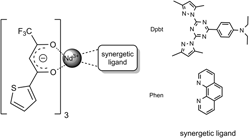
In this work, a visible-light-sensitized neodymium complex with 2-(N,N-diethylanilin-4-yl)-4,6-bis(3,5-dimethylpyrazol-1-yl)-1,3,5-triazine (Dpbt) as a synergetic ligand is synthesized and incorporated into poly(methyl methacrylate) (PMMA). Absorption and luminescent spectra of Nd(TTA)3Dpbt (TTA = thenoyltrifluoroacetonate) in PMMA are measured and compared with common complex Nd(TTA)3Phen (Phen = 1,10-phenanthroline). As a result, Nd(TTA)3Dpbt has relatively high luminescent intensity and wide excited spectral range, attributed to the sensitization of the ligand Dpbt. Judd–Ofelt analysis is used, and Judd–Ofelt parameters are calculated (Ω2 = 33.72 × 10⁻²⁰ cm2, Ω4 = 11.52 × 10⁻²⁰ cm2, and Ω6 = 6.81 × 10⁻²⁰ cm2). The radiative properties are predicted and compared with other different Nd complexes. The stimulated emission cross-section of 4F3/2→4I11/2 transition is 3.02 × 10⁻²⁰ cm2 and the estimated lifetime is 506 μs using the Judd–Ofelt parameters. Experimental fluorescence branching ratio of this transition is quite high for Nd ions. The radiative properties’ investigation for 4F3/2→4I11/2 transition indicates that it is possible to be a laser transition.
SrAl2O4:Eu2+,Dy3+ polynary complex nanobelts with long-persisting phosphorescence were synthesized via a facile but efficient combustion method followed by a postannealing reaction at temperature above 900 °C. All the samples emit greenish-yellow light from the d-f transition of Eu2+, and moreover, their wavelength redshifts with increasing calcination temperature since the increase in crystal size and crystalline quality causes a large average optical path and high crystal symmetry, respectively. The decay constant of the sample calcined at low temperature is smaller than that of the one annealed at high temperature owing to the presence of higher densities and depths of electron traps donated by host defects, and the initial brightness of the sample calcined at low temperature is relatively low owing to the small volume fraction from relatively low crystallinity.
A spherical indentation-based method and its numerical verification, which is capable of identifying the plastic properties, have been respectively provided by our previous work [P. Jiang, et al., J. Mater. Res.24, 1045 (2009)] and [T. Zhang, et al., J. Mater. Res.24, 3653 (2009)]. To examine its effectiveness for practical application, 10 typical metals were selected to perform experimental verifications. Here, the above method was used in combination with the Oliver–Pharr model to avoid its dependence on the previously known elastic modulus. To obtain reliable results, a reasonable calibration has been performed for the used spherical tip with imperfect shape. Finally, the present verification has shown that the deviations of yield strength and elastic modulus obtained from the indentation tests are at most 40% but are generally within 25%. And the effect of the difference in constitutive relationships between the ideal model and the actual material on the accuracy of the indentation-based method has also been illustrated.
Recent studies by a number of research groups have shown that the structure of epitaxial BiFeO3 (BFO) films changes drastically as a function of substrate-induced biaxial compression, with the crystal structure changing from one being nearly rhombohedral (R-like) to one being nearly tetragonal (T-like), where the “T-like” structure is characterized by a highly enhanced c/a ratio of out-of-plane c to in-plane a lattice parameters. In this work, we show that the critical compressive strain σc necessary to induce this transition can be reduced significantly by substituting 10% Ba for Bi [Bi0.9Ba0.1FeO3−δ (BBFO)] and that the “T-like” phase in both BBFO and BFO is stable up to the decomposition temperatures of the films in air. Furthermore, our results show that the BBFO solid solution shows clear ferromagnetic properties in contrast to its undoped BFO counterpart.
Phase structures of microscale and nanoscale higher manganese silicides (HMSs) were investigated using in situ energy dispersive x-ray diffraction at high temperatures or/and high pressure. A few phase transformations accompanied with the presence of MnSi phase were observed in different temperature regions, which were associated with the interevolution of several incommensurate HMS phases. It was found that in nanostructured HMS, the interevolution of HMS was remarkable and accelerated compared to that in the micropowders. Meanwhile, high pressure was able to influence these phase transformations due to giant strain in the materials. The phase transformations were discussed from thermodynamic aspects with respect to the different formation enthalpy of Mn–Si system and the large surface energy and structural instability of the nanopowders.
The Y-doped (Hf0.6Zr0.4)1-xYxNiSn (x = 0, 0.01, 0.02, 0.04, 0.06, 0.1, and 0.2) half-Heusler alloys have been prepared by levitation melting and spark plasma sintering. The effect of Y doping on thermoelectric properties of the alloys was investigated in the temperature range of 300–900 K. Y-doped samples had the lower electrical conductivity compared with the parent compound without Y doping. The thermal conductivity had weak dependence on Y doping content. The absolute values of Seebeck coefficient decreased significantly when x < 0.04. The sign of Seebeck coefficient turned from negative to positive at room temperature for x = 0.04 and 0.1, which means that the hole carriers became dominant in these alloys. However, the alloys changed to n-type conduction again at high temperatures. The maximum figure of merit value of about 0.45 was obtained at 780 K for the undoped sample.
We report a detailed study of the structural, chemical, electrical, and magnetic properties of undoped ZnO thin films grown under different conditions and the films that were annealed in various environments and irradiated with an ultraviolet laser. Samples prepared in low oxygen pressure or subsequently annealed in vacuum have always been strongly magnetic. Oxygen-annealed films displayed a sequential transition from the ferromagnetic to the diamagnetic state as a function of the annealing temperature. Reversible switching of room temperature ferromagnetism and n-type conductivity have been demonstrated either by annealing in different environments or by a novel laser irradiation treatment. Enhancements in both the electrical conductivity and magnetic moment have been controlled precisely with laser pulses, without altering the crystal structure. Electron paramagnetic resonance data were found to be in good agreement with the magnetization and conductivity measurements. Our secondary ion mass spectrometer and electron energy loss spectrometer studies conclusively rule out the presence of any external ferromagnetic impurities.