To save content items to your account,
please confirm that you agree to abide by our usage policies.
If this is the first time you use this feature, you will be asked to authorise Cambridge Core to connect with your account.
Find out more about saving content to .
To save content items to your Kindle, first ensure no-reply@cambridge.org
is added to your Approved Personal Document E-mail List under your Personal Document Settings
on the Manage Your Content and Devices page of your Amazon account. Then enter the ‘name’ part
of your Kindle email address below.
Find out more about saving to your Kindle.
Note you can select to save to either the @free.kindle.com or @kindle.com variations.
‘@free.kindle.com’ emails are free but can only be saved to your device when it is connected to wi-fi.
‘@kindle.com’ emails can be delivered even when you are not connected to wi-fi, but note that service fees apply.
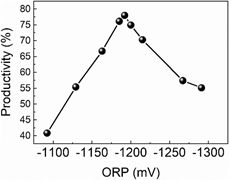
The physicochemical properties and broad applications of graphene have been extensively studied, but its preparation method is still a bottleneck, and it cannot simultaneously meet the requirements of low process cost and high quality of products in the time being. In this article, the redox potential was employed to control the quality of graphene prepared from graphene oxide by chemical reduction. The effects of the initial redox potential on the productivity, microscopic morphology, and structural and intrinsic properties of graphene were investigated. Results showed that there was an optimum initial redox potential range between −1200 and −1180 mV. In such a range could the graphene with a high yield be obtained, and layers of graphene products could be stabilized at 1 or 2 layers. Therefore, the redox potential could be used as an effective parameter instead of trying to design orthogonal tests to determine the optimal conditions and control the synthesis of graphene.
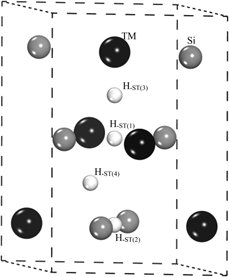
The improvement of hydrogen embrittlement (HE) is a key problem for transition-metal silicides. Although C40 TMSi2 disilicides are attracted candidates for ultrahigh-temperature applications, the HE mechanism of TMSi2 is unclear. Importantly, the role of hydrogen on the structural configuration, elastic modulus, and hardness of TMSi2 is entirely unknown. To reveal the HE, we study the role of hydrogen in TMSi2 (TM = Nb, Mo, and W) based on the first-principles calculations. Four H-doped sites are considered in detail. The calculated results show that hydrogen is favorable to occupy the octahedral interstitial site because the C40 TMSi2 layered structure is favorable to absorb hydrogen. H-doping results in lattice expansion of c-axis compared with the a-axis and b-axis. H-doping obviously reduces the elastic modulus and hardness of TMSi2 due to the interaction between hydrogen and TMSi2. In addition, H-doping changes the electronic properties of MoSi2 and WSi2.
Most crystallizations in the pharmaceutical industry are not carried out by crystallization scientists. The Cambridge Structure Database (CSD) contains over 850,000 crystal structures, and the number of organic molecules that have been isolated as solids is much larger. In many cases these isolations have not been repeated or scaled up. Yet this task, namely the development of robust, reproducible crystallization processes, is the main topic of this chapter. By way of introduction, meet the types of molecules, the types of people, and the nature of the industry.
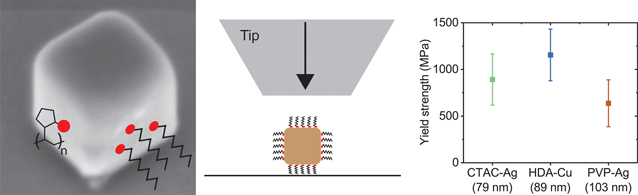
The strength of single-crystalline nanoscale metals is controlled by dislocation nucleation from free surfaces. Surface properties such as crystallographic orientation, surface stress, and surface diffusion have been proposed as key parameters that control dislocation surface nucleation, but have not been confirmed experimentally. To investigate the influence of surface parameters, in situ scanning electron microscope mechanical testing is used to compress defect-free Ag and Cu nanocubes that are passivated with organic surfactants in order to tune their surface properties. Comparison between passivated nanocubes indicates that yield strength may depend on surfactant binding energy, but is also dependent on intrinsic material properties.
Crystallization can be regarded as a self-assembly process in which randomly organized molecules in a fluid come together to form an ordered three-dimensional molecular array with a periodic repeating pattern. It is vital to many processes occurring in nature and manufacturing. Geologic crystallization is responsible from huge deposits of carbonates, sulfates, and phosphates that often grow in mountains and quarries. This process occurs over long periods of time, often at high temperatures and pressures, and results in large and usually highly ordered crystals such as diamond.
Batch crystallization is different from continuous crystallization in that the withdrawal of crystal product for the batch system is made only once at the end of the batch run. Batch crystallization may also include the semibatch system, in which one or more feed solutions are added to the crystallizer at a constant or variable rate throughout all or part of the batch.
Precipitation generally refers to a relatively rapid formation of a sparingly soluble crystalline – or sometimes amorphous – solid phase from a liquid solution phase. Precipitation is rather poorly understood when compared with crystallization of more soluble materials. It generally involves the simultaneous and rapid occurrence of nucleation and growth together with the so-called secondary processes, such as Ostwald ripening and agglomeration. In many cases, these processes are difficult to separate and investigate independently and mechanistically.
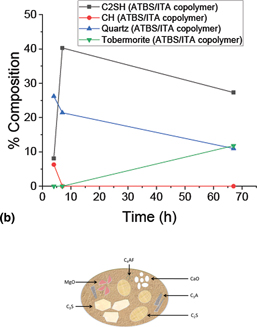
Powerful synergies between phosphonate, zinc oxide, and acrylamido-tert-butyl-sulfonate (ATBS) copolymer chemical additives render superior performance in a high-temperature retarder system for oil well grade Portland cement. The phosphonate retarder and ATBS-based retarders establish a two-tiered strength development where amorphous C-S-H converts to crystalline dicalcium silicate hydrate (C2SH) in the first (low compressive strength) tier prior to the reaction of Portlandite with quartz. The three additive retarder system can be tuned with nanosilica to eliminate the two-tiered strength development effect leading to a smooth transition from the cement in the slurry form directly to its highest compressive strength.
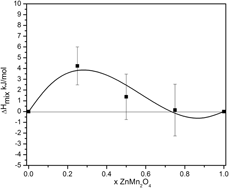
The thermodynamic properties of ZnxMn3−xO4 and Mg1−zCuzCr2O4 spinel solid solutions have been studied using high-temperature oxide melt solution calorimetry. Except for MgCr2O4 spinel, which possesses cubic structure, the other three end-members are tetragonal. The enthalpies of mixing are small endothermic and fit subregular solution behavior. The main contribution to the energetics of mixing of both spinel systems comes from the difference in the crystal structure between the end-members: a change in the tetragonal distortion for ZnxMn3−xO4 solid solutions and a transition from cubic to tetragonal for the Mg1−zCuzCr2O4 system. If all Mg1−zCuzCr2O4 spinels possessed the same structure, the mixing enthalpies would be close to zero. Because both series have normal cation distributions, the entropies of mixing are equal to the configurational entropies of mixing of Zn2+ and Mn2+ and of Mg2+ and Cu2+ on tetrahedral sites, and the activities would follow Raoult’s law. The calculated Gibbs energy of mixing confirms the absence of solvus at any temperature for both systems.
Learn from the experts about industrial crystallization in this third edition of a widely regarded classic that has been completely revised to reflect the latest developments in the field. New chapters on crystal nucleation, molecular modelling application, and precipitation and crystallization of pigments and dyes are included, as well as completely revised chapters on crystallization of proteins, crystallizer selection and design, control of crystallization processes, and process analytical technology. Richly illustrated with 150 new diagrams and photographs, and with dozens of practical hands-on examples, this is an ideal introduction for newcomers, and serves as an excellent reference for experienced professionals covering aspects of industrial crystallization in a single, complete volume.
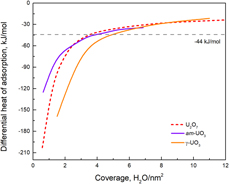
Enthalpies of water adsorption on amorphous and crystalline oxides and peroxides of uranium are reported. Despite substantial structural and computational research on reactions between actinides and water, understanding their surface interactions from the energetic perspective remains incomplete. Direct calorimetric measurements of hydration energetics of nano-sized, bulk-sized UO2, U3O8, anhydrous γ-UO3, amorphous UO3, and U2O7 were carried out, and their integral adsorption enthalpies were determined to be −67.0, −70.2, −73.0, −84.1, −61.6, and −83.6 kJ/mol water, with corresponding water coverages of 4.6, 4.5, 4.1, 5.2, 4.4, and 4.1 H2O per nm2, respectively. These energetic constraints are important for understanding the interfacial phenomena between water and U-containing phases. Additionally, this set of data also helps predict the absorption and desorption behavior of water from nuclear waste forms or used nuclear fuels under repository conditions. There are also underlying relations for water coverage among different U compounds. These experimentally determined data can be used as benchmark values for future computational investigations.
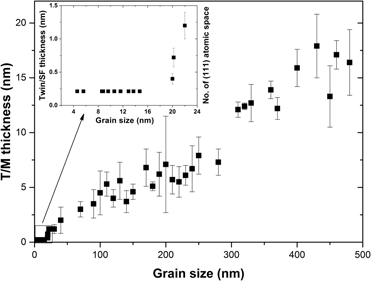
Grain size effect on twin thickness has been rarely investigated, especially when the grain size is less than 1000 nm. In our previous work (Mater. Sci. Eng.A527, 3942, 2010), different severe plastic deformation techniques were used to achieve a wide range of grain sizes from about 3 μm to 70 nm in a Cu–30% Zn alloy. Transmission electron microscopy (TEM) revealed a gradual decrease in the deformation twin thickness with decreasing grain size. In the present work, high-resolution TEM was used to further identify deformation twins and measure their thickness, especially for grain sizes below 70 nm. The twin thickness was found to gradually reduce with decreasing grain size, until a critical size (20 nm), below which only stacking faults were observed. Interestingly, the relationship between twin thickness and grain size in the ultrafine/nanocrystalline regime is found similar to that in the coarse-grained regime, despite the differences in their twinning mechanisms. This work provides a large set of data for setting up a model to predict the twin thickness in ultrafine-grained and nanocrystalline face-centered cubic materials.
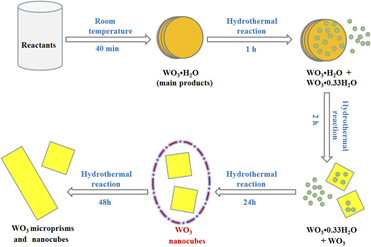
Regular WO3 nanocubes have been prepared on a large scale through a convenient hydrothermal route at the temperature of 200 °C. The products were characterized by powder X-ray diffraction (XRD), field-emission scanning electron microscopy, UV-vis diffuse reflectance spectroscopy (DRS), and photoluminescence (PL) spectroscopy. A crystal growth process for WO3 nanocubes was simply proposed based on the comparative experiments. The band gap energy (Eg) was determined to be 2.58 eV based on the UV-vis DRS analysis, and the PL spectrum exhibited a strong blue light emission band centered at 469 nm. The as-prepared WO3 nanocubes showed higher visible light photocatalytic performance for degrading rhodamine B compared with WO3·H2O and WO3·0.33H2O/WO3 which were obtained at 80 °C and 140 °C, respectively, suggesting potential application in the region of wastewater purification.
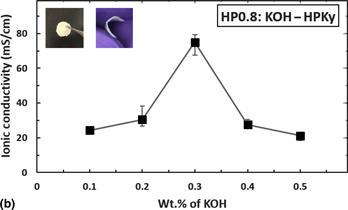
Polymeric electrolytes have attracted recent research interest because they offer the advantages of being safe and non-flammable, having no dendrite formation, and having no possibility of leakage. The incorporation of synthetic polymers to gel electrolytes has numerous disadvantages: for instance, the required preparation time for creating gel electrolytes from synthetic polymers is dubious and lengthy. Additionally, the conventional pristine polymer gel electrolyte layer has been reported to have low ionic conductivity. This work is focused on preparing a thin flexible gel electrolyte layer by using a naturally occurring wood-based nanofiber cellulose (NFC) hydrogel, to overcome the energy and time consumption of conventional processes. In addition, we use polyvinyl alcohol (PVA) as an additive to the NFC hydrogel in controlled amounts to fabricate a stable thin gel electrolyte layer. By using x-ray diffraction, optical microscopy, and Fourier transform infrared spectra studies, we were able to further our understanding of the microstructure of the films: i.e., the penetration and cross-linking (changes in the bonding structures) of semi-crystalline PVA and hydrogel to form a flexible gel electrolyte layer. The NFC hydrogel-PVA films resulted in much higher ionic conductivity values when compared to other existing pristine polymer electrolytes. The addition of KOH to the NFC hydrogel-PVA further enhanced the ionic conductivity. The best ionic conductivity recorded was 75 mS/cm for films with thickness in the range of 200–350 µm, which is comparable to the highest reported ionic conductivity values of gel electrolytes.
The growing application of data-driven analytics in materials science has led to the rise of materials informatics. Within the arena of data analytics, deep learning has emerged as a game-changing technique in the last few years, enabling numerous real-world applications, such as self-driving cars. In this paper, the authors present an overview of deep learning, its advantages, challenges, and recent applications on different types of materials data. The increasingly availability of materials databases and big data in general, along with groundbreaking advances in deep learning offers a lot of promise to accelerate the discovery, design, and deployment of next-generation materials.