To save content items to your account,
please confirm that you agree to abide by our usage policies.
If this is the first time you use this feature, you will be asked to authorise Cambridge Core to connect with your account.
Find out more about saving content to .
To save content items to your Kindle, first ensure no-reply@cambridge.org
is added to your Approved Personal Document E-mail List under your Personal Document Settings
on the Manage Your Content and Devices page of your Amazon account. Then enter the ‘name’ part
of your Kindle email address below.
Find out more about saving to your Kindle.
Note you can select to save to either the @free.kindle.com or @kindle.com variations.
‘@free.kindle.com’ emails are free but can only be saved to your device when it is connected to wi-fi.
‘@kindle.com’ emails can be delivered even when you are not connected to wi-fi, but note that service fees apply.
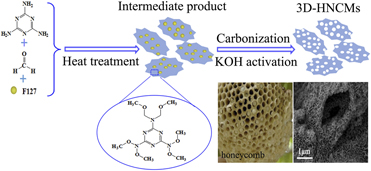
The preparation of three-dimensional honeycomb nitrogen-doped carbon materials (3D-HNCMs) which can be used as electrode materials for supercapacitors is reported. The composites with the 3D honeycomb structure exhibited better electrochemical performance, and the structure and properties were proved by various means, such as SEM, TEM, IR, N2 sorption, XRD and XPS. Used as electrode materials for supercapacitors in the KOH electrolyte, 3D-HNCMs displayed a significantly high specific capacitance (409 F/g at a current of 0.5 A/g). Moreover, the 3D-HNCM electrode exhibited superior electrochemical performance, such as excellent cycling stability (98% capacitance retention after 10,000 cycles), a maximum energy density of 15.37 W h/kg, a maximum power density of 40.3 kW/kg, and low equivalent series resistance (2.1 Ω). Particularly, the electrochemical characteristic of 3D-HNCMs could be attributed to the synergistic effect of a high surface area, unique microporous and mesoporous structure, and nitrogen atom doping. These carbon materials with unique structure are promising electrode materials for future supercapacitor application.
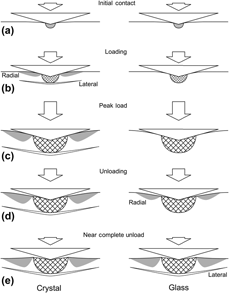
A fracture analysis is developed for crack initiation sequences occurring during sharp indentation of brittle materials. Such indentations, generated by pyramidal or conical loading, generate elastic and plastic deformation. The analysis uses a nonlinear elements-in-series model to describe indentation load–displacement responses, onto which lateral, radial, cone, and median crack initiation points are located. The crack initiation points are determined by extension and application of a contact stress-field model coupled to the indentation load, originally developed by Yoffe, in combination with crack nuclei coupled to the indentation displacement to arrive at an explicit fracture model. Parameters in the analysis are adapted directly from experimental fracture and deformation measurements, and the analysis outputs are directly comparable to experimental observations. After adaptation, crack initiation loads and sequences during indentation loading and unloading of glasses and crystals are predicted by the model from material modulus, hardness, and toughness values to within about 25% of peak contact load. This work is dedicated to George M. Pharr IV on the occasion of his 65th birthday in recognition of his contributions to indentation mechanics.
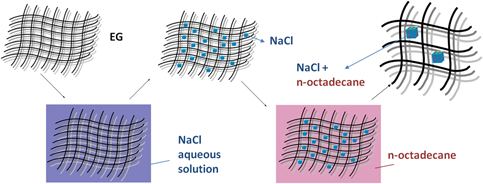
In this work, a novel shape-stabilized phase change material, composed of n-octadecane, expanded graphite (EG), and sodium chloride (NaCl), was prepared by a convenient method. In the composite, EG was used as the matrix material and NaCl served as the nucleating agent. Effects of the additional amount of NaCl on the thermal properties of the composite were investigated by DSC and TG. The melting and crystallization enthalpies of the composite are −160.23 J/g and 162.80 J/g, respectively; the supercooling degree of the composite decreased to 3.77 °C when compared to 7.58 °C of the pure n-octadecane. Furthermore, the thermal cycling performances became better, and the thermal decomposition temperature improved to 150 °C. The composite exhibited high latent heat, low supercooling degree, good thermal cycling performance, and enhanced thermal stability, making it a potential material for the thermal energy storage application in the field of thermal regulation.
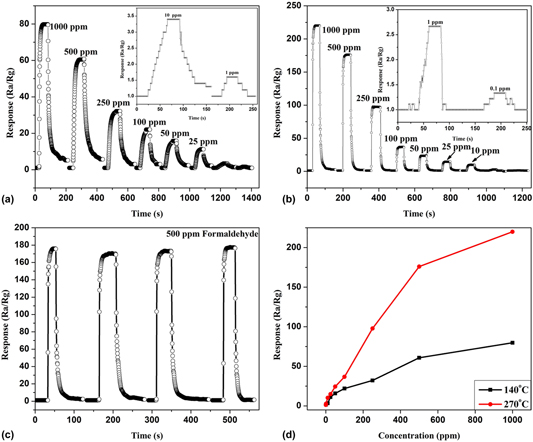
La3+-doped BaSnO3 microtubes (La3+–BaSnO3) have been synthesized by electrospinning method, and the influence of La3+ content on the sensing properties of BaSnO3 for detection of formaldehyde vapor has been investigated. The as-prepared materials have been characterized using XRD, SEM, DSC, XPS, and UV-Vis. The La3+–BaSnO3 sample doped with 4 wt% La exhibited a response as high as 220 to formaldehyde vapor (1000 ppm concentration) along with a very low detection limit of 0.1 ppm at 270 °C, whereas at 140 °C, it exhibited a response of 80 and detection limit of 1 ppm. In addition, the sensor showed excellent selectivity of 57 to formaldehyde at 140 °C when compared with other vapors. Further, the sensor also showed good repeatability and stability over a long period of time suggesting its strong potential as a commercial formaldehyde sensor.
We report on the X-ray diffraction data and unit-cell parameters of Mn4C, which has a cubic perovskite-type structure with a = 3.8726 Å and unit-cell volume V = 58.1 Å3. The measured lines were indexed and are consistent with the space group $ Pm { \bar {\it 3}} m$ (No. 221).
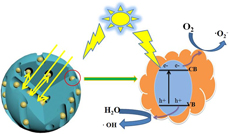
Composite materials include various components with different structures, which cooperatively increase their properties and extend their application. In this study, the graphitic carbon nitride (g-C3N4) guest material was assembled into the porous of the SiO2 aerogel, which was prepared during the gel process. By this way, the g-C3N4 could be absolutely encapsulated into the porous of the disordered porous SiO2 aerogel. The prepared g-C3N4/SiO2 composite had a loose porous structure and exhibited the much higher photocatalytic activity to the photodegradation of rhodamine B (RhB) under visible light. The disordered porous structure enhanced photocatalytic activity, and the degradation rate reached to 96.42% in 90 min under the irradiation of visible light, which could be attributed to its high surface area and effective electron–hole separation rate. The catalyst had the much higher stability and could be easily recycled utilization. The prepared composites could be applied to degrade organic pollutants in wastewater.
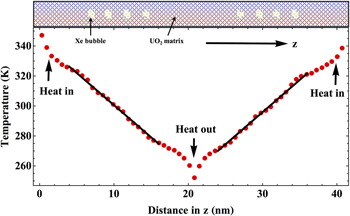
Thermal conductivity of uranium dioxide (UO2) is an important nuclear fuel performance property. Radiation- and fission-induced defects and microstructures, such as xenon (Xe) gas bubbles, can degrade the thermal conductivity of UO2 significantly. Here, molecular dynamics simulations are conducted to study the effect of Xe bubble size and pressure on the thermal conductivity of UO2. At a given porosity, thermal conductivity increases with Xe cluster size, then reaches a nearly saturated value at a cluster radius of 0.6 nm, demonstrating that dispersed Xe atoms result in a lower thermal conductivity than clustering them into bubbles. In comparison with empty voids of the same size, Xe-filled bubbles lead to a lower thermal conductivity when the number ratio of Xe atoms to uranium vacancies (Xe:VU ratio) in bubbles is high. Detailed atomic-level analysis shows that the pressure-induced distortion of atoms at bubble surface causes additional phonon scattering and thus further reduces the thermal conductivity.
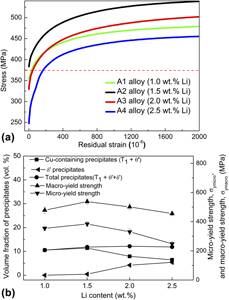
In this study, the effects of lithium(Li) content (1.0, 1.5, 2.0, and 2.5 wt%) on the microstructure, micro-yield strength (MYS) and coefficient of thermal expansion (CTE) of Al–Cu–Mg–Li–Sc–Ag alloys were investigated. The results showed that increased Li content promoted the formation of primary T1 phases and secondary T1 precipitates. While the primary T1 phases decreased the MYS of the Al–Cu–Mg–Li–Sc–Ag alloys due to large residual stress and stress concentration, secondary T1 precipitates increased the MYS due to their excellent pinning and impeding effect on mobile dislocations. In addition, the increase in Li content caused the CTETT (i.e., CTE transition temperature) first increased and then decreased, while the CTEH (CTETT to 300 °C) of alloys to first decrease and then increase. The CTEH and CTETT values were influenced by the MYS rather than by the macro-yield strength of alloys, arising from the differences in the amounts of the T1 precipitates among the four tested alloys; this was due to the superior thermal stability of the T1 precipitates.
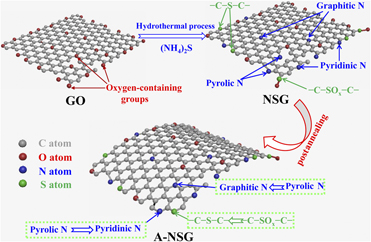
Heteroatom-doped carbon plays a vital role in the field of energy storage and conversion, and the synthesis of them has intimate relation with doping pathways. In this work, a facile two-step doping pathway, i.e., hydrothermal method followed by thermal annealing process, was employed to prepare annealed three-dimensional N,S-codoped graphene framework (3D A-NSG). The morphology, structure, composition, and related electrochemical performance were all studied. The results showed that A-NSG possessed typical 3D thin nanosheets, much increased specific surface area and structural defects, strengthened conductivity, and optimized N and S configurations (especially for dominated pyridinic N as well as graphitic N and –C–S–C–). As a result, A-NSG presented much better capacitance and oxygen reduction reaction performance than the counterparts. Apparently, our work offers a good guidance on the synthesis of advanced heteroatom-doped carbon materials by adjusting the doping strategy.
Powder X-ray diffraction was used to monitor the solvent-free synthesis of two-dimensional (2D) metal–organic frameworks (MOFs) via mechanochemical methods. For four isophthalic acid-based, alkoxide-functionalized organic ligands, optimal milling times were found to vary from 12 to 48 min. This work confirms that mechanochemical synthesis routes can be utilized to afford highly-crystalline, 2D MOFs.
Crystal structure analysis of a pyrazole carboxylic acid derivative, 5-(trifluoromethyl)-1-phenyl-1H-pyrazole-4-carboxylic acid (1) has been carried out from laboratory powder X-ray diffraction data. The crystal packing in the pyrazole carboxylic acid derivative exhibits an interplay of strong O–H…O, C–H…N and C–H…F hydrogen bonds to generate a three-dimensional molecular packing via the formation of R22(8) and R22(9) rings. Molecular electrostatic potential calculations indicated that carbonyl oxygen, pyrazole nitrogen and fluorine atoms to be the strongest acceptors. The relative contribution of different interactions to the Hirshfeld surface of pyrazole carboxylic acid and a few related structures retrieved from CSD indicates that H…H, N…H and O…H interactions can account for almost 70% of the Hirsfeld surface area in these compounds.
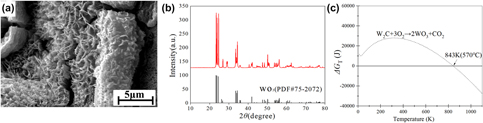
Cast tungsten carbide is widely used to reinforce iron or steel substrate surface composites to meet the demands of harsh wear environments due to its extremely high hardness and excellent wettability with molten steel. Cast tungsten carbide particle/steel matrix surface composites have demonstrated great potential development in applications under the abrasive working condition. The thermal shock test was used to investigate the fatigue behavior of the composites fabricated by vacuum evaporative pattern casting technique at different temperatures. At elevated temperatures, the fatigue behavior of the composites was influenced by the oxidation of tungsten carbide, producing WO3. Thermodynamic calculations showed that the W2C in the tungsten carbide particle was oxidized at an initial temperature of approximately 570 °C. The relationship between oxidation and thermal fatigue crack growth was investigated, and the results suggested that oxidation would become more significant with increasing thermal shock temperature. These findings provide a valuable guide for understanding and designing particle/steel substrate surface composites.
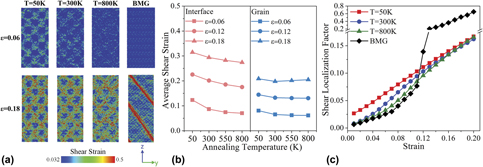
Intrinsic size effects in nanoglass plasticity have been connected to the structural length scales imposed by the interfacial network, and control over this behavior is critical to designing amorphous alloys with improved mechanical response. In this paper, atomistic simulations are employed to probe strain delocalization in nanoglasses with explicit correlation to the interfacial characteristics and length scales of the amorphous grain structure. We show that strength is independent of grain size under certain conditions, but scales with the excess free volume and degree of short-range ordering in the interfaces. Structural homogenization upon annealing of the nanoglasses increases their strength toward the value of the bulk metallic glass; however, continued partitioning of strain to the interfacial regions inhibits the formation of a primary shear band. Intrinsic size effects in nanoglass plasticity thus originate from biased plastic strain accumulation within the interfacial regions, which will ultimately govern strain delocalization and homogenous flow in nanoglasses.
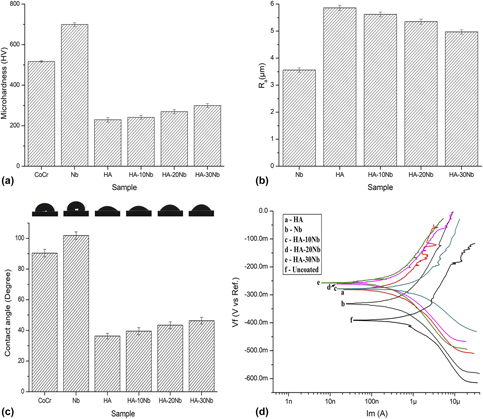
In this study, a niobium-reinforced hydroxyapatite (HA-Nb) coating was developed on cobalt–chromium (CoCr) alloy by plasma spraying with three varied levels, i.e., 10, 20, and 30% of weight percent (wt%) of Nb content. The corrosion behavior and biocompatibility of the samples were analyzed through electrochemical corrosion testing and cytotoxicity studies, respectively. The results of corrosion testing revealed that the HA coating increased the corrosion resistance of the CoCr alloy, and with the incremental increase of Nb reinforcement in HA, corrosion resistance was further enhanced. The HA-30Nb coating demonstrated the finest corrosion resistance with the highest Ecorr and lowest Icorr values, which were about one order of magnitude lower in comparison to the bare CoCr alloy. The surface hardness increased and the surface roughness decreased with the increase of Nb content in the coating. Wettability analysis revealed that HA and HA-Nb coatings had a hydrophilic nature. HA-Nb coatings demonstrated a significantly better cell proliferation than the CoCr alloy.
A total of 77 pottery shards originating from the Middle Jomon period (2500–1500 BC) were excavated from the Hinoki site in Tochigi, Japan. Fifty-five of those were Atamadai type pottery, which might contain some temper fragments from the manufacturing process. The pottery shards were analyzed by X-ray diffractometry (XRD). The mineral analyses were compared with the river sands around Mt. Tsukuba to demonstrate the temper's origin of the Atamadai type pottery. Their XRD profiles revealed the following solid solutions which could be fingerprint minerals: biotite for the temper and plagioclase, and hornblende for the clay and temper. These minerals might indicate the origin of each sample because their d-spacings depended on the solid solution composition reflecting their geological characteristics.
Protein-based materials are a powerful instrument for a new generation of biological materials, with many chemical and mechanical capabilities. Through the manipulation of DNA, researchers can design proteins at the molecular level, engineering a vast array of structural building blocks. However, our capability to rationally design and predict the properties of such materials is limited by the vastness of possible sequence space. Directed evolution has emerged as a powerful tool to improve biological systems through mutation and selection, presenting another avenue to produce novel protein materials. In this prospective review, we discuss the application of directed evolution for protein materials, reviewing current examples and developments that could facilitate the evolution of protein for material applications.
This accessible new text introduces the theoretical concepts and tools essential for graduate-level courses on the physics of materials in condensed matter physics, physical chemistry, materials science and engineering, and chemical engineering. Topics covered range from fundamentals such as crystal periodicity and symmetry, and derivation of single-particle equations, to modern additions including graphene, two-dimensional solids, carbon nanotubes, topological states, and Hall physics. Advanced topics such as phonon interactions with phonons, photons and electrons, and magnetism, are presented in an accessible way, and a set of appendices reviewing crucial fundamental physics and mathematical tools makes this text suitable for students from a range of backgrounds. Students will benefit from the emphasis on translating theory into practice, with worked examples explaining experimental observations, applications illustrating how theoretical concepts can be applied to real research problems, and 242 informative full color illustrations. End-of chapter exercises are included for homework and self-study, with solutions and lecture slides for instructors available online.
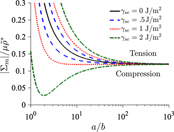
Several experiments and molecular dynamics calculations have reported anomalous mechanical behaviors of nanoporous materials that may be attributed to capillary effects. For example, nanoporous gold exhibits a tension–compression asymmetry in yield strength with the material being stronger in compression than tension. In addition, some molecular dynamics calculations have reported a spontaneous collapse of pores in nanoporous gold with nanometer-sized ligaments. Despite these perplexing observations, there are few theoretical models capable of shedding light on such capillary phenomena, particularly under general stress states. Here, we utilize a physics-based model to explore the implications of high surface energies on the mechanical response of dislocation-starved nanoporous materials subject to general stress states. For low stress triaxialities, we report an anomalous size effect and an anomalous temperature-dependence of dislocation-starved nanoporous materials with sufficiently large surface energies. Additionally, we provide an analytic criterion for spontaneous pore collapse in nanoporous materials with nanometer-sized ligaments.
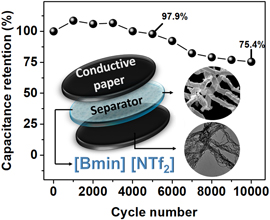
Improvement of the performance of renewable electronic devices is a crucial point for the consolidation of this emerging technology. Herein, we develop a supercapacitor based on cellulose, carbon nanotubes, and ionic liquids. A conductive paper prepared by simple acid hydrolysis of cellulose and carboxylated carbon nanotubes was used as an electrode. A cellulose sponge impregnated with 1-n-butyl-3-methylimidazolium bis(trifluoromethane sulfonyl)imide was used as a separator/electrolyte. Electrochemical tests were performed in a two-electrode cell that presented a specific capacitance of 34.37 F/g when considered the active mass and 97.9% of capacitance retention after 5000 charge/discharge cycles.