To save content items to your account,
please confirm that you agree to abide by our usage policies.
If this is the first time you use this feature, you will be asked to authorise Cambridge Core to connect with your account.
Find out more about saving content to .
To save content items to your Kindle, first ensure no-reply@cambridge.org
is added to your Approved Personal Document E-mail List under your Personal Document Settings
on the Manage Your Content and Devices page of your Amazon account. Then enter the ‘name’ part
of your Kindle email address below.
Find out more about saving to your Kindle.
Note you can select to save to either the @free.kindle.com or @kindle.com variations.
‘@free.kindle.com’ emails are free but can only be saved to your device when it is connected to wi-fi.
‘@kindle.com’ emails can be delivered even when you are not connected to wi-fi, but note that service fees apply.
In this paper, some results of neutron diffraction properties of the dispersive double-crystal Si(111) + Si(311) and Si(111) + Si(400) monochromator settings containing two bent perfect crystals but with the second one – analyzer in the strongly asymmetric diffraction geometry, are presented. For the sake of possible applications, both double crystal settings were tested in the orientation of the second crystal for the output beam compression geometry. Powder diffraction test was carried out on a α-Fe(211) pin of the diameter of 2 mm. Contrary to the Si(111) + Si(400) setting, an excellent resolution represented by full width at half maximum in the (Δd/d)-scale was obtained for the Si(111) + Si(311) double crystal monochromator in the parallel as well as in the antiparallel diffraction geometry.
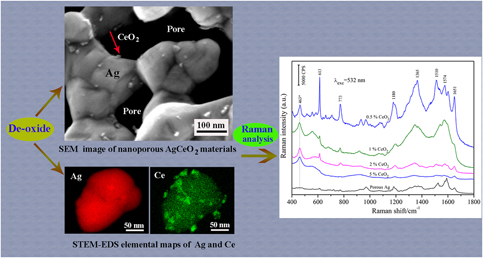
Noble metals combined with some oxides have synergetic contributions to surface-enhanced Raman scattering (SERS). In this work, a new method of de-oxide was proposed to prepare nanoporous metal based composites. Nanoporous Ag decorated with CeO2 nanoparticles was successfully prepared by decomposing Ag/CeO2/ZnO precursors in a 10 wt% NaOH aqueous solution. During the process of de-oxide, ZnO in the precursors could be removed completely and the nanoporous Ag/CeO2 nanocomposites with rough ligament surfaces were formed. The results indicated that the contents of CeO2 had significant influences on the microstructure and SERS performance of the prepared Ag/CeO2 materials. Using R6G and L-phenylalanine as probe molecules, the nanoporous Ag/CeO2(0.5%) substrates demonstrated a high enhancement factor of 1.2 × 10⁸. The improved SERS performances were mainly attributed to the strong coupling effects between Ag ligament and CeO2 nanoparticle. This work would like to be interesting for the design of nanoporous composites for the application in the fields of SERS technology.
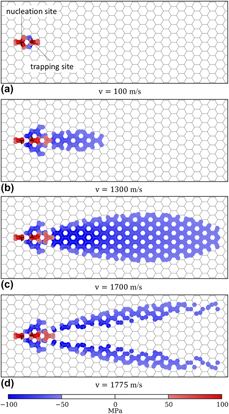
Dislocation-mediated plasticity in stable nanocrystalline metals, where grain boundary motion is suppressed, is revisited in the context of dislocation elastodynamics. The effect of transient waves that emanate from the generation and motion of dislocations is quantified for an idealized Cu–10 at.% Ta system with grain sizes on the order of 50 nanometers. Simulations indicate that for this material, as dislocation velocities approach 0.6–0.8 times the shear wave speed, grains several grain diameters away from the initial glide event experience a large transient shear stress for a finite duration. These transient shear stresses increase with increasing glide velocity and can activate nucleation sites far from the original nucleation event. These considerations are used to explain recent experimental observations of a lack of increase in flow stress with increasing loading rate, as well as localization resistance, in this class of stable nanocrystalline metals.
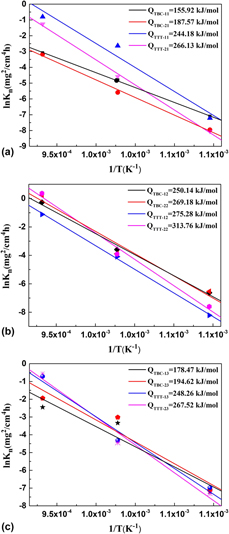
The oxidation behavior of two percentages of TiB + TiC reinforced Ti–6Al–4V composites derived from Ti–B4C–C and Ti–TiB2–TiC systems was investigated at 873–1073 K for 320 h in air. The oxidation weight gain curves of the (TiB + TiC)/Ti–6Al–4V composites at 973 K basically obey parabolic law, while those at 873 and 1073 K mainly follow linear law and parabolic-linear law, respectively. The oxide layers of the composites are predominately found to be rutile TiO2, Al2O3, and the mixture of V2O3 and V2O5. The oxidation layers turn thinner with increasing the nominal volume fraction of reinforcements in the (TiB + TiC)/Ti–6Al–4V composites. Moreover, according to the calculation results of reaction index (n) and effective activation energy (Qeff) and the analyses of cross-sections of the oxidation layers, the oxidation resistance ability of the composites from Ti–TiB2–TiC system is higher than that from Ti–B4C–C system while employing the same sintering temperature and nominal volume fraction of reinforcement.
Apatite-type materials AI4AII6(BO4)6X2 have two unique cations sites AI and AII, which can host large mono-, di- tri- and tetra-valent cations. The average cation radii will affect the twist angle and lattice constants. However, there are few reports on the influence of B site substitutions on the twist angle and lattice parameters. It is believed that the lattice constant variation as a function of B site substitutions may not follow the same twist-angle model as proposed for A site. This work reports our results on the crystal chemistry of synthetic apatite Ca10(VxP1−xO4)6F2 obtained through the crystal structure characterization using Rietveld refinement and high-resolution transmission electron microscopy. The quantification of vanadium/phosphorus partitioning in BO4 tetrahedra showed that equilibrium with more than 70% substitution of phosphorous by vanadium was difficult to achieve unless longer annealing (about 1 week at 900 °C) was employed. In comparison with the apatites with different ionic radii at AI and AII sites, Ca10(VxP1−xO4)6F2 apatites with different ionic radii at B site show little twist angle variation for the whole series, which indicates that the dilation of unit cell constants is mainly because of the expansions of BO4 tetrahedra when A site cation is fixed.
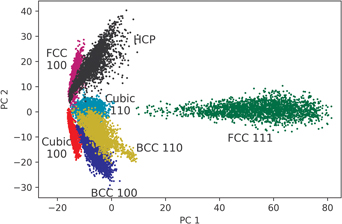
Nano-structured thin films have a variety of applications from waveguides, gaseous sensors to piezoelectric devices. Grazing Incidence Small Angle x-ray Scattering images enable classification of such materials. One challenge is to determine structure information from scattering patterns alone. This paper highlights the design of multiple Convolutional Neural Networks (CNN) to classify nanoparticle orientation in a thin film by learning scattering patterns. The network was trained on several thin films with a success rate of 94%. We demonstrate CNN robustness under different noises as well as demonstrate the potential of our proposed approach as a strategy to decrease scattering pattern analysis time.
This paper is devoted to the X-ray diffraction study of bone fragments of Permian parareptile Deltavjatia vjatkensis obtained from the Kotelnich vertebrate fossil site, one of the richest of the Permian period, which is characterized by the excellent preservation of fossil remains because of their burial in a silty anaerobic environment similar to modern bogs. The bone is well-preserved and consists of fluorapatite, calcite, quartz, and dolomite. The refined apatite unit-cell parameters of a and b-axis (9.3526 ± 0.0001 and 9.3587 ± 0.0001) Å and c-axis (6.8930 ± 0.0001 and 6.8968 ± 0.0001) Å correspond to F-apatite. Crystallinity index determined as the full width at half maximum of the 002 reflection in degrees 2θ is 0.266–0.250, which is typical for Mesozoic vertebrate bones. Apatite crystallite size (length 70.3–74.9 nm, width 30.7–30.3 nm) in fossil pareiasaur bone is larger than in subfossil and recent mammal bone and is in a good agreement with the values for seismosaurus bone. Both crystallite size and aspect ratio (2.3–2.5) are independent of the fossil pareiasaur bone length.
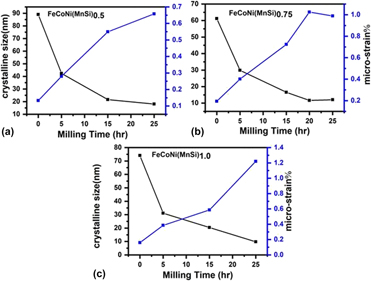
FeCoNi(Mn–Si)x (x = 0.5, 0.75, 1.0) high-entropy alloys (HEAs) were successfully synthesized by mechanical alloying (MA), and the effect of Mn and Si in the ferromagnetic alloys on crystal structure and magnetic behavior was thoroughly investigated. XRD, SEM, and TEM were used to investigate the effect of Mn and Si content on the structure of HEAs. The high Mn and Si contents change the structure from the BCC phase to FCC phase. The evolution of surface morphology was discussed on the basis of MA time and content of Mn and Si. The magnetic hysteresis curve confirmed the highest magnetic saturation (Ms) value of 134.21 emu/g for FeCoNi(Mn–Si)1.0 alloy and an appreciably low coercivity (Hc) of 98.07 Oe for FeCoNi(Mn–Si)0.5 alloy. The finite element method (FEM), using COMSOL Multiphysics software, has been used for determining the magnetic flux density (B) on the surface and at the center of the transformer core to determine the performance of the proposed HEAs.
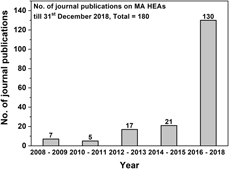
Mechanical alloying (MA) followed by sintering has been one of the most widely adopted routes to produce nanocrystalline high-entropy alloys (HEAs). Enhanced solid solubility, room temperature processing, and homogenous alloy formation are the key benefits provided by MA. Spark plasma sintering has largely been used to obtain high-density HEA pellets from milled powders. However, there are many challenges associated with the production of HEAs using MA, which include contamination during milling and high propensity of oxidation. The present review provides a comprehensive understanding of various HEAs produced by MA so far, with the aim to bring out the governing aspects of phase evolution, thermal stability, and properties achieved. The limitations and challenges of the process are also critically assessed with a possible way forward. The paper also compares the results obtained from high-pressure torsion, another severe plastic deformation technique.
Herein, in order to research the crystalline behaviors of cyclotetramethylenetetranitramine-aluminum (HM-Al) composites in solvents, the modified attachment energy model was applied to predict the morphologies of HMX in vacuum, dimethyl sulfoxide (DMSO), and ethanol. Then HMX-Al composites with Al coated and noncoated were prepared via solvent–nonsolvent method, and the morphologies were characterized. Results show that HMX interacts with DMSO and ethanol mainly via van der Waals force and electrostatic force. HMX grows into polyhedral crystals in two solvents. However, the shapes and the crystalline surface area distributions of the polyhedrons are different for two solvents. There are many aluminum particles embedded in HMX crystals of HMX-Al composite particles prepared via solvent–nonsolvent method, but Al particles cannot embed in HMX crystals in the existence of fluoropolymer. The crystal morphology predicted is consistent with the experimental results.
Obtention of titanium (Ti)- and titanium dioxide (TiO2)–based nanocomposites is of great interest for biological nanomaterial applications, including for dental implants. Their mechanical properties can be improved by use of hydroxyapatite (HA) and chitosan through their biological anchorage with osseointegration and antibacterial activity. Electrochemical methods were chosen to obtain these composites in a quick and controllable way. In this work, electrochemical synthesis in one (alternated potential) or two steps (alternated or constant potential) was successfully applied. The single step (SS) obtained TiO2 + HA sample had different optical properties, as shown using ultraviolet–visible spectrometry, and the HA phase formation was proved using Raman spectroscopy. Thereby, SS_TiO2 + HA increased the corrosion resistance of titanium in artificial saliva medium, as shown by linear polarization and electrochemical impedance spectroscopy results. When using chitosan, the samples showed two corrosion interfaces, indicating its dissolution in human medium. These results indicate that the samples are excellent materials for dental implants.
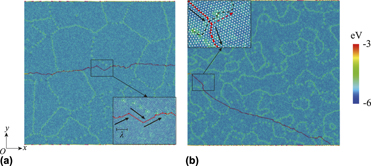
The stability of dynamic fracture is a fundamental and challenging problem in the field of materials science. The grain size effect on dynamic fracture instability in polycrystalline graphene under tear loading is explored via theoretical analysis and molecular dynamics simulations. The fracture stability phase diagram in terms of grain size and crack propagation velocity is obtained, and three regions of crack propagation are identified: stable, metastable, and unstable. For grain size above 2 nm, there exists a critical velocity beyond which fracture instability occurs, and this critical velocity depends linearly on grain size. Decreasing grain size leads to reduced characteristic time for correction of crack path deflection, which plays a dominant role in dynamic fracture instabilities. However, when grain size is below 2 nm, there does not exist a critical velocity for steady propagation of cracks due to discontinuous effects. Our results also provide a valuable insight into dynamic fracture of polycrystalline graphene as well as other 2D and quasi-2D materials.
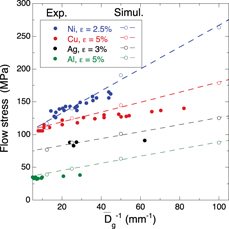
The effect of grain size on the flow strength of FCC polycrystals was analyzed by means of computational homogenization. The mechanical behavior of each grain was dictated by a dislocation-based crystal plasticity model in the context of finite strain plasticity and takes into the account the formation of pile-ups at grain boundaries. All the model parameters have a clear physical meaning and were identified for different FCC metals from dislocation dynamics simulations or experiments. It was found that the influence of the grain size on the flow strength of FCC polycrystals was mainly dictated by the similitude coefficient K that establishes the relationship between the dislocation mean free path and the dislocation density in the bulk. Finally, the modeling approach was validated by comparison with experimental results of the effect of grain size on the flow strength of Ni, Al, Cu, and Ag.
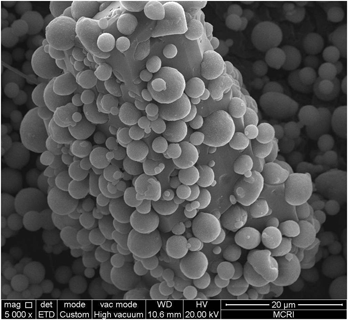
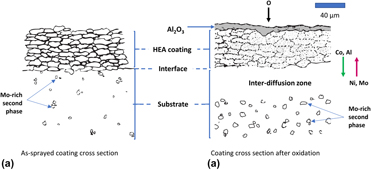
Cold-sprayed high-entropy alloy (HEA) coatings have been generated for the first time. Mechanically alloyed (MA) AlCoCrFeNi powder was chosen as feedstock, owing to the extensive literature on this alloy. Coatings were synthesized under various gas temperature and pressure conditions. Isothermal oxidation was conducted at 1100 °C for 25 h on the coating cold-sprayed at 400 °C and 10 bar on a Ni-base superalloy substrate. The as-sprayed coating retained the MA phases and formed a protective alumina layer upon oxidation. An interdiffusion zone at the interface and unanticipated Mo diffusion from the superalloy substrate into the coating were observed after oxidation. A comprehensive characterization at the coating–substrate interface suggests that diffusion in HEAs is not sluggish. The factors governing the coating’s oxidation are elucidated, and a plausible oxidation mechanism is discussed. These studies are aimed at developing oxidation-resistant HEA coatings for potential applications at high operating temperatures.
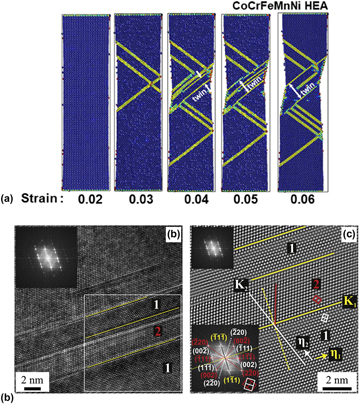
Lattice structures, defect structures, and deformation mechanisms of high-entropy alloys (HEAs) have been studied using atomistic simulations to explain their remarkable mechanical properties. These atomistic simulation techniques, such as first-principles calculations and molecular dynamics allow atomistic-level resolution of structure, defect configuration, and energetics. Following the structure–property paradigm, such understandings can be useful for guiding the design of high-performance HEAs. Although there have been a number of atomistic studies on HEAs, there is no comprehensive review on the state-of-the-art techniques and results of atomistic simulations of HEAs. This article is intended to fill the gap, providing an overview of the state-of-the-art atomistic simulations on HEAs. In particular, we discuss how atomistic simulations can elucidate the nanoscale mechanisms of plasticity underlying the outstanding properties of HEAs, and further present a list of interesting problems for forthcoming atomistic simulations of HEAs.
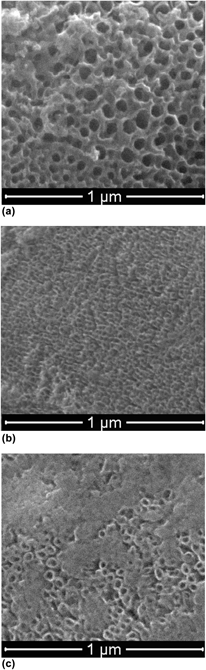
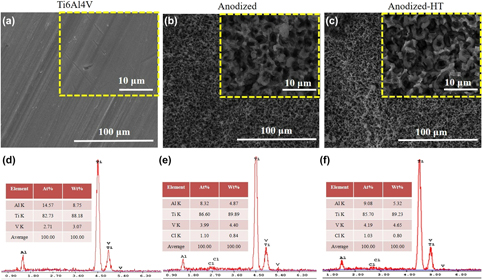
Ti6Al4V alloy is commonly used in hip and knee replacements due to its high strength, ductility, wear, and corrosion resistance. Despite its optimal physical and chemical properties, Ti6Al4V based orthopedic implants have a limited lifetime of only 15–20 years. One of the main reasons for having limited lifetime is the suboptimal integration of Ti6Al4V implants with the juxtaposed bone tissue (osseointegration). To enhance osseointegration, and thus prolong the lifetime of orthopedic implants, Ti6Al4V implants surfaces were modified to have bioactive properties using electrochemical anodization process. In this work, oxide based micropit structures were fabricated on Ti6Al4V surfaces using a fluoride-free electrolyte consisting of NH4Cl in distilled water. Micropit structures were characterized for their surface morphology, crystallinity, and chemistry before and after high temperature crystallization heat treatment. Upon interaction of Ti6Al4V samples with simulated body fluid up to 30 days, enhanced calcium phosphate mineral deposition was observed on anodized surfaces.
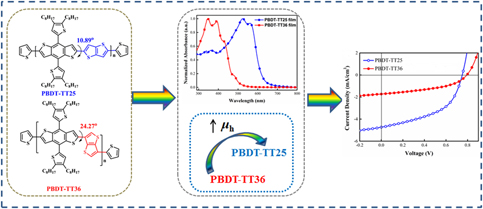
Two wide band gap conjugated polymers, namely PBDT-TT25 and PBDT-TT36, derived from (4,8-bis(4,5-dioctyl-thiophen-2-yl)benzo[1,2-b:4,5-b′]dithiophene-2,6-diyl)bis(trimethylstannane) with 2,5-dibromothieno[3,2-b]thiophene (TT25) or 3,6-dibromothieno[3,2-b]thiophene (TT36), have been synthesized by simply altering the linker positions of thieno[3,2-b]thiophene unit. The impact of linker positions on the energy levels, aggregation, active layer morphology, and optical and photovoltaic properties was evaluated systemically. We found that the absorption was greatly broadened, and the highest occupied molecular orbital (HOMO) energy level was elevated as the result of the significantly reduced twist angle on the polymer backbone when the linker positions changed from 3,6-isomer to 2,5-isomer. Therefore, the optimal inverted polymer solar cells exhibited a 1.87 times enhancement in power conversion efficiencies (PCE), which was mainly ascribed to the higher short circuit current densities (JSC) and fill factor (FF) of the devices mainly benefited from the widened, stronger absorption, higher hole mobility, and more ordered structure.