To save content items to your account,
please confirm that you agree to abide by our usage policies.
If this is the first time you use this feature, you will be asked to authorise Cambridge Core to connect with your account.
Find out more about saving content to .
To save content items to your Kindle, first ensure no-reply@cambridge.org
is added to your Approved Personal Document E-mail List under your Personal Document Settings
on the Manage Your Content and Devices page of your Amazon account. Then enter the ‘name’ part
of your Kindle email address below.
Find out more about saving to your Kindle.
Note you can select to save to either the @free.kindle.com or @kindle.com variations.
‘@free.kindle.com’ emails are free but can only be saved to your device when it is connected to wi-fi.
‘@kindle.com’ emails can be delivered even when you are not connected to wi-fi, but note that service fees apply.
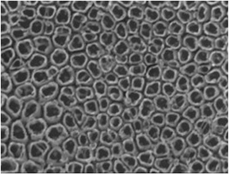
Surface properties of titanium implants are key factors for rapid and stable bone tissue integration. So, in order to promote the osseointegration of implants, various surface treatments have been proposed. The objective of these surface treatments is to improve protein adsorption, cell adhesion and differentiation, and consequently, the tissue integration of titanium implants. In this paper, we propose to describe and compare the different strategies available in the literature to produce micro- and nanostructured surfaces on titanium, especially the recent results using electrochemical anodization. Anodization is a cost-effective process that produces nanostructures based on the electrolytic growth of columnar titanium oxide layers. By mastering the electrolyte composition and voltage, a regular array of pores with controlled diameters ranging from 15 to 200 nm are easily produced. Then we will present the latest results on the osteointegration of the surface composed anodized titania nanotubes.
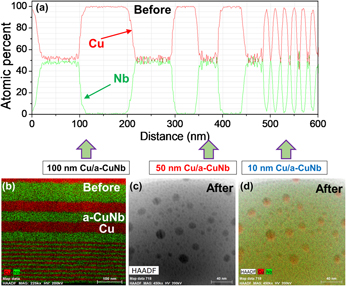
Nanocrystalline and nanolaminated materials show enhanced radiation tolerance compared with their coarse-grained counterparts, since grain boundaries and layer interfaces act as effective defect sinks. Although the effects of layer interface and layer thickness on radiation tolerance of crystalline nanolaminates have been systematically studied, radiation response of crystalline/amorphous nanolaminates is rarely investigated. In this study, we show that irradiation can lead to formation of nanocrystals and nanotwins in amorphous CuNb layers in Cu/amorphous-CuNb nanolaminates. Substantial element segregation is observed in amorphous CuNb layers after irradiation. In Cu layers, both stationary and migrating grain boundaries effectively interact with defects. Furthermore, there is a clear size effect on irradiation-induced crystallization and grain coarsening. In situ studies also show that crystalline/amorphous interfaces can effectively absorb defects without drastic microstructural change, and defect absorption by grain boundary and crystalline/amorphous interface is compared and discussed. Our results show that tailoring layer thickness can enhance radiation tolerance of crystalline/amorphous nanolaminates and can provide insights for constructing crystalline/amorphous nanolaminates under radiation environment.
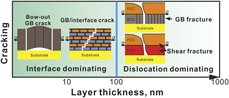
Fatigue performance of metallic nanolayered composites (NLCs) has been gaining more and more attention due to the rapid development in the field of both micro-electro-mechanical systems and high-performance engineering structure materials and the increasing demand for long-term fatigue reliability. Metallic NLCs have exhibited different damage behaviors due to the effect of high-density heterogeneous interface compared with bulk materials and thin metal films. In this review paper, the cyclic deformation damage behavior, fatigue cracking feature, and fatigue properties of some metallic NLCs are reviewed. Effects of length scales, including layer thickness and grain size, on fatigue damage behaviors of the NLCs are revealed, and the transition of the fatigue cracking behavior and the corresponding damage mechanism are discussed. Then, the fatigue properties of some typical metallic NLCs are presented and compared with that of bulk materials and metal thin films. The effect of interface type and grain boundary alignment is also discussed to correlate with fatigue cracking resistance of the NLCs. Finally, some prospective research topics on fatigue performance of metallic NLCs are addressed.
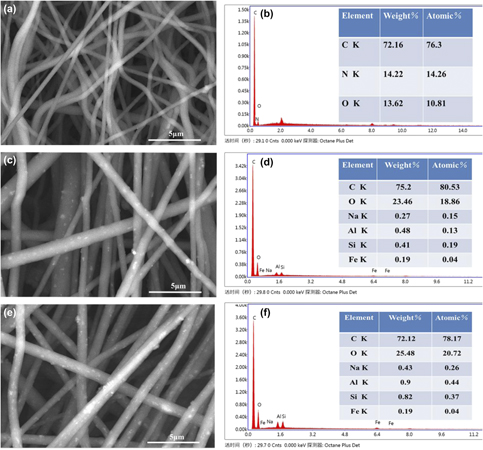
As distinctive spontaneous polarization and far-infrared radiation characteristics, the natural mineral tourmaline (TM) has the regulatory effect on crystallization behavior, which possesses potential application in biomimetic mineralization and bone regeneration. In this study, polyurethane (PU) and gelatin (GE) membranes with different adding proportion of TM nanoparticles were prepared via electrospinning. Additionally, the effect of TM nanoparticles on the mineralization process of hydrophobic PU and hydrophilic GE was investigated by immersing the composite TM/PU and TM/GE electrospun membranes in the 10× simulated body fluid (10SBF) at 37 °C for varying periods of time. SEM images confirmed the well-dispersed TM nanoparticles in the PU and GE electrospun fibers. The mineralization deposition was characterized by the SEM, EDS, XRD, and FTIR, and it indicated that two types of calcium phosphate deposits with different Ca/P molar ratios were obtained when TM/PU membranes and TM/GE membranes were incubated in 10SBF. Honeycomb-like hydroxyapatite crystals nucleated and grew faster on TM/PU and TM/GE membranes than the pure PU and GE membranes, respectively. Furthermore, with the increase of the added TM nanoparticles in the composite membranes, more calcium phosphate crystals were precipitated. These results showed that the added TM nanoparticles were able to improve the mineralization of polymer fibrous membranes, which is potential for the composite bone scaffold.
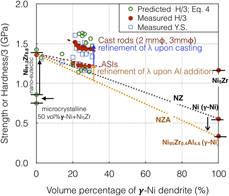
The effect of cooling rate on the microstructure evolution and the mechanical properties of ingots and rods of 2–5 mm diameter of (Ni0.92Zr0.08)100−xAlx (0 ≤ x ≤ 4 at.%) ultrafine eutectic composites have been investigated. The microstructure of the composites is comprised of micrometer size γ-Ni dendrites embedded in a nano/-ultrafine lamellar fcc γ-Ni and Ni5Zr matrix. The evolution of the microstructure at a wide range of cooling rates (10–104 K/s) has been analyzed in respect of volume fraction of the phases, lamellar spacing, and secondary dendritic arm spacing. All these composites exhibit high hardness up to 4.6 GPa and yield strength up to 1.6 GPa with large compressive plasticity up to 22% at room temperature. The effect of cooling rates on the strength and hardness, and the plasticity of the nanolamellar composites with wide range of alloy composition have been correlated.
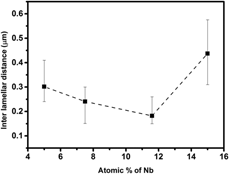
In the design of high-entropy alloys (HEAs) with desired properties, identifying the effects of elements plays an important role. HEAs with eutectic microstructure can be obtained by judiciously modifying the alloy compositions. In this study, the effect of Nb addition to FeCoNiCuNbx (x = 0.5, 5, 7.5, 11.6, 15) alloys was studied by varying the Nb concentration (at.%). FeCoNiCuNb0.5 HEA shows liquid phase separation to form Cu-rich and FeCoNiCu-rich phases. Detailed solidification paths are proposed for these alloys, which show eutectic, peritectic, and pseudo quasi-peritectic reactions. Increasing Nb content promotes the liquid phase separation tendency and causes the formation of Cu-rich spheres. The effect of Nb on the FeCoNiCu-rich phase was studied based on the nanoindentation and correlated with nanohardness. The compressive deformation properties of these alloys are studied at room temperature and high temperature and correlated with microstructure. Fractography results show the mode of fracture and are correlated with the microstructure obtained.
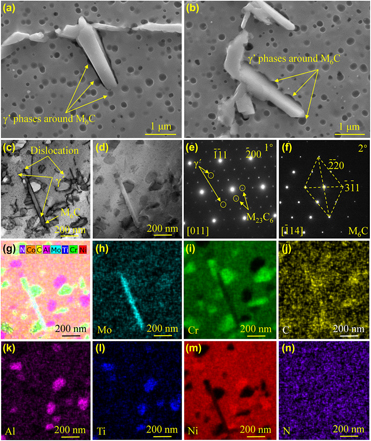
Coarsening mechanism of precipitations was investigated in a weld metal of Alloy 617 during long-term aging at 750 °C, and its effect on impact toughness was clarified distinctly. The needle-like M6C phases at the grain boundary nucleated and coarsened at 2000 h and then presented a stable size with aging to 8000 h. Spherical γ′ phase grew rapidly with the rate of 0.0121 nm/h when aged at 1000 h; then, its ripening rate (RR) reduced to 0.0033 nm/h at 8000 h and stabilized around it. The coarsening of M6C and γ′ was, respectively, controlled by interface diffusion and volume diffusion with the coarsening rate constant of 7.865 × 10⁻²⁰ m2/s and 1.519 × 10⁻²⁷ m3/s. Interaction of M6C and γ′ could facilitate their coarsening and cause dramatic decrease in toughness at the early stage. At aging to 8000 h and more, the lower RR of needle-like M6C phases and γ′ phases helped to form stable toughness at a later stage.
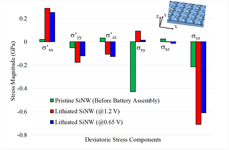
Silicon is a promising material for lithium-ion batteries. However, it expands by 300% on lithiation, leading to fracture. Nanostructuring of silicon is expected to be a promising method to improve the mechanical strength of the silicon electrodes. In the present work, a unique battery test cell was designed and fabricated to study the in situ stress evolution in the silicon nanowire (SiNW) electrode during electrochemical lithiation using synchrotron X-ray microdiffraction. The stress in the SiNWs at pristine state and during lithiation was evaluated using energy scans. The average stress in the pristine nanowires was found to be ∼40 MPa tensile, which changed to ∼325 MPa compressive on lithiation. Further, the deviatoric stress state in the SiNWs during lithiation was evaluated using Laue diffraction and the lithiated nanowires were found to be in triaxial stress state with high shear stresses. The technique and the findings provide new and more in-depth understanding of the stress evolution in the SiNWs during electrochemical lithiation.
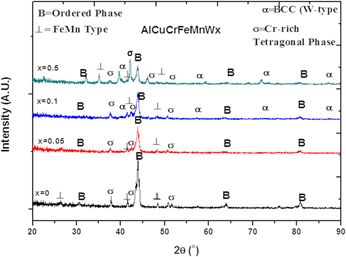
A novel series of nanocrystalline AlCuCrFeMnWx (x = 0, 0.05, 0.1, 0.5) high-entropy alloys (HEAs) were synthesized by mechanical alloying followed by spark plasma sintering. The phase evolution of the current HEAs was studied using X-ray diffraction (XRD), transmission electron microscopy, and selected area electron diffraction. The XRD of the AlCuCrFeMn sintered HEA shows evolution of ordered B2 phase (AlFe type), sigma phase (Cr rich), and FeMn phase. AlCuCrFeMnWx (x = 0.05, 0.1, 0.5 mol) shows formation of ordered B2 phases, sigma phases, FeMn phases, and BCC phases. Micro-hardness of the AlCuCrFeMnWx samples was measured by Vickers microindentation and the maximum value observed is 780 ± 12 HV. As the tungsten content increases, the fracture strength under compression increases from 1010 to 1510 MPa. Thermodynamic parameters of present alloys confirm the crystalline phase formation, and finally structure–property relationship was proposed by conventional strengthening mechanisms.
AgNPs@g-C3N4 composite was synthesized from Ag-containing sol and g-C3N4 powder by the ultrasonic-assisted self-assembly method. The composite has hierarchical pore size distributions, which will be beneficial to the ion transport with different size. Ag nanoparticles with the size of 5 nm successfully adhere on the surface of g-C3N4. The AgNPs@g-C3N4 composite has excellent specific capacitance and specific power performance for the supercapacitors as an electrode material. The specific capacitance of composite is 4 times greater than that of g-C3N4. It can be ascribed to the introduction of Ag nanoparticles that the internal resistance of the composite is significantly decreased.
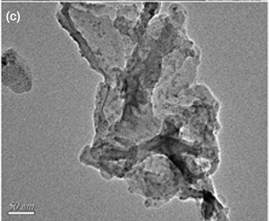
Durable antibacterial PAN/Ag NPs nanofiber membrane was prepared by electrospinning. In this study, Ag NPs were composed by applying polyvinyl pyrrolidone as a dispersant and sodium borohydride (NaBH4) as a reductant. The composite nanofiber films and silver nanoparticles were characterized and tested by transmission electron microscopy, scanning electron microscopy, energy dispersive spectroscopy, X-ray photoelectron spectroscopy, Fourier-transform infrared spectroscopy, X-ray diffraction, and Brunauer Emmett Teller (BET) and thermogravimetric analysis test. The specific surface area of PAN/Ag NPs (1%) and PAN/Ag NPs (3%) nanofiber membrane were about 25.00 m2/g calculated by the BET equation. It can be seen that the pore sizes of PAN, PAN/Ag NPs (1%), and PAN/Ag NPs (3%) nanofiber membranes were mainly distributed between 30 and 40 nm. The maximum removal rate of PM10, PM2.5, and PM1.0 was about 94%, 89%, and 82%, respectively, indicating it has a good filtering effect. The results also demonstrated that this membrane has bacterial reduction of over 99.9% for E. coli and S. aureus, respectively. In addition, the thermal stability of the fiber membrane with Ag NPs has no clear difference when compared to pure PAN nanofiber membrane and also has better moisture conductivity, indicating it is a potential candidate applied in biopharmaceutical antiseptic protection products.
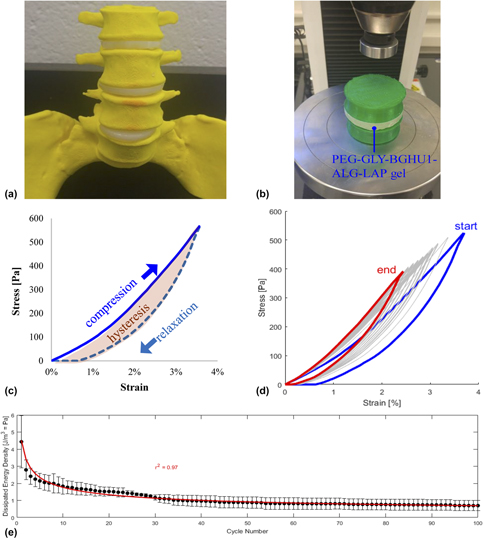
Poly(ethylene glycol) (PEG)-based materials can potentially be used as biomechanical matrices in regenerative medicine and tissue engineering implants including the replacement of intervertebral (IV) disks. Glycerol and other generally recognized as safe (GRAS) plasticizers (low-MW PEG, propylene glycol, and sorbitol) were added to the bulk PEG matrix and gelled using chemical and photochemical methods at different temperatures (21, 37, 59, and 80 °C) and pressures (0 and 90 MPa gauge) settings, and their compression testing properties were acquired and analyzed. Surface incorporation of custom-made bioactive glass particles shortened the blood clotting time (78% compared to no glass particles), while alginate and laponite additives improved the gel’s mechanical properties to 645 kPa compressive modulus, 12% yield strain, and 79 kPa yield strength. This IV disk-modeled hydrogel system endured the cyclic loading and unloading tests at 4% compressive strain indicative of an elastic response, but required improvement to its biomechanical tolerance for downstream bioengineering applications.
Density functional theory (DFT) has proved to be exceptionally successful in rationalizing trends in activity and functionality for electrochemical functional materials. With continued increases in computing power, there has been an increased interest in “high-throughput” materials discovery and design based on a few descriptors to scan the phase space en masse for thousands of potential candidates, which could be made technologically and commercially viable. However, given fundamental accuracy limitations associated with DFT, the success of high-throughput material discovery efforts has been limited. In this review, we suggest an additional dimension to aid in high-throughput material discovery related to uncertainty quantification and propagation, which provides a more realistic picture of the likelihood of new candidate materials to improve upon known materials. We demonstrate the approach and its utility through two case studies: (1) electrocatalyst materials for their activity and selectivity for the oxygen reduction reaction, and (2) cathode materials for Li-ion batteries based on Ni-Mn-Co oxides. The ease with which uncertainty quantification and propagation can be incorporated into traditional high-throughput material discovery with almost no additional computational cost allows for its proposed wide usage.
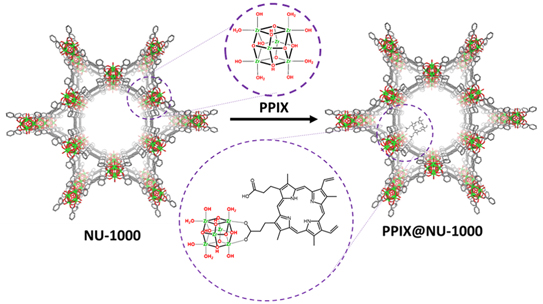
Porphyrins absorb light to initiate photocatalytic activity. The complex, asymmetric structures of natural porphyrins such as heme, chlorophyll, and their derivatives hold unique interest. A platform for biosynthesis of porphyrins in Escherichia coli is developed with the aim of producing a variety of porphyrins for examining their photocatalytic properties within a porous material. Bioderived protoporphyrin IX is tethered inside the highly porous metal-organic framework (MOF) NU-1000 via solvent-assisted ligand incorporation. This MOF catalyzes the photocatalytic oxidation of 2-chloroethyl ethyl sulfide with improved performance over an expanded range of the visible spectrum when compared to unmodified NU-1000.