To save content items to your account,
please confirm that you agree to abide by our usage policies.
If this is the first time you use this feature, you will be asked to authorise Cambridge Core to connect with your account.
Find out more about saving content to .
To save content items to your Kindle, first ensure no-reply@cambridge.org
is added to your Approved Personal Document E-mail List under your Personal Document Settings
on the Manage Your Content and Devices page of your Amazon account. Then enter the ‘name’ part
of your Kindle email address below.
Find out more about saving to your Kindle.
Note you can select to save to either the @free.kindle.com or @kindle.com variations.
‘@free.kindle.com’ emails are free but can only be saved to your device when it is connected to wi-fi.
‘@kindle.com’ emails can be delivered even when you are not connected to wi-fi, but note that service fees apply.
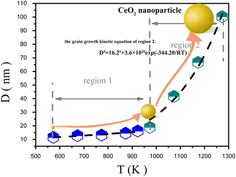
This article reports on the growth kinetics of cerium oxide (CeO2) nanoparticles prepared via a sintering method. By varying the sintering temperatures and periods of time, particle size of CeO2 nanoparticles was tuned from 11 to 100 nm. Ostwald ripening mechanism prevails in the growth process, and the growth kinetics is determined to follow an equation, D5 = 16.25 + 3.6 × 10²⁰ exp(−344.20/RT) in the temperature range of 700 to 1000°C. After dispersing Pt on CeO2 nanoparticles, the size effect for the catalytic performance of the CO oxidation reaction was researched. When temperature and period of time are set at 700 °C and 2 h, respectively, dispersion of Pt onto CeO2 nanoparticles led to the largest quantity of chemisorbed oxygen species on the surface and the best catalytic performance. The findings reported here would provide a feasible path for the preparation of advanced catalysts in the future and moreover to discover novel size-dependent supports for many catalytic applications.
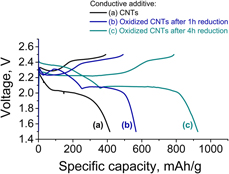
In this study, for the first time, chemically modified carbon nanotubes (CNTs) were used as a conductive additive in the cathode composite for lithium–sulfur batteries. Oxidation of pure CNTs has been carried out using modified Hummers’ method, and to partially remove oxygen groups from the CNT surface and increase their electronic conductivity, oxidized CNTs have been hydrothermally treated. The cathode slurry was mixed in water with a water-soluble LA133 binder. Despite the decrease in electronic conductivity of CNTs after chemical treatment, the presence of structural defects and oxygen groups provides uniform distribution of modified CNTs in the sulfur-based composite, which results in more than twice higher electrode specific capacity compared with the electrodes comprising pure CNTs. Using chemically modified CNTs as a conductive additive is proposed as an effective way for the preparation of nontoxic and cost-effective water-based cathode slurries in lithium–sulfur batteries.
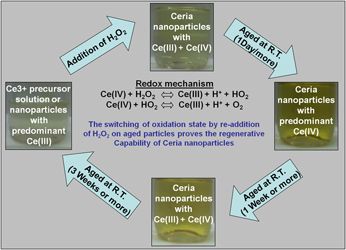
Cerium oxide nanoparticles (CNPs) are of significant interest to the scientific community due to their widespread applications in a variety of fields. It is proposed that size-dependent variations in the extent of Ce3+ and Ce4+ oxidation states of cerium in CNPs determine the performance of CNPs in application environments. To obtain greater molecular and structural understanding of chemical state transformations previously reported for ceria of ≈3 nm nanoparticles (CNPs) in response to changing ambient conditions, micro-XRD and Raman measurements were carried out for various solution conditions. The particles were observed to undergo a reversible transformation from a defective ceria structure to a non-ceria amorphous oxyhydroxide/peroxide phase in response to the addition of 30% hydrogen peroxide. For CNPs made up of ∼8 nm crystallites, a partial transformation was observed, and no transformation was observed for CNPs made up of ∼40 nm crystallites. This observation of differences in size-dependent transition behavior may help explain the benefits of using smaller CNPs in applications requiring regenerative property.
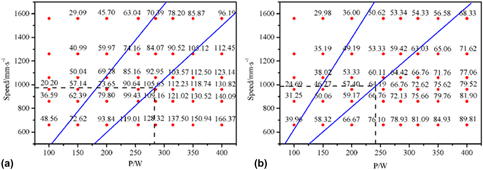
GH3536 alloy is one of the high-temperature nickel-based alloys and widely applied in aviation and aerospace industries. In this study, a combination of experiment and simulation is proposed to study the effect of processing parameters on the selective laser melting (SLM) of GH3536 powder. It is concluded that the relationship between density and laser input energy during SLM complies with a quadratic function and presents an inverted U-shaped distribution. By fitting density and input power to a quadratic polynomial, the optimal laser input energy during SLM of GH3536 alloy can be obtained. The result shows that using 275 W laser power and 960 mm/s scanning speed, the SLM GH3536 specimens can reach the maximum density. This experimental result is consistent with the simulation result obtained by analyzing molten pool dimension. Furthermore, a full process energy prediction diagram for SLM GH3536 alloy based on the simulated molten pool depth and width is proposed. The result shows that it provides an innovative and efficient method for the selection of processing parameters during SLM of GH3536 powder.
Leucites are silicate framework structures with some of the silicon framework cations partially replaced by divalent or trivalent cations. A monovalent extraframework alkali metal cation is also incorporated to balance the charges. We have previously reported Pbca leucite structures with the stoichiometries Cs2X2+Si5O12 (X = Mg, Mn, Co, Ni, Cu, Zn, Cd) and Rb2X2+Si5O12 (X = Mg, Mn, Ni, Cd). These orthorhombic leucite structures have all the silicon and non-silicon framework cations completely ordered onto separate crystallographic sites. This structure has five distinct Si sites and 1 X site; there are also two distinct sites for the extra-framework Cs or Rb. We have recently synthesised leucite analogues with two different extra-framework cations, these have the stoichiometry RbCsX2+Si5O12 (X = Mg, Ni, Cd). The initial Rietveld refinements assumed 50% Cs and 50% Rb on each of the two extra-framework cation sites. The refined structures for X = Ni and Cd have (within error limits) complete extra-framework cation site disorder. However, for X = Mg there is partial ordering of the extra-framework cation sites, the site occupancies are:- Cs1 0.37(3), Rb1 0.63(3), Cs2 0.63(3), Rb2 0.37(3).
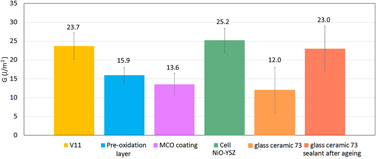
Thermal cycling of planar solid oxide cell (SOC) stacks can lead to failure due to thermal stresses arising from differences in thermal expansion of the stack’s materials. The interfaces between the cell, interconnect, and sealing are particularly critical. Hence, understanding possible failure mechanisms at the interfaces and developing robust sealing concepts are important for stack reliability. In this work, the mechanical performance of interfaces in the sealing region of SOC stacks is studied. Joints comprising Crofer22APU (preoxidized or coated with MnCo2O4 or Al2O3) are sealed using V11 glass. The fracture energy of the joints is measured, and the fractured interfaces are analyzed using microscopy. The results show that choosing the right coating solution would increase the fracture energy of the sealing area by more than 70%. We demonstrate that the test methodology could also be used to test the adhesion of thin coatings on metallic substrates.
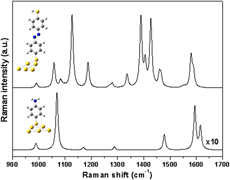
A facile one-pot and environmentally friendly method was developed to synthesize multi-branched flowerlike gold (Au) nanostructures by reducing chlorate gold (HAuCl4) with hydrogen peroxide (H2O2) in the presence of sodium citrate. The multibranched Au nanostructures were characterized by transmission electron microscopy and Ultraviolet-visible (UV-vis) absorption spectroscopy. The molar ratio of sodium citrate to HAuCl4 and the concentrations of the reacted reagents play important roles in the formation of multibranched Au nanostructures. The multibranched Au nanostructures with sharp tips exhibit excellent surface-enhanced Raman scattering (SERS) ability of 4-aminothiophenol (PATP). The experimental and simulated results both confirm that the photoinduced catalytic coupling reaction of PATP transformation to 4,4′-dimercaptoazobenzene occurs on the surface of multibranched Au nanostructures at a high power during the SERS measurement. It is believed that these multibranched Au nanostructures may find potential applications in SERS, biosensors, and the photoinduced surface catalytic application fields.
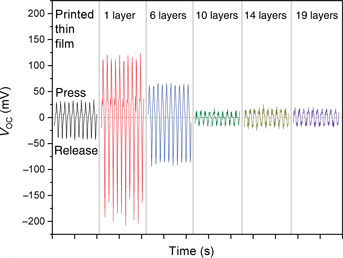
Flexible piezoelectric generators (PEGs) present a unique opportunity for renewable and sustainable energy harvesting. Here, we present a low-temperature and low-energy deposition method using solvent evaporation-assisted three-dimensional printing to deposit electroactive poly(vinylidene fluoride) (PVDF)-trifluoroethylene (TrFE) up to 19 structured layers. Visible-wavelength transmittance was above 92%, while ATR-FTIR spectroscopy showed little change in the electroactive phase fraction between layer depositions. Electroactivity from the fabricated PVDF-TrFE PEGs showed that a single structured layer gave the greatest output at 289.3 mV peak-to-peak voltage. This was proposed to be due to shear-induced polarization affording the alignment of the fluoropolymer dipoles without an electric field or high temperature.
A commercially available combined X-ray diffraction – differential scanning calorimetry (XRD-DSC) stage was adapted for studies of gas loading in microporous materials, including metal organic frameworks (MOFs). Insertion of a custom-built humid atmosphere swing chamber (HASC) between a humidity generator and the XRD-DSC stage facilitates both humid atmosphere and vacuum swing gas loading. The HASC is necessary to buffer between the humidity generator and the XRD-DSC stage, allowing the gas mixture to homogenize prior to sample exposure, so that both humid atmosphere and vacuum swings could be performed. The changes in XRD can be used to follow structural changes, including collapse, which is indicative of a lack of microporosity upon activation, and the flexibity of frameworks upon gas sorption–desorption cycles. Measurements of the area under the DSC curve allows for calculation of the isosteric heat of adsorption (Qst; kJ molGAS−1). Vacuum-atmosphere swing experiments performed at different pressure steps allow for the reconstruction of the enthalpy of gas adsorption before and after a phase transition. These modes of operation are illustrated in three case studies from a program of exploratory MOF synthesis used to discover novel materials for selective gas sorption from humid gas streams: (1) gas binding in Stony Brook metal organic framework-1, (2) zeolitic imidazolate framework-7 response to variable pressure vacuum-atmosphere swing, and (3) high throughput evaluation of the selectivity of novel MOFs synthesized from customized linkers.
The crystal structure of MoO2(O2)(H2O)·H2O has been solved using parallel tempering with the FOX software package and refined using synchrotron powder diffraction data obtained from beamline 08B1-1 at the Canadian Light Source. Rietveld refinement, performed with the software package GSAS, yielded monoclinic lattice parameters of a = 17.3355(5) Å, b = 3.83342(10) Å, c = 6.55760(18) Å, and β = 91.2114(27)° (Z = 4, space group I2/m). The structure is composed of double zigzag molybdate chains running parallel to the b-axis. The Rietveld refined structure was compared with density functional theory (DFT) calculations performed with CRYSTAL14, and shows comparable agreement with two DFT optimized structures of similar energy, which differ by the location of the molybdate coordinated water molecule. The true structure is likely a disordered combination of the two DFT optimized structures.
Dyeing wastewater has caused serious environmental problems nowadays. In this work, nickel–phosphorus plating–titanium dioxide (Ni-P-TiO2) electroless plating polyimide (PI) fabric was fabricated as an excellent visible light response composite. First, polyaniline (PANI) was in situ polymerized on the surface of the PI fabric. Second, PANI reduced palladium ions to be active seeds for initiating electroless plating of Ni-P-TiO2 layer. Finally, the Ni-P-TiO2/PANI/PI fabric with all-in-one structure was prepared, which can effectively overcome the drawbacks of poor loading fastness and insensitivity to visible light response. It was characterized by scanning electron microscopy, energy-dispersive spectroscopy, X-ray diffraction, X-ray photoelectron spectroscopy, thermogravimetric analysis, and ultraviolet–visible diffuse reflectance spectroscopy. The photocatalytic activity was evaluated by degrading reactive blue 19, methylene blue, and reactive red (M-3BE) under visible light irradiation. The results show that the degradation rates of the all three dyes were over 91% with robust cycle stability for repeated 5 cycles of use. The possible photocatalytic degradation mechanism of fabrics was also proposed based on free radical and hole removal experiments.
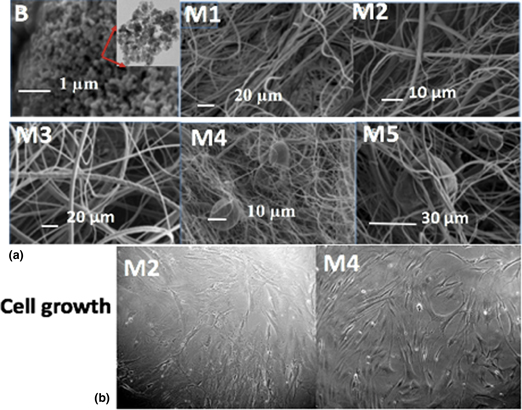
We report on the design of polycaprolactone (PCL)-TiO2-collagenase mesh scaffolds by Forcespinning technique. The dependence of the degree of crystallinity in PCL caused by the incorporation of dopants (TiO2-collagenase) and the reduction of dimensionality (1D), during the nanofiber formation, were investigated by x-ray diffraction and differential scanning calorimetry. The tensile strength of the mesh scaffolds (randomly oriented) was determined using uniaxial testing equipment. The permeability was measured by contact angle obtaining an improvement in the hydrophobicity for the PCL-TiO2-collagenase mesh scaffolds. The results reported in this research are of great relevance for tissue engineering applications.
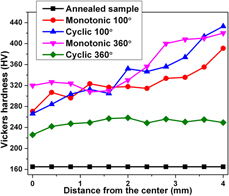
Discs of CoCuFeMnNi face centered cubic high entropy alloy were subjected to monotonic and cyclic high pressure torsion (HPT) in a single step and multiple steps of 5° forward and reverse cycle for 100° and 360° twist, respectively, under 5 GPa pressure at room temperature. It was observed that the 100° cyclic HPT sample shows the highest hardness at the periphery comparable to 360° monotonic HPT sample, while the cyclic 360° HPT sample shows the lowest hardness throughout the sample. High hardness of 100° cyclic HPT sample can be attributed to finer grain size and unstable dislocation substructure by continuous change in strain path from initial compression to forward–reverse torsion, while stable dislocation structure corresponding to shear contributes to increase in hardness from 100° to 360° for monotonic HPT sample. The unstable dislocation substructure promotes grain boundary migration–enabled grain growth leading to low hardness throughout the 360° cyclic HPT sample.
This work studied the relationship between embedded particle volume fraction and magnetic particle orientation distribution in aligned 325 mesh barium hexaferrite (BHF) and polydimethylsiloxane (Sylgard 184; Dow Corning) magnetoactive elastomer (MAE) composites. BHF particles were aligned within the elastomer in the out-of-plane direction, as the material cured. Particle orientation distribution was defined herein by observations of the population of directions at which particle magnetizations resided; magnetization coincides with the physical crystallographic c-axis of BHF. The work used results of vibrating sample magnetometry experiments on MAEs with increasing volume concentrations of embedded ferromagnetic particles (10–30 v/v%) to determine changing widths of analytical particle distribution functions used to describe the range of particle orientations. With over 80% confidence, results showed that MAE composites having the intermediate 15 v/v% had the highest degree of magnetic (and thereby physical) alignment as well as magnetic remanence.
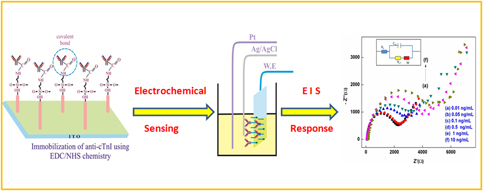
We report the development of a sensitive and a label-free electrochemical immunosensing platform for the detection of cardiac biomarker troponin I (cTnI) using tungsten trioxide nanorods (WO3 NRs). The low-temperature hydrothermal technique was employed for the controlled synthesis of WO3 NRs. Thin films of 3-aminopropyltriethoxy saline (APTES)-functionalized WO3 NRs were deposited on indium tin oxide (ITO)-coated glass substrate (0.5 cm × 1 cm) using electrophoretic deposition technique. The covalent immobilization of cTnI antibody onto functionalized WO3 NRs electrode was accomplished using EDC-NHS [1-(3-(dimethylamino)-propyl)-3-ethylcarbodiimide hydrochloride and N-hydroxysulfosuccinimide] chemistry. The structural and morphological characterizations of WO3 NRs and functionalized WO3 NRs were studied using X-ray diffraction, field emission scanning electron microscopy, transmission electron microscopy, Fourier transform infrared spectroscopy, and electrochemical techniques. The impedimetric response study of the proposed immunosensor demonstrates high sensitivity [6.81 KΩ mL·cm2)] in a linear detection range of 0.01–10 ng/mL. The excellent selectivity, good reproducibility, and long-term stability of the proposed immunosensing platform indicate WO3 NRs as a suitable platform for the development of a point-of-care biosensing device for cardiac detection.
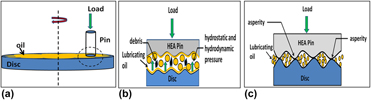
This study aims to investigate the sliding wear behavior of Al0.4FeCrNiCox (x = 0, 0.25, 0.5, 1.0 mol) high-entropy alloys (HEAs) under oil lubricating conditions at room temperature. Phase and microstructural characterizations of HEAs are performed by utilizing X-ray photoelectron spectroscopy (XRD) and scanning electron microscope (SEM). The compressive yield strength of Al0.4FeCrNiCox (x = 0, 0.25, 0.5, 1.0 mol) HEAs is observed to decrease from 1169.35 to 257.63 MPa. Plastic deformation up to 75% is achieved in the case of Al0.4FeCrNiCox=1 HEA. The microhardness of HEA samples is found to decrease from 377 to 199 HV after the addition of cobalt content from x = 0 to 1.0 mol. Thermal analysis is performed using a differential scanning calorimeter. It is confirmed that Al0.4FeCrNiCox (x = 0, 0.25, 0.5, 1.0 mol) HEAs do not undergo any phase change up to 1000 °C. The specific wear rate of Al0.4FeCrNiCox=1 HEA is observed to be highest in all wear conditions. The worn surfaces were analyzed by SEM with attached energy-dispersive spectroscopy, 3D profiling, and X-ray photoelectron spectroscopy (XPS).
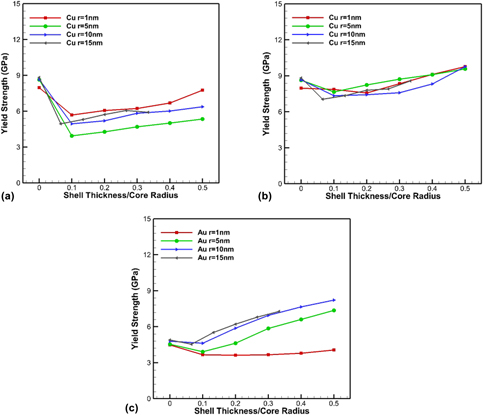
The mechanical properties of core–shell bimetallic composite nanowires, forming the bases of nanoporous metallic foams, have been investigated and compared with pure metal nanowires using molecular dynamics simulations. In the current study, pure copper and gold nanowires under uniaxial loading were tested at room temperature and compared to composite nanowires of the same materials (core) with a nickel coating (shell). The core radius ranged from 1 to 15 nm, and the shell thickness ranged from 0.1 to 5 nm. The tension strain was performed along the [001] direction under room temperature. Both coherent and semi-coherent composite nanowires were studied, and the effect of coating layer thickness was investigated. The strengthening mechanisms of the core–shell structures due to the presence of the two different types of interfaces were investigated for various nickel thicknesses. The atomistic simulation results revealed that the addition of the nickel shell strengthens the structure when the layer thickness exceeds a critical value.
Diffusion barrier materials play an important role in both structure reliability and performance stability of thermoelectric (TE) modules. Preferred barrier materials are screened out from various candidates by comparing the interdiffusion at the barrier material/TE substrate interfaces. Traditionally, for each barrier material candidate, complicated fabrication processing of TE elements (electrode/barrier material/TE material) must be finished to obtain relative interfaces, which makes the screening costly and time consuming. In this article, using a high-throughput strategy, we developed a high-efficiency screening method of barrier materials. By cosintering the mixture of TE substrate material and various barrier material candidates simply following the TE material’s sintering parameters, various microinterfaces were integrated to one single sample. This enables parallel aging and microstructure characterization of different interfaces, and preferred barrier materials can be swiftly screened out. As a result, it makes the design and optimization of TE modules much more efficient and economical.
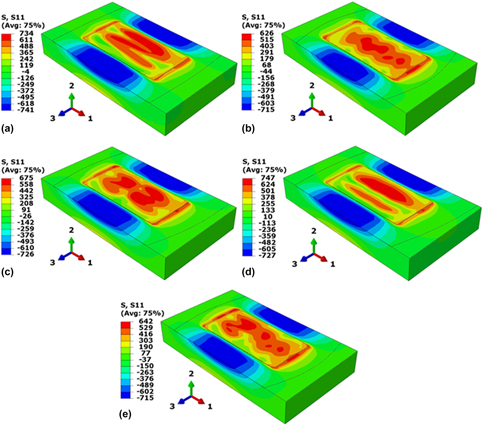
In this study, a thermal–elastic–plastic finite element model is proposed to investigate the effect of volume energy density on the temperature field, molten pool size, and residual stress distribution in the selective laser melting (SLM) process of Inconel 718 alloy. A temperature-dependent thermal–mechanical property of materials is considered, as well as the properties conversion between powder layer and solidified alloy. Within the scope of the study parameters, the simulated molten pool size increases with increasing volume energy density and exhibits linear growth relationship, which are validated by the experimental results and show a good agreement. In addition, five scanning strategies are adopted to study the effect of these scanning strategies on the residual stress distribution in this research. The results show that the residual stress distribution of SLM Inconel 718 specimen largely depends on the scanning strategy. Finally, to reveal the mechanism of residual stress formation, the restraint bar model is used to further analyze the formation mechanism of residual stress during the SLM process.
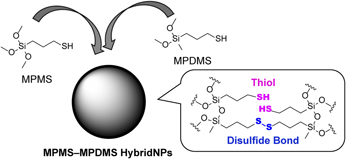
Stimuli-responsive degradable silica nanoparticles (NPs) are active topics of nanomaterial research, because they are expected to be low health-risk nanocarriers capable of controlled release of drugs. Among various stimuli-responsive silica NPs, disulfide bond-containing NPs show degradability by glutathione reduced form (GSH). Here, we synthesized and characterized three kinds of thiol-organosilica NPs made from 3-mercaptopropyltrimethoxysilane (MPMS) and 3-mercaptopropyl(dimethoxy)methylsilane (MPDMS). MPMS NPs, MPDMS NPs, and MPMS–MPDMS hybrid NPs revealed that the abundance ratio of disulfide bonds to thiols increased with the increase in content rate of MPDMS in thiol-organosilica NPs. We also revealed that thiol-organosilica NPs, which have disulfide bonds, are GSH-responsive degradable silica NPs using an electron microscopy and Ellman’s tests. Furthermore, we synthesized fluorescent MPMS–MPDMS NPs, including rhodamine B, and demonstrated the GSH-responsive release of dye from the NPs. These experiments indicate the potential of thiol-organosilica NPs, which have disulfide bonds as a GSH-responsive drug carrier.