To save content items to your account,
please confirm that you agree to abide by our usage policies.
If this is the first time you use this feature, you will be asked to authorise Cambridge Core to connect with your account.
Find out more about saving content to .
To save content items to your Kindle, first ensure no-reply@cambridge.org
is added to your Approved Personal Document E-mail List under your Personal Document Settings
on the Manage Your Content and Devices page of your Amazon account. Then enter the ‘name’ part
of your Kindle email address below.
Find out more about saving to your Kindle.
Note you can select to save to either the @free.kindle.com or @kindle.com variations.
‘@free.kindle.com’ emails are free but can only be saved to your device when it is connected to wi-fi.
‘@kindle.com’ emails can be delivered even when you are not connected to wi-fi, but note that service fees apply.
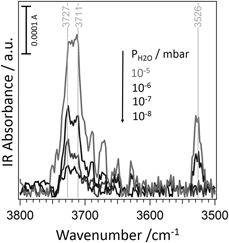
The configurations associated with the dissociative adsorption of water on a variety of low-coordinated sites of MgO(100) surfaces, including corners, steps, MgO vacancies, and kinks on 〈010〉 steps, have been studied and assigned by combining infrared spectroscopy and ab initio calculations. Three kinds of MgO powders were examined: powders of very high specific surface area prepared by chemical vapor synthesis and well-defined cubic smoke particles obtained by combustion in either 20:80 or 60:40 O2:Ar mixtures, the latter one involving less defects and smaller particles. It appears that an imperative requirement to obtain a precise characterization of the reactive behavior of defects is to keep the samples in ultra–high vacuum conditions and to control the water partial pressure finely.
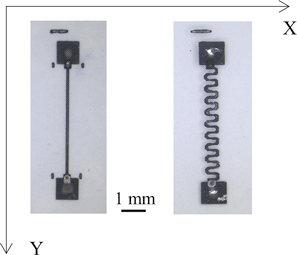
Inkjet printing is a promising technology providing cost-effective method for processing various materials on deformable substrates. In this work, linear and serpentine inkjet printed interconnects on two different substrates were fabricated and electromechanically characterized. A particular attention was given to the optimization of the process parameters; high quality can be achieved only printing slowly in vertical direction and optimizing the drop spacing to the specific pattern. The electromechanical results showed that the geometrical layout and printing direction strongly affect the printing quality and the electromechanical response; serpentine shapes should be preferred to straight interconnects as better gauge factors are obtained.
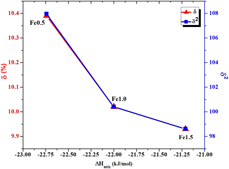
Three different high entropy-alloys consisting of six elements (Ti, Zr, V, Cr, Ni, and Fe) with varying Fe content were synthesized by using the RF induction melting technique. All the as-cast, slow-cooled, and rapidly quenched alloys exhibit C14 Laves phase, and it is found to be stable at high temperature. A lattice contraction has been observed with the addition of Fe. To the best of our knowledge, this is the first report on the synthesis of a single-phase high-entropy complex intermetallic compound in the hexanary alloy system. It has been shown that the thermodynamic calculations following Miedema’s approach and the parametric approach utilizing several descriptors comprising configurational entropy, mixing enthalpy, atomic size mismatch, electronegativity, and valence electron concentration favor the stability of the high-entropy multicomponent Laves phase.
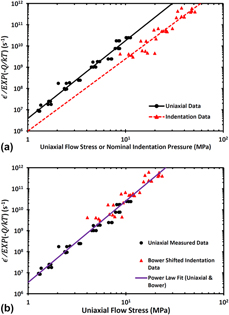
A high-temperature nanoindentation system was used to examine the steady state indentation creep behavior of CsHSO4. This high proton conductivity solid-acid material is a candidate for use as a solid-state electrolyte in intermediate temperature fuel cells. Constant strain rate indentation creep tests yielded a stress exponent and a creep activation energy in close agreement with results obtained from previous uniaxial compression testing. The large penetration depths reached during creep testing necessitated validating an indenter area function well beyond depths measurable in fused silica. The developed methodology is material agnostic meaning it can be used for indentation creep measurements in other high creep rate materials. In addition, it is shown how an analysis developed by Bower et al. (Proc. Royal Soc. 441, 97–124, 1993) can be successfully used to convert the indentation creep parameters into the more common material parameters measured in uniaxial creep tests.
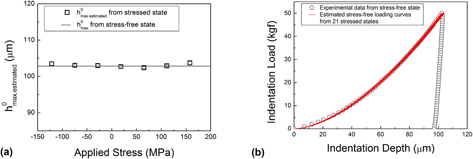
Residual stress is generally evaluated using indentation by comparing the indentation curves of stressed and stress-free states. Here, we suggest a new method that can evaluate surface residual stress without indentation testing on stress-free specimen using stress-independent indentation parameters and an analysis of indentation contact morphology for the stress-free state. We found that several indentation parameters are independent of the stress by Vickers indentation testing on various stress states. The indentation contact morphology can be represented by indentation parameters including stress-independent ones, and by applying the stress-independent parameters obtained from the stressed state to the indentation contact depth function, we can estimate an indentation curve for stress-free state. The estimated curve matches well with the experimental stress-free indentation curve, and it was also confirmed that the applied stress values evaluated by comparing the estimated curve with the stressed indentation curve agree well with the reference values obtained from strain gauge.
Environmental pollution and energy shortages seriously restrict the development of society. Photocatalytic oxidation technology can directly use solar energy to drive a series of chemical reactions. It has the advantages of low energy consumption, mild reaction conditions, and no secondary pollution, and is an effective method to solve organic pollutions in water. The key to achieve this process is to find and design efficient photocatalytic materials. In this paper, a novel silver-based metal–organic framework (Ag-MOF) [{Ag(H2btc)}{Ag2(Hbtc)}]n (1) (H3btc = 1,3,5-trimesic acid) is designed that exhibits a high performance in the photocatalytic degradation of methylene blue (MB). The process of photocatalytic degradation of MB conforms to pseudo first-order kinetics, and the rate is the fastest at pH 3 (K = 0.2654). Meanwhile, the photocatalytic mechanism of 1 is analyzed by in situ electron paramagnetic resonance (EPR) and ESI-MS spectra. The results are helpful for in situ research of the photocatalytic mechanism of MOFs.
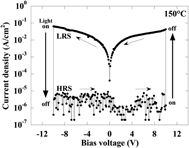
This work demonstrates the in situ growth of carbon nanowalls (CNWs) on diamond semiconductors by microwave plasma-assisted chemical vapor deposition. The resulting CNW/diamond junctions behave as photomemristors having both photocontrollable multiple resistance states and nonvolatile memory functions. The resistance state (high or low resistance) can be selected by irradiation with blue or violet light in conjunction with the application of a bias voltage, giving a large resistance switching ratio of ∼106. The photoinduced resistance switching behaviors are rarely observed and has only been observed in a few materials and/or heterostructures. These junctions also exhibit a photoresponsivity of ∼12 A/W, which is much larger than that obtained from photodiodes composed of other materials. These results suggest that CNW/diamond (i.e., carbon sp2/sp3) junctions could have applications in novel photocontrollable devices, which have photosensing, memory, and switching functions.
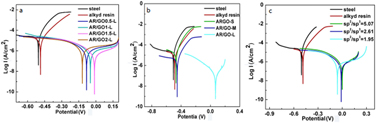
Graphene oxide (GO) is a promising material in improving the corrosion resistance properties of metals. This improvement significantly relies on the microstructure and electrical properties of GO, which nevertheless is rarely studied. Here, multiscale GOs with different flake sizes and oxidation degrees were fabricated and incorporated into waterborne alkyd resin (AR). The physical and chemical structures of GO and AR/GO composites were characterized in detail. Multiscale GOs are successfully prepared, and the corrosion resistance of AR/GO coatings is measured by electrochemical workstation. Electrochemical experiments indicate that GOs with larger flake sizes have excellent barrier properties due to the shielding effect; GOs with appropriate oxidation degrees could effectively improve the dispersion of GO and avoid the conductive path of GO in the matrix, because oxidation degree of GO could influence the dispersion and electrical properties. The corrosion protection efficiency of AR/GO(GO: 120 μm, 1.5 wt%, sp2/sp3 = 2.61) is 98.14%, which is 2.26 times higher than AR. The multiscale effects of GO on the corrosion resistance property of AR coatings are quite general, thus providing guidelines for developing highly efficient corrosion resistant coatings for practical usage.
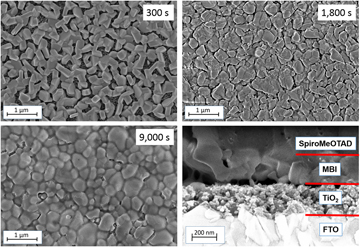
In the past years, numerous alternative cations to replace Pb2+ in perovskite solar cells have been investigated. In terms of toxicity and chemical stability, methylammonium bismuth iodide [(CH3NH3)3Bi2I9 or MBI] containing the Bi3+ cation has been considered as a promising material. However, fabrication of coherent MBI films remains challenging. Recently, significant progress has been achieved by using vapor deposition processes. Compared with solution-processed ones, vapor-deposited MBI solar cells show higher fill factors and efficiencies. In this work, chemical vapor deposition (CVD) of MBI is investigated. Employing nitrogen as carrier gas, the precursors bismuth iodide (BiI3) and methylammonium iodide (MAI) are deposited sequentially over several cycles and form MBI during the process. In order to form dense and coherent layers, the lengths of the deposition cycles as well as the substrate temperature have been optimized. Scanning electron microscopy reveals the strong influence of both parameters on growth and crystal properties. Optimized films of MBI integrated into solar cells show that CVD of MBI is a promising method for fabricating large-area solar cells.
Small luminescent Y2O3:Eu3+ particles were prepared by a hydrothermal method first, and then, Y2O3:Eu3+/C3N4 nanocomposites were further prepared by a chemisorption method. The luminescent Y2O3:Eu3+/C3N4 nanocomposites are not only a promising down-conversion luminescent material, but also it could be used to improve the efficiencies of dye-sensitized solar cells (DSSCs). Especially, the morphology of Y2O3:Eu3+ has great influence on the performance of DSSCs. Compared with Y2O3:Eu3+ nanorods, the introduction of small Y2O3:Eu3+ particles into the cells is conducive to the improvement of cell efficiency. The efficiencies of TiO2-Y2O3:Eu3+–C3N4 composite cells were not only higher than those of pure TiO2 cells but also higher than those of TiO2-Y2O3:Eu3+ or TiO2-C3N4 composite cells, resulting in the enhancement of the average efficiency of the TiO2-Y2O3:Eu3+–C3N4 composite cell from 7.16% to 8.14%, with 14% improvement over the pure TiO2 cell. The enhancement of the efficiency can be attributed to the synergetic effect of small Y2O3:Eu3+ particles and C3N4.
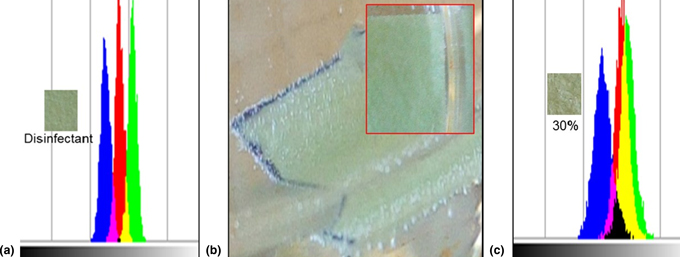
In this report, a facile system consisting of iron (III) meso-tetrakis(4-hydroxyphenyl)porphyrin-methylene blue dye hybrid immobilized on a disposable paper strip was used to detect and sense H2O2 in aqueous solutions via a low-cost pixelometric imaging technique. The new technology was employed to evaluate the level of H2O2 in a self-administering 30%-labeled commercial H2O2 disinfectant solution. The result showed that the concentration of H2O2 in the tested pharmaceutical sample solution deviated from the label by 92.37%. The current approach provides a simple low-cost resolution for the rapid detection and quantification of H2O2 in aqueous solution and pharmaceutical fluids.
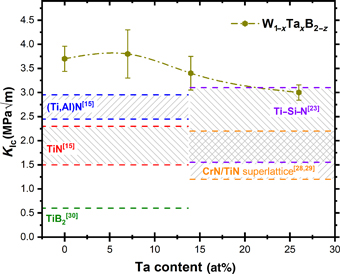
Based on density functional theory, we recently suggested that metastable α-WB2 is a promising candidate combining very high hardness with high toughness. These calculations further suggested that the addition of Tantalum supports the crystallization of α-structured W1−xTaxB2−z, with only minor reduction in toughness. Thus, various Ta containing WB2-based coatings have been synthesized using physical vapor deposition. With increasing Ta content, the hardness increases from ~41 GPa (WB2) to ~45 GPa (W0.74Ta0.26B2). In situ micromechanical cantilever bending tests exhibit fracture toughness KIC values of 3.7 to 3.0 MPa√m for increasing Ta content (single-phased up to 26 at.% Ta).
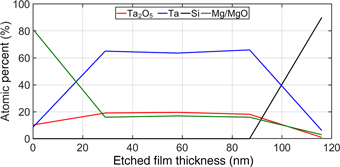
A specialized dealloying technique called thermal dealloying was developed over 10 years ago for certain biomedical materials. This method is not widely used for synthesizing nanoporous metals. However, it offers advantages over conventional dealloying processes for fabrication of nanoporous structures, and is highly suitable for refractory metals that may be susceptible to oxidation during chemical/electrochemical dealloying and liquid metal dealloying. In this study, nanoporous structures were successfully fabricated from magnesium-based precursor alloys via sublimation of magnesium at elevated temperature under vacuum conditions. Different refractory metal diffusion rates affect the resulting density and amount of retained magnesium in each nanoporous material.
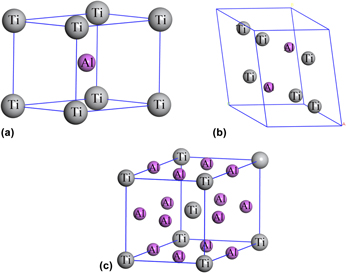
In this study, we investigated the elastic constants, moduli, hardness, and electronic structures of Ti–Al intermetallic compounds (TiAl, Ti3Al, and TiAl3) using first-principles calculations. The cohesive energy and formation enthalpy of these compounds are negative, which indicates that they are thermodynamically stable. We calculated the elastic constants and moduli using the stress–strain method and Voigt–Reuss–Hill approximation, respectively. We evaluated the mechanical anisotropy of these compounds using the anisotropic index and found that the results are in good agreement with other experimental and theoretical data. We evaluated the chemical bonding of these compounds by calculating their density of states, the results of which revealed that the bonding behavior of all Ti–Al intermetallic compounds involved a mixture of metallic and covalent bonds. We also estimated the Debye temperature and sound velocities of these Ti–Al intermetallic compounds.
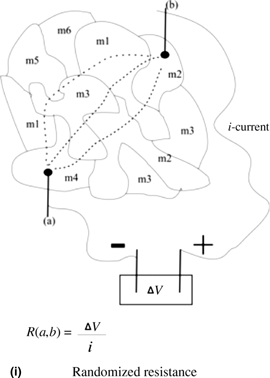
We propose a device to secure random data in analog format, so that it is taken off the digital grid. Such action will turn off the means by which remote hackers violate security. A physical “rock” manufactured through 3D printing technology, constructed on the basis of high-grade randomness, which is packed into the comprising materials of that rock. The rock functions as an oracle, and does not allow any massive copy of its content. Thus, a major claim of this Prospective is that materials science and engineering may hold the keys to the future of cryptography.
Based on an established course and covering the fundamentals, central areas and contemporary topics of this diverse field, Fundamentals of Condensed Matter Physics is a much-needed textbook for graduate students. The book begins with an introduction to the modern conceptual models of a solid from the points of view of interacting atoms and elementary excitations. It then provides students with a thorough grounding in electronic structure and many-body interactions as a starting point to understand many properties of condensed matter systems - electronic, structural, vibrational, thermal, optical, transport, magnetic and superconducting - and methods to calculate them. Taking readers through the concepts and techniques, the text gives both theoretically and experimentally inclined students the knowledge needed for research and teaching careers in this field. It features 246 illustrations, 9 tables and 100 homework problems, as well as numerous worked examples, for students to test their understanding. Solutions to the problems for instructors are available at www.cambridge.org/cohenlouie.
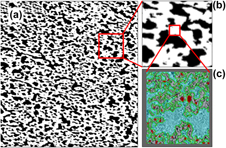
Transport properties, performance, and durability of a proton exchange fuel cell (PEMFC) highly depend on microstructure and spatial distribution of components in the gas diffusion layer (GDL), microporous layer (MPL), and catalyst layers (CLs) of the fuel cell. Modeling of transport properties and understanding of these effects are challenging due to limited understanding of actual three-dimensional (3D) structure of the components, especially over a wide range of length scales. In this work, 3D imaging on multiple scales, namely electron tomography on a nanoscale, focused ion beam–scanning electron microscopy on a microscale, and 3D X-ray microscopy on a macroscale, was applied to obtain 3D reconstructions of the actual CL, MPL, and GDL microstructure. Direct numerical simulations on 3D data sets with an upscaling approach were applied to demonstrate the capability to simulate overall electrical conductivity of the system. Details of the process, challenges, and results are described.
Nature’s optical nanomaterials are poised to form the platform for future optical devices with unprecedented functionality. The brilliant colors of many animals arise from the physical interaction of light with nanostructured, multifunctional materials. While their length scale is typically in the 100-nm range, the morphology of these structures can vary strongly. These biological nanostructures are obtained in a controlled manner, using biomaterials under ambient conditions. The formation processes nature employs use elements of both equilibrium self-assembly and far-from-equilibrium and growth processes. This renders not only the colors themselves, but also the formation processes technologically and ecologically highly relevant. Yet, for many biological nanostructured materials, little is known about the formation mechanisms—partially due to a lack of in vivo imaging methods. Here, we present the toolbox of natural multifunctional nanostructures and the current knowledge about the understanding of their far-from-equilibrium assembly processes.