To save content items to your account,
please confirm that you agree to abide by our usage policies.
If this is the first time you use this feature, you will be asked to authorise Cambridge Core to connect with your account.
Find out more about saving content to .
To save content items to your Kindle, first ensure no-reply@cambridge.org
is added to your Approved Personal Document E-mail List under your Personal Document Settings
on the Manage Your Content and Devices page of your Amazon account. Then enter the ‘name’ part
of your Kindle email address below.
Find out more about saving to your Kindle.
Note you can select to save to either the @free.kindle.com or @kindle.com variations.
‘@free.kindle.com’ emails are free but can only be saved to your device when it is connected to wi-fi.
‘@kindle.com’ emails can be delivered even when you are not connected to wi-fi, but note that service fees apply.
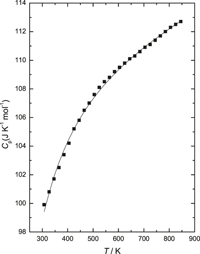
Standard molar heat capacity, $C_{{\rm{p,m}}}^{\rm{o}}\left( T \right)$, of YbRhO3(s) was determined using a heat flux type differential scanning calorimeter from 126 to 846 K. The heat capacities in the temperature range 307 ≤ T (K) ≤ 846 were fitted into a polynomial expression and can be represented by $C_{{\rm{p,m}}}^{\rm{o}}$ (YbRhO3, s, T) [J/(K mol)] = 106.82 + 8.57 × 10⁻³T (K) − 9.48 × 10⁵/T2(K). The standard molar heat capacity of YbRhO3(s), $C_{{\rm{p,m}}}^{\rm{o}}$, at 298.15 K is 98.7 J/(K mol). The standard molar Gibbs energy of formation of YbRhO3(s) was also determined using calcia stabilized zirconia as an oxide electrolyte and air as the reference electrode by the solid state electrochemical technique. The cell can be represented by (−)Pt–Rh/{Yb2O3(s) + YbRhO3(s) + Rh(s)}//CSZ//O2(p(O2) = 21.21 kPa)/Pt–Rh(+). The electromotive force was measured in the temperature range from 889 to 1110 K. The standard Gibbs energy of formation of YbRhO3(s) from elements in their standard state can be represented by ΔfGo{YbRhO3(s)}/kJ/mol(±1.62) = −1110.9 + 0.287 T (K). The heat capacity of YbRhO3(s) was used along with the data obtained from the electrochemical cell to evaluate all thermodynamic functions of YbRhO3(s).
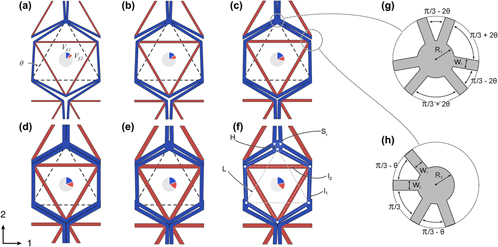
Low coefficient of thermal expansion (CTE) lattices occupy a unique area of property space. With such a system, it is possible to achieve relatively high stiffness, with opportunities to combine low thermal expansion and with a range of advantageous properties. Possibilities include combinations that are not rivaled by any bulk material, e.g., low CTE and high melting temperature, and low CTE with low conductivity. One design in particular, the UCSB Lattice, has biaxial stiffness very near theoretical upper bounds when the joints are pinned. Bonded lattices are found to inherit the near optimal performance of the parent pin-jointed design. Despite near optimal performance, however, stiffnesses and strengths are limited to a few percent of the relative property of the constituents. The local deformations necessary to accommodate low net CTE are similar to those of auxetic lattices, with similar behavior, having a low, zero, or negative tunable Poisson’s ratio. An investigative framework, including experiments, finite element, and analytical formulas, is used to construct these assessments.
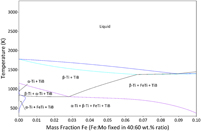
The design and the processing of a new class of titanium boride (TiB)-based bulk cermets containing a metallic phase (β-Ti phase) for toughening is presented. The general approach is rapid reaction and densification, using starting powders of Ti, TiB2, Fe, and Mo, by electric-field-activated sintering. The cermets consist of two-phase microstructures in which the boride phase formed as a networked structure of TiB whiskers that were created in situ upon the reaction between the powders. Hardness, flexural strength, and fracture toughness measurements of these materials revealed that they possess an interesting set of properties up to: hardness values of 1090 kg/mm2, flexural strength values of 953 MPa, and fracture toughness values of 18 MPa m1/2. A remarkable finding is that although the metallic phase fractured by microscopic cleavage, the cermets showed good fracture toughness values. The present study not only illustrates the process details and microstructure leading to these properties but also provides a broad powder metallurgical approach to design and synthesize cermets that may yield further improved properties.
The pharmacy (spezieria) Santa Maria della Scala was founded in Rome by the Discalced Carmelites Order in the 17th century, and during the 18th and 19th centuries it became the official supplier of medicines for Vatican Popes. The laboratory and the cases of this spezieria still preserve glass jars with organic and inorganic materials, which were presumably used for medicine and artistic material preparation, whose composition is unknown to date. A research project was initiated with the aim to study the stored materials and the role that the pharmacy played in regional, national and international contexts. In this manuscript, the compounds were analysed through X-ray powder diffraction with the scope to derive the quantitative mineralogical composition of the inorganic fraction, their possible use in pharmacopoeias and as mineral pigments. Most of the analysed samples are salts (sulphates, chlorides, carbonates, phosphates, borates, sulphides), sulphates being the predominant class; oxides were also detected.
Predictions of the mechanical response of polycrystalline metals and underlying microstructure evolution and deformation mechanisms are critically important for the manufacturing and design of metallic components, especially those made of new advanced metals that aim to outperform those in use today. In this review article, recent advancements in modeling deformation processing-microstructure evolution and in microstructure–property relationships of polycrystalline metals are covered. While some notable examples will use standard crystal plasticity models, such as self-consistent and Taylor-type models, the emphasis is placed on more advanced full-field models such as crystal plasticity finite elements and Green’s function-based models. These models allow for nonhomogeneity in the mechanical fields leading to greater insight and predictive capability at the mesoscale. Despite the strides made, it still remains a mesoscale modeling challenge to incorporate in the same model the role of influential microstructural features and the dynamics of underlying mechanisms. The article ends with recommendations for improvements in computational speed.
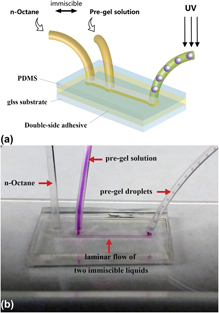
Conventional pNIPAAm microgel synthesis utilizes surfactants to suspend pre-gel droplets in the immiscible continuous phase due to the slow polymerization required for synthesizing pNIPAAm in aqueous solvent. To improve the fabrication process and to eliminate the effects of surfactant on microgel quality, a surfactant-free and water-free method was developed. Rapid polymerization of high-quality microgels was achieved in a single-channel microfluidic device to help maintain the integrity of gel particles without the addition of surfactants. The droplet generation mechanism and the effect of flow rate of the two in-going immiscible fluid on the geometry of the produced microgels were studied. The produced microgels have low polydispersity with a dispersity index of 6.4%. The pNIPAAm hydrogels fabricated in the DMSO solvent has smaller pore size and more uniform microstructure compared to that synthesized in water. The fabricated pNIPAAm microgels show a sharp volume phase transition at ∼32 °C and high deswelling/swelling rate.
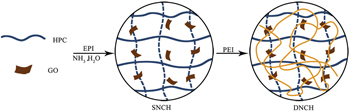
Composite hydrogels based on hydroxypropyl cellulose (HPC) and graphene oxide (GO) were developed and used for adsorption of phenol. The single network composite hydrogel (SNCH) was first prepared by crosslinking of HPC and GO by epichlorohydrin; then the SNCH was treated with polyethyleneimine solution, forming the double network composite hydrogel (DNCH). The DNCH exhibited better adsorption capacity than the SNCH due to larger surface area and more functional groups. The possible adsorption mechanism of the composite hydrogels toward phenol involved electrostatic, hydrogen bonding, and π–π interactions. Study on dynamic adsorption behavior of phenol by SNCH and DNCH indicated that the breakthrough time increased when the initial concentration and feed flow rate of phenol decreased. Furthermore, the breakthrough time of DNCH was longer than that of SNCH at all operating conditions due to the relatively higher adsorption capacity of DNCH. The SNCH and DNCH could be repeatedly used without significant loss in the initial binding affinity after six adsorption–desorption cycles, which indicated that the composite hydrogels were qualified for practical application.
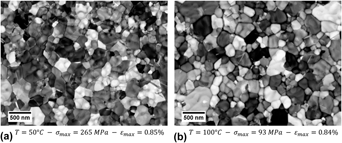
The creep behavior of 200-nm thick gold films was investigated by plane-strain bulge testing between 23 and 100 °C. The polycrystalline gold films were produced by thermal evaporation and their columnar microstructure was stabilized by a preliminary heat treatment at 120 °C. The creep tests were performed at constant stress values between 80 and 300 MPa over 12 h, using a custom-built bulge tester. The stress exponent calculated from the creep data decreased from 4.3 to 2.8 between 23 and 100 °C, suggesting a possible transition in deformation mechanisms. The stress exponent and activation energy measured around room temperature point toward the climb of dislocations at grain boundaries being the rate-limiting deformation mechanism. Above 75 °C, scanning electron microscope inspections of tested membranes suggest an increased contribution of diffusion and of grain-boundary mediated deformation, as evidenced by the formation of grooves along grain boundaries. This is presumably the reason for the decrease of the apparent stress exponent and sudden increase of the apparent activation energy.
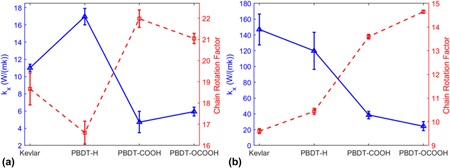
Kevlar (polyparaphenylene terephthalamide) and PBDT (poly(2,2′-disulfonyl-4,4′-benzidine terephthalamide))-derivatives have very similar chemical structures with aromatic rings. In this study, thermal conductivities of their single chains were calculated using molecular dynamics simulations. Chain rotation was found to be the key to reducing the thermal conductivity. By introducing a new chain rotation factor (CRF), we can easily quantify chain rotation level of single-chain polymers. We demonstrated that thermal conductivity decreases as the CRF increases. We performed further calculations on phonon properties and unveiled that the small thermal conductivity led by large chain rotation can be attributed to reduced phonon group velocities and shortened phonon mean free paths. Insights obtained in this study can be used for tuning thermal conductivity of various polymers and facilitating their various applications including thermal energy conversion and management.
X-ray powder diffraction data for (S)-methyl-2-hexanamido-3-(4-hydroxyphenyl)propanoate, C16H23NO4, are reported [a = 17.795(4) Å, b = 15.101(1) Å, c = 12.746(3) Å, unit-cell volume V = 3425.51 Å3, Z = 8, and space group P212121]. All measured lines were indexed and are consistent with the P212121 space group. No detectable impurities were observed. The single crystallographic data of the compound are also reported [a = 12.5998(3) Å, b = 17.6856(5) Å, c = 14.6711(5) Å, unit-cell volume V = 3269.25(16) Å3, Z = 8, and space group P212121]. Because of the single-crystal diffraction data were measured at low temperature (110 K), the cell parameters, volume, and calculated density of single-crystal experiment have slight differences with powder diffraction results.
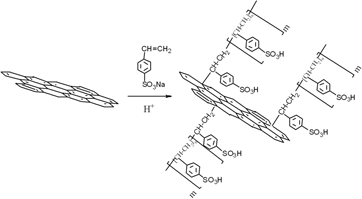
Here we report a facile and mild synthesis of the sulfonated graphene (PSS-RGO) catalysts by in situ polymerization of sodium p-styrenesulfonate. Graphene sheets can be used as the flat backbones to graft abundant sulfonate groups on both sides. The PSS-RGO catalysts were characterized by 1H Nuclear Magnetic Resonance (1H NMR), energy dispersive spectrometer, Raman spectroscopy, X-ray photoelectron spectroscopy, and so on. The catalytic properties of the PSS-RGO catalysts for the hydrolysis of ethyl acetate and the esterification of acetic acid with ethanol were evaluated, showing that the as-made PSS-RGO catalysts were active for both probe reactions. The possible deactivation mechanism involved in the surface catalysis of the graphene-based acid catalysts has been addressed.
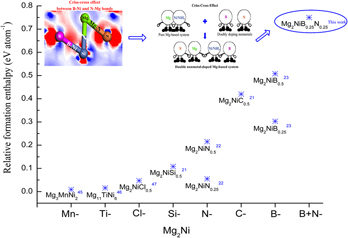
The strong interactions between Mg and Ni/NiH4 are attributed to harsh operating conditions and difficulties for H2 release, restricting the practical applications of the Mg-based hydrides. In this study, a new method of interstitial nonmetals co-doping was proposed to reduce the strong interactions. The calculation results showed that the method of interstitial nonmetals co-doping causes a more significant reduction in the thermal stability of Mg-based hydrides, as compared with the methods of either single transition metal or nonmetal doping. To determine the influence mechanism, a theoretical study was conducted based on the first-principles calculations. The computations demonstrated that the criss-cross action between B–Ni and N–Mg bonds weakens the bonding effects between Mg and Ni/NiH4. Besides, the mutual interactions between nonmetals and H atoms could weaken Ni–H bonding effects and stimulate the breaking of stable NiH4 clusters, thereby facilitating the release of H2 from the hydride.
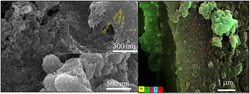
Highly porous alumina-based oxides, γ-Al2O3, SiO2–Al2O3, and TiO2–Al2O3 were synthesized by a modified sol–gel method. Polivinylpyrrolidone was used as the pore expanding agent, whereas cetyltrimethylammonium bromide was used as the template in the presence of alkoxide inorganic precursors. Both as-synthesized and calcined solids were used as catalysts for esterification of glycerol with acetic acid (EG). The XRD and SEM-EDS measurements demonstrated that the Si-containing solids are amorphous while those containing Ti are semicrystalline with the latter composed of TiO2 rutile, TiO2 anatase, and γ-Al2O3 phases. All solids possessed ordered porous structures comprising of micro- and mesoporosity, with interconnectivity between these pores of different length scales. The high acidity of γ-Al2O3 and TiO2–Al2O3 materials resulted in good catalytic performances in the EG. Porosity of the solids plays a secondary role in determining the catalytic activity. Under the same conditions, the as-synthesized solids exhibited slightly lower catalytic performances compared to that of the calcined ones.
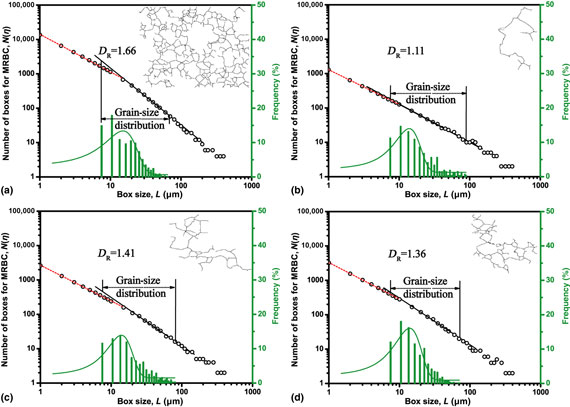
We investigated the connectivity of high-energy random grain boundaries through fractal analyses of specimens with different grain boundary (GB) microstructures in BFe10-1-1 copper–nickel alloy. It was found that the profile of maximum random boundary network possesses a fractal nature and more than one fractal dimension can exist. The fraction of special boundaries and grain size homogeneity can play an important role on GB character distribution. Here, GB microstructures are combined with quantitative materials structure–property relationship models to predict intergranular corrosion properties. The experimental results are accurately consistent with the theoretical predictions.
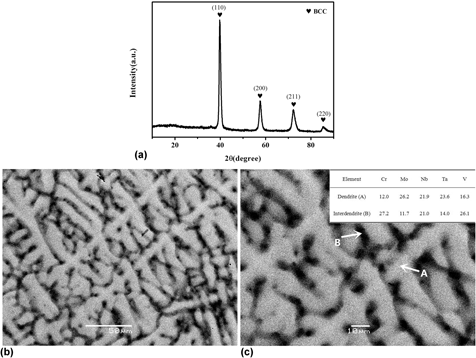
The microstructure and oxidation behavior at high temperatures ranging from 900 °C to 1100 °C of equiatomic CrMoNbTaV high-entropy alloy produced by vacuum arc melting were investigated. The phase component, microstructure, and microhardness of the alloy were examined by using X-ray diffraction, scanning electron microscopy equipped with an energy-dispersive X-ray spectroscope, and Vickers hardness tests, respectively. The as-cast alloy consists of a single body-centered cubic (BCC) refractory metal solid solution due to the high mixing entropy effect and exhibits a dendritic microstructure. The alloy has a very high microhardness value of 923 HV due to the strong solid solution strengthening effect. The average microhardness in interdendrites (950 HV) was higher than that in dendrites (896 HV) because of composition segregation. The oxidation kinetic curves of the alloy after exposure to air at 900 and 1000 °C follow the pseudo-parabolic rate law, while the mass gain increases first and then decreases at 1100 °C. The thickness of the oxide layer increases with the increasing of oxidation time. The long rod-shaped oxidation products are composed of Nb2O5, NbO2, CrTaO4, CrNbO4, Ta9VO25, Nb9VO25, and TaO after oxidation at 900 and 1000 °C for 25 h. The oxides of CrTaO4 and CrNbO4 disappear as the oxidation temperature elevated to 1100 °C.
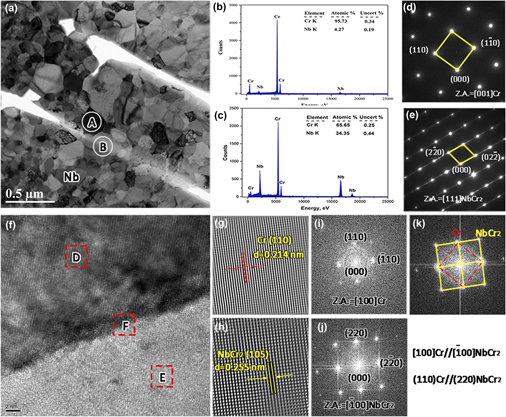
A bulk NbCr2 Laves phase matrix composite toughened with ductile Cr phase has been fabricated by spark plasma sintering (SPS) using pre-alloyed NbCr2 and Cr powders. The sintering behaviour and phase morphological evolution of the sintered alloy were investigated. The results show that a series of microstructure evolutions along the sintering temperature occurred: elongated Cr phase with uniform dispersion of fine NbCr2 and Cr phase → coarse Cr phase with matured fine NbCr2 and Cr → coarse Cr and Nb phases with lamellar eutectics. The microstructural evolution and phase transformation along the sintering temperature are analyzed by considering the inhomogenous temperature distribution and the accelerated atomic diffusion due to the pulsed electric current applied during SPS. The room temperature fracture toughness of the sintered samples is expected to be markedly improved due to the absence of lamellar or the occurrence of ductile Cr and Nb phases.
A series of double-perovskite oxides, Sr2RNbO6 (R = Sm, Gd, Dy, Ho, Y, Tm, and Lu) were prepared and their crystal structure and powder diffraction reference patterns were determined using the Rietveld analysis technique. The crystal structure of each of the Sr2RNbO6 phase is reported in this paper. The R = Gd, Ho, and Lu samples were studied using synchrotron radiation, while R = Sm, Dy, Y, and Tm samples were studied using laboratory X-ray diffraction. Members of Sr2RNbO6 are monoclinic with a space group of P21/n and are isostructural with each other. Following the trend of “lanthanide contraction”, from R = Sm to Lu, the lattice parameters “a” of these compounds decreases from 5.84672(10) to 5.78100(3) Å, b from 5.93192(13) to 5.80977(3) Å, c from 8.3142(2) to 8.18957(5) Å, and V decreases from 288.355(11) to 275.057(2) Å3. In this double-perovskite series, the R3+ and Nb5+ ions are structurally ordered. The average Nb–O bond length is nearly constant, while the average R–O bond length decreases with the decreasing ionic radius of R3+. Powder diffraction patterns for these compounds have been submitted to the Powder Diffraction File (PDF).
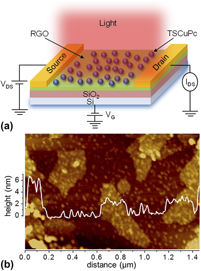
Reduced graphene oxide (RGO) and its composites have a great potential for their applications in optoelectronic devices. In particular, small molecules can be used for tailoring optoelectronic properties of RGO. Here, we report the fabrication of a hybrid RGO/tetrasulfonate salt of the copper phthalocyanine (RGO/TSCuPc) nanocomposite phototransistor. The device shows p-type transistor behavior in the dark which changes to ambipolar behavior at the lower light intensity, and then shows a complete n-type property at the higher light intensity. The photoresponsivity of the device can be tuned by gate voltages, and the best photoresponsivity is recorded to be as high as ∼4.6 A/W for positive gate voltage and ∼6.3 A/W with a negative sign for negative gate voltage under solar light irradiation. The observations suggest that the photogenerated free electrons of TSCuPc molecules can be injected efficiently onto RGO sheets, resulting in increases in electron conduction and hole quenching.