To save content items to your account,
please confirm that you agree to abide by our usage policies.
If this is the first time you use this feature, you will be asked to authorise Cambridge Core to connect with your account.
Find out more about saving content to .
To save content items to your Kindle, first ensure no-reply@cambridge.org
is added to your Approved Personal Document E-mail List under your Personal Document Settings
on the Manage Your Content and Devices page of your Amazon account. Then enter the ‘name’ part
of your Kindle email address below.
Find out more about saving to your Kindle.
Note you can select to save to either the @free.kindle.com or @kindle.com variations.
‘@free.kindle.com’ emails are free but can only be saved to your device when it is connected to wi-fi.
‘@kindle.com’ emails can be delivered even when you are not connected to wi-fi, but note that service fees apply.
The characterization of nanostructured samples with at least one restricted dimension like thin films or nanowires is challenging but important to understand their structure and transport mechanism and to improve current industrial products and production processes. We report on the development of a chip-based platform to simultaneously measure the in-plane electrical and thermal conductivity, the Seebeck coefficient as well as the Hall constant of a thin film in the temperature range from 120 K up to 450 K and in a magnetic field of up to 1 T. Due to the design of the setup, time consuming preparation steps can be omitted and a nearly simultaneous measurement of the sample properties is achieved. Typical errors caused by different sample compositions, varying sample geometries, and different heat profiles are avoided with the presented measurement method. As a showcase study displaying the validity and accuracy of our system, we present measurements of the thermoelectric properties of a 110 nm Bi87Sb13 thin film in the temperature range from 120 K up to 450 K.
A semitransparent CuO film was applied for photoelectrochemical (PEC) cell to produce the record-high photocurrent (6.4 mA/cm2) for nanocrystalline monoclinic CuO photocathode. Large-scale affordable reactive-sputtering method was effectively formed Cu oxide films and sequential thermal processes efficiently controlled the Cu oxide phases with enhanced optical-transparency of Cu oxide films. Structural, physical, optical, and electrical properties of various Cu oxide films (CuO, Cu4O3, and Cu2O) were systematically investigated according to the sputtering condition and thermal processes. It was found that the energy band gap of CuO can be tuned from 1.7 to 1.9 eV by modulating the oxygen flow for reactive sputtering. Mott–Schottky analyses revealed the flat band potential close to the 0.96 V versus reversible hydrogen electrode and energy band edges of Cu oxide films. This state-of-the-art CuO photocathode would provide a strong potential for wide applications of the transparent PEC system of on-site energy generation.
Hot indirect extrusion behaviors of fully dense 3 mol% Y2O3-stabilized ZrO2 polycrystals with a grain size of 80 nm were investigated by using a conical graphite die. During early extrusion at 1843 K and a constant compression stress of 60–80 MPa, the relative moving billet velocity (v0) shows a sharp maximum, followed by a continuous decrease until it reaches a steady-state v0 value. Visual observations of the material flow by using graphite foil markers indicate that the deformation zone at the steady-state v0 is well represented by a spherical velocity field. The decrease in v0 corresponds to the transition from heterogeneous to homogeneous deformation. The stress exponent (n) of 2.07 was obtained from the log–log plots of the steady-state v0 versus the external applied stress that is compensated by threshold and sliding friction stresses. This n value suggests plastic deformation through grain-boundary sliding in indirect extrusion.
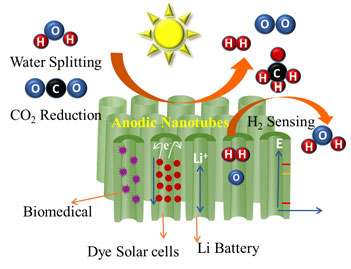
Among various material nanoarchitectures, the nanotube geometry has received incredible attention due to the unique properties provided by its high surface area as well as nanoscale wall thickness and the availability of a variety of techniques to fabricate them. Since the beginning of this century, anodization has emerged as one of the most effective techniques for the fabrication of functional oxide nanotubes. Oxide nanotubes of a number of metals and alloys have been developed using this versatile technique. We review here the research activities on anodic nanotubes of various binary, ternary, and multinary materials and their selected applications.
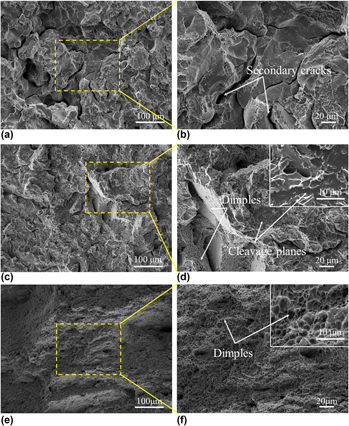
Dissimilar joints of advanced 9Cr/CrMoV have been successfully welded by narrow gap submerged arc welding using multi-layer and multi-pass techniques. The objective of our study is to establish the correlation between impact toughness and microstructural characteristics of the welded joints. Impact toughness tests were conducted in a wide range of temperature from −60 °C to 80 °C for different regions in the dissimilar joints. The fracture appearance transition temperature of base metal of 9Cr, CrMoV and weld metal were tested as 23 °C, −9 °C and −2 °C respectively, which all satisfied the service requirement. Optical microscope and scanning electron microscope revealed that weld metal and base metal of CrMoV comprised martensite and bainite while 9Cr was composed of lath martensite. The low toughness in the latter region arose from large grains with excessive carbide precipitates. Nonuniform microstructure in the heat-affected zone of 9Cr side caused different crack propagation paths and subsequently led to large variations of absorbed energy. When crack propagates along carbon-enriched zone in heat affected zone, the absorbed energy was 48 J. With crack deviating far from carbon-enriched zone, the absorbed energy increased to 147 J. Examination on fracture surfaces revealed the typical brittle fracture appearance in 9Cr and inter-granular fracture mode in heat-affected zone of 9Cr side when crack propagated along carbon-enriched zone.
The effects of boron and zirconium contents from 0 to 0.049 wt% on the casting fluidity, as-cast microstructure and mechanical properties of IN718C superalloy are systematically investigated. The results show that as the B or Zr content increases, the fluidity firstly increases and then decreases. The optimum fluidity is obtained at the pouring temperature of 1470 °C when the content of B is 0.0059 wt% or Zr is 0.042 wt%, respectively. The addition of Zr can lead to the formation of blocky laves phase, but B has no influence on microstructure morphology. Furthermore, the addition of B or Zr can effectively improve the tensile and stress life properties as well as casting fluidity of IN718C superalloy. As compared with IN718C master alloys, the tensile strength can increase 6.2–8.6% and stress life can be improved by 1.3 times when B content is 0.0059 wt%. In addition, when the alloy contains 0.042 wt% Zr, the tensile strength can increase 5.6–7% and stress life can increase 1.076 times than that of the master alloy.
Due to gravitational self-compression, the pressure in planetary interiors can reach millions of times the atmospheric pressure. Such high pressure has a significant influence on their rheology. In the present paper, we focus on how pressure in the range of the Earth's lower mantle may influence the structure of a MgO {310}/[001] tilt boundary. The defected structure of the grain boundary (GB) will be described through its dislocation, disclination, and generalized-disclination (g-disclination) density fields. At first, the strain and rotation fields in the boundary area at different pressures are derived from the discrete atomic positions simulated by first-principles calculations. For each pressure, the discontinuities of displacement, rotation, and strain in the boundary area are continuously rendered by dislocation, disclination, and g-disclination density fields, respectively. These density fields measured at different pressures are compared to provide understanding on how pressure does influence the GB structures in Earth materials.
This fully revised, updated and reorganised third edition provides a thorough introduction to the characterisation techniques used in surface science and nanoscience today. Each chapter brings together and compares the different techniques used to address a particular research question, including how to determine the surface composition, surface structure, surface electronic structure, surface microstructure at different length scales (down to sub-molecular), and the molecular character of adsorbates and their adsorption or reaction properties. Readers will easily understand the relative strengths and limitations of the techniques available to them and, ultimately, will be able to select the most suitable techniques for their own particular research purposes. This is an essential resource for researchers and practitioners performing materials analysis, and for senior undergraduate students looking to gain a clear understanding of the underlying principles and applications of the different characterisation techniques used in the field today.
From authors renowned in the fields of engineering and biology, this is the first book to integrate sensor and actuator technology with bioinspired design. Beginning with detailed descriptions of actuation and sensing mechanisms in plants and animals, the authors move on to apply these principles to synthetic design, offering in-depth knowledge of the development of state-of-the-art smart materials and devices. All of this is supported with a range of real-world applications, from tactile sensory systems in insects linked with the development of robotic hands, to the structural colour systems in nature used to inspire camouflage technology. Further examples are given of successful designs along with their integrated autonomous systems, such as flying and swimming, unmanned systems, and autonomous zero-energy building design. With a wide interdisciplinary appeal, this is an ideal resource for any student, practising engineer, or researcher interested in the connection between natural systems and synthetic design.
The oxidation behavior of bulk ZrSi2 at 700, 1000, and 1200 °C in ambient air has been investigated. Parabolic to cubic oxide layer growth kinetics was confirmed by weight gain measurements and the average oxide layer thickness was 470 nm, 6.7 µm, and 37 µm at 700 °C, 1000 °C, and 1200 °C, respectively, after 5 h oxidation tests. Evolution of compositionally modulated nano/micro structures was confirmed in the oxide layer. At 700 °C, Si diffusion resulted in discontinuous Si-rich oxide phases in amorphous Zr–Si–O matrix. At 1000 °C, complex multilayered structures such as fine and coarse irregular spinodal structures, wavy Si-rich oxide, and Si-rich islands evolved. At 1200 °C, additional nucleation of nanoscale ZrO2 particulate phase was observed. The spinodal structures were confirmed to be crystalline ZrO2 and amorphous SiO2, and the thermodynamic driving force for phase evolution has been explained by extension of liquid miscibility gap in the binary ZrO2–SiO2 phase diagram.
A self-made die with large cross section (180.2 × 22.2 mm) for equal channel angular pressing (ECAP) was used to study the influence of two different pressing routes (CX and CY) on refining homogeneity of high-purity aluminum plates. Microstructures were investigated by optical microscopy (OM) and electron back scatter diffraction (EBSD) methods, and micro-hardness and tensile tests were taken to evaluate deformation degree across the cross section and mechanical properties, respectively. The results indicate that pressing routes of ECAP have a great influence on structure homogeneity of plate samples. The route CY leads to fine grains with better homogeneity because the same deformation direction is taken through each pass. Coarse columnar crystals with 3–4 mm change to 68.6 μm nearly equiaxed grains and a strong cube texture forms after four CY passes, and corresponding mechanical properties increase by a factor compared to as-cast plate.
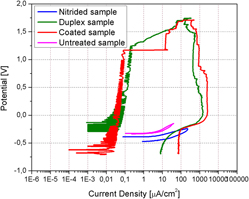
Surface modification treatments, such as the plasma nitriding improve the tribological properties of AISI 420 stainless steel; however, the corrosion resistance is deteriorated. The DLC (Diamond-Like Carbon) coatings were not only having a low friction coefficient but also good wear and corrosion resistance. In this work, both the corrosion behavior and the adhesion of the DLC hard coating, deposited on nitrided and non-nitrided AISI 420 stainless steel substrates, were studied. The coatings were characterized by means of EDS and Raman. In addition, nitrided layer microstructure and the coatings were analyzed by SEM-FIB and XRD. Corrosion behavior was evaluated by the salt spray fog test and cyclic potentiodynamic polarization tests in NaCl solution. The adhesion was assessed using Rockwell indentation and scratch tests. The a-C:H film and nitrided layer thicknesses were about 2.5 μm and 11 μm respectively. The nitrided layer improved adhesion in both tests. The coated AISI 420 stainless steel proved to have excellent atmospheric corrosion resistance and a passive behavior over 1 V (versus SCE) in the electrochemical tests. The adhesion and the corrosion performance were improved when the coating was deposited after the plasma nitriding treatment.
Ni-based composites with in situ formed Al2O3 and TiC ceramic phases were fabricated by hot pressing technology and that with directly added Al2O3 and TiC particles (ex situ) were also fabricated for comparison. The antioxygenic property and tribological properties of the composites were comparatively studied. The results show that the high-temperature oxidation resistance of the composite with in situ formed Al2O3 and TiC ceramic is superior to that of ex situ composite, and the friction coefficient of in situ composite is lower than that of ex situ composite in the wide temperature range from 400 °C to 1000 °C. The lowest friction coefficient was about 0.19 at 1000 °C and the wear rate of the composites are in the order of magnitude of 10−6 mm3/(N m) at high temperatures. The differences in tribological properties of in situ/ex situ composites are attributed to the formation of the glaze layer composed of MoO3, TiO2, Al2TiO5, NiAl2O4, and NiO on the worn surfaces and the difference of the distribution of the ceramics in the matrix.
Different volume fractions (0.5–4.5 vol%) of carbon nanotubes (CNTs) were used to reinforce a binary Fe50Co soft magnetic alloy. The first method for dispersion involved dry mixing and ball milling of the powder, while the second included wet mixing in dimethylformamide under ultrasonic agitation, drying and then dry ball milling. The powders were consolidated using spark plasma sintering. Tensile test and SEM analyses were performed to characterize the mechanical properties and the fracture surface of the sintered materials. The best magnetic and mechanical properties were achieved using the first method. A maximum enhancement in tensile strength of around 20% was observed in the 0.5 vol% CNT composite with improved elongation compared to the monolithic Fe50Co alloy. In addition, the magnetic properties were enhanced by adding CNTs up to 1 vol%, and an improvement in densification was observed in composites up to 1.5 vol% CNT with respect to monolithic Fe50Co alloy.
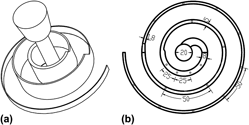
The high-frequency vibration technology was introduced to relieve the quenched residual stress in the Cr12MoV steel based on the high-frequency vibration system that mainly consisted of an electromagnetic vibrator and an amplitude boost unit. The high-frequency vibratory stress relief (VSR) experiments were conducted to study the effectiveness of the high-frequency vibration technology. In addition, the high-frequency vibration plasticity model was developed based on the thermal activation theory to reveal the mechanism of the high-frequency VSR. The results show that the high-frequency VSR has good effects on eliminating residual stress, while the surface hardness for the Cr12MoV steel remains almost the same. Moreover, there are no changes in the grain size of the Cr12MoV steel during the high-frequency VSR, while the dislocation density for the Cr12MoV steel during the high-frequency VSR decreases by 27.21%. The decrease of dislocation density in the Cr12MoV steel is the essence of residual stress relaxation. The findings confirm the significant effects of high-frequency vibration on metal plasticity and provide a basis to understand the underlying mechanism of the high-frequency VSR.