To save content items to your account,
please confirm that you agree to abide by our usage policies.
If this is the first time you use this feature, you will be asked to authorise Cambridge Core to connect with your account.
Find out more about saving content to .
To save content items to your Kindle, first ensure no-reply@cambridge.org
is added to your Approved Personal Document E-mail List under your Personal Document Settings
on the Manage Your Content and Devices page of your Amazon account. Then enter the ‘name’ part
of your Kindle email address below.
Find out more about saving to your Kindle.
Note you can select to save to either the @free.kindle.com or @kindle.com variations.
‘@free.kindle.com’ emails are free but can only be saved to your device when it is connected to wi-fi.
‘@kindle.com’ emails can be delivered even when you are not connected to wi-fi, but note that service fees apply.
So far, we have been talking about DNA branched motifs and the various things we could make from them, often by holding them together with sticky ends. Here, we want to talk about motifs and cohesion that work, to a pretty good approximation, in the same way that structures and strong glues work on the macroscopic scale. It may seem that there is almost no need for this chapter, but in fact the lack of robust motifs was the major stumbling block to building periodic arrays and DNA nanomechanical devices in the late 1980s and much of the 1990s. It's worth thinking about. Just to be clear about what we mean, we'll define a rigid component as one that can specify the vectors of DNA double helix axes (and hence the angles between them) within limits of flexibility no greater than those of linear duplex DNA.
Periodic arrays need to be made from components that are fairly rigid. Anyone familiar with crystals knows that the structures derived from them are produced by summing up Fourier series, where the amplitudes are experimentally available and the phases are derived by a variety of methods. Fourier series are periodic sinusoidal functions, sines and cosines. These are functions that correspond to projections of the radius of a circle as it traverses the circular trajectory. It is clear from this relationship that designs that are aimed at making periodic functions must be prevented from cyclizing, primarily by rigidity, so that the cycles do not poison the growth of the lattice. In a similar fashion, robust nanomechanical devices function like their analogs on the macroscopic scale, by changing structural states without undergoing major deformations or multimerization or breakdown as a consequence of thermal noise. Rigidity is a requirement for robustness in nanomechanical devices, although it is possible and sometimes useful to make devices that are not robust.
The need to discover robust motifs was apparent fairly early in the history of this field. A 3-arm junction with sticky ends was designed and purchased. The naïve notion behind this junction was that six 3-arm junctions would self-assemble to look like a hexagon, as shown in Figure 6-1. There were three different strands, shown as red, blue, and green.
Most of this book has been devoted to structure, although in Chapter 8 we talked about DNA-based nanomechanical devices. It is a natural thing to wish to combine devices with structures, so that one can place the devices and get them to work in a specific structural context. To be sure that the motion is occurring in the device whose state is being varied, as opposed to some other devices that might be in solution, direct structural observation of the device, or an array of devices, is desirable. Therefore, it is necessary is to have a structure large enough to accommodate both a machine and the attachments necessary to demonstrate the motion.
Combinations before origami. The first attempt at doing this was in the era before DNA origami. Thus, the way to provide a structural context for a nanomechanical device was a 2D array. We saw in Chapter 7 that a TX array can be connected 1–3 to its neighbors (see Figure 7-8), thereby generating a gap that provides a little space for accommodating the attachments. This space provides an attachment point where a nanomechanical device can be placed. The PX-JX2 device was used in the first example below. This device was converted to a cassette that could be fitted into the slot by the addition of an extra helix. The cassette consists of the PX-JX2 device with another domain added to it on one end, as shown in Figure 10-1. Panel a shows the cassette in the PX state in a frontal view. A third helical domain is visible on the lower left. Panel c shows the same cassette in the JX2 state. You should note that the PX device is formed with crossovers between strands of the same polarity, but the cassette has been added by fusing strands of the opposite polarity. So as to visualize the motion of the device in the context of the array, it was necessary to add a hairpin marker, which appears as a circular magenta helix with yellow base pairs viewed down its axis. It is in front of the cassette device in panel a, and behind it in panel c. The cassette is shown obliquely in panels b and d, where the hairpin is more readily visible.
Structural DNA nanotechnology rests on three pillars: (1) nucleic acid hybridization, (2) facile synthesis of designed DNA sequences, and (3) the ability to design branched DNA molecules. This chapter is primarily about the third topic, but before we get into it, we should briefly discuss the other two topics. The hybridization of DNA strands is taken for granted by virtually all investigators today, but this was not always so. When the first hybridization was done in 1956 by Rich and Davies (see Chapter 1), the result was treated with skepticism, typified by the comment, “You mean [the two strands hybridize] without an enzyme?”
The first approaches to DNA nanotechnology entailed sequence design that attempted to minimize sequence symmetry in every way possible. Such sequences are not readily obtained from natural sources, so the synthesis of DNA molecules of arbitrary sequence is a sine qua non for DNA nanotechnology; the field would not exist without the phosphoramidite-based synthesis methodology developed by Caruthers and his colleagues. Fortunately, DNA synthesis has existed for about as long as needed by DNA nanotechnology: synthesis within laboratories or centralized facilities has been around since the 1980s; today it is possible to order all the DNA components needed for DNA nanotechnology, so long as they are free of complex modifications, i.e., so-called “vanilla” DNA. In addition, the biotechnology enterprise has generated demand for many variants on the theme of DNA (e.g., biotinylated molecules), and these molecules are also readily synthesized or purchased.
The details of DNA base pairing. What about branched DNA? All of us know that A pairs with T and G pairs with C. That's how biology works. However, we are not talking about biology here. We are talking about making things out of DNA that do not form readily in biological systems. What problems arise in this case? What can go wrong, and why? Are there simple solutions to the issues that arise? To answer these questions we should examine the structure of DNA in more detail, and talk about the things DNA and its components can do, so as to be sure that we can get it to do what we want it to do.
When we talk about A pairing with T and G pairing with C, we are talking about hydrogen bonded interactions.
The preceding chapters have emphasized theoretical methods for designing sequences and motifs in structural DNA nanotechnology. We have implicitly assumed that there was some way to put DNA strands together to produce target products. In this chapter, we will discuss how this is done. Interspersed with the theoretical methods have been obscure comments that such-and-such motif forms well or does not form well, or perhaps does not form at all. It is now time to discuss the experimental techniques that give us the right to make such claims. Many of the construction and analysis experiments done so far in structural DNA nanotechnology have been done on a scale ranging from femtomoles to nanomoles, which is the scale on which the techniques of molecular biology are employed. Structural DNA nanotechnology is indeed somewhat parasitic on molecular biology, both in terms of its methods and in terms of the materials that are commercially available because of the molecular biology and biotechnology enterprises. These range from enzymes, such as restriction enzymes, ligases, and topoisomerases, to specialized components for synthesizing and modifying DNA strands.
Construction methods
Synthesis and purification
Solid-support methodology for the synthesis of DNA-containing designated sequences is the central enabling methodology for the pursuit of structural DNA nanotechnology. This field is still at the stage where the key principles are being elucidated. Consequently, it is both economical and convenient to perform syntheses on relatively small scales, e.g., 10–200 nm. On a well-tuned synthesizer, one can achieve apparent step yields of 99.2% or so based on trityl group deprotection; these step yields lead to about 45% yield of crude target product in the synthesis of a 100-mer. Despite numerous attempts at alternative approaches, purification by denaturing gel remains the most reliable (and tedious) method of separating target molecules from failure products. It is worth pointing out that DNA of this length frequently has suffered damage during the synthesis, so reproducing (and amplifying) it with polymerase chain reaction (PCR) may be advisable in cases where high chemical purity is an issue. These cases include the accurate measurement of physical properties, and crystal formation. PCR is a very good method to amplify small numbers of molecules up to the picomole scale; however, if larger quantities are needed, say for crystallization, synthesis followed by an orthogonal dimension of HPLC is likely to be the most effective way of getting larger quantities.
I was approached by many publishers in the early years of this century to write a book about structural DNA nanotechnology. At the time, I was working on the central goal of my program, the control of the assembly of matter in three dimensions. I was rightfully afraid that I could get distracted from achieving that goal, so I turned them all down. Ultimately, in 2009, we published the 3D structure of a self-assembled DNA lattice, and I felt it was time to put my stamp on the field. In 2010, Cambridge University Press agreed to publish the book, I applied for and got a Guggenheim Fellowship, and I took my first sabbatical, to write it.
During the twentieth century, the field and what we were doing in my laboratory were kind of the same thing, but as the new millennium dawned, interest in DNA nanotechnology grew, and many laboratories were attracted to the field. The directions that the field has gone are not entirely reflective of my take on the issue of controlling structure with branched DNA motifs. I am interested in making lattices, not objects, but that is the main thrust of the field these days, largely owing to the popularity of DNA origami and DNA bricks. Both of those approaches are themselves consequences of the dropping price of DNA, a sort of Moore's law of DNA synthesis.
Thus, this book is heavily laden with the things that I do and that I have thought about since 1980. These include topology, sequence control, and other issues that are not thought about much today. I was about 2/3 of the way through the book at the 3/4 point of my sabbatical. At that point, I suffered an injury that kept me from finishing the book until my deadline approached at the end of 2014. The field has grown substantially from 2011 until now, but I never saw this monograph as a big review article containing the latest and greatest. Thus, the final two chapters are really just highlights of their topics, and the reader should not expect them to be even close to comprehensive.
Up to this point, we have been talking largely about Watson–Crick double helical DNA. No variations in the base-pairing and no variations in the backbone. Here we are going to discuss just a little bit of the work that is going on with other DNA structures, work that entails non-DNA backbones, and other species organized by DNA nanoconstructs. This chapter is not meant to be a comprehensive review of variations on the theme of either DNA nor its interactions with other species, just a taste to stimulate the reader to pursue other materials on her own.
Paukstelis DNA structure. Perhaps the first place to start is DNA, but DNA that is not simply Watson–Crick. A robust motif discovered in a single-crystal structure is shown in Figure 13-1. This motif contains three conventional nucleotide pairs and three parallel pairs, consisting of one A–G pair and two G–G pairs. This overall motif is shown in stereo in Figure 13-2. A salient feature of the structure is that it crystallizes in a hexagonal space group with a cavity whose volume is 300 Å3, which is shown in stereo in Figure 13-3a. The robustness of the motif is demonstrated by the fact that the Watson–Crick portion of the motif can be extended by 10 nucleotide pairs, yet the space group remains the same. Although the resolution of the crystal decreases somewhat, the cavity is greatly expanded by this expansion, so its volume is now increased markedly, as shown in Figure 13-3b.
Triplex DNA. In addition to the simple double helical motif, there are other helical motifs that have been characterized. The earliest of these was the DNA triplex, wherein a pyrimidine–purine–pyrimidine structure was formed (see Figures 2-4 and 2-5). There are a number of utilities that one can imagine for such systems in DNA constructs. Without disrupting the double helix, it is possible to address specifically designed locations within the assembly by adding a triplex-forming oligonucleotide (TFO). One could imagine tethering both small molecules and macromolecules to DNA constructs by the use of triplex associations. An example of triplex DNA added to DNA tensegrity-triangle crystals (see Chapter 7, especially Figure 7-23) is shown schematically in Figure 13-4; crystals to which triplex molecules containing dyes have been attached are shown in Figure 13-5.
This book is not about biology, but it is hard to separate DNA from biology. Nature uses DNA to store and replicate the information for living organisms, so it is natural to ask whether DNA motifs can be used to replicate information and to select materials that are the most propitious for particular environments. Replication can be used to provide exponential growth in molecular or cellular populations. However, one can ask whether there is any merit to doing that, rather than just making a large batch of whatever you want. Certainly chemicals are not produced by replication; when a large amount of material is wanted, the synthesis methods are just scaled up, from, say, the millimole scale to the mole scale.
Evolution and selection. The key element here is the notion of selection and evolution. If there are many different species produced, then it is useful to be able to select for the best one, given particular selection criteria. If there is a given circumstance existent in the medium, then it is useful to be able to select those individuals, be they molecules, cells, or larger organisms, that are best suited to survive under the selection criteria. If only those particular individuals survive the selection criteria, or if they are better suited to replicate, then self-replication is useful: the best-fitted individuals can then dominate the succeeding populations within that environment. This is hardly new wisdom. The nature of natural selection was pointed out by Darwin and Wallace in the nineteenth century. The idea of applying this notion to molecules (viral genomes) was first suggested by Spiegelman in the last third of the twentieth century, and then was taken up by Ellington and Szostak and by Tuerk and Gold some years later. In the latter cases, the investigators made partially random linear RNA molecules thought likely to fold to give a specific phenotype, either enzymatic or binding activity. Those molecules best suited to have this phenotype were selected and amplified repeatedly until a few molecular species dominated the population and their sequences could be identified.
Can the same thing be done with unusual DNA motifs? It is certainly an open challenge to optimize detailed structural properties in the 1–4 Å range based on selection procedures involving conventional phosphoramidites.
Anybody who has reached this point in the book realizes that DNA and its congeners are special molecules because of their ability to encrypt information. We have seen a variety of examples here of how that information can be used to direct the folding of molecules to produce specifically shaped and organized molecular species. Likewise, everybody alive during the twenty-first century is aware that we live in an age of information. The information that we use is usually encrypted in electronic bits, rather than in DNA; nevertheless, some information has already been stored specifically in DNA molecules, as an alternative to electronic or print media. Of course, the key way in which we are exposed to information in our daily lives is through our computers and their variations: pads and smartphones. These circumstances lead one to ask if it might be useful to try doing computation with DNA. There is a large community of investigators who work in the field of molecular computation, and, more than any other, this community has contributed valuable ideas and workers to the field of structural DNA nanotechnology. The treatment of this topic here is only a simplified introduction to a few topics in an elementary form.
DNA in logical computations: the Adleman experiment. The first use of DNA in computation was done by Leonard Adleman. He solved a Hamiltonian path problem using DNA molecules. The problem he solved, as has been the case for much of the computation performed with DNA, was a toy problem, one that could be solved simply in one's head, but which also represented a class of problems that are potentially challenging to traditional computational techniques. The Hamiltonian path problem is related closely to the “traveling salesman” problem, the optimization of a route through a number of cities in a territory. If there are only a few cities, the problem is easy to work out, but the number of solutions becomes enormous if there are many cities. Thus, if there are 10 cities, the number of possible answers is proportional to 10!, or about 11 million, a large but tractable number. However, if there are 100 cities, the number of possible answers is proportional to 100!, which is not a number readily handled by a computer that examines each possibility in turn.
The ground state properties of γ-Fe4X (X = B, C, N, and O) were studied by means of the density functional theory. The calculations were performed using the linearized augmented plane wave method as implemented in the Wien2k code. From the equilibrium cohesive energy point of view, all the compounds are ferromagnetic and the stability increases in the following sequence: γ-Fe4O, γ-Fe4N, γ-Fe4B, γ-Fe4C. The electron density suggests that the chemical bonding in γ-Fe4X (X = B, C, N, and O) is a mixture of covalent and ionic character that vary in intensity with the X atom. The magnetic moments and hyperfine interactions are clearly and differently affected by the nature of the X atom. The results indicated that there is not a linear relation between the 2p electron number of the X atom and the magnetic properties of the compounds.
One of the central concepts in structural science is the notion of resolution. What we're talking about here is the extent of detail or precision with which we wish to work. Resolution is usually thought of as the detail level of analysis, particularly optical analysis, but it can also refer to the detail level of construction. For example, when I was a “small molecule” crystallographer, it was useful to have a mental picture of my structures where the rulings were approximately every 10 picometers. My structures themselves were built up from Fourier components whose crests were separated by about 80 picometers (their nominal resolution) or more, but I was able to find meaningful differences between things such as bond lengths that were about 10 picometers different from each other. It is usually more useful to think of macromolecular crystals (resolution typically 200–400 picometers) more crudely, say in a world where the rulings are around 50 picometers apart. Resolution should fit the subject appropriately: if we were building a house with 5 × 10 × 15 cm bricks, this type of thinking would be far too detailed; we would be wasting out time thinking in a world with rulings closer than about a centimeter. Biology is replete with phenomena that take place on multiple distance scales, everywhere from the sub-nanometer scale (e.g., simple enzymatic reactions) to the nanometer scale (e.g., transcription, translation, recombination, and other aspects of nucleic acid metabolism) to the micron scale (cellular phenomena) to the macroscopic scale (organs like muscles and nerves).
DNA origami. In the aspects of structural DNA nanotechnology we have discussed so far, our basic unit has been the DNA double helix, with a diameter of 2 nm. 2D DX arrays should in principle have a repeat perpendicular to the helix axis of about 4–5 nm, but we usually find that the actual repeat is about 6 nm. Thus, these structures are usually designable to within ±1 nm. If we loosen up our design criteria a bit, say to 6 nm, it is possible to design larger structures readily. This is the technique known as DNA origami, first published by Paul Rothemund in 2006. He took the single-stranded form of the M13 virus, ~7500 nt, which is commercially available, and combined it with around 250 “staple” strands to get it to fold into a series of shapes containing parallel helix axes. These shapes are all based on extended versions of the DAO motif.
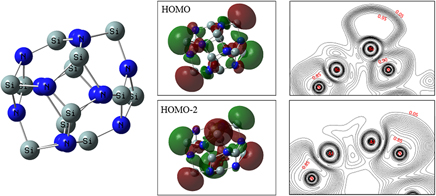
AlnSi12−nN12 (n = 0, 1, 2, and 4) are electron redundant systems. The calculations show that the stabilities of AlnSi12−nN12 and Al12N12 are very close. One Si atom in each Si2N2 square protrudes obviously and the cages are distorted. The excess electrons reside at the outside of the protrudent Si atoms as lone pair electrons. They occupy antibonding orbitals and form the highest occupied band. The Si–N bonds are covalent bonds with strong polarity. The overlap integral is 0.38 per Si–N bond and is 17% stronger than the overlap in Al12N12. The atoms in molecule charge on the in-plane and protrudent Si atoms are 3.13e and 1.65e, respectively. The lone pair electrons form large local dipole moments enhance the electrostatic interaction between the protrudent Si and N atoms. The energy gaps of the electron redundant cages AlnSi12−nN12 (n = 0, 1, 2, and 4) are about 1 eV smaller than the gap of Al12N12. As the lone pair electrons are loosely bond, the SiN-based cages have large hyper-polarizabilities and so have potential applications, such as nonlinear optical materials.
We have been talking so far about static DNA structures: we make them with some expectation of their 3D geometry, or perhaps of their topology, and then they sit there, perhaps changing shape as a result of thermal fluctuations. However, it is certainly possible to do more with DNA than just make static species. It is also possible to make molecules that can change their shapes, producing multi-state devices that can produce mechanical action on the nanoscale. The key DNA devices operate on two different principles: either DNA structural transitions, or programmed sequence-dependent devices whose states can be addressed or created individually. DNA structural transitions can be based on the contents of the solution, but they are only individually addressable by nuanced chemistry, such as the formation of the various knots shown in Figure 4-4, or by the action of protein molecules.
Robust devices. As all of you reading this book are aware, things can happen in chemical systems that do not happen on the macroscopic scale. If we are making a DNA-based nanomechanical device, we term it a “robust” device if all of the molecules undergo the same transition, looking the same after the transition as they did before. If the strands of its framework can recombine and perhaps form another species (a dimer or a breakdown product), then we would say that the device is not robust. Exchange of strands while in an intermediate state is another example of non-robust behavior. Sometimes the conditions will define the robustness of the device. If the device is based on a DNA structural transition, a partial transition of the ensemble of molecules will be the result if the transition trigger is not present in an overwhelming quantity; such conditions could be corrected, if necessary. The basic notion of a robust device is that it behaves like a macroscopic device made of simple machines: a lever is either up or down, a torsional element is either rotated or not, a movement occurs or it doesn't, throughout the ensemble of molecules in the system.
Shape-shifters
A key category of devices can be thought of as shape-shifters, molecules that have different structures under different conditions. Clearly a molecule at equilibrium will have a fixed shape or ensemble of shapes, and they won't change.
Let's look again at the molecule shown in Figure 3-5a. It looks like a cube built of DNA. However, as we noted earlier, the molecular geometry has really not been characterized, because the 3-arm junctions on its vertices are floppy units. Thus, it could look as we have drawn it, or it could look like a rhombohedron (a cube-like structure where one of the body diagonals has been stretched or squashed somewhat). The things we can say for sure about the molecule are that each of the edges is two turns long (the sequence was designed that way) and that each face of the object corresponds to a cyclic single strand of DNA. For example, the front face corresponds to the red strand. Because DNA is a double helix, every turn of the double helix results in the strands being interwound. Since each edge is two turns long, that means that the red strand is linked twice to the four strands of the four faces that flank the front: the green strand on the right, the cyan strand on top, the magenta strand on the left, and the dark-blue strand on the bottom. It is only indirectly linked to the yellow strand at the back. When cyclic molecules are linked together like the links of a chain, they form what is known as a catenane. Of course the hexacatenane corresponding to the cube is a much more complex object than just a simple chain. The molecule in Figure 3-5b, with the connectivity of a truncated octahedron, is a 14-catenane. It is even more complex than the cube-like molecule shown in Figure 3-5a.
Catenanes and knots. It turns out that catenanes are closely related to knots. This relationship is indicated in Figure 4-1. The upper left image is of a knot with five nodes and an arbitrary strand polarity. Look at the lower right node in this knot. It is made up of a strand that passes over another strand. You can think of it as four strands: the first half of the strand on top, connected to the second half of the strand on top, the first half of the strand on the bottom, connected to the second half of the strand on the bottom. Now, let's imagine breaking those connections, and reconnecting the strands so that we maintain the same polarity.
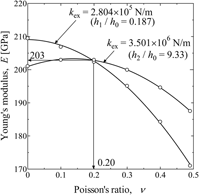
This paper proposes a method for determining the mechanical properties (Young's modulus, Poisson's ratio, yield strength, and work hardening factor) of a material at a specific point using an indentation technique that utilizes a specially designed indenter in conjunction with an inverse problem and finite element analyses. The specially designed indenter combines the characteristics of spherical and conical indenters and can be used to produce multiple indentations at a single point. The feasibility of the proposed method for determining the local mechanical properties of a material was confirmed by detailed precision verifications in the ideal case and the worst case.
Magnesium based nanocomposites containing 0.66 vol% of different types of oxide (i.e., Al2O3, Y2O3, and ZrO2) nano particles. The nano oxide particles were dispersed using melt processing. Microstructural characterization reveled that Y2O3 and ZrO2 nano particles were relatively better magnesium matrix grain refiner compared to nano-size Al2O3 particles. Mechanical characterization revealed that the oxides used in this study as reinforcement have strong strengthening effect on the magnesium matrix, where Y2O3 particles were most effective and Al2O3 particles were least effective. Ductility and resistance to fracture of magnesium was significantly improved by Al2O3 nano particles, unaffected by Y2O3 nano particles, and adversely affected by ZrO2 nano particles.
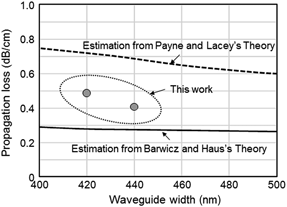
Low-propagation-loss silicon wire waveguides are key components of optical integrated circuits. In this paper, we clarified, through assessment of the relationship between waveguide loss and fabrication technology that high-resolution lithography and an adjusted lithography process window are important for low-loss waveguides. The silicon wire waveguides fabricated by high-resolution lithography technology using ArF immersion lithography process showed world-record low propagation losses of 0.40 dB/cm for the C-band and 1.28 dB/cm for the O-band. Analysis with Barwicz and Haus's theory indicated that sidewall scattering is the main cause of propagation loss even in such low-loss waveguides.
This paper investigates friction and wear between an electro-deposited coating and high carbon chrome steel. A ball-on-flat plate tribometer was developed, measuring tangential and normal displacements of a high carbon chrome steel ball. For the purpose of measuring displacements of a ball, laser displacement sensors were used. An electro-deposited coating was applied to a cold-rolled high strength steel plate. Displacement amplitudes of 0.2 and 1.0 mm were imposed to produce fretting and reciprocal sliding at contact. A steady-state value of the kinetic friction coefficient between an electro-deposited coating and high carbon chrome steel was found to be about 0.28. It was identified that wear volume on a coated specimen increased with the number of cycles. Correlation between the wear volume and a normal displacement of a ball was found to be linear. It was demonstrated that the proposed method is useful for understanding friction and wear of an electro-deposited coating.