To save content items to your account,
please confirm that you agree to abide by our usage policies.
If this is the first time you use this feature, you will be asked to authorise Cambridge Core to connect with your account.
Find out more about saving content to .
To save content items to your Kindle, first ensure no-reply@cambridge.org
is added to your Approved Personal Document E-mail List under your Personal Document Settings
on the Manage Your Content and Devices page of your Amazon account. Then enter the ‘name’ part
of your Kindle email address below.
Find out more about saving to your Kindle.
Note you can select to save to either the @free.kindle.com or @kindle.com variations.
‘@free.kindle.com’ emails are free but can only be saved to your device when it is connected to wi-fi.
‘@kindle.com’ emails can be delivered even when you are not connected to wi-fi, but note that service fees apply.
X-ray powder diffraction data, unit-cell parameters, and space group for DCT (C12H12Cl2N6O4S2 • C6H15N) are reported [a = 18.991(9) Å, b = 19.057(2) Å, c = 7.346(8) Å, α = β = γ = 90°, unit-cell volume V = 2659.05 Å3, Z = 4, and space-group P212121]. No detectable impurity was observed.
The solid-state phase equilibria of the copper (Cu)–dysprosium (Dy)–titanium (Ti) ternary system at 973 K has been experimentally investigated. The existence of nine binary compounds, Cu4Ti, Cu3Ti2, Cu4Ti3, CuTi, CuTi2, CuTi3, CuDy, Cu2Dy, and Cu5Dy was confirmed. The controversial phase of CuTi3 was found in this work. The temperature range of Cu7Dy was determined to be from 1112 to 1183 K. The phase relations at 973 K are governed by ten ternary phase regions, 21 binary phase regions, and 12 single-phase regions. The solid solubility of Cu in Dy is undetectable. None of the other phase in this system reveals a remarkable homogeneity range at 973 K.
We report the first observation of reversible equilibrium crystalline–metastable crystalline phase transformation in mechanically alloyed Ni–Ge powder mixtures. The formation of the equilibrium NiGe and metastable NiGe2 phases was investigated using x-ray diffraction and scanning electron microscopy methods. It was clearly shown that milling of the blended elemental powders first resulted in the formation of the equilibrium NiGe phase and continued milling led to the formation of the metastable NiGe2 phase. However, on milling for a longer time, the metastable phase transformed back to the equilibrium NiGe phase. The formation mechanisms of the stable and metastable phases and the reversibility of the phase transformations have been explained on the basis of the thermodynamic stability of the different phases and the contribution of defect concentration and surface energy effects to the free energy of the milled powder.
Cu90Ag10 alloys were subjected to severe plastic deformation at temperatures ranging from 25 to 400 °C and strain rates ranging from 0.1 to 6.25 s−1 using high-pressure torsion. The deformed samples were characterized by x-ray diffraction, transmission electron microscopy, and atom-probe tomography. A dynamic competition between shear-induced mixing and thermally activated decomposition led to the self-organization of the Cu–Ag system at length scales varying from a few atomic distances at room temperature to ≈50 nm at 400 °C. Steady-state microstructural length scales were minimally affected by varying the strain rate, although at 400 °C, the grain morphology did depend on strain-rate. Our results show that diffusion below 300 °C is dominated by nonequilibrium vacancies, and by comparison with previous Kinetic Monte Carlo simulations [D. Schwen et al., J. Mater. Res.28, 2687–2693 (2013)], their concentration could be obtained.
This review focuses on in situ functionalization of gallium nitride (GaN) with different adsorbates in the presence of an etchant. The low-temperature aqueous nature of this process provides a safe, environmentally friendly technique for tailoring the semiconductor's properties for various applications. Surface binding to GaN relies on a native oxide layer or direct attachment to the metal center present on the etched surface. The specifics of the binding mechanism are based on the functional groups present on the adsorbate. The effects of the GaN surface polarity and quality on the modification approach are analyzed. The review summarizes the alteration of GaN properties after the in situ treatment. Quantitative data until now have shown changes in morphological, surface chemical, optical, electronic, and aqueous stability properties. The review concludes with a short outlook on future studies associated with this surface modification approach.
Rutile nanoparticles have been synthesized by acid hydrolysis of titanium isopropoxide by low-temperature dissolution-reprecipitation process. High-resolution transmission electron micrographs of the rutile colloidal solution show needle-shaped rutile nanoparticles with the dimensions of 10–30 nm in diameter and 100–150 nm in length. X-ray diffraction (XRD) data show the existence of only the rutile polymorph in TiO2 powder with a crystallite size of 11.3 nm. The dielectric constant of rutile nanoparticles has been found to be 57 at 10 MHz AC frequency and DC conductance as 2.3 × 10⁻⁶ S/cm. Transmission electron micrographs and XRD data analysis imply that the rutile crystallites are self-organized in a regular fashion to produce multilayer three-dimensional linear clusters. The clusters have been found to be microporous (average porosity 1.4 nm) with high specific surface area (132.2 m2/g). At higher concentration, the clusters aggregate to produce interconnected network of star- or flower-like structures. This organized crystalline microporous metal-oxide semiconductor might find various practical applications.
Semisolid powder processing (SPP) was used to fabricate n-type bismuth telluride-based polycrystalline bulk materials with improved thermoelectric properties. The minimum lattice thermal conductivity and the maximum ZT value of the SPP sample obtained in this study are 0.163 W m−1 K−1 at 383 K and 0.89 at 423 K, respectively. This ZT value exhibited a significant enhancement of 65.7 and 101.3% compared with the hot-pressing and the die-casting counterparts, respectively. The reduction of the lattice thermal conductivity is mainly due to the nanoscale grains and the mesoscale pores induced by the SPP. The grain boundaries and the interfaces brought by the porosities could scatter the phonons with mean free paths extensively from 300 nm to 1 μm. The remarkable enhancement of the ZT value and the convenient fabricating process suggest that the SPP is a promising method for mass production of high-performance bismuth telluride-based polycrystalline bulk materials.
The study reports the functionalization of the size-controlled synthesized silver nanoparticles (AgNPs) with coumarin derivative. The size and the morphology of the as-synthesized AgNPs were obtained in the presence of glycerol and sodium citrate which acted as the reducing agent which led to nucleation of silver ions thus yielding different sizes of AgNPs. The obtained AgNPs were functionalized with different stoichiometric ratios of [HS-(CH2)11-NHCO-coumarin:HS-PEG-(CH2)11COOH] to form mixed monolayer protected silver clusters and their Raman activities were evaluated to determine the effect of particle size on the enhancement factor (EF). The functionalization and the stability of AgNPs were confirmed using a combination of techniques, namely UV–Visible spectroscopy, transmission electron microscopy, Zetasizer, and Raman spectroscopy. The obtained Raman spectra were used to calculate the EF of the HS-(CH2)11-NHCO-coumarin adsorbed on AgNPs, which was observed to increase with an increase in size of AgNPs from 16 to 30 nm. Increasing the particle size to 43 nm lowered the EF by 10-fold and hence an optimal size of ∼30 nm was achieved for the coumarin derivative adsorbate.
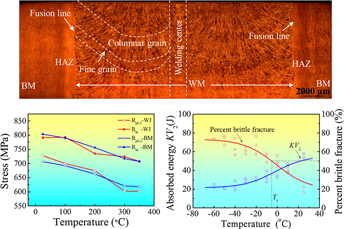
NiCrMoV steels used in nuclear rotor with heavy section were successfully fabricated by ultra-narrow gap submerged arc welding method. In this study, the mechanical properties including the tensile and impact toughness of the welded joints (WJs) with a wide temperature range were systematically investigated. Microstructural characterization indicated that the high-temperature tempered martensite and tempered bainite, as the main microstructure in WJ, were responsible for the improved comprehensive mechanical properties of the WJ. Microhardness across the WJ was measured as well, showing that the highest value of hardness occurred at the heat-affected zone which represents the appropriate lowest impact toughness of WJ. However, compared with the base metal, the ultimate tensile strength of the WJ displayed approximately equivalent values, while the yield strength was increased with increasing temperature. All the fracture of the WJ specimens occurred on the weld metal. In addition, the Charpy impact energy of weld metal was obtained at various temperatures, and the transition temperature (Tt) of welded metal was determined as 5 °C, which helps for the application design. The fractography indicated that the ductile fracture modes changed to quasi-cleavage ones gradually with decreasing temperature, and also the dimples became smaller and shallower.
An interesting experimental phenomenon was obtained by Mintz that the hot ductility of an austenitic steel decreases with decreasing strain rate whereas that of a ferritic steel increases. However, the mechanism is still unclear. In this study, the critical time and critical cooling rate of nonequilibrium grain-boundary segregation (NGS) are calculated. It is shown that for Mintz's thermal cycle prior to tensile testing, the effective time of the austenitic steel is shorter than the critical time and that of the ferritic steel is longer than the critical time. When the strain rate decreases, the elastic stress aging time increases. As a result, for the austenitic steel, the grain-boundary segregation of impurity increases, thereby reducing the hot ductility, whereas for the ferritic steel, the segregation of impurity decreases, thereby enhancing the hot ductility. Consequently, the hot ductility loss of both austenitic and ferritic stainless steels is induced by NGS of impurity.
We report on the study of the characteristics of indium–tin oxide (ITO) films prepared by well-controlled and reproducible DC magnetron sputtering in argon with consequent annealing in oxygen atmosphere. The structural, electrical, and optical properties of the ITO films were investigated. It was found that the films deposited in argon atmosphere with a commercial ITO target have low transparency and high resistivity. The lower value of the resistivity around 3 × 10⁻⁴ Ω cm and the higher value of the figure of merit of 7.4 × 10⁻³ Ω−1 for 200 nm thick films are obtained after postannealing the films at the optimal temperature T = 300 °C for 1 h. It was found experimentally that postannealing at different temperatures allows tuning effective work function of the ITO films in the range of 4.2–5.5 eV. The latter is an important issue for applications in optoelectronic devices. The fabrication method is useful for the fabrication of ITO films with high electro-optical parameters on flexible polyimide substrates.
To optimize the structure of the flexible piezoresistive sensor based on conductive polymer composite and widen the workable pressure range, a piezoresistive sensor with a multilayered structure based on carbon nanotubes/carbon black/silicone rubber conductive composite was designed and investigated. Different from the traditional monolayer structure, this novel multilayered sensor consisted of three microstructured piezoresistive composite films. The experimental data showed that the electrical resistance of the sensor varied regularly with a wide range of applied pressure (0–1.8 MPa at least). The high sensitivity, high flexibility, facile fabrication, and low cost were also the advantages of this pressure sensor. In addition, the piezoresistive mechanism was studied and shown to be the synergistic effects of the contact resistance mechanism and bulk resistance mechanism. Factors influencing the piezoresistive properties were also investigated. Moreover, the consecutive loading tests verified the feasibility and stability to use this sensor element for pressure measurement.
Double-filled high Fe content skutterudites, BaxYbyFe3CoSb12 (x + y = 1), were synthesized to investigate their high temperature transport properties. Both their phase and stoichiometry were characterized by powder x-ray diffraction and energy dispersive spectroscopy. The Seebeck coefficient, S, and electrical resistivity, ρ, increase with increasing temperature for all specimens over the entire measured temperature range. The thermal conductivity for the two low Ba content specimens decreases with increasing temperature up to 550 K at which point it increases with temperature due to bipolar diffusion. Bipolar diffusion becomes negligible with increasing Ba content. Due to this low bipolar diffusion, the ZT values of the higher Ba content specimens increase linearly with temperature, with the highest ZT value obtained for Ba0.9Yb0.1Fe3CoSb12.
Model Fe–9Cr–xMo alloys with high Mo content alloys were cast to investigate the effect of Mo on the phase evolution and properties of the alloys. The Mo contents in the alloys were 5, 7, and 9 wt%, while the Cr content was held constant at 9 wt%. For comparison, a commercial A213T 9-P9 (Fe–9Cr–1Mo) alloy, widely used in the petrochemical industry, was also investigated. The alloys were heat-treated at temperatures between 450 and 650 °C and characterized by scanning electron microscopy, x-ray dispersive energy spectroscopy, and electron backscatter diffraction. Potentiodynamic linear polarization technique was used to evaluate the corrosion of the alloys in a 0.5 mol L−1 H2SO4 solution containing 0.1 mol L−1 NaCl. The results showed that the corrosion resistance of the alloys was affected by precipitation of the µ phase and that the Mo content in excess of 5% is deleterious to the corrosion resistance of the Fe–Cr–Mo alloys.
A fast and nondestructive method for polarity determination of wurtzite GaN crystals based on x-ray photoelectron diffraction (XPD) has been demonstrated. Photoelectron emission from N 1s core level excited by Mg Kα source was found sufficient for the polarity determination of GaN crystals. XPD polar plots from polar GaN {0001} and semipolar GaN$\{ 10\bar 11\}$, $\left\{ {20\bar 21} \right\}$, $\left\{ {11\bar 22} \right\}$ crystals have been analyzed. Due to dominant electron forward scattering along N–Ga directions, photoelectron intensities either increase or decrease within a relatively narrow emission polar angle range. The slopes of polar plots are found noticeably different in the polar angle range of 20°–25° for (0001) or $\left( {000\bar 1} \right)$ crystals, respectively. The semipolar GaN substrates can be divided into two groups, depending on whether m-plane or a-plane is perpendicular to the semipolar surface. It was found that the slopes of the polar plots are different in the angular range of 20°–27° for semipolar GaN$\left\{ {10\bar 11} \right\}$, 10°–22° for GaN$\left\{ {20\bar 21} \right\}$ substrates, while for the GaN$\left\{ {11\bar 22} \right\}$ semipolar planes, the slopes are different in the range of 0°–15° with respect to the surface normal.
The peculiarities of the Seebeck coefficient and power factor are studied in porous thermoelectric materials with spherical hollow pores of varying diameter from nanometer to micrometer length scales. The pores are assumed to be randomly dispersed throughout the matrix material. The influence of trap centers situated at pore interfaces on the power factor is investigated. Using the model based on gamma distribution of the pore sizes, the analytical expression is obtained for the power factor at the arbitrary level of the Fermi energy. Limiting cases of nondegenerate and degenerately doped porous semiconductors are examined as well. The results are compared with calculations for a multilayer composite in which each layer contains pores of a single length-scale. It is shown that the presence of hollow pores with multiscale hierarchical disorder leads to more considerable enhancement in the thermopower over its value in the bulk. Necessary conditions for the enhancement of the power factor are found.
Biomineralization is the matrix-directed calcification of tissue in living organisms. The deposition of different polymorphs of calcium phosphate or calcium carbonate is a highly regulated process. It may involve cell-controlled mechanisms with vesicular delivery of inorganic material to the extracellular matrix and cell-independent processes mediated by dedicated matrix proteins. These proteins promote the formation of microscopic crystals of defined size and shape, which combine to form bio-inorganic materials with unique properties. Successful biomineralization is correlated with structural elements, such as matrix proteins involved in the nucleation process. Circular dichroism (CD) is a spectroscopic technique for the determination of a secondary structure of proteins and has therefore been applied for studying numerous biomineralization promoter proteins. This article reviews and compares CD data on matrix proteins from different contexts, such as eggs, seashells, and teeth. It highlights the potential of CD for secondary structure determination and quantification and points out pitfalls that may lead to misinterpretation of CD spectra. The data suggest that most biomineralization promoter proteins contain domains of different secondary structure with predominantly unordered conformation. However, they may acquire a higher degree of order initiated by environmental factors such as pH, presence of cations, or charged surfaces.
Biomineralization is the process by which living organisms orchestrate the synthesis and organization of minerals (biominerals), and it may be viewed as an ancient process for accumulation of metal ions in living systems. The structure and properties of biominerals have yet to be rivaled by any synthetic effort by scientists to date. Therefore, deciphering the assembly algorithms and the components that initiate and promote hierarchical deposition of cations has significant implications for the development of nanocomposites and nanotechnology as a whole. This issue of MRS Bulletin highlights some of the challenges in characterizing and replicating the biomineralization processes, and the role of non-collagenous proteins in the biomineralization process.