To save content items to your account,
please confirm that you agree to abide by our usage policies.
If this is the first time you use this feature, you will be asked to authorise Cambridge Core to connect with your account.
Find out more about saving content to .
To save content items to your Kindle, first ensure no-reply@cambridge.org
is added to your Approved Personal Document E-mail List under your Personal Document Settings
on the Manage Your Content and Devices page of your Amazon account. Then enter the ‘name’ part
of your Kindle email address below.
Find out more about saving to your Kindle.
Note you can select to save to either the @free.kindle.com or @kindle.com variations.
‘@free.kindle.com’ emails are free but can only be saved to your device when it is connected to wi-fi.
‘@kindle.com’ emails can be delivered even when you are not connected to wi-fi, but note that service fees apply.
Heterogeneous gas–solid catalyst reactions occur at the atomic level, and understanding and controlling complex catalytic reactions at this level is crucial for the development of improved processes and materials. There are postulations that single atoms and very small clusters can act as primary active sites in chemical reactions. Early applications of our novel aberration-corrected (AC) environmental (scanning) transmission electron microscope (E(S)TEM) with single-atom resolution are described. This instrument combines, for the first time, controlled operating temperatures and a continuous gas environment around the sample with full AC STEM capabilities for real-time in situ analysis and visualization of single atoms and clusters in nanoparticle catalysis. ESTEM imaging and analysis in controlled gas and temperature environments can provide unique insights into catalytic reaction pathways that may involve metastable intermediate states. Benefits include new knowledge and more environmentally friendly technological processes for health care and renewable energy as well as improved or replacement mainstream technologies in the chemical and energy industries.
Graphene is not the only prominent example of two-dimensional (2D) materials. Due to their interesting combination of high mechanical strength and optical transparency, direct bandgap and atomic scale thickness transition-metal dichalcogenides (TMDCs) are an example of other materials that are now vying for the attention of the materials research community. In this article, the current state of quantum-theoretical calculations of the electronic and mechanical properties of semiconducting TMDC materials are presented. In particular, the intriguing interplay between external parameters (electric field, strain) and band structure, as well as the basic properties of heterostructures formed by vertical stacking of different 2D TMDCs are reviewed. Electrical measurements of MoS2, WS2, and WSe2 and their heterostructures, starting from simple field-effect transistors to more demanding logic circuits, high-frequency transistors, and memory devices, are also presented.
Oxidation of atomized Al–Mg–Li alloys with compositions ranging from Al0.85Mg0.1Li0.05 to Al0.55Mg0.4Li0.05 (wt%) was examined by thermogravimetry/differential thermal analysis. The results showed that oxidation proceeded in two steps. During the first step, lithium and magnesium were oxidized preferentially and removed from the metallic phase. The other step, during which the remainder of the metallic phase was oxidized, occurred over a wide range of temperature (989–1098 °C). The temperature of the second effect decreased slightly with increasing magnesium content from 10 to 30% in the alloy. For Al0.55Mg0.4Li0.05 alloy, the second exothermic peak occurred at 540 °C, and no exothermic peak was observed at higher temperature. The porous structure formed during the selective oxidation promotes the oxidation of residual Al in the alloy. Al0.55Mg0.4Li0.05 was oxidized completely at 1100 °C, lower than the temperature of other alloys. The thermite reaction experiment of Al0.55Mg0.4Li0.05–Fe2O3 system conducted in Ar showed a reaction temperature of 587 °C, significantly lower than the reaction temperature observed for Al–Fe2O3 system.
Phase maps of Co–Cr alloys bonded to dental porcelain cycled through an incremental number of porcelain firings at two separate thicknesses (0.5 and 1 mm) were analyzed. Bulk hexagonal close-packed (hcp) phase vol% of the alloy was found to increase with the number of porcelain firings for both 0.5 and 1 mm specimens. At the metal-porcelain interface, a uniform fine-grained hcp phase was observed. The depth and grain size of this hcp layer increased with the number of porcelain firings with the thicker specimens undergoing more substantial growth and transformation. Simple heat transfer modeling of the specimens during heat treatment cycles indicated that the thicker specimen had more time at high temperature to affect the face-centered cubic to hcp phase transformation. Therefore, the amount of porcelain firings and the thickness of the alloy should be considered and kept to a minimal when manufacturing metal-porcelain restoration.
Shape-memory epoxy is receiving considerable attention because of its superior mechanical and thermal properties and excellent shape-memory performance. In this study, a novel series of shape-memory epoxy resins are prepared using hydro-epoxy, hexahydrophthalic anhydride, and diglycidyl 4,5-epoxy tetrahydro phthalate (TDE-85) to further improve the recovery force of shape-memory epoxy resins. The thermal, mechanical, and shape-memory properties of the shape-memory epoxy resin system are investigated by differential scanning calorimetry, dynamic mechanical analysis, bend test, and shape recovery test. Results indicate that the glass transition temperature (Tg), rubber modulus, and room-temperature bend strength increase as TDE-85 content increases. Investigation of the shape-memory behavior of the resin reveals that full recovery can be achieved after only several minutes when the temperature is equal to or above Tg. The shape recovery time decreases with the increase in TDE-85 content at Tg, Tg + 10 °C, and Tg + 20 °C. These results are attributed to the increase in TDE-85 content.
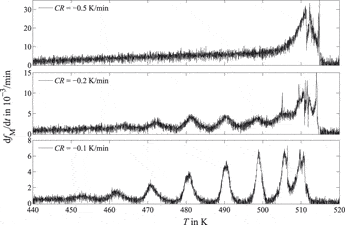
The martensitic transformation of Fe–22 wt% Ni austenite was investigated by high-resolution dilatometry as well as differential thermal analysis. Macroscopically discontinuous formation of lath martensite was observed, manifested in a train of transformation-rate maxima. It is proposed that the modulation of the transformation rate is caused by simultaneous formation of blocks in different martensite packages. The origin of simultaneity is ascribed to the interplay of chemical driving force, developing strain energy, and its relaxation upon sufficiently slow cooling. The transformation-rate maxima become more distinct with decreasing cooling rate (CR), clearly indicating the involvement of a thermally activated process in martensite formation. Quantitative analysis of the microstructure of differently cooled specimens revealed smaller martensite block sizes for higher CRs. All observations are compatible with athermal nucleation and thermally activated growth. (Local) strain relaxation in the austenite was identified as the involved thermally activated mechanism.
In this contribution, the structural, mechanical, and thermal properties of MSiO4 have been investigated theoretically and the anisotropy of elastic properties has been discussed in detail. The heterogeneous bonding nature was revealed from density functional theory computations and chemical bond theory (CBT). The Young's modulus and shear modulus of MSiO4 were anisotropic and the anisotropy on different planes was quite different. The thermal expansion coefficients of MSiO4 estimated from CBT were 5.1 × 10⁻⁶ and 4.4 × 10⁻⁶ K−1 for ZrSiO4 and HfSiO4, respectively. These results were quite consistent with the experiments. The temperature dependent thermal conductivities of MSiO4 were estimated from Slack's model, the minimum thermal conductivity was predicted to be 1.54 and 1.24 W m−1 K−1 for ZrSiO4 and HfSiO4, respectively. Our theoretical results show that MSiO4 are excellent thermal barrier materials with good tolerance to withstand the mechanical damage.
Highly textured, ultrafine grain pure Bi2Te3 has been obtained by applying large-strain high-pressure torsion (HPT) to hot-pressed (HP) coarse grain material. Its thermal conductivity is significantly smaller than the conductivity of HP Bi2Te3, and its crystallographic texture and mechanical properties significantly improved. The mechanical properties of both, coarse grain and ultrafine grain, samples have been assessed by compression tests of 2 µm diameter micropillars machined by focused ion beam. The micropillars built from coarse grain samples are single crystalline, those built from ultrafine grain materials are an order of magnitude larger than their grain size. The test results put in evidence the elastic and plastic anisotropy of Bi2Te3 and the significant strengthening and toughening effect of ultrafine grain refining. For instance, after an equivalent strain of about 100, the Vickers hardness (in kg mm−2) increases from 60 to 120. Simultaneously, about a 40% reduction of the thermal conductivity has been measured, and a very strong basal texture is developed normal to the torsion axis. Such combination of properties looks very promising for simultaneously enhancing the thermoelectric figure of merit and the mechanical reliability of Bi2Te3-based alloys through HPT processing.
The introduction of functional units onto semiconducting polymers either as side chains or at the α- and ω-ends of polymeric chains is the method of choice in order to impose additional functions to the final semiconducting materials when aiming specific applications. Moreover, the functionalization approach provides a route to further complex macromolecular architectures as well as the generation of hybrid materials through the covalent attachment of the semiconductor to carbon nanostructures or to inorganic nanoparticles. Via this prospective an outline over functionalized and hybrid semiconducting polymers is provided along with possible paths of future research toward functional and hybrid semiconductors.
A possible approach to raise the efficiency of single-junction solar cells is to couple them with thermoelectric generators (TEGs). It was shown that TEG contribution to the output power is basically ruled by the characteristics of the photovoltaic (PV) material. In this study, we present a quantitative model that correlates the efficiency of the hybrid thermoelectric–photovoltaic (HTEPV) device with the energy gap and the working temperature of the solar cell. Two HTEPV structures are discussed, one capable only to recover the heat released by relaxation of hot electron–hole pairs; and a second one also capturing the low–energy part of the solar spectrum. We show that in the second case the increase of the conversion efficiency could justify the effort needed to add a TEG stage to the PV device. HTEPV constructions are also shown to enable the use of wide-gap materials that are not currently considered in PV applications.
We demonstrate the fabrication by anodization of niobium oxide microcones, several microns long, from aqueous solutions of 1 wt% hydrogen fluoride (HF) with varied sodium fluoride (NaF) concentration (0–1 M). Raman spectroscopy and x-ray diffractometer analysis revealed the as-grown microcones to be crystalline Nb2O5−x with preferred (1 0 0) and (0 1 0) orientations. The overall Nb2O5−x formation rate increased with the increasing NaF concentration, and structures as tall as 20 μm were achieved in just 20 min of anodization at 1 M NaF. Rapid formation of niobia microcones was even observed in the absence of HF at this NaF concentration. Photocatalytic activity for water oxidation was highest for microcones grown under the highest NaF concentration.
Carbon dioxide (CO2) capture is regarded as one of the biggest challenges of the 21st century; therefore, intense research effort has been dedicated in the area of developing new materials for efficient CO2 capture. Here, we report high CO2 capture capacity in the low region of applied CO2 pressures observed with ultramicroporous silicon nitride-based material. The latter is synthesized by a facile one-step NH3-assisted thermolysis of a polysilazane. Our newly developed material for CO2 capture has the following outstanding properties: (i) one of the highest CO2 capture capacities per surface area of micropores, with a CO2 uptake of 2.35 mmol g−1 at 273 K and 1 bar (ii) a low isosteric heat of adsorption (27.6 kJ mol−1), which is independent from the fractional surface coverage of CO2. Furthermore, we demonstrate that the pore size plays a crucial role in elevating the CO2 adsorption capacity, surpassing the effect of Brunauer–Emmett–Teller specific surface area.