To save content items to your account,
please confirm that you agree to abide by our usage policies.
If this is the first time you use this feature, you will be asked to authorise Cambridge Core to connect with your account.
Find out more about saving content to .
To save content items to your Kindle, first ensure no-reply@cambridge.org
is added to your Approved Personal Document E-mail List under your Personal Document Settings
on the Manage Your Content and Devices page of your Amazon account. Then enter the ‘name’ part
of your Kindle email address below.
Find out more about saving to your Kindle.
Note you can select to save to either the @free.kindle.com or @kindle.com variations.
‘@free.kindle.com’ emails are free but can only be saved to your device when it is connected to wi-fi.
‘@kindle.com’ emails can be delivered even when you are not connected to wi-fi, but note that service fees apply.
A noncentrosymmetric aluminum borate crystal, Al5BO9, was obtained via high-temperature solution method. Considering the structure diversities of Al5BO9, the single crystal structure was cautiously redetermined before the investigation. The fundamental building blocks of the structure are BO3 triangles, AlO4 tetrahedra, and AlO6 octahedra. Since Al5BO9 only consists of strong covalent B–O and Al–O bonds, it is worth investigating the structure–optical property relationship thoroughly, especially the linear and nonlinear optical properties. To gain further insight into the origin of the nonlinear optical response of Al5BO9, the electronic structure calculations, second harmonic generation (SHG)-weighted electron density, and dipole moment of polyhedra were analyzed in detail. All evidences deduced from calculated results indicate that the SHG contribution from the Al–O polyhedra is more pronounced than that of the BO3 group in Al5BO9, which is anticipated to open a window for the search and design of new inorganic materials.
The 〈001〉-textured 36Pb(In1/2Nb1/2)O3–30Pb(Mg1/3Nb2/3)O3–34PbTiO3 (36PIN–30PMN–34PT) ceramics were successfully prepared by the templated grain growth method using BaTiO3 (BT) templates with an average edge length of 10 μm and a thickness of about 0.5 μm. The highest Lotgering factor of 95% has been achieved for the textured ceramics with 5 wt% BT templates sintered at 1240 °C. The Curie temperature (TC) and dielectric constant (εr) of the textured 36PIN–30PMN–34PT ceramics were 225 °C and 2850, respectively. The piezoelectric constant d33 of the textured samples was 780 pC/N and almost 2 times higher than that of random 36PIN–30PMN–34PT samples. The planar mode electromechanical coupling coefficient kp was 59% for the textured samples. Unipolar strain-field measurements for the textured ceramics exhibited 0.34% strain at 4 kV/mm.
More than two decades of III-N materials research has led to the production of visible spectrum commercial light-emitting diodes (LEDs) and laser diodes (LDs). Commercial c-plane LEDs are currently limited by efficiency droop which describes the decline in efficiency with increasing input current density. Laser-based sources, however, provide peak efficiencies at much higher current densities and may circumvent efficiency droop limitations. The potential benefits of non-basal plane (NBP) orientations could accelerate the evolution of solid-state lighting from LED to LD sources. Here, we review the progress in long-wavelength (440–590 nm) NBP quantum well LD research and discuss applications in solid-state lighting, visible light communication and smart lighting.
Polymer-based nanomaterials have captured increasing interest over the past decades for their promising use in a wide variety of applications including photovoltaics, catalysis, optics, and energy storage. Bottom-up assembly engineering based on the self- and directed-assembly of polymer-based building blocks has been considered a powerful means to robustly fabricate and efficiently manipulate target nanostructures. Here, we give a brief review of the recent advances in assembly and reconfigurability of polymer-based nanostructures. We also highlight the role of computer simulation in discovering the fundamental principles of assembly science and providing critical design tools for assembly engineering of complex nanostructured materials.
Screen-printed organic electrochemical transistors (OECTs) were tested as glucose and lactate sensors. The intrinsic amplification of the device allowed it to detect metabolites in low molecular range and validation tests were made on real human sweat. The development of an organically modified sol–gel solid electrolyte paves the way for all printed OECT-based biosensors.
We investigated improvements to the mechanical properties of iron matrix composites for the case where the surfaces of the reinforcing particles are coated with copper and a hybrid mixture of different types of reinforcing ceramic particles (hybrid particles mixture) is used. Copper coating on the surfaces of SiC, TiC, and TiN particles can eliminate interfacial defects to significantly improve the composites' mechanical properties. The addition of uncoated hybrid particles mixture has little effect on the tensile strength improvement of composites compared with composites reinforced by monolithic particles, whereas copper-coated hybrid reinforcement has a significant effect. Any composite reinforced with copper-coated hybrid particles mixture will always have higher strength than that reinforced with monolithic particles. Our findings suggest that the load transfer between the matrix and reinforcing particles improved because of different elastic moduli, coefficients of thermal expansion and reaction heats of different types of reinforcing particles.
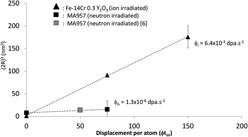
The Oxide Dispersion Strengthened (ODS) materials are potential candidates as cladding tubes for Sodium-cooled Fast Reactors. The nano-oxides are finely dispersed within the grains and confer excellent mechanical properties to these alloys. Hence, assessing nano-particle stability under irradiation remains crucial to guarantee safe use of these materials. Although neutron irradiation remains a binding and challenging experimental study to conduct, difficulties can be overcome by ion beam processing. Ion beam processing of the ODS material allows to identify the radiation-induced Ostwald ripening as the mechanism governing the nano-particle response under irradiation. The result is the increase in size and a decrease in density of the finely dispersed Y2Ti2O7 nano-particles. Under neutron irradiation, radiation-induced Ostwald ripening appears to be less effective since a slight growth of nano-particles is observed. Further, our approach shows that nanoparticle growth kinetics should scale as φ1/3, φ being the radiation flux. This suggests that the low irradiation flux is at the origin of the slower growth kinetics of the neutron irradiated particles. Both neutron and ion irradiation induce a modification of the nanoparticles/matrix interfaces which are generally flat and sharp prior to irradiation and present steps after irradiation. This could alter the nano-particle coarsening during irradiation.
Amorphous and nanocrystalline soft magnetic alloys have garnered interests in academia and industry due to their potentials for applications, such as power transformers, electric motors, and sensors. To achieve good glass formability, thermal stability, and prevent grain overgrowth, elements such as B, Nb, Ta, and Hf are used in many soft magnetic systems. However, the high price of these precursors results in expensive soft magnetic alloys. Herein, we report on substituting Ta and Hf with TaC and HfC, respectively, to significantly reduce the cost of Fe-based FINEMET and Co-based HTX005 alloys. Soft magnetic properties of these alloys are studied. The effect of thermal annealing and strain annealing on TaC and HfC substituted alloys are also investigated. Lastly, we discuss the cost analysis on these alloys. Using the synthesis route presented here, a cost reduction of up to 74% can be achieved.
The mechanical response of materials under repeated impact loading is of primary importance to model different types of surface mechanical treatments, such as shot peening. A reverse identification method of stress–strain curves using repeated impact has been developed by Kermouche et al. [Kermouche et al., Mater. Sci. Eng., A569, 71–77 (2013)] and later improved by Al Baida et al. [Al Baida et al., Mech. Mater.86, 11–20 (2015)]. This study deals with the experimental validation of this method on three materials: a home-made pure iron, a commercially pure copper, and an industrial aluminum alloy. An approximate method derived from cone indentation theory to check the reverse method reliability. Balls of different sizes have been used to cover a wide enough range of strain. The results are also compared with macroscopic compression and traction tests. The effect of the strain rate on the stress–strain curve is discussed. The conclusion section highlights the rapidity and the ease of use of the reverse identification method.
Nanosized Al2O3 (Al2O3np) reinforced Al7075 composites were fabricated by specially made Al2O3np containing Mg powder and subtype multifrequency ultrasonic vibration. Compared to traditional techniques, Al2O3np was effectively dispersed in the matrix by the novel method. Microstructural studies showed that the addition of Al2O3np caused the grain refinement and that the resultant microstructures of composites depended on the dominant size and degree of Al2O3np clustering. The grain refinement could be mainly attributed to particle pushing mechanisms. Compared to the matrix alloy, the ultimate tensile and compressive strength of the as-cast composite with 1.5 wt% Al2O3np fabricated at 800 °C were increased by 59.6% and 42.6%, respectively. Transmission electron microscope analysis showed that high density dislocations and clear interfaces between particles and matrix were present in the grains, suggesting that the superior improvement of mechanical properties can be attributed to dislocation-type strengthening of matrix alloy and load transfer from matrix to hard nanoparticles.
Fabrication of nanoperforated TiO2 thin films (NP-TiO2) on various substrates utilizing evaporation-induced self-assembly has been widely reported during recent years. For many applications, such as solar cells and gas sensors, it would be beneficial if the active material could be deposited onto a desired area or in the form of a pattern or array. In this study, inkjet printing was successfully used to produce NP-TiO2 at both ambient temperature and 60 °C. Especially for intermediate drop spacings (40 and 50 µm), millimeter-sized homogeneous NP-TiO2 patches were obtained with similar NP structure as those being processed by dip coating and drop casting. Compared to ambient temperature, inkjet printing at 60 °C provides a narrower height distribution of the NP structures of about 5 nm. Compared to dip coating and drop casting, inkjet printing enables the deposition of the ink onto target areas, thus enabling the fabrication of microscale arrays and other patterned structures.
This work studies the nitridation of Ta by laser irradiation by means of x-ray photoelectron spectroscopy. The study has been carried out under “in situ” conditions by controlling the nitrogen partial pressure, the presence of traces of oxygen, and the irradiance of the laser. It is found that a thin layer of Ta2O5 is directly obtained when irradiating in the presence of oxygen, while a Ta3N5 surface compound and some minor contributions of nonstoichiometric phases are formed in the presence of nitrogen. For O2:N2 mixtures at 0.1 Pa, preferential nitride formation occurs up to a ratio of 1:4, while Ta2O5 starts to be predominant for ratios above this value. The air stability of the tantalum nitride layer formed by laser irradiation and the surface topography of the irradiated metal are also studied. The possible factors determining this behavior are discussed.
Self-energy correction density functional theory local density approximation–1/2 (LDA-1/2) method was successfully applied to predict the electronic structure and optical properties of the N-doped, Ti-vacant Ti3−δO4N oxynitride [G. Hyett et al., J. Am. Chem. Soc.129, 15541–15548 (2007)], which was shown experimentally to be more photocatalytic than titania. The procedure takes into consideration of the two possible types of Ti vacancies (with different numbers of nitrogen and oxygen neighbors) and their formation energies, according to the experimental data on fractional occupancies, with potential effects on the electronic structure and photocatalyst mechanisms analyzed. Different defective model structures were calculated for optimal final configuration, whose optical calculations revealed massive damping in infrared spectrum, while transparency in green region. The band gap determined by our methodology is 2.5 eV, in close agreement to the experimental value of 2.6(1) eV. Results presented in this work represent the first report of an electronic structure modeling of Ti3−δO4N, which is a starting point to help provide an understanding of its photocatalytic activity.
Poly[sulfur-random-1,3-diisopropenylbenzene (DIB)] copolymers synthesized via inverse vulcanization form electrochemically active polymers used as cathodes for high-energy density Li–S batteries, capable of enhanced capacity retention (1005 mAh/g at 100 cycles) and lifetimes of over 500 cycles. In this prospective, we demonstrate how analytical electron microscopy can be employed as a powerful tool to explore the origins of the enhanced capacity retention. We analyze morphological and compositional features when the copolymers, with DIB contents up to 50% by mass, are blended with carbon nanoparticles. Replacing the elemental sulfur with the copolymers improves the compatibility and interfacial contact between active sulfur compounds and conductive carbons. There also appears to be improvements of the cathode mechanical stability that leads to less cracking but preserving porosity. This compatibilization scheme through stabilized organosulfur copolymers represents an alternative strategy to the nanoscale encapsulation schemes which are often used to improve the cycle life in high-energy density Li–S batteries.
A novel strain-rate jump method was developed for the plane-strain bulge test and used to investigate the time-dependent deformation behavior of gold thin films in the thickness range 100–400 nm. The experimental method is based on an abrupt variation of the pressurization rate. The evaluated strain-rate sensitivity was found to be five times higher for films in freestanding condition (m = 0.094) than for films tested on a SiNx substrate (m = 0.020). Bulge creep tests confirmed this increased time-dependence. The observation of the surface of the freestanding films after the creep tests provided evidence of apparent grain boundary sliding taking place next to intragranular plastic deformation. The out-of-plane deformation was presumably favored by the columnar microstructure of the samples, with grains extending between both free surfaces. In the case of SiNx-supported films, grain boundary sliding was prevented by the good adhesion of gold to the SiNx substrate.
Metamaterials are man-made designer matter that obtains its unusual effective properties by structure rather than chemistry. Building upon the success of electromagnetic and acoustic metamaterials, researchers working on mechanical metamaterials strive at obtaining extraordinary or extreme elasticity tensors and mass-density tensors to thereby mold static stress fields or the flow of longitudinal/transverse elastic vibrations in unprecedented ways. In this prospective paper, we focus on recent advances and remaining challenges in this emerging field. Examples are ultralight-weight, negative mass density, negative modulus, pentamode, anisotropic mass density, Origami, nonlinear, bistable, and reprogrammable mechanical metamaterials.
A quantitative analysis of In concentration in InGaN/GaN multiquantum wells in light-emitting diodes was carried out using high-resolution transmission electron microscopy (HRTEM) and high-angle annual dark-field scanning TEM (HAADF-STEM). The In composition in InGaN was evaluated by the precise measurement of c-lattice parameters in the HRTEM micrographs, which increase with increasing In composition. The reliability of the results was confirmed by high-resolution x-ray diffraction measurements and Rutherford backscattering spectrometry. Quantitative In compositions can, therefore, be determined using HRTEM. We tried to determine the quantitative In compositions in InGaN by analyzing the intensity profiles of the HAADF-STEM images. However, several problems were encountered, such as differences in the thickness of the region observed, carbon contamination, and ion beam damage during specimen preparation. Therefore, relative differences in composition were observed in the HAADF-STEM images.
Bridging the gap between theory and practice, this text provides the reader with a comprehensive overview of industrial crystallization. Newcomers will learn all of the most important topics in industrial crystallization, from key concepts and basic theory to industrial practices. Topics covered include the characterization of a crystalline product and the basic process design for crystallization, as well as batch crystallization, measurement techniques, and details on precipitation, melt crystallization and polymorphism. Each chapter begins with an introduction explaining the importance of the topic, and is supported by homework problems and worked examples. Real world case studies are also provided, as well as new industry-relevant information, making this is an ideal resource for industry practitioners, students, and researchers in the fields of industrial crystallization, separation processes, particle synthesis, and particle technology.