To save content items to your account,
please confirm that you agree to abide by our usage policies.
If this is the first time you use this feature, you will be asked to authorise Cambridge Core to connect with your account.
Find out more about saving content to .
To save content items to your Kindle, first ensure no-reply@cambridge.org
is added to your Approved Personal Document E-mail List under your Personal Document Settings
on the Manage Your Content and Devices page of your Amazon account. Then enter the ‘name’ part
of your Kindle email address below.
Find out more about saving to your Kindle.
Note you can select to save to either the @free.kindle.com or @kindle.com variations.
‘@free.kindle.com’ emails are free but can only be saved to your device when it is connected to wi-fi.
‘@kindle.com’ emails can be delivered even when you are not connected to wi-fi, but note that service fees apply.
Gas turbine engines for fixed-wing or rotary-wing aircraft are operated in a variety of harsh weather environments ranging from arctic, volcanic zones, to desert conditions. Operation under these degraded conditions leads to the undesired entrainment of complex particulates resulting in drastic performance losses. Hence, there is a critical need to understand the governing mechanisms to inform the development of durable thermal and environmental barrier coatings. The objective of the current work is to present a novel multiscale physics-based approach to study two-phase flows that take into account the underpinning particle transport and deposition dynamics. Sessile droplet models are presented and used to compute the contact angle at high temperatures and compared with experiments. The study also investigates the sensitivity of deposition patterns to the Stokes number and the results identify local vulnerability regions. The analysis suggests that particle size distributions and the initial trajectories of the particles are critically important in predicting the final deposition pattern.
In the present paper, the authors investigated the microstructures and mechanical properties of dual-phase Co–Ti–V-based superalloys with different additions of Ru. The results showed that with the increase of Ru contents, the size of γ′ precipitates of the alloy gradually raised, the volume fraction of γ′ phase slightly, and the lattice misfit between γ/γ′ phases increased. Ru was enriched in the γ′ phase, and the elemental partition coefficients (KX = Cγ′/Cγ) of Ti and V increased with the increment of Ru. The Ru contents have no remarkable influence on the solvus temperatures of γ′ in the Co–Ti–V alloys. The yield strength at 1000 °C of the Co–10Ti–11V–0.5Ru alloy was the highest, while the yield strength of the 1Ru alloy was the smallest. Transmission electron microscopy and scanning electron microscopy observations showed that the γ′ shape in the compressed specimen containing 0.5Ru remain integrated, while the γ′ in other alloys were cut into several parts.
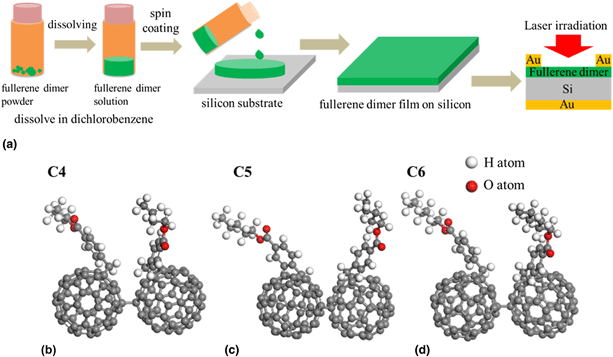
Fullerene dimers have attracted extensive attention due to their unique structures and fascinating properties. Here, fullerene dimer derivatives with four to six carbon atoms in the esters are designed and synthesized. The property differences that caused by the carbon number in the esters of the fullerene dimers are investigated by performing their electrochemical, optical, and photoelectric measurements. As the carbon atom numbers in the esters increase from four to five and six, the absorption intensities increase to 1.6- and 4.4-folds. The intensities of the fluorescence spectra increase to 1.8- and 5.2-folds. Their photocurrent increases to 2- and 7-folds under the irradiation of a 405-nm laser. The LUMO energy levels move downward slightly from −3.89 to −3.90 and −3.92 eV, respectively. Our results indicate that as the carbon number increases, the carbon chain lengths in the ester structures increase, very slight effects produced on the energy levels of the fullerene dimers, but strongly contribute to their chemical activities and thus the photoelectronic efficiencies.
To detect low concentrations of formaldehyde selectively, the sensing properties of SnO2 nanostructured are enhanced by modifying with p-type semiconductor NiO. In this study, a nanostructured SnO2/NiO composite was prepared by a simple hydrothermal method. The X-ray photoelectron spectroscopy (XPS) peak in 532.4 eV proved that the existence of the SnO2/NiO composite structure increased the amount of adsorbed oxygen O− and O2− significantly. Gas-sensing tests showed that these mixed phases SnO2/NiO are highly promising for gas sensor applications, as the gas response for formaldehyde was significantly enhanced in gas response, selectivity at an operating temperature of 230 °C. The sensor fabricated by SnO2/NiO composite can detect as low as 1 ppm of formaldehyde at 230 °C, and the corresponding response is 1.57. The results of physicochemical properties tests of the samples show that the enhancement in sensitivity and selectivity is attributed to the oxygen vacancies and heterojunction between SnO2 and NiO. The SnO2/NiO composites can be applied to sensitive materials of formaldehyde sensors.
Poly(phthalaldehyde) (pPHA) and copolymers with aliphatic aldehydes were investigated as dry-develop, positive-tone photoresist. Exposure of the films loaded with a photoacid generator to 248 nm radiation creates an acid that depolymerizes the polymer into volatile monomers, allowing the development of features by vaporization rather than solution-based processes. By controlling the acid content, the vaporization rate of the reaction products, and the degree of liquid formation of the decomposed polymer, control of spatial resolution and the quality of polyaldehyde dry-develop photoresist was achieved. Heat, vacuum, and forced convection were evaluated as development techniques in determining the resist sensitivity, contrast, and resolution. Forced convection of heated nitrogen was the most controllable development method for pPHA films. Five-micron lines and spaces were printed. Poly(aldehyde) copolymer resins had slightly lower spatial resolution but were able to be developed faster due to higher vapor pressure of the depolymerized monomers. Cold photo-exposures and development were used to prevent detrimental liquid formation of the decomposed copolymers. In addition to exploring new dry-development methods that have not been tested before, these findings offer insights into designing better material systems and optimizing processes for dry-develop photoresists.
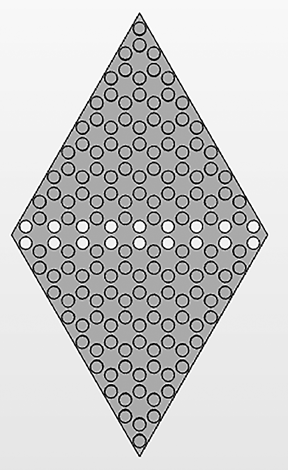
Honeycomb phononic crystal can obtain wider band gaps in the low frequency based on local resonance theory. Its band structure can be adjustable if we change the height of the cores, which means different kinds of honeycomb phononic crystal can be selected on the basis of different damping demands. Meanwhile, the point defects and line defects affect the localized modes of sound waves and propagation characteristics, the dispersion relations and the displacement fields of the eigenmodes are calculated in the defected systems, as well as the propagation behaviors in the frequency ranges of the band structure, which are also discussed in detail. We constructed the model based on the periodic boundary condition and calculated the band structure according to Bloch theory, and also performed a series of simulation through the COMSOL software, showing that honeycomb has excellent features in reducing noise and vibration, which has a far-reaching influence in designing the new type of acoustic wave devices.
Growing zinc oxide (ZnO) nanowires (NWs) on yarns promotes smart sensing and creates opportunities for new applications. ZnO NWs sensing performance is influenced by its dimensions, which can be tailored by controlling the growth parameters. In this study, we investigated the effect of the growth parameters (time, temperature, and precursor concentration ratio) on the NWs’ morphology, dimensions, and piezoelectric performance. Our results showed that ZnO NWs produced with 6 and 9 h had long nanowires; however, they mainly got tangled with the nanowires on the adjacent fibers and peeled-off the fiber surface. Growth at a 1:1 precursor concentration ratio for 9 h produced the same nanowires’ length (~3 μm) as growth at a 3:1 precursor concentration ratio for 3 h. Among all of the studied growth conditions, ZnO NWs produced with a 3:1 precursor concentration ratio at 90 °C for 3 h showed uniform dimensions and stable electrical charge output.
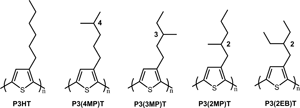
Flexible alkyl side chain in conjugate polymers (CPs) improves the solubility and promotes solution processability, in addition, it affects interchain packing and charge mobilities. Despite the well-known charge mobility and morphology correlation for these semi-crystalline polymers, there is a lack of fundamental understanding of the impact of side chain on their crystallization kinetics. In the present work, isothermal crystallization of five poly(3-alkylthiophene-2,5-diyl) (P3ATs) with different side-chain structures were systematically investigated. To suppress the extremely fast crystallization and trap the sample into amorphous glass, an advanced fast scanning chip calorimetry technique, which is able to quench the sample with few to tens thousands of K/s, was applied. Results show that the crystallization of P3ATs was greatly inhibited after incorporation of branched side chains, as indicated by a dramatic up to six orders of magnitude decrease in the crystallization rate. The suppressed crystallization of P3ATs were correlated with an increased π–π stacking distance due to unfavorable side-chain steric interaction. This work provides a pathway to use side-chain engineering to control the crystallization behavior for CPs, thus to control device performance.
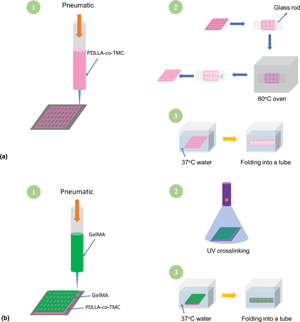
This study investigated a new strategy for fabricating porous scaffolds with the self-folding ability and controlled release of growth factors (GFs) via 3D printing. The scaffolds were a bilayer structure comprising a poly(D,L-lactide-co-trimethylene carbonate) scaffold for providing the shape morphing ability and a gelatin methacrylate scaffold for encapsulating and delivering GF. The structure, shape morphing behavior, GF release, and its effect on stem cell behavior were studied for new scaffolds. The results suggest that these scaffolds have great potential for regenerating tissues such as blood vessels. This work also contributes to developments of 3D printing in tissue engineering.
An ultraviolet (UV) irradiation-based in situ silver nanoparticle (AgNP) synthesis approach has drawn significant attention for functionalizing a great variety of biomaterials. Here, we designed an AgNP-functionalized 3D-printed polylactic acid (PLA) composite scaffold with a green physical approach by employing the UV irradiation (1, 2, and 3 h) method without using any reducing agent or heat treatments. In situ AgNP synthesis was performed under different UV exposure times. The zeta sizer analysis results demonstrated that AgNPs were highly monodisperse with the particle size of 20 ± 2.2, 30 ± 3.6, and 50 ± 4.8 nm under various UV light exposure times. In situ synthesis of AgNPs on 3D-printed PLA scaffolds significantly changed the surface hydrophilicity of the 3D-printed scaffolds. These results showed that UV irradiation-based in situ AgNP synthesis on 3D-printed PLA scaffolds can be useful in various biomedical applications, such as cell culture scaffolds, biosensors, and wound healing applications.
This study presents a dual Eulerian–Lagrangian particle approach for time-accurate computational fluid dynamics (CFD) modeling of volcanic ash in gas turbine engines and initial results. The objective is to enable high-fidelity simulations of calcia–magnesia–alumina-silica (CMAS) particles in gas turbine engines to better predict deposition and particle paths to rapidly test mitigation solutions. The approach uses a primarily first principles framework to account for the various physical phenomena in the system. Particles are modeled using Lagrangian methods which track individual particles and Equilibrium Eulerian methods which track particles in terms of concentration densities. Lagrangian methods become prohibitively expensive for fine particles. Eulerian methods are physically appropriate for fine particles but become inaccurate for large particle sizes. A dual approach using both Eulerian and Lagrangian methods allows for optimal computational cost with maximum accuracy. Simulation results using the proposed approach are compared against experimental data for a representative gas turbine engine blade.
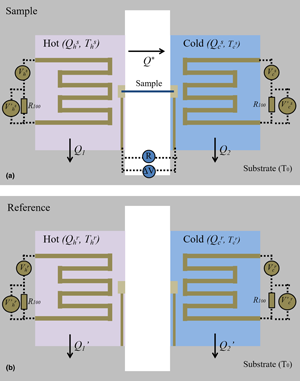
The development of thermoelectric measurement technology at nanoscale is a challenging task. Here, a novel MEMS-based dual temperature control (DTC) measurement method for thermoelectric properties of individual nanowires was proposed. Different from conventional thermal bridge testing devices, this DTC thermoelectric testing device can obtain the thermoelectric properties by independently control ambient temperature and temperature difference between two ends of the nanowires through two separate resistance thermometers without auxiliary heating devices. The reliability of the model and the testing accuracy were verified by accurately measuring the thermal conductivity, electrical conductivity, and the absolute value of the Seebeck coefficient of VO2 nanowires.
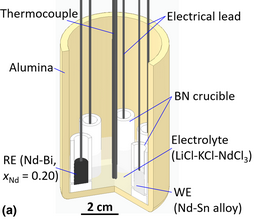
Thermodynamic properties of Nd–Bi and Nd–Sn alloys were determined via electromotive force (emf) measurements at 725–1075 K. The emf measurements of an Nd–Bi alloy at mole fraction xNd = 0.20 were conducted using a solid CaF2–NdF3 electrolyte relative to pure Nd(s). The emf values from the CaF2–NdF3 electrolyte were verified in separate experiments in molten LiCl–KCl–NdCl3 where pure Nd(s) was electrodeposited. The Nd–Bi (xNd = 0.20) exhibited two-phase behavior with a peritectic reaction (L + NdBi = NdBi2) at 926 K from differential scanning calorimetry. The two-phase Nd–Bi (xNd = 0.20) was employed as a stable reference electrode in molten LiCl–KCl–NdCl3 for emf measurements of Nd–Bi (xNd = 0.15–0.40) and Nd–Sn (xNd = 0.10) alloys. The emf measurements of these alloys were reproducible during thermal cycles over 50 h and were used to calculate thermodynamic properties, including the partial molar Gibbs energy, entropy, and enthalpy.
This article reviews the advancements and prospects of liquid cell transmission electron microscopy (TEM) imaging and analysis methods in understanding the nucleation, growth, etching, and assembly dynamics of nanocrystals. The bonding of atoms into nanoscale crystallites produces materials with nonadditive properties unique to their size and geometry. The recent application of in situ liquid cell TEM to nanocrystal development has initiated a paradigm shift, (1) from trial-and-error synthesis to a mechanistic understanding of the “synthetic reactions” responsible for the emergence of crystallites from a disordered soup of reactive species (e.g., ions, atoms, molecules) and shape-defined growth or etching; and (2) from post-processing characterization of the nanocrystals’ superlattice assemblies to in situ imaging and mapping of the fundamental interactions and energy landscape governing their collective phase behaviors. Imaging nanocrystal formation and assembly processes on the single-particle level in solution immediately impacts many existing fields, including materials science, nanochemistry, colloidal science, biology, environmental science, electrochemistry, mineralization, soft condensed-matter physics, and device fabrication.