Refine search
Actions for selected content:
106129 results in Materials Science
Meet our Authors
-
- Journal:
- MRS Bulletin / Volume 38 / Issue 3 / March 2013
- Published online by Cambridge University Press:
- 13 March 2013, pp. 221-222
- Print publication:
- March 2013
-
- Article
-
- You have access
- HTML
- Export citation
MRS volume 38 issue 3 Cover and Back matter
-
- Journal:
- MRS Bulletin / Volume 38 / Issue 3 / March 2013
- Published online by Cambridge University Press:
- 13 March 2013, pp. b1-b2
- Print publication:
- March 2013
-
- Article
-
- You have access
- Export citation
2012 Materials Research Society Fall Meeting emphasizes sustainability, graphene, and other materials highlights: www.mrs.org/fall2012
-
- Journal:
- MRS Bulletin / Volume 38 / Issue 3 / March 2013
- Published online by Cambridge University Press:
- 13 March 2013, pp. 274-276
- Print publication:
- March 2013
-
- Article
-
- You have access
- HTML
- Export citation
CAREER CENTRAL
-
- Journal:
- MRS Bulletin / Volume 38 / Issue 3 / March 2013
- Published online by Cambridge University Press:
- 13 March 2013, pp. 281-287
- Print publication:
- March 2013
-
- Article
-
- You have access
- Export citation
MRC volume 3 issue 1 Cover and Front matter
-
- Journal:
- MRS Communications / Volume 3 / Issue 1 / March 2013
- Published online by Cambridge University Press:
- 21 March 2013, pp. f1-f4
- Print publication:
- March 2013
-
- Article
-
- You have access
- Export citation
Younan Xia to present Kavli Lecture on nanoscience at 2013 MRS Spring Meeting
-
- Journal:
- MRS Bulletin / Volume 38 / Issue 3 / March 2013
- Published online by Cambridge University Press:
- 13 March 2013, p. 280
- Print publication:
- March 2013
-
- Article
-
- You have access
- HTML
- Export citation
Alexandra Boltasseva named 2013 MRS Outstanding Young Investigator for photonics
-
- Journal:
- MRS Bulletin / Volume 38 / Issue 3 / March 2013
- Published online by Cambridge University Press:
- 13 March 2013, p. 279
- Print publication:
- March 2013
-
- Article
-
- You have access
- HTML
- Export citation
Nano Focus: Two-dimensional dielectric monolayer grown on metal-supported graphene
-
- Journal:
- MRS Bulletin / Volume 38 / Issue 3 / March 2013
- Published online by Cambridge University Press:
- 13 March 2013, p. 199
- Print publication:
- March 2013
-
- Article
-
- You have access
- HTML
- Export citation

Ziegler-Natta catalysis: 50 years after the Nobel Prize
-
- Journal:
- MRS Bulletin / Volume 38 / Issue 3 / March 2013
- Published online by Cambridge University Press:
- 13 March 2013, pp. 213-218
- Print publication:
- March 2013
-
- Article
- Export citation
The Effect of Magnesium Substitution on the Hardness of Synthetic and Biogenic Calcite – CORRIGENDUM/ERRATUM
-
- Journal:
- MRS Communications / Volume 3 / Issue 1 / March 2013
- Published online by Cambridge University Press:
- 21 March 2013, p. 79
- Print publication:
- March 2013
-
- Article
-
- You have access
- HTML
- Export citation

Some reflections on the current state of Cr-based polymerization catalysts
-
- Journal:
- MRS Bulletin / Volume 38 / Issue 3 / March 2013
- Published online by Cambridge University Press:
- 13 March 2013, pp. 234-238
- Print publication:
- March 2013
-
- Article
- Export citation
Effect of the ∑5(310)/[001]θ = 53.1° grain boundary on the incipient yield of bicrystal copper: A quasicontinuum simulation and nanoindentation experiment
-
- Journal:
- Journal of Materials Research / Volume 28 / Issue 5 / 14 March 2013
- Published online by Cambridge University Press:
- 21 February 2013, pp. 766-773
- Print publication:
- 14 March 2013
-
- Article
- Export citation
-
To study the initial plasticity during the nanoindentation of face-centered cubic bicrystal materials at the micro- and nanoscales, a $\sum {5(310)/[001]} {\rm{\theta }} = 53.1\circ $ symmetrical tilt grain boundary (GB) model of bicrystal copper was constructed using the quasicontinuum method. The nanoindentation process of the model was then simulated, and a group of indents across the GB during a bicrystal copper nanoindentation experiment were performed. The effect of the GB on the incipient yield was studied when the transition from elastic to plastic deformation and the first dislocation emission occur. The results show that the maximum incipient load appears in the center of the boundary; the load first increases and then gradually decreases until it presents no further significant changes when the indenter is far from the GB. It is observed that theoretical simulation results are in good agreement with those of the experimental measurement. The incipient yield force was affected by the size and the position of the indenter, the structure of the boundary, and the first dislocation emission.
JMR volume 28 issue 4 Cover and Back matter
-
- Journal:
- Journal of Materials Research / Volume 28 / Issue 4 / 28 February 2013
- Published online by Cambridge University Press:
- 18 February 2013, pp. b1-b4
- Print publication:
- 28 February 2013
-
- Article
-
- You have access
- Export citation
JMR volume 28 issue 4 Cover and Front matter
-
- Journal:
- Journal of Materials Research / Volume 28 / Issue 4 / 28 February 2013
- Published online by Cambridge University Press:
- 18 February 2013, pp. f1-f5
- Print publication:
- 28 February 2013
-
- Article
-
- You have access
- Export citation

Enhancement of microwave absorption of polyaniline–PbTiO3 composites prepared by using sodium dodecyl benzene sulfonoic acid
-
- Journal:
- Journal of Materials Research / Volume 28 / Issue 6 / 28 March 2013
- Published online by Cambridge University Press:
- 18 February 2013, pp. 840-847
- Print publication:
- 28 March 2013
-
- Article
- Export citation

Emergence of central mode in the paraelectric phase of ferroelectric perovskites
-
- Journal:
- MRS Communications / Volume 3 / Issue 1 / March 2013
- Published online by Cambridge University Press:
- 12 February 2013, pp. 41-45
- Print publication:
- March 2013
-
- Article
- Export citation

Carbon nanotube-induced formation of vanadium oxide nanorods and nanotubes
-
- Journal:
- Journal of Materials Research / Volume 28 / Issue 4 / 28 February 2013
- Published online by Cambridge University Press:
- 11 February 2013, pp. 627-634
- Print publication:
- 28 February 2013
-
- Article
- Export citation
Computational design of new organics dyes with improved solar absorbance for dye-sensitized solar cells – ERRATUM
-
- Journal:
- MRS Communications / Volume 3 / Issue 1 / March 2013
- Published online by Cambridge University Press:
- 11 February 2013, p. 81
- Print publication:
- March 2013
-
- Article
-
- You have access
- HTML
- Export citation
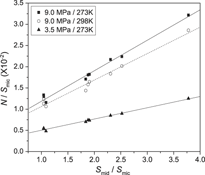
Influence of structure of activated carbon with superhigh specific surface area on hydrogen storage capacity
-
- Journal:
- Journal of Materials Research / Volume 28 / Issue 4 / 28 February 2013
- Published online by Cambridge University Press:
- 11 February 2013, pp. 605-610
- Print publication:
- 28 February 2013
-
- Article
- Export citation

Adhesion behavior of polymer networks with tailored mechanical properties using spherical and flat contacts
-
- Journal:
- MRS Communications / Volume 3 / Issue 1 / March 2013
- Published online by Cambridge University Press:
- 11 February 2013, pp. 73-77
- Print publication:
- March 2013
-
- Article
- Export citation
