To save content items to your account,
please confirm that you agree to abide by our usage policies.
If this is the first time you use this feature, you will be asked to authorise Cambridge Core to connect with your account.
Find out more about saving content to .
To save content items to your Kindle, first ensure no-reply@cambridge.org
is added to your Approved Personal Document E-mail List under your Personal Document Settings
on the Manage Your Content and Devices page of your Amazon account. Then enter the ‘name’ part
of your Kindle email address below.
Find out more about saving to your Kindle.
Note you can select to save to either the @free.kindle.com or @kindle.com variations.
‘@free.kindle.com’ emails are free but can only be saved to your device when it is connected to wi-fi.
‘@kindle.com’ emails can be delivered even when you are not connected to wi-fi, but note that service fees apply.
To overcome the low fabrication yield associated with single crystalline 3C–SiC diaphragm-based high temperature capacitive pressure sensors fabricated by wafer bonding, we have developed an alternative based on a polycrystalline SiC-on-Si architecture. The capacitive pressure sensing element, i.e., a thin film diaphragm, was fabricated using low stress and high conductivity low-pressure chemical vapor deposition poly-SiC thin films, and the sensing architecture was formed by wafer bonding a poly-SiC film to a Si substrate using phosphosilicate glass bonding films. With a geometric aspect ratio of up to 800:1 and a maximum deflection load eight times or more to their thickness, the poly-SiC diaphragm-based sensors presented repeatable pressure sensing characteristics up to 500 °C.
In this work, the relationship between the substrate crystallinity and the on-state resistances of silicon carbide (SiC) photoconductive semiconductor switches (PCSSs) was investigated. PCSSs with different channel lengths were fabricated on semi insulating 6H–SiC having different crystal qualities. A method was introduced for determining the photoconductive capacity of the SiC PCSSs. The experimental data suggest that the photoconductive capacity decreases sharply with the degradation of the full width at half maximum of the rocking curve of the 6H–SiC substrates. It is found that increasing the carrier mobility is a key factor for reducing the on-state resistance of the 6H–SiC PCSSs. Moreover, the results in this work present reference for the selection of 6H–SiC substrates for the fabrication of PCSSs and some other photoelectric devices.
Quantum simulations of oxygen incorporation at a Σ5 grain boundary in yttria-stabilized zirconia (YSZ), a common solid oxide fuel cells (SOFCs) electrolyte, show that the incorporation energy is reduced compared with YSZ with no grain boundaries. The simulation results are supported by electrochemical impedance spectroscopy (EIS) measurements conducted on a single crystalline YSZ substrate with nanogranular interlayered YSZ. EIS results showed that single crystalline YSZ membranes with nanogranular surface (i.e., high grain boundary densities) exhibit small electrode impedances than the reference single crystalline YSZ. The 20-nm-thick nanogranular YSZ interlayer was fabricated by atomic layer deposition and the performance for SOFCs with nanograined interlayer was increased by factor of 2 at operating temperatures between 350 and 450 °C.
In this work, a novel core–shell structured hybrid graphene oxide-encapsulated silica (GO–SiO2) was first fabricated via an electrostatic assembly between negatively charged graphene oxide (GO) sheets and positively charged sub-micro-sized silica. Then, the new kind of hybrid filler was used for the in situ preparation of poly(ethylene terephthalate) (PET)/GO–SiO2 composites. The microstructure and mechanical properties of the prepared composites were analyzed by scanning electron microscopy, transmission electron microscopy, thermogravimetric analysis, dynamic mechanical analysis measurements, and tensile test. It was found that GO could be covalently assembled onto the subsized silica surface via its plenty of functional groups that can also provide strong interaction with the PET. As a result, a uniform dispersion of GO–SiO2 hybrids and enhanced interfacial adhesion as well as improved mechanical property have been evidenced. The new concept of using GO as a potent inorganic fillers surface modifier may broaden the use of GO and provides a new idea for the design and fabrication of advanced polymer composites.
In this study, silicon nanowire (SiNW)/polycaprolactone composites with different surface topographies were fabricated by straightforward embedding or printing methods and their cytocompatibility was evaluated with a bone-relevant cell line derived from mouse stroma. The incorporation of biocompatible polymers with semiconducting SiNWs can ideally provide an enhanced environment to support proliferation and differentiation functions of bone cells. Cell/composite interactions were assessed with suitable assays including viability and alkaline phosphatase activity, while scanning electron microscopy characterization was used to study the morphology of cells grown on composites. Such results suggest that for nanowires in a vertical array, the presence of the polymer improves cellular attachment and overall viability relative to the nanowire-only system.
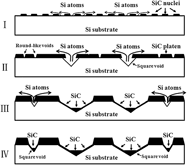
Ultrathin SiC buffer layers have been grown on Si (100) substrates by atmospheric pressure chemical vapor deposition. The evolution of buffer layer morphological properties as a function of carbonization parameters is investigated by atomic force microscopy. Based on the quantitative analysis of the dependences of void density, void depth, void width, and surface roughness on carbonization parameters, a buffer layer growth model is proposed, and the effects of carbonization parameters on buffer layer morphology are clarified. The void density is related to the carbonization temperature, temperature ramp-up rate, and C3H8 concentration by affecting the initial SiC nuclei density. The void size is evolved with processing time and mainly dependent on the carbonization temperature but slightly affected by C3H8 and H2. The buffer layer morphology is deteriorated with increasing H2 flow rate when the C3H8 concentration is fixed.
A quantitative correlation between R-line luminescence at around 1.37 µm and {311} defect nature, size and concentration has been undertaken in silicon, following keV Si-implantation and subsequent annealing using photoluminescence spectroscopy and plan-view transmission electron microscopy. The formation and evolution of the rod-like defects were found to be dependent on annealing time at a temperature of 700 °C, but there was no simple correlation found between the density and size of those defects and the R-line intensity. In particular, whereas the presence of {311} defects is essential for observing R-line luminescence, both very small {311} defects at short annealing times and fully developed {311} defects at long annealing times do not contribute to such luminescence. We provide possible explanations for this behavior and suggest that the local (strain) environment around defects, the dopant level and impurities in the silicon substrate may all play a role in determining R-line intensity.
A cosolvent spray pyrolysis process was used for the generation of micrometer-sized pure copper particles. Ethylene glycol (EG) and ethanol (ET) were selected as cosolvents, and their effects on particle morphology and composition were systematically investigated. Experimental results showed that oxide-free copper particles could be generated at temperatures greater than 400 °C with either cosolvent. Hollow particles with cracks were generated with ET at temperatures from 400 to 1000 °C, whereas EG promoted the formation of porous particles at temperatures up to 600 °C and hollow shell particles with smooth surfaces at 875 and 1000 °C. Results from short residence time experiments indicated that, during the generation process, lamellar and fragment-like copper hydroxy nitrate [Cu2(OH)3NO3] precipitated when EG and ET were used respectively. Cu2(OH)3NO3 then decomposed to cupric oxide (CuO) and cuprous oxide (Cu2O). Finally the oxides were reduced to copper (Cu) in the reducing atmosphere created by EG and ET.
A method is presented for the identification of plastic material properties, i.e., yield strength and work hardening rate, using the residual imprint geometry formed by a spheroconical indentation. A corresponding finite element simulation with the same tip geometry and maximum as applied in the indentation experiment yields a numerical imprint profile. Then, the imprint profiles resulting from simulation and experiment are compared, and the material parameters of the simulation are varied by an optimization procedure until a satisfying agreement between simulation and experiment is established. At this stage, the material parameters used for the simulation represent the true material properties. It is shown that this procedure yields unique results that are furthermore verified by independent uniaxial straining experiments. Finally, the reliability of this method with special emphasis on its sensitivity with respect to measurement errors of the imprint geometry is demonstrated. Hence, it is concluded that the residual imprint can be regarded as the fingerprint of a material that contains sufficient information on plastic material behavior to uniquely extract values for yield strength and work hardening rate.
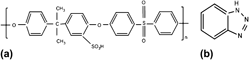
As anhydrous proton conductive membranes, sulfonated polysulfone (SPSU) and 1H-1,2,3-benzotriazole (BTri) hybrid membranes were prepared. The sulfonation of polysulfone was performed with trimethylsilyl chlorosulfonate, and high degree of sulfonation (134%) was obtained. The polymer electrolyte membranes, SPSU–BTriX, were prepared by blending of 1H-1,2,3-benzotriazole in SPSU. FTIR confirmed the sulfonation of PSU and the ionic interaction between sulfonic acid and benzotriazole units. Thermogravimetric analysis (TGA) analysis showed that the polymer electrolyte membranes are thermally stable up to approximately 200 °C. Scanning electron microscopy analysis indicated the homogeneity of the membranes. The maximum proton conductivity has been measured for SPSU–BTri2 as 3.6 × 10⁻³S/cm at 150 °C.
This book introduces the reader to methods of selecting materials for engineering applications. With the rapid growth in the variety of manufacturing materials available, the choice of the optimum material for an engineering design is of increasing importance and difficulty. Materials have to be chosen that satisfy several, often conflicting, criteria including strength, durability, flammability, and cost. The author, an acknowledged expert on materials, provides a guide to many of the classes of engineering materials currently available. He includes tables and lists of standards, along with lists of consultants' addresses and references. Materials covered include metals, ceramics, polymers, and composites, and there are chapters on surface finishes, materials' performance, and the impact of manufacturing processes on design possibilities.
This undergraduate textbook merges traditional solid state physics with contemporary condensed matter physics, providing an up-to-date introduction to the major concepts that form the foundations of condensed materials. The main foundational principles are emphasized, providing students with the knowledge beginners in the field should understand. The book is structured in four parts and allows students to appreciate how the concepts in this broad area build upon each other to produce a cohesive whole as they work through the chapters. Illustrations work closely with the text to convey concepts and ideas visually, enhancing student understanding of difficult material, and end-of-chapter exercises varying in difficulty allow students to put into practice the theory they have covered in each chapter and reinforce new concepts.
Positron annihilation lifetime measurements are performed for sol–gel-derived 70 mol% SiO2–30 mol% CaO bioactive glass. Strong positronium formation processes are shown to be an inherent feature for these kinds of materials. Observed orthopositronium (o-Ps) lifetimes show a three-modal distribution with lifetime values weighed at ∼2, ∼18, and ∼70 ns. The exposure of the investigated sol–gel-derived bioactive glasses to water vapor significantly modifies o-Ps lifetime distribution due to the penetration of water molecules into the nanopores, indicating high ratio of their interconnectivity. Classic Tao–Eldrup equation is used to relate the o-Ps lifetimes with the size of nanopores, whose distribution is verified by nitrogen adsorption porosimetry.