To save content items to your account,
please confirm that you agree to abide by our usage policies.
If this is the first time you use this feature, you will be asked to authorise Cambridge Core to connect with your account.
Find out more about saving content to .
To save content items to your Kindle, first ensure no-reply@cambridge.org
is added to your Approved Personal Document E-mail List under your Personal Document Settings
on the Manage Your Content and Devices page of your Amazon account. Then enter the ‘name’ part
of your Kindle email address below.
Find out more about saving to your Kindle.
Note you can select to save to either the @free.kindle.com or @kindle.com variations.
‘@free.kindle.com’ emails are free but can only be saved to your device when it is connected to wi-fi.
‘@kindle.com’ emails can be delivered even when you are not connected to wi-fi, but note that service fees apply.
We are interested in non-negative non-trivial solutions of
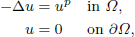
where 1 < p and Ω is a bounded smooth domain in ℝN with 3 ⩽ N ⩽ 9. We show that given a non-negative integer M there is some large p(M,Ω) such that the only non-negative solution u, of Morse index at most M, is u = 0.
We study the following polyharmonic Hénon equation:

where (m)* = 2N/(N – 2m) is the critical exponent, B1(0) is the unit ball in ℝN, N ⩾ 2m + 2 and K(|y|) is a bounded function. We prove the existence of infinitely many non-radial positive solutions, whose energy can be made arbitrarily large.
where Ω = ℝN or Ω = B1, N ⩾ 3, p > 1 and . Using a suitable map we transform problem (1) into another one without the singularity 1/|x|2. Then we obtain some bifurcation results from the radial solutions corresponding to some explicit values of λ.

We answer a question of Takesaki by showing that the following can be derived from the thesis of Shen: if A and B are σ-unital hereditary C*-subalgebras of C such that ‖p – q‖ < 1, where p and q are the corresponding open projections, then A and B are isomorphic. We give some further elaborations and counterexamples with regard to the σ-unitality hypothesis. We produce a natural one-to-one correspondence between complete order isomorphisms of C*-algebras and invertible left multipliers of imprimitivity bimodules. A corollary of the above two results is that any complete order isomorphism between σ-unital C*-algebras is the composite of an isomorphism with an inner complete order isomorphism. We give a separable counterexample to a question of Akemann and Pedersen; namely, the space of quasi-multipliers is not linearly generated by left and right multipliers. But we show that the space of quasi-multipliers is multiplicatively generated by left and right multipliers in the σ-unital case. In particular, every positive quasi-multiplier is of the form T*T for T a left multiplier. We show that a Lie theory consequence of the negative result just stated is that the map sending T to T*T need not be open, even for very nice C*-algebras. We show that surjective maps between σ-unital C*-algebras induce surjective maps on left, right, and quasi-multipliers. (The more significant similar result for multipliers is Pedersen's non-commutative Tietze extension theorem.) We elaborate the relations of the above with continuous fields of Hilbert spaces and in so doing answer a question of Dixmier and Douady. We discuss the relationship of our results to the theory of perturbations of C*-algebras.
We consider the Steklov eigenvalues of the Laplace operator as limiting Neumann eigenvalues in a problem of mass concentration at the boundary of a ball. We discuss the asymptotic behaviour of the Neumann eigenvalues and find explicit formulae for their derivatives in the limiting problem. We deduce that the Neumann eigenvalues have a monotone behaviour in the limit and that Steklov eigenvalues locally minimize the Neumann eigenvalues.
In this paper we study certain sheaves of $p$-adically complete rings of differential operators on semistable models of the projective line over the ring of integers in a finite extension $L$ of $\mathbb{Q}_{p}$. The global sections of these sheaves can be identified with (central reductions of) analytic distribution algebras of wide open congruence subgroups. It is shown that the global sections functor furnishes an equivalence between the categories of coherent module sheaves and finitely presented modules over the distribution algebras. Using the work of M. Emerton, we then describe admissible representations of $\text{GL}_{2}(L)$ in terms of sheaves on the projective limit of these formal schemes. As an application, we show that representations coming from certain equivariant line bundles on Drinfeld’s first étale covering of the $p$-adic upper half plane are admissible.
Anticipating the formal definition below, we note that a wavelet is a function ψ ∊ L2(ℝ) whose scaled, dilated, translated copies ψj,k for j, k ∊ ℤ form an orthonormal basis for i > L2(ℝ). Given such a function, the results of Section 4.6 tell us that any function in L2(ℝ) can be expressed as a Fourier series with respect to the functions ψj,k, though we will usually call such a series a wavelet series and the corresponding Fourier coefficients the wavelet coefficients. All of this, of course, corresponds exactly to what we know from earlier chapters in the specific case of the Haar wavelet H.
Recall from Section 2.3 that for k = 0, 1, 2, … we denote by Ck(I) the space of functions on an interval I which have continuous derivatives up to and including order k. Note that the case k = 0 is included: C0(I) is just C(I), the space of continuous functions on I. Further, recall that we define C∞(I) to be the space of infinitely differentiable functions on I. Terms such as smooth and smoothness are often used in an informal way to describe the location of a function in the hierarchy of spaces Ck(ℝ); a function in Ck+1(ℝ) might be said to be smoother than one in Ck(ℝ), for example.
Applications of wavelets usually call for the use of wavelets that satisfy specific conditions of one kind or another, and the condition that a wavelet have some degree of smoothness is almost universal. The minimal requirement for a wavelet in practice is therefore usually continuity (membership of C0(ℝ)), though a higher order of smoothness might well be preferred (membership of C1(ℝ) or C2(ℝ), for example). This means that we need to have methods for finding wavelets that are smoother than the Haar wavelet, which is not continuous and so is not in Ck(ℝ) for any k ≥ 0.
For example, consider the use of wavelets for data compression. (This will often involve data in several dimensions – an image file is an obvious two-dimensional example – while we are only considering wavelets in one dimension, in L2(ℝ), but the principle is essentially the same.)
Given the largely introductory nature of this book, the decision was made early on not to include explicit references to the literature in the main text. However, for the reader who wants pointers to sources, this appendix provides them.
It should be said that the coverage of the literature here is quite selective, and the appendix is very far from forming a literature survey. Roughly, three types of references are included. First, there are references of a general nature on certain topics, which are introduced not so much as sources for particular results in the main text but as accounts of bodies of theory as a whole. Second, there are references that are used as sources for specific results, though our formulations may be less general than those referred to. Third, there are references to advanced material that is mentioned or hinted at in the text but is beyond the scope of the text.
Some references are undergraduate-level mathematical texts, some are texts at a more advanced level, and some are expository or research articles from mathematical journals. We generally do not list sources in detail for material that is essentially standard and that is therefore covered by many texts, since the reader will have no difficulty locating suitable references. Since the focus thus tends to be on the less standard material, a consequence is that the density of our coverage of sources tends to increase from chapter to chapter.
When there are several relevant texts on a topic, the selection made here is often a personal one, and failure to mention a particular text should not be taken as implicit disparagement. Any reader who does not have access to the specific texts mentioned or prefers to look for other styles of presentation will find that numerous standard texts are available which cover virtually all the topics of Chapters 2, 3 and 4.
Chapters 1 to 4: general comments. Since Chapter 1 is the book in microcosm, all its topics are treated in more detail and with more rigour later in the book, and so we give no references specifically for this chapter. Neither do we list references for linear algebra, the subject of Chapter 2.
We prove a strong optimal Hardy–Sobolev inequality for the twisted Laplacian on ℂn. The twisted Laplacian is the magnetic Laplacian for a system of n particles in the plane, corresponding to the constant magnetic field. The inequality we obtain is strong optimal in the sense that the weight cannot be improved. We also show that our result extends to a one-parameter family of weighted Sobolev spaces.
In the previous chapters, we have developed the general ideas necessary to be able to speak with precision about wavelets and wavelet series. The key concepts were those of Hilbert spaces and of orthonormal bases and Fourier series in Hilbert spaces, and we have seen that Haar wavelet series are
examples of such series.
But although we have developed a substantial body of relevant background material, we have so far developed no general theory of wavelets. Indeed, the simple and rather primitive Haar wavelet is the only wavelet we have encountered, and we have not even hinted at ways of constructing other wavelets, perhaps with ‘better’ properties than the Haar wavelet, or at the desirability of being able to do so. These are the issues that we turn to in the final chapters of the book.
Specifically, our major remaining goals are as follows:
• to develop a general framework, called a multiresolution analysis, for the construction of wavelets;
• to develop within this framework as much of the general theory of wavelets as our available methods allow; and
• to use that theory to show how other wavelets can be constructed with certain specified properties, culminating in the construction of the infinite family of wavelets known as the Daubechies wavelets, of which the Haar wavelet is just the first member.
The main aim of the present short chapter is to introduce the idea of a multiresolution analysis by defining and studying the multiresolution analysis that corresponds to the Haar wavelet.
The Haar Wavelet Multiresolution Analysis
The concept of a multiresolution analysis was developed in about 1986 by the French mathematicians Stéphane Mallat and Yves Meyer, providing a framework for the systematic creation of wavelets, a role which it still retains. Mirroring all of our discussion of wavelets up to this point, we will introduce the idea of a multiresolution analysis by first examining it carefully in the specific case of the Haar wavelet. As we have found in our previous discussion, the Haar wavelet is simple enough for us to see in a very concrete fashion how the various constructions and arguments work.
We have noted in previous chapters that the usual approach to the theory of wavelets makes use of the Fourier transform. Application of the transform allows all the problems we want to solve to be ‘translated’ into a different form, where a different range of techniques can usually be applied to help solve them; and since there is also a ‘translation’ back in the other direction, solutions obtained in this way give us solutions to the original problems.
Anything approaching a full discussion of this approach is impossible in this book. If the Fourier transform is to be discussed in any depth, a substantial body of other theory (Lebesgue integration theory, in particular) needs to be developed first. A proper discussion of the transform itself is then a non-trivial application of this background work, and the application to wavelets itself is again non-trivial. While all this work certainly repays the effort, this book is not the place to attempt it.
Nevertheless, the Fourier transform approach is the subject of this chapter. We aim to explore the structure of wavelet theory with the extra insight given by use of the Fourier transform, though necessarily without many proofs. As in the previous chapters, it is possible to proceed usefully in this way – as, for example, in our discussion of Lebesgue integration earlier, where we introduced just enough of the ideas and results to allow our discussion to proceed. Thus although the going will be somewhat easier for a reader with a deeper level of background knowledge than that relied on in earlier chapters, we do not assume such knowledge.
The Complex Case
Our attention so far in this text has been exclusively on real-valued structures: our vector and inner product space theory has been for spaces over the field of real numbers, and the specific space L2(∝) which has been the location for our wavelet theory is a space of real-valued functions. However, the Fourier transform is intrinsically an operator on complex-valued functions, so it is necessary for us to spend some time systematically shifting our focus from the real to the complex case.
The overall aim of this book is to provide an introduction to the theory of wavelets for students with a mathematical background at senior undergraduate level. The text grew from a set of lecture notes that I developed while teaching a course on wavelets at that level over a number of years at the University of Wollongong.
Although the topic of wavelets is somewhat specialised and is certainly not a standard one in the typical undergraduate syllabus, it is nevertheless an attractive one for introduction to students at that level. This is for several reasons, including its topicality and the intrinsic interest of its fundamental ideas. Moreover, although a comprehensive study of the theory of wavelets makes the use of advanced mathematics unavoidable, it remains true that substantial parts of the theory can, with care, be made accessible at the undergraduate level.
The book assumes familiarity with finite-dimensional vector spaces and the elements of real analysis, but it does not assume exposure to analysis at an advanced level, to functional analysis, to the theory of Lebesgue integration and measure or to the theory of the Fourier integral transform. Knowledge of all these topics and more is assumed routinely in all full accounts of wavelet theory, which make heavy use of the Lebesgue and Fourier theories in particular.
The approach adopted here is therefore what is often referred to as ‘elementary’. Broadly, full proofs of results are given precisely to the extent that they can be constructed in a form that is consistent with the relatively modest assumptions made about background knowledge. A number of central results in the theory of wavelets are by their nature deep and are not amenable in any straightforward way to an elementary approach, and a consequence is that while most results in the earlier parts of the book are supplied with complete proofs, a few of those in the later parts are given only partial proofs or are proved only in special cases or are stated without proof.

