Refine search
Actions for selected content:
26078 results in Abstract analysis
Index
-
- Book:
- Wavelets
- Published online:
- 23 February 2017
- Print publication:
- 11 January 2017, pp 262-264
-
- Chapter
- Export citation
Determinantal Systems of Points.
-
- Journal:
- Proceedings of the Edinburgh Mathematical Society / Volume 34 / February 1915
- Published online by Cambridge University Press:
- 11 January 2017, pp. 155-159
-
- Article
-
- You have access
- Export citation
Numerical Approximations to Extremal Toric Kähler Metrics with Arbitrary Kähler Class
- Part of
-
- Journal:
- Proceedings of the Edinburgh Mathematical Society / Volume 60 / Issue 4 / November 2017
- Published online by Cambridge University Press:
- 10 January 2017, pp. 893-910
-
- Article
- Export citation
-
We develop new algorithms for approximating extremal toric Kähler metrics. We focus on an extremal metric on
 , which is conformal to an Einstein metric (the Chen–LeBrun–Weber metric). We compare our approximation to one given by Bunch and Donaldson and compute various geometric quantities. In particular, we demonstrate a small eigenvalue of the scalar Laplacian of the Einstein metric that gives numerical evidence that the Einstein metric is conformally unstable under Ricci flow.
 , which is conformal to an Einstein metric (the Chen–LeBrun–Weber metric). We compare our approximation to one given by Bunch and Donaldson and compute various geometric quantities. In particular, we demonstrate a small eigenvalue of the scalar Laplacian of the Einstein metric that gives numerical evidence that the Einstein metric is conformally unstable under Ricci flow.
A Fractal Operator on Some Standard Spaces of Functions
- Part of
-
- Journal:
- Proceedings of the Edinburgh Mathematical Society / Volume 60 / Issue 3 / August 2017
- Published online by Cambridge University Press:
- 10 January 2017, pp. 771-786
-
- Article
- Export citation
-
Through appropriate choices of elements in the underlying iterated function system, the methodology of fractal interpolation enables us to associate a family of continuous self-referential functions with a prescribed real-valued continuous function on a real compact interval. This procedure elicits what is referred to as an α-fractal operator on
 , the space of all real-valued continuous functions defined on a compact interval I. With an eye towards connecting fractal functions with other branches of mathematics, in this paper we continue to investigate the fractal operator in more general spaces such as the space
  of all bounded functions and the Lebesgue space
  , and in some standard spaces of smooth functions such as the space
  of k-times continuously differentiable functions, Hölder spaces
  and Sobolev spaces
  . Using properties of the α-fractal operator, the existence of Schauder bases consisting of self-referential functions for these function spaces is established.
 , the space of all real-valued continuous functions defined on a compact interval I. With an eye towards connecting fractal functions with other branches of mathematics, in this paper we continue to investigate the fractal operator in more general spaces such as the space
  of all bounded functions and the Lebesgue space
  , and in some standard spaces of smooth functions such as the space
  of k-times continuously differentiable functions, Hölder spaces
  and Sobolev spaces
  . Using properties of the α-fractal operator, the existence of Schauder bases consisting of self-referential functions for these function spaces is established.
Derivation and solution of effective medium equations for bulk heterojunction organic solar cells
-
- Journal:
- European Journal of Applied Mathematics / Volume 28 / Issue 6 / December 2017
- Published online by Cambridge University Press:
- 10 January 2017, pp. 973-1014
-
- Article
-
- You have access
- Export citation
Defining Coarsenings of Valuations
- Part of
-
- Journal:
- Proceedings of the Edinburgh Mathematical Society / Volume 60 / Issue 3 / August 2017
- Published online by Cambridge University Press:
- 10 January 2017, pp. 665-687
-
- Article
- Export citation
-
We study the question of which Henselian fields admit definable Henselian valuations (with or without parameters). We show that every field that admits a Henselian valuation with non-divisible value group admits a parameter-definable (non-trivial) Henselian valuation. In equicharacteristic 0, we give a complete characterization of Henselian fields admitting a parameter-definable (non-trivial) Henselian valuation. We also obtain partial characterization results of fields admitting
 -definable (non-trivial) Henselian valuations. We then draw some Galois-theoretic conclusions from our results.
 -definable (non-trivial) Henselian valuations. We then draw some Galois-theoretic conclusions from our results.
The Hausdorff Dimension is Convex on the Left Side of 1/4
- Part of
-
- Journal:
- Proceedings of the Edinburgh Mathematical Society / Volume 60 / Issue 4 / November 2017
- Published online by Cambridge University Press:
- 10 January 2017, pp. 911-936
-
- Article
- Export citation
Examples of K-Unstable Fano Manifolds with the Picard Number 1
- Part of
-
- Journal:
- Proceedings of the Edinburgh Mathematical Society / Volume 60 / Issue 4 / November 2017
- Published online by Cambridge University Press:
- 09 January 2017, pp. 881-891
-
- Article
- Export citation
On Lorentzian surfaces in ℝ2,2
- Part of
-
- Journal:
- Proceedings of the Royal Society of Edinburgh. Section A: Mathematics / Volume 147 / Issue 1 / February 2017
- Published online by Cambridge University Press:
- 06 January 2017, pp. 61-88
- Print publication:
- February 2017
-
- Article
- Export citation
Existence results for semilinear problems in the two-dimensional hyperbolic space involving critical growth
- Part of
-
- Journal:
- Proceedings of the Royal Society of Edinburgh. Section A: Mathematics / Volume 147 / Issue 1 / February 2017
- Published online by Cambridge University Press:
- 06 January 2017, pp. 141-176
- Print publication:
- February 2017
-
- Article
- Export citation
-
We consider semilinear elliptic problems on two-dimensional hyperbolic space. A model problem of our study is

where H 1(𝔹2) denotes the Sobolev space on the disc model of the hyperbolic space and f(x, t) denotes the function of critical growth in dimension 2. We first establish the Palais–Smale (PS) condition for the functional corresponding to the above equation, and using the PS condition we obtain existence of solutions. In addition, using a concentration argument, we also explore existence of infinitely many sign-changing solutions.
On Teter rings
- Part of
-
- Journal:
- Proceedings of the Royal Society of Edinburgh. Section A: Mathematics / Volume 147 / Issue 1 / February 2017
- Published online by Cambridge University Press:
- 06 January 2017, pp. 125-139
- Print publication:
- February 2017
-
- Article
- Export citation
Normal developable surfaces of surfaces along curves
- Part of
-
- Journal:
- Proceedings of the Royal Society of Edinburgh. Section A: Mathematics / Volume 147 / Issue 1 / February 2017
- Published online by Cambridge University Press:
- 06 January 2017, pp. 177-203
- Print publication:
- February 2017
-
- Article
- Export citation
Corrigendum and Addendum: Abstract M- and Abstract L-Spaces of Polynomials on Banach Lattices
- Part of
-
- Journal:
- Proceedings of the Edinburgh Mathematical Society / Volume 60 / Issue 4 / November 2017
- Published online by Cambridge University Press:
- 06 January 2017, pp. 877-879
-
- Article
- Export citation
JMJ volume 16 Issue 1 Cover and Front matter
-
- Journal:
- Journal of the Institute of Mathematics of Jussieu / Volume 16 / Issue 1 / February 2017
- Published online by Cambridge University Press:
- 05 January 2017, pp. f1-f2
- Print publication:
- February 2017
-
- Article
-
- You have access
- Export citation
JMJ volume 16 Issue 1 Cover and Back matter
-
- Journal:
- Journal of the Institute of Mathematics of Jussieu / Volume 16 / Issue 1 / February 2017
- Published online by Cambridge University Press:
- 05 January 2017, pp. b1-b4
- Print publication:
- February 2017
-
- Article
-
- You have access
- Export citation
On the Asphericity of a Family of Positive Relative Group Presentations
- Part of
-
- Journal:
- Proceedings of the Edinburgh Mathematical Society / Volume 60 / Issue 3 / August 2017
- Published online by Cambridge University Press:
- 05 January 2017, pp. 545-564
-
- Article
- Export citation
-
Excluding four exceptional cases, we determine the asphericity of the relative presentation
 for m ⩾ 2. If H = ⟨g, h⟩ ⩽ G, then the exceptional cases occur when H is isomorphic to C 5 or C 6.
 for m ⩾ 2. If H = ⟨g, h⟩ ⩽ G, then the exceptional cases occur when H is isomorphic to C
 Splitting Numbers of Links
- Part of
-
- Journal:
- Proceedings of the Edinburgh Mathematical Society / Volume 60 / Issue 3 / August 2017
- Published online by Cambridge University Press:
- 03 January 2017, pp. 587-614
-
- Article
- Export citation
On the Global Gaussian Lipschitz Space
- Part of
-
- Journal:
- Proceedings of the Edinburgh Mathematical Society / Volume 60 / Issue 3 / August 2017
- Published online by Cambridge University Press:
- 03 January 2017, pp. 707-720
-
- Article
- Export citation
-
It is well known that the standard Lipschitz space in Euclidean space, with exponent α ∈ (0, 1), can be characterized by means of the inequality
 , where
  is the Poisson integral of the function f. There are two cases: one can either assume that the functions in the space are bounded, or one can not make such an assumption. In the setting of the Ornstein–Uhlenbeck semigroup in ℝn , Gatto and Urbina defined a Lipschitz space by means of a similar inequality for the Ornstein–Uhlenbeck Poisson integral, considering bounded functions. In a preceding paper, the authors characterized that space by means of a Lipschitz-type continuity condition. The present paper defines a Lipschitz space in the same setting in a similar way, but now without the boundedness condition. Our main result says that this space can also be described by a continuity condition. The functions in this space turn out to have at most logarithmic growth at infinity.
 , where
  is the Poisson integral of the function f. There are two cases: one can either assume that the functions in the space are bounded, or one can not make such an assumption. In the setting of the Ornstein–Uhlenbeck semigroup in ℝ
ARRANGEMENTS OF HOMOTHETS OF A CONVEX BODY
- Part of
-
- Journal:
- Mathematika / Volume 63 / Issue 2 / 2017
- Published online by Cambridge University Press:
- 09 August 2017, pp. 696-710
- Print publication:
- 2017
-
- Article
- Export citation
-
Answering a question of Füredi and Loeb [On the best constant for the Besicovitch covering theorem. Proc. Amer. Math. Soc.121(4) (1994), 1063–1073], we show that the maximum number of pairwise intersecting homothets of a $d$ -dimensional centrally symmetric convex body $K$ , none of which contains the center of another in its interior, is at most $O(3^{d}d\log d)$ . If $K$ is not necessarily centrally symmetric and the role of its center is played by its centroid, then the above bound can be replaced by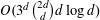 $O(3^{d}\binom{2d}{d}d\log d)$ . We establish analogous results for the case where the center is defined as an arbitrary point in the interior of $K$ . We also show that, in the latter case, one can always find families of at least $\unicode[STIX]{x1D6FA}((2/\sqrt{3})^{d})$ translates of $K$ with the above property.


POINT DISTRIBUTIONS IN COMPACT METRIC SPACES
- Part of
-
- Journal:
- Mathematika / Volume 63 / Issue 3 / 2017
- Published online by Cambridge University Press:
- 29 November 2017, pp. 1152-1171
- Print publication:
- 2017
-
- Article
- Export citation
