Refine search
Actions for selected content:
26078 results in Abstract analysis
A Study of the Length Function of Generalized Fractions of Modules
- Part of
-
- Journal:
- Proceedings of the Edinburgh Mathematical Society / Volume 60 / Issue 3 / August 2017
- Published online by Cambridge University Press:
- 02 November 2016, pp. 721-737
-
- Article
- Export citation
-
Let
 be a Noetherian local ring and let M be a finitely generated R-module of dimension d. Let
  be a system of parameters of M and let
  be a d-tuple of positive integers. In this paper we study the length of generalized fractions M(1/(x 1, … , xd , 1)), which was introduced by Sharp and Hamieh. First, we study the growth of the function
Then we give an explicit calculation for the function
 in the case in which M admits a certain Macaulay extension. Most previous results on this topic are improved in a clearly understandable way.
 be a Noetherian local ring and let M be a finitely generated R-module of dimension d. Let
  be a system of parameters of M and let
  be a d-tuple of positive integers. In this paper we study the length of generalized fractions M(1/(x
 in the case in which M admits a certain Macaulay extension. Most previous results on this topic are improved in a clearly understandable way.
Multiple solutions for a critical fractional elliptic system involving concave–convex nonlinearities
- Part of
-
- Journal:
- Proceedings of the Royal Society of Edinburgh. Section A: Mathematics / Volume 146 / Issue 6 / December 2016
- Published online by Cambridge University Press:
- 27 October 2016, pp. 1167-1193
- Print publication:
- December 2016
-
- Article
- Export citation
-
We are concerned with the multiplicity of solutions to the system driven by a fractional operator with homogeneous Dirichlet boundary conditions. Namely, using fibering maps and the Nehari manifold, we obtain multiple solutions to the following fractional elliptic system:
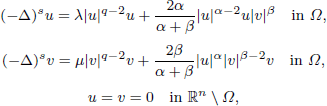
where Ω is a smooth bounded set in ℝn , n > 2s, with s ∈ (0, 1); (–Δ)s is the fractional Laplace operator;, λ, μ > 0 are two parameters; the exponent n/(n – 2s) ⩽ q < 2; α > 1, β > 1 satisfy
 is the fractional critical Sobolev exponent.
 is the fractional critical Sobolev exponent.
On the number of topological orbits of complex germs in
 classes (xy, xa + yb )
- Part of
-
- Journal:
- Proceedings of the Royal Society of Edinburgh. Section A: Mathematics / Volume 147 / Issue 1 / February 2017
- Published online by Cambridge University Press:
- 27 October 2016, pp. 205-224
- Print publication:
- February 2017
-
- Article
- Export citation
-
We show that there exist an infinite number of topological orbits in
classes of complex map germs from the plane to the plane that have a representative of type (xy, xa + yb ), with (a, b) ≠ = (2, 3) or (2, 5). Our key tool to prove this existence is the existence (or not) of stems in the class; these germs are not  -finitely determined and allow the determination of a non-finite number of topological orbits. We also show that the class (xy, x 2 + y 5) has two topological orbits.
 classes (xy, x
 -finitely determined and allow the determination of a non-finite number of topological orbits. We also show that the
 A note on waveless subcritical flow past symmetric bottom topography
-
- Journal:
- European Journal of Applied Mathematics / Volume 28 / Issue 4 / August 2017
- Published online by Cambridge University Press:
- 26 October 2016, pp. 562-575
-
- Article
- Export citation
Exponentially accurate Hamiltonian embeddings of symplectic A-stable Runge–Kutta methods for Hamiltonian semilinear evolution equations
- Part of
-
- Journal:
- Proceedings of the Royal Society of Edinburgh. Section A: Mathematics / Volume 146 / Issue 6 / December 2016
- Published online by Cambridge University Press:
- 25 October 2016, pp. 1265-1301
- Print publication:
- December 2016
-
- Article
- Export citation
Extremal Beltrami Differentials of Non-Landslide Type
- Part of
-
- Journal:
- Proceedings of the Edinburgh Mathematical Society / Volume 60 / Issue 2 / May 2017
- Published online by Cambridge University Press:
- 25 October 2016, pp. 519-526
-
- Article
- Export citation
Multiplicity of Multi-Bump Type Nodal Solutions for A Class of Elliptic Problems with Exponential Critical Growth in ℝ2
- Part of
-
- Journal:
- Proceedings of the Edinburgh Mathematical Society / Volume 60 / Issue 2 / May 2017
- Published online by Cambridge University Press:
- 25 October 2016, pp. 273-297
-
- Article
- Export citation
-
In this paper we establish the existence and multiplicity of multi-bump nodal solutions forthe class of problems

where λ ∈ (0, ∞), f is a continuous function with exponential critical growth and V : ℝ2→ ℝ is a continuous function verifying some hypotheses.
Morse Theory and the Lusternik–Schnirelmann Category of Quaternionic Grassmannians
- Part of
-
- Journal:
- Proceedings of the Edinburgh Mathematical Society / Volume 60 / Issue 2 / May 2017
- Published online by Cambridge University Press:
- 25 October 2016, pp. 441-449
-
- Article
- Export citation
-
The Lusternik–Schnirelmann category of the quaternionic Grassmannian

is known to be k(n − k). In this paper we show that this result can be deduced from Morse theory.
Asymptotic behaviour and symmetry of positive solutions to nonlinear elliptic equations in a half-space
- Part of
-
- Journal:
- Proceedings of the Royal Society of Edinburgh. Section A: Mathematics / Volume 146 / Issue 6 / December 2016
- Published online by Cambridge University Press:
- 25 October 2016, pp. 1243-1263
- Print publication:
- December 2016
-
- Article
- Export citation
-
We consider the following equation:

where d(x) = d(x, ∂Ω), θ > –2 and Ω is a half-space. The existence and non-existence of several kinds of positive solutions to this equation when
 , f(u) = up (p > 1) and Ω is a bounded smooth domain were studied by Bandle, Moroz and Reichel in 2008. Here, we study exact the behaviour of positive solutions to this equation as d(x) → 0+ and d(x) → ∞, respectively, and the symmetry of positive solutions when , Ω is a half-space and f(u) is a more general nonlinearity term than up . Under suitable conditions for f, we show that the equation has a unique positive solution W, which is a function of x 1 only, and W satisfies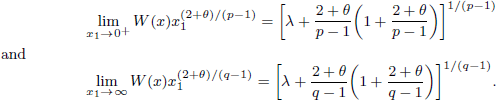
 , f(u) = u

The Theory of H(b) Spaces
-
- Published online:
- 20 October 2016
- Print publication:
- 20 October 2016
26 - Operators on H(b) spaces with b extreme
-
- Book:
- The Theory of <I>H</I>(<I>b</I>) Spaces
- Published online:
- 20 October 2016
- Print publication:
- 20 October 2016, pp 377-401
-
- Chapter
- Export citation
References
-
- Book:
- The Theory of <I>H</I>(<I>b</I>) Spaces
- Published online:
- 20 October 2016
- Print publication:
- 20 October 2016, pp 603-613
-
- Chapter
- Export citation
Dedication
-
- Book:
- The Theory of <I>H</I>(<I>b</I>) Spaces
- Published online:
- 20 October 2016
- Print publication:
- 20 October 2016, pp v-vi
-
- Chapter
- Export citation
18 - The structure of H(b) and H(b)
-
- Book:
- The Theory of <I>H</I>(<I>b</I>) Spaces
- Published online:
- 20 October 2016
- Print publication:
- 20 October 2016, pp 69-98
-
- Chapter
- Export citation
31 - Geometric properties of sequences of reproducing kernels
-
- Book:
- The Theory of <I>H</I>(<I>b</I>) Spaces
- Published online:
- 20 October 2016
- Print publication:
- 20 October 2016, pp 553-602
-
- Chapter
- Export citation
25 - H(b) spaces generated by an extreme symbol b
-
- Book:
- The Theory of <I>H</I>(<I>b</I>) Spaces
- Published online:
- 20 October 2016
- Print publication:
- 20 October 2016, pp 353-376
-
- Chapter
- Export citation
21 - Angular derivatives of H(b) functions
-
- Book:
- The Theory of <I>H</I>(<I>b</I>) Spaces
- Published online:
- 20 October 2016
- Print publication:
- 20 October 2016, pp 170-223
-
- Chapter
- Export citation
28 - Topics regarding inclusions M(a) ⊂ H(b) ⊂ H(b)
-
- Book:
- The Theory of <I>H</I>(<I>b</I>) Spaces
- Published online:
- 20 October 2016
- Print publication:
- 20 October 2016, pp 439-488
-
- Chapter
- Export citation
30 - Nearly invariant subspaces and kernels of Toeplitz operators
-
- Book:
- The Theory of <I>H</I>(<I>b</I>) Spaces
- Published online:
- 20 October 2016
- Print publication:
- 20 October 2016, pp 520-552
-
- Chapter
- Export citation
27 - Inclusion between two H(b) spaces
-
- Book:
- The Theory of <I>H</I>(<I>b</I>) Spaces
- Published online:
- 20 October 2016
- Print publication:
- 20 October 2016, pp 402-438
-
- Chapter
- Export citation
