Refine search
Actions for selected content:
26078 results in Abstract analysis
Re-conceptualizing centrality in social networks†
-
- Journal:
- European Journal of Applied Mathematics / Volume 27 / Issue 6 / December 2016
- Published online by Cambridge University Press:
- 26 September 2016, pp. 971-985
-
- Article
- Export citation
FORMS OF DIFFERING DEGREES OVER NUMBER FIELDS
- Part of
-
- Journal:
- Mathematika / Volume 63 / Issue 1 / 2017
- Published online by Cambridge University Press:
- 26 September 2016, pp. 92-123
- Print publication:
- 2017
-
- Article
- Export citation
-
Consider a system of polynomials in many variables over the ring of integers of a number field $K$ . We prove an asymptotic formula for the number of integral zeros of this system in homogeneously expanding boxes. As a consequence, any smooth and geometrically integral variety $X\subseteq \mathbb{P}_{K}^{m}$ satisfies the Hasse principle, weak approximation, and the Manin–Peyre conjecture if only its dimension is large enough compared to its degree. This generalizes work of Skinner, who considered the case where all polynomials have the same degree, and recent work of Browning and Heath-Brown, who considered the case where $K=\mathbb{Q}$ . Our main tool is Skinner’s number field version of the Hardy–Littlewood circle method. As a by-product, we point out and correct an error in Skinner’s treatment of the singular integral.


SHAPES OF POLYHEDRA, MIXED VOLUMES AND HYPERBOLIC GEOMETRY
- Part of
-
- Journal:
- Mathematika / Volume 63 / Issue 1 / 2017
- Published online by Cambridge University Press:
- 23 September 2016, pp. 124-183
- Print publication:
- 2017
-
- Article
- Export citation
-
We generalize to higher dimensions the Bavard–Ghys construction of the hyperbolic metric on the space of polygons with fixed directions of edges. The space of convex $d$ -dimensional polyhedra with fixed directions of facet normals has a decomposition into type cones that correspond to different combinatorial types of polyhedra. This decomposition is a subfan of the secondary fan of a vector configuration and can be analyzed with the help of Gale diagrams. We construct a family of quadratic forms on each of the type cones using the theory of mixed volumes. The Alexandrov–Fenchel inequalities ensure that these forms have exactly one positive eigenvalue. This introduces a piecewise hyperbolic structure on the space of similarity classes of polyhedra with fixed directions of facet normals. We show that some of the dihedral angles on the boundary of the resulting cone-manifold are equal to $\unicode[STIX]{x1D70B}/2$ .


CLOSED SETS WITH THE KAKEYA PROPERTY
- Part of
-
- Journal:
- Mathematika / Volume 63 / Issue 1 / 2017
- Published online by Cambridge University Press:
- 23 September 2016, pp. 184-195
- Print publication:
- 2017
-
- Article
- Export citation
-
We say that a planar set $A$ has the Kakeya property if there exist two different positions of $A$ such that $A$ can be continuously moved from the first position to the second within a set of arbitrarily small area. We prove that if $A$ is closed and has the Kakeya property, then the union of the non-trivial connected components of $A$ can be covered by a null set which is either the union of parallel lines or the union of concentric circles. In particular, if $A$ is closed, connected and has the Kakeya property, then $A$ can be covered by a line or a circle.


Von Neumann Algebras and Extensions of Inverse Semigroups
- Part of
-
- Journal:
- Proceedings of the Edinburgh Mathematical Society / Volume 60 / Issue 1 / February 2017
- Published online by Cambridge University Press:
- 19 September 2016, pp. 57-97
-
- Article
- Export citation
Well-Posedness of Second-Order Degenerate Differential Equations with Finite Delay
- Part of
-
- Journal:
- Proceedings of the Edinburgh Mathematical Society / Volume 60 / Issue 2 / May 2017
- Published online by Cambridge University Press:
- 19 September 2016, pp. 349-360
-
- Article
- Export citation
-
We give necessary and sufficient conditions for the Lp -well-posedness of the second-order degenerate differential equations with finite delay

with periodic boundary conditions (Mu)(0) = (Mu)(2π), (Mu)′(0) = (Mu)′(2π). Here A and M are closed operators on a complex Banach space X satisfying D(A) ⊂ D(M), α ∈ ℂ is fixed, F is a bounded linear operator from Lp ([−2π, 0],X) into X, and ut is given by ut (s) = u(t + s) when s ∈ [−2π, 0].
The Inner Corona Algebra of a C 0(X)-Algebra
- Part of
-
- Journal:
- Proceedings of the Edinburgh Mathematical Society / Volume 60 / Issue 2 / May 2017
- Published online by Cambridge University Press:
- 19 September 2016, pp. 299-318
-
- Article
- Export citation
Saturated Subgraphs of the Hypercube
- Part of
-
- Journal:
- Combinatorics, Probability and Computing / Volume 26 / Issue 1 / January 2017
- Published online by Cambridge University Press:
- 19 September 2016, pp. 52-67
-
- Article
- Export citation
-
We say a graph is (Q n ,Q m )-saturated if it is a maximal Q m -free subgraph of the n-dimensional hypercube Q n . A graph is said to be (Q n ,Q m )-semi-saturated if it is a subgraph of Q n and adding any edge forms a new copy of Q m . The minimum number of edges a (Q n ,Q m )-saturated graph (respectively (Q n ,Q m )-semi-saturated graph) can have is denoted by sat(Q n ,Q m ) (respectively s-sat(Q n ,Q m )). We prove that
for fixed m, disproving a conjecture of Santolupo that, when m=2, this limit is 1/4. Further, we show by a different method that sat(Q n , Q 2)=O(2n ), and that s-sat(Q n , Q m )=O(2n ), for fixed m. We also prove the lower bound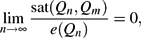 $$\begin{linenomath}\lim_{n\to\infty}\ffrac{\sat(Q_n,Q_m)}{e(Q_n)}=0,\end{linenomath}$$ thus determining sat(Q n ,Q 2) to within a constant factor, and discuss some further questions.
 $$\begin{linenomath}\ssat(Q_n,Q_m)\geq \ffrac{m+1}{2}\cdot 2^n,\end{linenomath}$$
Richard. J Nowakowski (editor), Games of no chance 4, Mathematical Sciences Research Institute Publications, Volume 63 (Cambridge University Press, 2015), x + 339 pp., 978-1-107-01103-8 (hardback), $94.99.
-
- Journal:
- Proceedings of the Edinburgh Mathematical Society / Volume 59 / Issue 4 / November 2016
- Published online by Cambridge University Press:
- 19 September 2016, pp. 1075-1076
-
- Article
- Export citation
JMJ volume 15 Issue 4 Cover and Back matter
-
- Journal:
- Journal of the Institute of Mathematics of Jussieu / Volume 15 / Issue 4 / October 2016
- Published online by Cambridge University Press:
- 14 September 2016, pp. b1-b7
- Print publication:
- October 2016
-
- Article
-
- You have access
- Export citation
JMJ volume 15 Issue 4 Cover and Front matter
-
- Journal:
- Journal of the Institute of Mathematics of Jussieu / Volume 15 / Issue 4 / October 2016
- Published online by Cambridge University Press:
- 14 September 2016, pp. f1-f2
- Print publication:
- October 2016
-
- Article
-
- You have access
- Export citation
A Sequence of Triangle-Free Pseudorandom Graphs
-
- Journal:
- Combinatorics, Probability and Computing / Volume 26 / Issue 2 / March 2017
- Published online by Cambridge University Press:
- 13 September 2016, pp. 195-200
-
- Article
- Export citation
Self-tuning proportional integral control for consensus in heterogeneous multi-agent systems
-
- Journal:
- European Journal of Applied Mathematics / Volume 27 / Issue 6 / December 2016
- Published online by Cambridge University Press:
- 13 September 2016, pp. 923-940
-
- Article
- Export citation
On the Chromatic Number of Random Cayley Graphs
- Part of
-
- Journal:
- Combinatorics, Probability and Computing / Volume 26 / Issue 2 / March 2017
- Published online by Cambridge University Press:
- 09 September 2016, pp. 248-266
-
- Article
- Export citation
-
Let G be an abelian group of cardinality n, where hcf(n, 6) = 1, and let A be a random subset of G. Form a graph ΓA on vertex set G by joining x to y if and only if x + y ∈ A. Then, with high probability as n → ∞, the chromatic number χ(ΓA ) is at most $(1 + o(1))\tfrac{n}{2\log_2 n}$ . This is asymptotically sharp when G = ℤ/nℤ, n prime.

Stable finite element approximation of a Cahn–Hilliard–Stokes system coupled to an electric field
-
- Journal:
- European Journal of Applied Mathematics / Volume 28 / Issue 3 / June 2017
- Published online by Cambridge University Press:
- 09 September 2016, pp. 470-498
-
- Article
- Export citation
-
We consider a fully practical finite element approximation of the Cahn–Hilliard–Stokes system:
subject to an initial condition u 0(.) ∈ [−1, 1] on the conserved order parameter u ∈ [−1, 1], and mixed boundary conditions. Here, γ ∈ $$\begin{align*}\gamma \tfrac{\partial u}{\partial t} + \beta v \cdot \nabla u -\nabla \cdot \left(\nablaw\right) & = 0 \,, \quadw= -\gamma \Delta u + \gamma ^{-1} \Psi ' (u) - \tfrac12 \alpha c'(\cdot,u)| \nabla \phi |^2\,, \\\nabla \cdot (c(\cdot,u) \nabla \phi) & = 0\,,\quad\begin{cases}-\Delta v + \nabla p = \varsigma w \nabla u,\\\nabla \cdot v = 0, \end{cases}\end{align*}$$ $\mathbb{R}_{>0}$ is the interfacial parameter, α ∈ $\mathbb{R}_{\geq0}$ is the field strength parameter, Ψ is the obstacle potential, c(⋅, u) is the diffusion coefficient, and c′(⋅, u) denotes differentiation with respect to the second argument. Furthermore, w is the chemical potential, φ is the electro-static potential, and (v , p) are the velocity and pressure. The system has been proposed to model the manipulation of morphologies in organic solar cells with the help of an applied electric field and kinetics.


VARIÉTÉS DE KISIN STRATIFIÉES ET DÉFORMATIONS POTENTIELLEMENT BARSOTTI-TATE
-
- Journal:
- Journal of the Institute of Mathematics of Jussieu / Volume 17 / Issue 5 / November 2018
- Published online by Cambridge University Press:
- 08 September 2016, pp. 1019-1064
- Print publication:
- November 2018
-
- Article
- Export citation
-
Let $F$ be a unramified finite extension of $\mathbb{Q}_{p}$ and $\overline{\unicode[STIX]{x1D70C}}$ be an irreducible mod $p$ two-dimensional representation of the absolute Galois group of $F$. The aim of this article is the explicit computation of the Kisin variety parameterizing the Breuil–Kisin modules associated to certain families of potentially Barsotti–Tate deformations of $\overline{\unicode[STIX]{x1D70C}}$. We prove that this variety is a finite union of products of $\mathbb{P}^{1}$. Moreover, it appears as an explicit closed connected subvariety of $(\mathbb{P}^{1})^{[F:\mathbb{Q}_{p}]}$. We define a stratification of the Kisin variety by locally closed subschemes and explain how the Kisin variety equipped with its stratification may help in determining the ring of Barsotti–Tate deformations of $\overline{\unicode[STIX]{x1D70C}}$.


The Threshold Probability for Long Cycles
- Part of
-
- Journal:
- Combinatorics, Probability and Computing / Volume 26 / Issue 2 / March 2017
- Published online by Cambridge University Press:
- 08 September 2016, pp. 208-247
-
- Article
- Export citation
Asymptotic behaviour of solutions of free boundary problems for Fisher-KPP equation
-
- Journal:
- European Journal of Applied Mathematics / Volume 28 / Issue 3 / June 2017
- Published online by Cambridge University Press:
- 30 August 2016, pp. 435-469
-
- Article
- Export citation
Asymptotic behaviour of the lifespan of solutions for a semilinear heat equation in hyperbolic space
- Part of
-
- Journal:
- Proceedings of the Royal Society of Edinburgh. Section A: Mathematics / Volume 146 / Issue 5 / October 2016
- Published online by Cambridge University Press:
- 30 August 2016, pp. 1091-1114
- Print publication:
- October 2016
-
- Article
- Export citation
Triangles in Cartesian Squares of Quasirandom Groups
- Part of
-
- Journal:
- Combinatorics, Probability and Computing / Volume 26 / Issue 2 / March 2017
- Published online by Cambridge University Press:
- 25 August 2016, pp. 161-182
-
- Article
- Export citation
