Refine search
Actions for selected content:
26078 results in Abstract analysis
5 - Malliavin Calculus
-
- Book:
- Stochastic Analysis
- Published online:
- 17 November 2016
- Print publication:
- 07 November 2016, pp 195-280
-
- Chapter
- Export citation
Frequently Used Notation
-
- Book:
- Stochastic Analysis
- Published online:
- 17 November 2016
- Print publication:
- 07 November 2016, pp xii-xii
-
- Chapter
- Export citation
Contents
-
- Book:
- Stochastic Analysis
- Published online:
- 17 November 2016
- Print publication:
- 07 November 2016, pp v-viii
-
- Chapter
- Export citation
Index
-
- Book:
- Stochastic Analysis
- Published online:
- 17 November 2016
- Print publication:
- 07 November 2016, pp 344-346
-
- Chapter
- Export citation
6 - The Black-Scholes Model
-
- Book:
- Stochastic Analysis
- Published online:
- 17 November 2016
- Print publication:
- 07 November 2016, pp 281-296
-
- Chapter
- Export citation
7 - The Semiclassical Limit
-
- Book:
- Stochastic Analysis
- Published online:
- 17 November 2016
- Print publication:
- 07 November 2016, pp 297-328
-
- Chapter
- Export citation
3 - Brownian Motion and the Laplacian
-
- Book:
- Stochastic Analysis
- Published online:
- 17 November 2016
- Print publication:
- 07 November 2016, pp 102-132
-
- Chapter
- Export citation
Preface
-
-
- Book:
- Stochastic Analysis
- Published online:
- 17 November 2016
- Print publication:
- 07 November 2016, pp ix-xi
-
- Chapter
- Export citation
1 - Fundamentals of Continuous Stochastic Processes
-
- Book:
- Stochastic Analysis
- Published online:
- 17 November 2016
- Print publication:
- 07 November 2016, pp 1-51
-
- Chapter
- Export citation
Appendix - Some Fundamentals
-
- Book:
- Stochastic Analysis
- Published online:
- 17 November 2016
- Print publication:
- 07 November 2016, pp 329-336
-
- Chapter
- Export citation
Optimal Hardy inequalities in cones
- Part of
-
- Journal:
- Proceedings of the Royal Society of Edinburgh. Section A: Mathematics / Volume 147 / Issue 1 / February 2017
- Published online by Cambridge University Press:
- 04 November 2016, pp. 89-124
- Print publication:
- February 2017
-
- Article
- Export citation
-
Let Ω be an open connected cone in ℝn with vertex at the origin. Assume that the Operator
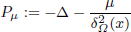
is subcritical in Ω, where δΩ is the distance function to the boundary of Ω and μ ⩽ 1/4. We show that under some smoothness assumption on Ω the improved Hardy-type inequality

holds true, and the Hardy-weight λ(μ)|x|–2 is optimal in a certain definite sense. The constant λ(μ) > 0 is given explicitly.
Dirichlet problems for fully anisotropic elliptic equations
- Part of
-
- Journal:
- Proceedings of the Royal Society of Edinburgh. Section A: Mathematics / Volume 147 / Issue 1 / February 2017
- Published online by Cambridge University Press:
- 04 November 2016, pp. 25-60
- Print publication:
- February 2017
-
- Article
- Export citation
Dynamics of screw dislocations: A generalised minimising-movements scheme approach†
- Part of
-
- Journal:
- European Journal of Applied Mathematics / Volume 28 / Issue 4 / August 2017
- Published online by Cambridge University Press:
- 03 November 2016, pp. 636-655
-
- Article
- Export citation
INHOMOGENEOUS INCOMPRESSIBLE VISCOUS FLOWS WITH SLOWLY VARYING INITIAL DATA
- Part of
-
- Journal:
- Journal of the Institute of Mathematics of Jussieu / Volume 17 / Issue 5 / November 2018
- Published online by Cambridge University Press:
- 03 November 2016, pp. 1121-1172
- Print publication:
- November 2018
-
- Article
- Export citation
-
The purpose of this paper is to provide a large class of initial data which generates global smooth solution of the 3D inhomogeneous incompressible Navier–Stokes system in the whole space $\mathbb{R}^{3}$. This class of data is based on functions which vary slowly in one direction. The idea is that 2D inhomogeneous Navier–Stokes system with large data is globally well-posed and we construct the 3D approximate solutions by the 2D solutions with a parameter. One of the key point of this study is the investigation of the time decay properties of the solutions to the 2D inhomogeneous Navier–Stokes system. We obtained the same optimal decay estimates as the solutions of 2D homogeneous Navier–Stokes system.

INTRINSIC DIOPHANTINE APPROXIMATION ON GENERAL POLYNOMIAL SURFACES
- Part of
-
- Journal:
- Mathematika / Volume 63 / Issue 1 / 2017
- Published online by Cambridge University Press:
- 02 November 2016, pp. 250-259
- Print publication:
- 2017
-
- Article
- Export citation
-
We study the Hausdorff measure and dimension of the set of intrinsically simultaneously $\unicode[STIX]{x1D713}$ -approximable points on a curve, surface, etc, given as a graph of integer polynomials. We obtain complete answers to these questions for algebraically “nice” manifolds. This generalizes earlier work done in the case of curves.

Factoriality and Type Classification of k-Graph von Neumann Algebras
- Part of
-
- Journal:
- Proceedings of the Edinburgh Mathematical Society / Volume 60 / Issue 2 / May 2017
- Published online by Cambridge University Press:
- 02 November 2016, pp. 499-518
-
- Article
- Export citation
-
Let
 be a single vertex k-graph and let
  be the von Neumann algebra induced from the Gelfand–Naimark–Segal (GNS) representation of a distinguished state ω of its k-graph C*-algebra
  . In this paper we prove the factoriality of , and furthermore determine its type when either has the little pullback property, or the intrinsic group of has rank 0. The key step to achieving this is to show that the fixed-point algebra of the modular action corresponding to ω has a unique tracial state.
 be a single vertex k-graph and let
  be the von Neumann algebra induced from the Gelfand–Naimark–Segal (GNS) representation of a distinguished state ω of its k-graph C*-algebra
  . In this paper we prove the factoriality of
 Topological stability criteria for networking dynamical systems with Hermitian Jacobian
-
- Journal:
- European Journal of Applied Mathematics / Volume 27 / Issue 6 / December 2016
- Published online by Cambridge University Press:
- 02 November 2016, pp. 888-903
-
- Article
- Export citation
Network analysis and modelling: Special issue of European Journal of Applied Mathematics
-
- Journal:
- European Journal of Applied Mathematics / Volume 27 / Issue 6 / December 2016
- Published online by Cambridge University Press:
- 02 November 2016, pp. 807-811
-
- Article
-
- You have access
- Export citation
On Semipositone Non-Local Boundary-Value Problems with Nonlinear or Affine Boundary Conditions
- Part of
-
- Journal:
- Proceedings of the Edinburgh Mathematical Society / Volume 60 / Issue 3 / August 2017
- Published online by Cambridge University Press:
- 02 November 2016, pp. 635-649
-
- Article
- Export citation
-
We consider the boundary-value problem
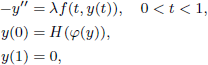
where H: [0,+∞) → ℝ and f : [0, 1] × ℝ → ℝ are continuous and λ > 0 is a parameter. We show that if H satisfies a boundedness condition on a specified compact set, then this, together with an assumption that H is either affine or superlinear at +∞, implies existence of at least one positive solution to the problem, even in the case where we impose no growth conditions on f. Finally, since it can hold that f(t, y) < 0 for all (t, y) ∈ [0, 1]×ℝ, the semipositone problem is included as a special case of the existence result.
Global Well-Posedness and Finite-Time Blow-Up of Some Heat-Type Equations
- Part of
-
- Journal:
- Proceedings of the Edinburgh Mathematical Society / Volume 60 / Issue 2 / May 2017
- Published online by Cambridge University Press:
- 02 November 2016, pp. 481-497
-
- Article
- Export citation
