Refine search
Actions for selected content:
26078 results in Abstract analysis
ON THE $\ell$-ADIC COHOMOLOGY OF SOME $p$-ADICALLY UNIFORMIZED SHIMURA VARIETIES
- Part of
-
- Journal:
- Journal of the Institute of Mathematics of Jussieu / Volume 17 / Issue 5 / November 2018
- Published online by Cambridge University Press:
- 01 December 2016, pp. 1197-1226
- Print publication:
- November 2018
-
- Article
- Export citation
-
We determine the Galois representations inside the $\ell$-adic cohomology of some unitary Shimura varieties at split places where they admit uniformization by finite products of Drinfeld upper half spaces. Our main results confirm Langlands–Kottwitz’s description of the cohomology of Shimura varieties in new cases.


Non-local Cahn–Hilliard equations with fractional dynamic boundary conditions
-
- Journal:
- European Journal of Applied Mathematics / Volume 28 / Issue 5 / October 2017
- Published online by Cambridge University Press:
- 01 December 2016, pp. 736-788
-
- Article
- Export citation
Added mass of a pair of disks at small separation
-
- Journal:
- European Journal of Applied Mathematics / Volume 28 / Issue 4 / August 2017
- Published online by Cambridge University Press:
- 01 December 2016, pp. 687-706
-
- Article
- Export citation
GMJ volume 59 issue 1 Cover and Front matter
-
- Journal:
- Glasgow Mathematical Journal / Volume 59 / Issue 1 / January 2017
- Published online by Cambridge University Press:
- 29 November 2016, pp. f1-f2
-
- Article
-
- You have access
- Export citation
GMJ volume 59 issue 1 Cover and Back matter
-
- Journal:
- Glasgow Mathematical Journal / Volume 59 / Issue 1 / January 2017
- Published online by Cambridge University Press:
- 29 November 2016, pp. b1-b2
-
- Article
-
- You have access
- Export citation
Local Conditions for Exponentially Many Subdivisions
- Part of
-
- Journal:
- Combinatorics, Probability and Computing / Volume 26 / Issue 3 / May 2017
- Published online by Cambridge University Press:
- 28 November 2016, pp. 423-430
-
- Article
- Export citation
COMPACT SPACES OF THE FIRST BAIRE CLASS THAT HAVE OPEN FINITE DEGREE
- Part of
-
- Journal:
- Journal of the Institute of Mathematics of Jussieu / Volume 17 / Issue 5 / November 2018
- Published online by Cambridge University Press:
- 21 November 2016, pp. 1173-1196
- Print publication:
- November 2018
-
- Article
- Export citation
-
We introduce the open degree of a compact space, and we show that for every natural number $n$, the separable Rosenthal compact spaces of degree $n$ have a finite basis.



Stochastic Analysis
- Itô and Malliavin Calculus in Tandem
-
- Published online:
- 17 November 2016
- Print publication:
- 07 November 2016
Spectral Curve of the Halphen Operator
- Part of
-
- Journal:
- Proceedings of the Edinburgh Mathematical Society / Volume 60 / Issue 2 / May 2017
- Published online by Cambridge University Press:
- 14 November 2016, pp. 451-460
-
- Article
- Export citation
-
The Halphen operator is a third-order operator of the form

where g ≠ 2 mod(3), where the Weierstrass ℘-function satisfies the equation

In the equianharmonic case, i.e. g2 = 0, the Halphen operator commutes with some ordinary differential operator Ln of order n ≠ 0 mod(3). In this paper we find the spectral curve of the pair L 3, Ln .
On Groups with Slow Intersection Growth
- Part of
-
- Journal:
- Proceedings of the Edinburgh Mathematical Society / Volume 60 / Issue 2 / May 2017
- Published online by Cambridge University Press:
- 14 November 2016, pp. 387-390
-
- Article
- Export citation
The Monotonicity and Log-Behaviour of Some Functions Related to the Euler Gamma Function
- Part of
-
- Journal:
- Proceedings of the Edinburgh Mathematical Society / Volume 60 / Issue 2 / May 2017
- Published online by Cambridge University Press:
- 09 November 2016, pp. 527-543
-
- Article
- Export citation
-
The aim of this paper is to develop analytic techniques to deal with the monotonicity of certain combinatorial sequences. On the one hand, a criterion for the monotonicity of the function
 is given, which is a continuous analogue of a result of Wang and Zhu. On the other hand, the log-behaviour of the functions
is considered, where ζ(x) and Γ(x) are the Riemann zeta function and the Euler Gamma function, respectively. Consequently, the strict log-concavities of the function θ(x) (a conjecture of Chen et al.) and
 for some combinatorial sequences (including the Bernoulli numbers, the tangent numbers, the Catalan numbers, the Fuss–Catalan numbers, and the binomial coefficients
  are demonstrated. In particular, this contains some results of Chen et al., and Luca and Stănică. Finally, by researching the logarithmically complete monotonicity of some functions, the infinite log-monotonicity of the sequence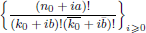
is proved. This generalizes two results of Chen et al. that both the Catalan numbers
 and the central binomial coefficients
  are infinitely log-monotonic, and strengthens one result of Su and Wang that
  is log-convex in n for positive integers d > δ. In addition, the asymptotically infinite log-monotonicity of derangement numbers is showed. In order to research the stronger properties of the above functions θ(x) and F(x), the logarithmically complete monotonicity of functions
is also obtained, which generalizes the results of Lee and Tepedelenlioǧlu, and Qi and Li.
 is given, which is a continuous analogue of a result of Wang and Zhu. On the other hand, the log-behaviour of the functions
 for some combinatorial sequences (including the Bernoulli numbers, the tangent numbers, the Catalan numbers, the Fuss–Catalan numbers, and the binomial coefficients
  are demonstrated. In particular, this contains some results of Chen et al., and Luca and Stănică. Finally, by researching the logarithmically complete monotonicity of some functions, the infinite log-monotonicity of the sequence
 and the central binomial coefficients
  are infinitely log-monotonic, and strengthens one result of Su and Wang that
  is log-convex in n for positive integers d > δ. In addition, the asymptotically infinite log-monotonicity of derangement numbers is showed. In order to research the stronger properties of the above functions θ(x) and F(x), the logarithmically complete monotonicity of functions
Homogenization and norm-resolvent convergence for elliptic operators in a strip perforated along a curve
- Part of
-
- Journal:
- Proceedings of the Royal Society of Edinburgh. Section A: Mathematics / Volume 146 / Issue 6 / December 2016
- Published online by Cambridge University Press:
- 08 November 2016, pp. 1115-1158
- Print publication:
- December 2016
-
- Article
- Export citation
Stable spike clusters for the one-dimensional Gierer–Meinhardt system
-
- Journal:
- European Journal of Applied Mathematics / Volume 28 / Issue 4 / August 2017
- Published online by Cambridge University Press:
- 08 November 2016, pp. 576-635
-
- Article
-
- You have access
- Open access
- Export citation
-
We consider the Gierer–Meinhardt system with precursor inhomogeneity and two small diffusivities in an interval
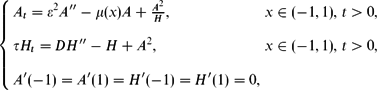 $$\begin{equation*}\left\{\begin{array}{ll}A_t=\epsilon^2 A''- \mu(x) A+\frac{A^2}{H}, &x\in(-1, 1),\,t>0,\\[3mm]\tau H_t=D H'' -H+ A^2, & x\in (-1, 1),\,t>0,\\[3mm]A' (-1)= A' (1)= H' (-1) = H' (1) =0,\end{array}\right.\end{equation*}$$
  $$\begin{equation*}\mbox{where } \quad 0<\epsilon \ll\sqrt{D}\ll 1, \quad\end{equation*}$$ A spike cluster is the combination of several spikes which all approach the same point in the singular limit. We rigorously prove the existence of a steady-state spike cluster consisting of N spikes near a non-degenerate local minimum point t 0 of the smooth positive inhomogeneity μ(x), i.e. we assume that μ′(t 0) = 0, μ″(t 0) > 0 and we have μ(t 0) > 0. Here, N is an arbitrary positive integer. Further, we show that this solution is linearly stable. We explicitly compute all eigenvalues, both large (of order O(1)) and small (of order o(1)). The main features of studying the Gierer–Meinhardt system in this setting are as follows: (i) it is biologically relevant since it models a hierarchical process (pattern formation of small-scale structures induced by a pre-existing large-scale inhomogeneity); (ii) it contains three different spatial scales two of which are small: the O(1) scale of the precursor inhomogeneity μ(x), the
 $$\begin{equation*}\tau\geq 0\mbox{ and$\tau$ is independent of $\epsilon$.}\end{equation*}$$ $O(\sqrt{D})$ scale of the inhibitor diffusivity and the O(ε) scale of the activator diffusivity; (iii) the expressions can be made explicit and often have a particularly simple form.

The Reeb Graph of a Map Germ from ℝ3 to ℝ2 with Isolated Zeros
- Part of
-
- Journal:
- Proceedings of the Edinburgh Mathematical Society / Volume 60 / Issue 2 / May 2017
- Published online by Cambridge University Press:
- 08 November 2016, pp. 319-348
-
- Article
- Export citation
The interface dynamics of a surfactant drop on a thin viscous film†
-
- Journal:
- European Journal of Applied Mathematics / Volume 28 / Issue 4 / August 2017
- Published online by Cambridge University Press:
- 08 November 2016, pp. 656-686
-
- Article
- Export citation
Connecting orbits for a class of singular time-periodic second-order Hamiltonian systems
- Part of
-
- Journal:
- Proceedings of the Royal Society of Edinburgh. Section A: Mathematics / Volume 146 / Issue 6 / December 2016
- Published online by Cambridge University Press:
- 08 November 2016, pp. 1211-1241
- Print publication:
- December 2016
-
- Article
- Export citation
-
We show the existence of connecting orbits for a class of singular second-order Hamiltonian systems

where, as opposed to most of the existing literature, we assume that the potential V has not one but any finite number of maxima of equal value. We use variational methods under the assumption that V (t, u) satisfies the so-called ‘strong-force’ condition at the singularity.
4 - Stochastic Differential Equations
-
- Book:
- Stochastic Analysis
- Published online:
- 17 November 2016
- Print publication:
- 07 November 2016, pp 133-194
-
- Chapter
- Export citation
2 - Stochastic Integrals and Itô's Formula
-
- Book:
- Stochastic Analysis
- Published online:
- 17 November 2016
- Print publication:
- 07 November 2016, pp 52-101
-
- Chapter
- Export citation
References
-
- Book:
- Stochastic Analysis
- Published online:
- 17 November 2016
- Print publication:
- 07 November 2016, pp 337-343
-
- Chapter
- Export citation
Frontmatter
-
- Book:
- Stochastic Analysis
- Published online:
- 17 November 2016
- Print publication:
- 07 November 2016, pp i-iv
-
- Chapter
- Export citation
