Refine search
Actions for selected content:
26079 results in Abstract analysis
ON GROUPS WITH TWO ISOMORPHISM CLASSES OF DERIVED SUBGROUPS
-
- Journal:
- Glasgow Mathematical Journal / Volume 55 / Issue 3 / September 2013
- Published online by Cambridge University Press:
- 25 February 2013, pp. 655-668
-
- Article
-
- You have access
- Export citation
-
The structure of groups which have at most two isomorphism classes of derived subgroups ( $\mathfrak{D}$2-groups) is investigated. A complete description of $\mathfrak{D}$2-groups is obtained in the case where the derived subgroup is finite: the solution leads an interesting number theoretic problem. In addition, detailed information is obtained about soluble $\mathfrak{D}$2-groups, especially those with finite rank, where algebraic number fields play an important role. Also, detailed structural information about insoluble $\mathfrak{D}$2-groups is found, and the locally free $\mathfrak{D}$2-groups are characterized.

BIHARMONIC LAGRANGIAN SUBMANIFOLDS IN KÄHLER MANIFOLDS
-
- Journal:
- Glasgow Mathematical Journal / Volume 55 / Issue 2 / May 2013
- Published online by Cambridge University Press:
- 25 February 2013, pp. 465-480
-
- Article
-
- You have access
- Export citation
2-LOCAL DERIVATIONS ON SEMI-FINITE VON NEUMANN ALGEBRAS
-
- Journal:
- Glasgow Mathematical Journal / Volume 56 / Issue 1 / January 2014
- Published online by Cambridge University Press:
- 25 February 2013, pp. 9-12
-
- Article
-
- You have access
- Export citation
ON THE VANISHING OF LOCAL HOMOLOGY MODULES
-
- Journal:
- Glasgow Mathematical Journal / Volume 55 / Issue 2 / May 2013
- Published online by Cambridge University Press:
- 25 February 2013, pp. 457-464
-
- Article
-
- You have access
- Export citation
-
Let R be a commutative Noetherian ring,


TAUBERIAN THEOREMS AND SPECTRAL THEORY IN TOPOLOGICAL VECTOR SPACES
-
- Journal:
- Glasgow Mathematical Journal / Volume 55 / Issue 3 / September 2013
- Published online by Cambridge University Press:
- 25 February 2013, pp. 511-532
-
- Article
-
- You have access
- Export citation
MEAN VALUE TYPE INEQUALITIES FOR QUASINEARLY SUBHARMONIC FUNCTIONS
-
- Journal:
- Glasgow Mathematical Journal / Volume 55 / Issue 2 / May 2013
- Published online by Cambridge University Press:
- 25 February 2013, pp. 349-368
-
- Article
-
- You have access
- Export citation
SCHOTTKY UNIFORMIZATIONS OF SYMMETRIES
-
- Journal:
- Glasgow Mathematical Journal / Volume 55 / Issue 3 / September 2013
- Published online by Cambridge University Press:
- 25 February 2013, pp. 591-613
-
- Article
-
- You have access
- Export citation
-
A real algebraic curve of genus g is a pair (S,〈 τ 〉), where S is a closed Riemann surface of genus g and τ: S → S is a symmetry, that is, an anti-conformal involution. A Schottky uniformization of (S,〈 τ 〉) is a tuple (Ω,Γ,P:Ω → S), where Γ is a Schottky group with region of discontinuity Ω and P:Ω → S is a regular holomorphic cover map with Γ as its deck group, so that there exists an extended Möbius transformation $\widehat{\tau}$ keeping Ω invariant with P o $\widehat{\tau}$=τ o P. The extended Kleinian group K=〈 Γ, $\widehat{\tau}$〉 is called an extended Schottky groups of rank g. The interest on Schottky uniformizations rely on the fact that they provide the lowest uniformizations of closed Riemann surfaces. In this paper we obtain a structural picture of extended Schottky groups in terms of Klein–Maskit's combination theorems and some basic extended Schottky groups. We also provide some insight of the structural picture in terms of the group of automorphisms of S which are reflected by the Schottky uniformization. As a consequence of our structural description of extended Schottky groups, we get alternative proofs to results due to Kalliongis and McCullough (J. Kalliongis and D. McCullough, Orientation-reversing involutions on handlebodies, Trans. Math. Soc. 348(5) (1996), 1739–1755) on orientation-reversing involutions on handlebodies.

REGULARITY AND FRACTAL DIMENSION OF PULLBACK ATTRACTORS FOR A NON-AUTONOMOUS SEMILINEAR DEGENERATE PARABOLIC EQUATION
-
- Journal:
- Glasgow Mathematical Journal / Volume 55 / Issue 2 / May 2013
- Published online by Cambridge University Press:
- 25 February 2013, pp. 431-448
-
- Article
-
- You have access
- Export citation
-
Considered here is the pullback attractor of the process associated with the first initial boundary value problem for the non-autonomous semilinear degenerate parabolic equation
in a bounded domain Ω in ℝN (N≥2). We prove the regularity in the space L2p−2(Ω)∩ \begin{linenomath}u_t-\text{div}(\sigma(x)\nabla u)+f(u)=g(x,t)\end{linenomath} $D_0^2(\Omega,\sigma)$, and estimate the fractal dimension of the pullback attractor in L2(Ω).

BRUNN–MINKOWSKI TYPE INEQUALITIES FOR Lp MOMENT BODIES*
-
- Journal:
- Glasgow Mathematical Journal / Volume 55 / Issue 2 / May 2013
- Published online by Cambridge University Press:
- 25 February 2013, pp. 391-398
-
- Article
-
- You have access
- Export citation
IRREDUCIBLE HARISH CHANDRA MODULES OVER THE DERIVATION ALGEBRAS OF RATIONAL QUANTUM TORI
-
- Journal:
- Glasgow Mathematical Journal / Volume 55 / Issue 3 / September 2013
- Published online by Cambridge University Press:
- 25 February 2013, pp. 677-693
-
- Article
-
- You have access
- Export citation
-
Let d be a positive integer, q=(qij)d×d be a d×d matrix, ℂq be the quantum torus algebra associated with q. We have the semidirect product Lie algebra $\mathfrak{g}$=Der(ℂq)⋉Z(ℂq), where Z(ℂq) is the centre of the rational quantum torus algebra ℂq. In this paper, we construct a class of irreducible weight $\mathfrak{g}$-modules $\mathcal{V}$α (V,W) with three parameters: a vector α∈ℂd, an irreducible $\mathfrak{gl}$d-module V and a graded-irreducible $\mathfrak{gl}$N-module W. Then, we show that an irreducible Harish Chandra (uniformaly bounded) $\mathfrak{g}$-module M is isomorphic to $\mathcal{V}$α(V,W) for suitable α, V, W, if the action of Z(ℂq) on M is associative (respectively nonzero).


NIELSEN EQUIVALENCE OF GENERATING PAIRS OF SL(2,q)
-
- Journal:
- Glasgow Mathematical Journal / Volume 55 / Issue 3 / September 2013
- Published online by Cambridge University Press:
- 25 February 2013, pp. 481-509
-
- Article
-
- You have access
- Export citation
UNIQUENESS FOR SINGULAR SEMILINEAR ELLIPTIC BOUNDARY VALUE PROBLEMS
-
- Journal:
- Glasgow Mathematical Journal / Volume 55 / Issue 2 / May 2013
- Published online by Cambridge University Press:
- 25 February 2013, pp. 399-409
-
- Article
-
- You have access
- Export citation
-
We prove uniqueness of positive solutions for the boundary value problems
where Ω is a bounded domain in ℝn with smooth boundary ∂Ω, λ is a positive parameter and f:(0,∞) → (0,∞) is sublinear at ∞ and is allowed to be singular at 0.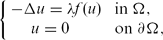 \[\{\begin{array}{ll} -\Delta u=\lambda f(u)\ \ &\text{in}\Omega, \ \ \ \ \ u=0 &\text{on \partial \Omega,\]
EXAMPLES OF RIGID AND FLEXIBLE SEIFERT FIBRED CONE-MANIFOLDS
-
- Journal:
- Glasgow Mathematical Journal / Volume 55 / Issue 2 / May 2013
- Published online by Cambridge University Press:
- 25 February 2013, pp. 411-429
-
- Article
-
- You have access
- Export citation
EJM volume 24 issue 2 Cover and Back matter
-
- Journal:
- European Journal of Applied Mathematics / Volume 24 / Issue 2 / April 2013
- Published online by Cambridge University Press:
- 22 February 2013, pp. b1-b8
-
- Article
-
- You have access
- Export citation
EJM volume 24 issue 2 Cover and Front matter
-
- Journal:
- European Journal of Applied Mathematics / Volume 24 / Issue 2 / April 2013
- Published online by Cambridge University Press:
- 22 February 2013, pp. f1-f2
-
- Article
-
- You have access
- Export citation
On the bifurcation of limit cycles in a dynamic model of a small open economy
-
- Journal:
- European Journal of Applied Mathematics / Volume 24 / Issue 3 / June 2013
- Published online by Cambridge University Press:
- 22 February 2013, pp. 455-470
-
- Article
- Export citation
Role of technology in combating social crimes: A modeling study
-
- Journal:
- European Journal of Applied Mathematics / Volume 24 / Issue 4 / August 2013
- Published online by Cambridge University Press:
- 22 February 2013, pp. 501-514
-
- Article
- Export citation
The Size of the Largest Part of Random Weighted Partitions of Large Integers
-
- Journal:
- Combinatorics, Probability and Computing / Volume 22 / Issue 3 / May 2013
- Published online by Cambridge University Press:
- 21 February 2013, pp. 433-454
-
- Article
- Export citation
Population dynamics with age-dependent diffusion and death rates
-
- Journal:
- European Journal of Applied Mathematics / Volume 24 / Issue 4 / August 2013
- Published online by Cambridge University Press:
- 21 February 2013, pp. 471-500
-
- Article
- Export citation
JMJ volume 12 issue 2 Cover and Back matter
-
- Journal:
- Journal of the Institute of Mathematics of Jussieu / Volume 12 / Issue 2 / April 2013
- Published online by Cambridge University Press:
- 20 February 2013, pp. b1-b2
- Print publication:
- April 2013
-
- Article
-
- You have access
- Export citation
