Refine search
Actions for selected content:
26079 results in Abstract analysis
Towards a Weighted Version of the Hajnal–Szemerédi Theorem
-
- Journal:
- Combinatorics, Probability and Computing / Volume 22 / Issue 3 / May 2013
- Published online by Cambridge University Press:
- 28 February 2013, pp. 346-350
-
- Article
- Export citation
-
For a positive integer r ≥ 2, a Kr-factor of a graph is a collection vertex-disjoint copies of Kr which covers all the vertices of the given graph. The celebrated theorem of Hajnal and Szemerédi asserts that every graph on n vertices with minimum degree at least
 $(1-\frac{1}{r})n contains a Kr-factor. In this note, we propose investigating the relation between minimum degree and existence of perfect Kr-packing for edge-weighted graphs. The main question we study is the following. Suppose that a positive integer r ≥ 2 and a real t ∈ [0, 1] is given. What is the minimum weighted degree of Kn that guarantees the existence of a Kr-factor such that every factor has total edge weight at least
  $$t\binom{r}{2}$?$ We provide some lower and upper bounds and make a conjecture on the asymptotics of the threshold as n goes to infinity.


Iwasawa theory of de Rham $(\varphi , \Gamma )$-modules over the Robba ring
- Part of
-
- Journal:
- Journal of the Institute of Mathematics of Jussieu / Volume 13 / Issue 1 / January 2014
- Published online by Cambridge University Press:
- 27 February 2013, pp. 65-118
- Print publication:
- January 2014
-
- Article
- Export citation
-
The aim of this article is to study the Bloch–Kato exponential map and the Perrin-Riou big exponential map purely in terms of $(\varphi , \Gamma )$-modules over the Robba ring. We first generalize the definition of the Bloch–Kato exponential map for all the $(\varphi , \Gamma )$-modules without using Fontaine’s rings ${\mathbf{B} }_{\mathrm{crys} } $, ${\mathbf{B} }_{\mathrm{dR} } $ of $p$-adic periods, and then generalize the construction of the Perrin-Riou big exponential map for all the de Rham $(\varphi , \Gamma )$-modules and prove that this map interpolates our Bloch–Kato exponential map and the dual exponential map. Finally, we prove a theorem concerning the determinant of our big exponential map, which is a generalization of theorem $\delta (V)$ of Perrin-Riou. The key ingredients for our study are Pottharst’s theory of the analytic Iwasawa cohomology and Berger’s construction of $p$-adic differential equations associated to de Rham $(\varphi , \Gamma )$-modules.


De Branges’ theorem on approximation problems of Bernstein type
- Part of
-
- Journal:
- Journal of the Institute of Mathematics of Jussieu / Volume 12 / Issue 4 / October 2013
- Published online by Cambridge University Press:
- 27 February 2013, pp. 879-899
- Print publication:
- October 2013
-
- Article
- Export citation
-
The Bernstein approximation problem is to determine whether or not the space of all polynomials is dense in a given weighted ${C}_{0} $-space on the real line. A theorem of de Branges characterizes non-density by existence of an entire function of Krein class being related with the weight in a certain way. An analogous result holds true for weighted sup-norm approximation by entire functions of exponential type at most $\tau $ and bounded on the real axis ( $\tau \gt 0$ fixed).
We consider approximation in weighted ${C}_{0} $-spaces by functions belonging to a prescribed subspace of entire functions which is solely assumed to be invariant under division of zeros and passing from $F(z)$ to $ \overline{F( \overline{z} )} $, and establish the precise analogue of de Branges’ theorem. For the proof we follow the lines of de Branges’ original proof, and employ some results of Pitt.


SUBGROUP PERMUTABILITY DEGREE OF PSL(2,pn)
-
- Journal:
- Glasgow Mathematical Journal / Volume 55 / Issue 3 / September 2013
- Published online by Cambridge University Press:
- 26 February 2013, pp. 581-590
-
- Article
-
- You have access
- Export citation
The onset of multi-valued solutions of a prescribed mean curvature equation with singular non-linearity
-
- Journal:
- European Journal of Applied Mathematics / Volume 24 / Issue 5 / October 2013
- Published online by Cambridge University Press:
- 26 February 2013, pp. 631-656
-
- Article
- Export citation
A NOTE ON THE GENUS OF GLOBAL FUNCTION FIELDS
-
- Journal:
- Glasgow Mathematical Journal / Volume 55 / Issue 3 / September 2013
- Published online by Cambridge University Press:
- 26 February 2013, pp. 559-565
-
- Article
-
- You have access
- Export citation
-
To give a relatively elementary proof of the Brumer–Stark conjecture in a function field context involving no algebraic geometry beyond the Riemann–Roch theorem for curves, Hayes Compos. Math., vol. 55, 1985, pp. 209–239) defined a normalizing field $H_\mathfrak{e}^*$ associated with a fixed sgn-normalized Drinfeld module and its extension field $K_\mathfrak{m}$, which is an analogue of cyclotomic function fields over a rational function field. We present explicitly in this note the formulae for the genus of the two fields and the maximal real subfield $H_\mathfrak{m}$ of $K_\mathfrak{m}$. In some sense, our results can be regarded as generalizations of formulae for the genus of classical cyclotomic function fields obtained by Hayes Trans. Amer. Math. Soc., vol. 189, 1974, pp. 77–91) and Kida and Murabayashi (Tokyo J. Math., vol. 14(1), 1991, pp. 45–56).


PERSISTENCE OF THE NORMALIZED EIGENVECTORS OF A PERTURBED OPERATOR IN THE VARIATIONAL CASE
-
- Journal:
- Glasgow Mathematical Journal / Volume 55 / Issue 3 / September 2013
- Published online by Cambridge University Press:
- 25 February 2013, pp. 629-638
-
- Article
-
- You have access
- Export citation
GENERATORS OF THE EISENSTEIN–PICARD MODULAR GROUP IN THREE COMPLEX DIMENSIONS
-
- Journal:
- Glasgow Mathematical Journal / Volume 55 / Issue 3 / September 2013
- Published online by Cambridge University Press:
- 25 February 2013, pp. 645-654
-
- Article
-
- You have access
- Export citation
COHERENT POWER SERIES RING AND WEAK GORENSTEIN GLOBAL DIMENSION
-
- Journal:
- Glasgow Mathematical Journal / Volume 55 / Issue 3 / September 2013
- Published online by Cambridge University Press:
- 25 February 2013, pp. 533-536
-
- Article
-
- You have access
- Export citation
UPPER AND LOWER FREQUENTLY UNIVERSAL SERIES
-
- Journal:
- Glasgow Mathematical Journal / Volume 55 / Issue 3 / September 2013
- Published online by Cambridge University Press:
- 25 February 2013, pp. 615-627
-
- Article
-
- You have access
- Export citation
CONTRACTED, $\mathfrak{m}$-FULL AND RELATED CLASSES OF IDEALS IN LOCAL RINGS
-
- Journal:
- Glasgow Mathematical Journal / Volume 55 / Issue 3 / September 2013
- Published online by Cambridge University Press:
- 25 February 2013, pp. 669-675
-
- Article
-
- You have access
- Export citation
-
The class of $\mathfrak{m}$-full and four related classes of ideals in a local ring (R, $\mathfrak{m}$) are extended by replacing $\mathfrak{m}$ with other ideals and the resulting classes of ideals are compared. It is shown that contracted ideals are $\mathfrak{m}$-full in a local ring with infinite residue field.


RING ENDOMORPHISMS WITH LARGE IMAGES
-
- Journal:
- Glasgow Mathematical Journal / Volume 55 / Issue 2 / May 2013
- Published online by Cambridge University Press:
- 25 February 2013, pp. 381-390
-
- Article
-
- You have access
- Export citation
A HYPONORMAL TOEPLITZ COMPLETION PROBLEM
-
- Journal:
- Glasgow Mathematical Journal / Volume 56 / Issue 1 / January 2014
- Published online by Cambridge University Press:
- 25 February 2013, pp. 1-8
-
- Article
-
- You have access
- Export citation
-
In this paper we consider the following ‘Toeplitz completion’ problem: Complete the unspecified analytic Toeplitz entries of the partial block Toeplitz matrix
to make A hyponormal, where ψi∈H∞ is a non-constant rational function for i=1,2.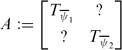 $\begin{linenomath}A:=\begin{bmatrix} T_{\overline\psi_1}& ?\\[4pt]\T_{\overline\psi_2} \end{bmatrix}\end{linenomath}$
A NOTE ON p-CENTRAL GROUPS
-
- Journal:
- Glasgow Mathematical Journal / Volume 55 / Issue 2 / May 2013
- Published online by Cambridge University Press:
- 25 February 2013, pp. 449-456
-
- Article
-
- You have access
- Export citation
-
A group G is n-central if Gn ≤ Z(G), that is the subgroup of G generated by n-powers of G lies in the centre of G. We investigate pk-central groups for p a prime number. For G a finite group of exponent pk, the covering group of G is pk-central. Using this we show that the exponent of the Schur multiplier of G is bounded by $p^{\lceil \frac{c}{p-1} \rceil}$, where c is the nilpotency class of G. Next we give an explicit bound for the order of a finite pk-central p-group of coclass r. Lastly, we establish that for G, a finite p-central p-group, and N, a proper non-maximal normal subgroup of G, the Tate cohomology Hn(G/N, Z(N)) is non-trivial for all n. This final statement answers a question of Schmid concerning groups with non-trivial Tate cohomology.

GROUP BIALGEBRAS AND PERMUTATION BIALGEBRAS
-
- Journal:
- Glasgow Mathematical Journal / Volume 55 / Issue 3 / September 2013
- Published online by Cambridge University Press:
- 25 February 2013, pp. 639-643
-
- Article
-
- You have access
- Export citation
STABLE LEFT AND RIGHT BOUSFIELD LOCALISATIONS
-
- Journal:
- Glasgow Mathematical Journal / Volume 56 / Issue 1 / January 2014
- Published online by Cambridge University Press:
- 25 February 2013, pp. 13-42
-
- Article
-
- You have access
- Export citation
CHARACTERIZATIONS OF LINEAR WEINGARTEN SPACELIKE HYPERSURFACES IN EINSTEIN SPACETIMES
-
- Journal:
- Glasgow Mathematical Journal / Volume 55 / Issue 3 / September 2013
- Published online by Cambridge University Press:
- 25 February 2013, pp. 567-579
-
- Article
-
- You have access
- Export citation
DESCRIPTION OF SIMPLE MODULES FOR SCHUR SUPERALGEBRA S(2|2)
-
- Journal:
- Glasgow Mathematical Journal / Volume 55 / Issue 3 / September 2013
- Published online by Cambridge University Press:
- 25 February 2013, pp. 695-719
-
- Article
-
- You have access
- Export citation
SINGULAR LIMITS FOR 2-DIMENSIONAL ELLIPTIC PROBLEMS INVOLVING EXPONENTIAL NONLINEARITIES WITH SUB-QUADRATIC CONVECTION TERM
-
- Journal:
- Glasgow Mathematical Journal / Volume 55 / Issue 3 / September 2013
- Published online by Cambridge University Press:
- 25 February 2013, pp. 537-557
-
- Article
-
- You have access
- Export citation
-
Let Ω be a bounded domain with smooth boundary in ℝ2, q∈[1,2) and x1, x2,. . .,xm ∈ Ω. In this paper we are concerned with the following type of problem:
with u = 0 on ∂ Ω. We use some nonlinear domain decomposition method to construct a positive weak solution vρ,λ in Ω, which tends to a singular function at each xi as the parameters ρ and λ tend to 0 independently. \[ -\Delta u-\lambda|\nabla u|^q = \rho^{2}e^{u}, \]
ℵn-FREE MODULES OVER COMPLETE DISCRETE VALUATION DOMAINS WITH ALMOST TRIVIAL DUAL*
-
- Journal:
- Glasgow Mathematical Journal / Volume 55 / Issue 2 / May 2013
- Published online by Cambridge University Press:
- 25 February 2013, pp. 369-380
-
- Article
-
- You have access
- Export citation
