Refine search
Actions for selected content:
26079 results in Abstract analysis
GMJ volume 53 issue 2 Cover and Back matter
-
- Journal:
- Glasgow Mathematical Journal / Volume 53 / Issue 2 / May 2011
- Published online by Cambridge University Press:
- 21 March 2011, pp. b1-b2
-
- Article
-
- You have access
- Export citation
GMJ volume 53 issue 2 Cover and Front matter
-
- Journal:
- Glasgow Mathematical Journal / Volume 53 / Issue 2 / May 2011
- Published online by Cambridge University Press:
- 21 March 2011, pp. f1-f2
-
- Article
-
- You have access
- Export citation
REMARKS ON THE DIVISIBILITY OF THE CLASS NUMBERS OF IMAGINARY QUADRATIC FIELDS
-
- Journal:
- Glasgow Mathematical Journal / Volume 53 / Issue 2 / May 2011
- Published online by Cambridge University Press:
- 21 March 2011, pp. 379-389
-
- Article
-
- You have access
- Export citation
-
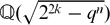
We consider the divisibility of the class numbers of imaginary quadratic fields
 , where q is an odd prime number, k and n are positive integers. Suppose that k ≡ 1 mod 2 or n ≢ 3 mod 6. We show that the class numbers of imaginary quadratic fields ≠
  are divisible by n for q ≡ 3 mod 8. This is a generalization of the result of Kishi for imaginary quadratic fields
  when k ≡ 1 mod 2 or n ≢ 3 mod 6. We also show that the class numbers of imaginary quadratic fields ≠
  are divisible by n for q ≡ 1 mod 4 and the class numbers of imaginary quadratic fields ≠ are divisible by n for q ≡ 7 mod 8.
 , where q is an odd prime number, k and n are positive integers. Suppose that k ≡ 1 mod 2 or n ≢ 3 mod 6. We show that the class numbers of imaginary quadratic fields
  are divisible by n for q ≡ 3 mod 8. This is a generalization of the result of Kishi for imaginary quadratic fields
  when k ≡ 1 mod 2 or n ≢ 3 mod 6. We also show that the class numbers of imaginary quadratic fields
  are divisible by n for q ≡ 1 mod 4 and the class numbers of imaginary quadratic fields
 Random zeros on complex manifolds: conditional expectations
- Part of
-
- Journal:
- Journal of the Institute of Mathematics of Jussieu / Volume 10 / Issue 3 / July 2011
- Published online by Cambridge University Press:
- 11 March 2011, pp. 753-783
- Print publication:
- July 2011
-
- Article
- Export citation
-
We study the conditional distribution
 of zeros of a Gaussian system of random polynomials (and more generally, holomorphic sections), given that the polynomials or sections vanish at a point p (or a fixed finite set of points). The conditional distribution is analogous to the pair correlation function of zeros but we show that it has quite a different small distance behaviour. In particular, the conditional distribution does not exhibit repulsion of zeros in dimension 1. To prove this, we give universal scaling asymptotics for around p. The key tool is the conditional Szegő kernel and its scaling asymptotics.
 of zeros of a Gaussian system of random polynomials (and more generally, holomorphic sections), given that the polynomials or sections vanish at a point p (or a fixed finite set of points). The conditional distribution is analogous to the pair correlation function of zeros but we show that it has quite a different small distance behaviour. In particular, the conditional distribution does not exhibit repulsion of zeros in dimension 1. To prove this, we give universal scaling asymptotics for
 ON FREE SPECTRA OF LOCALLY TESTABLE SEMIGROUP VARIETIES
-
- Journal:
- Glasgow Mathematical Journal / Volume 53 / Issue 3 / September 2011
- Published online by Cambridge University Press:
- 10 March 2011, pp. 623-629
-
- Article
-
- You have access
- Export citation
-
For each k ≥ 2, we determine the asymptotic behaviour of the sequence of cardinalities of finitely generated free objects in


ON A CHARACTERISTIC PROPERTY OF FINITE-DIMENSIONAL BANACH SPACES*
-
- Journal:
- Glasgow Mathematical Journal / Volume 53 / Issue 3 / September 2011
- Published online by Cambridge University Press:
- 10 March 2011, pp. 443-449
-
- Article
-
- You have access
- Export citation
ON CLOSED GEODESICS IN THE LEAF SPACE OF SINGULAR RIEMANNIAN FOLIATIONS
-
- Journal:
- Glasgow Mathematical Journal / Volume 53 / Issue 3 / September 2011
- Published online by Cambridge University Press:
- 10 March 2011, pp. 555-568
-
- Article
-
- You have access
- Export citation
A DIOPHANTINE FROBENIUS PROBLEM RELATED TO RIEMANN SURFACES
-
- Journal:
- Glasgow Mathematical Journal / Volume 53 / Issue 3 / September 2011
- Published online by Cambridge University Press:
- 10 March 2011, pp. 501-522
-
- Article
-
- You have access
- Export citation
ON THE LOW REGULARITY SOLUTIONS FOR A MODIFIED TWO-COMPONENT CAMASSA–HOLM SHALLOW WATER SYSTEM
-
- Journal:
- Glasgow Mathematical Journal / Volume 53 / Issue 3 / September 2011
- Published online by Cambridge University Press:
- 10 March 2011, pp. 611-621
-
- Article
-
- You have access
- Export citation
INFLUENCE OF STRONGLY CLOSED 2-SUBGROUPS ON THE STRUCTURE OF FINITE GROUPS
-
- Journal:
- Glasgow Mathematical Journal / Volume 53 / Issue 3 / September 2011
- Published online by Cambridge University Press:
- 10 March 2011, pp. 577-581
-
- Article
-
- You have access
- Export citation
UNCONDITIONAL CONVERGENCE IN THE STRONG OPERATOR TOPOLOGY AND ℓ∞
-
- Journal:
- Glasgow Mathematical Journal / Volume 53 / Issue 3 / September 2011
- Published online by Cambridge University Press:
- 10 March 2011, pp. 583-598
-
- Article
-
- You have access
- Export citation
Examples of non-commutative Hodge structures
- Part of
-
- Journal:
- Journal of the Institute of Mathematics of Jussieu / Volume 10 / Issue 3 / July 2011
- Published online by Cambridge University Press:
- 10 March 2011, pp. 635-674
- Print publication:
- July 2011
-
- Article
- Export citation
SIGN-CHANGING SOLUTIONS OF (e1, B)-LIMIT INCREASING OPERATOR EQUATION*
-
- Journal:
- Glasgow Mathematical Journal / Volume 53 / Issue 3 / September 2011
- Published online by Cambridge University Press:
- 10 March 2011, pp. 535-554
-
- Article
-
- You have access
- Export citation
AN EXTENDED LOOMIS–WHITNEY INEQUALITY FOR POSITIVE DOUBLE JOHN BASES
-
- Journal:
- Glasgow Mathematical Journal / Volume 53 / Issue 3 / September 2011
- Published online by Cambridge University Press:
- 10 March 2011, pp. 451-462
-
- Article
-
- You have access
- Export citation
EXPONENTIAL STABILISATION OF A TREE-SHAPED NETWORK OF STRINGS WITH VARIABLE COEFFICIENTS*
-
- Journal:
- Glasgow Mathematical Journal / Volume 53 / Issue 3 / September 2011
- Published online by Cambridge University Press:
- 10 March 2011, pp. 481-499
-
- Article
-
- You have access
- Export citation
PRINCIPAL MATRIX SOLUTIONS AND VARIATION OF PARAMETERS FOR VOLTERRA INTEGRO-DYNAMIC EQUATIONS ON TIME SCALES
-
- Journal:
- Glasgow Mathematical Journal / Volume 53 / Issue 3 / September 2011
- Published online by Cambridge University Press:
- 10 March 2011, pp. 463-480
-
- Article
-
- You have access
- Export citation
-
We introduce the principal matrix solution Z(t, s) of the linear Volterra-type vector integro-dynamic equation
![\[
x^{\Delta}(t)=A(t)x(t)+\int_{s}^{t}B(t,u)x(u)\Delta u
\]](//static.cambridge.org/content/id/urn%3Acambridge.org%3Aid%3Aarticle%3AS0017089511000073/resource/name/S0017089511000073_eqnU1.gif?pub-status=live) and prove that it is the unique matrix solution of
and prove that it is the unique matrix solution of![\[
Z^{\Delta_{t}}(t,s)=A(t)Z(t,s)+\int_{s}^{t}B(t,u)Z(u,s)\Delta u,\ \ Z(s,s)=I.
\]](//static.cambridge.org/content/id/urn%3Acambridge.org%3Aid%3Aarticle%3AS0017089511000073/resource/name/S0017089511000073_eqnU2.gif?pub-status=live) We also show that the solution of
We also show that the solution of![\[
x^{\Delta}(t)=A(t)x(t)+\int_{\tau}^{t}B(t,u)x(u)\Delta u+f(t),\ \ \ x(\tau)=x_{0}
\]](//static.cambridge.org/content/id/urn%3Acambridge.org%3Aid%3Aarticle%3AS0017089511000073/resource/name/S0017089511000073_eqnU3.gif?pub-status=live) is unique and given by the variation of parameters formula
is unique and given by the variation of parameters formula![\[
x(t)=Z(t,\tau)x_{0}+\int_{\tau}^{t}Z(t,\sigma(s))f(s)\Delta s.
\]](//static.cambridge.org/content/id/urn%3Acambridge.org%3Aid%3Aarticle%3AS0017089511000073/resource/name/S0017089511000073_eqnU4.gif?pub-status=live)
![\[
x^{\Delta}(t)=A(t)x(t)+\int_{s}^{t}B(t,u)x(u)\Delta u
\]](http://static.cambridge.org/content/id/urn%3Acambridge.org%3Aid%3Aarticle%3AS0017089511000073/resource/name/S0017089511000073_eqnU1.gif?pub-status=live)
![\[
Z^{\Delta_{t}}(t,s)=A(t)Z(t,s)+\int_{s}^{t}B(t,u)Z(u,s)\Delta u,\ \ Z(s,s)=I.
\]](http://static.cambridge.org/content/id/urn%3Acambridge.org%3Aid%3Aarticle%3AS0017089511000073/resource/name/S0017089511000073_eqnU2.gif?pub-status=live)
![\[
x^{\Delta}(t)=A(t)x(t)+\int_{\tau}^{t}B(t,u)x(u)\Delta u+f(t),\ \ \ x(\tau)=x_{0}
\]](http://static.cambridge.org/content/id/urn%3Acambridge.org%3Aid%3Aarticle%3AS0017089511000073/resource/name/S0017089511000073_eqnU3.gif?pub-status=live)
![\[
x(t)=Z(t,\tau)x_{0}+\int_{\tau}^{t}Z(t,\sigma(s))f(s)\Delta s.
\]](http://static.cambridge.org/content/id/urn%3Acambridge.org%3Aid%3Aarticle%3AS0017089511000073/resource/name/S0017089511000073_eqnU4.gif?pub-status=live)
A THEOREM OF PHRAGMÉN-LINDELÖF TYPE FOR SUBFUNCTIONS IN A CONE*
-
- Journal:
- Glasgow Mathematical Journal / Volume 53 / Issue 3 / September 2011
- Published online by Cambridge University Press:
- 10 March 2011, pp. 599-610
-
- Article
-
- You have access
- Export citation
REFLEXIBLE REGULAR MAPS WITH NO NON-TRIVIAL EXPONENTS FROM RESIDUAL FINITENESS
-
- Journal:
- Glasgow Mathematical Journal / Volume 53 / Issue 3 / September 2011
- Published online by Cambridge University Press:
- 10 March 2011, pp. 437-441
-
- Article
-
- You have access
- Export citation
THE CONVEX INTERSECTION BODY OF A CONVEX BODY
-
- Journal:
- Glasgow Mathematical Journal / Volume 53 / Issue 3 / September 2011
- Published online by Cambridge University Press:
- 10 March 2011, pp. 523-534
-
- Article
-
- You have access
- Export citation
-
Let L be a convex body in


LOWER BOUNDS FOR BLOW-UP TIME IN SOME NON-LINEAR PARABOLIC PROBLEMS UNDER NEUMANN BOUNDARY CONDITIONS
-
- Journal:
- Glasgow Mathematical Journal / Volume 53 / Issue 3 / September 2011
- Published online by Cambridge University Press:
- 10 March 2011, pp. 569-575
-
- Article
-
- You have access
- Export citation
