Refine search
Actions for selected content:
26079 results in Abstract analysis
EIGENVALUE ESTIMATES FOR QUADRATIC POLYNOMIAL OPERATOR OF THE LAPLACIAN
-
- Journal:
- Glasgow Mathematical Journal / Volume 53 / Issue 2 / May 2011
- Published online by Cambridge University Press:
- 08 December 2010, pp. 321-332
-
- Article
-
- You have access
- Export citation
A Lower Bound for the Size of a Minkowski Sum of Dilates
-
- Journal:
- Combinatorics, Probability and Computing / Volume 20 / Issue 2 / March 2011
- Published online by Cambridge University Press:
- 06 December 2010, pp. 249-256
-
- Article
- Export citation
CPC volume 20 issue 1 Cover and Back matter
-
- Journal:
- Combinatorics, Probability and Computing / Volume 20 / Issue 1 / January 2011
- Published online by Cambridge University Press:
- 03 December 2010, pp. b1-b2
-
- Article
-
- You have access
- Export citation
CPC volume 20 issue 1 Cover and Front matter
-
- Journal:
- Combinatorics, Probability and Computing / Volume 20 / Issue 1 / January 2011
- Published online by Cambridge University Press:
- 03 December 2010, pp. f1-f2
-
- Article
-
- You have access
- Export citation
Large-time rescaling behaviours of Stokes and Hele-Shaw flows driven by injection
-
- Journal:
- European Journal of Applied Mathematics / Volume 22 / Issue 1 / February 2011
- Published online by Cambridge University Press:
- 02 December 2010, pp. 7-19
-
- Article
- Export citation
The Dual BKR Inequality and Rudich's Conjecture
-
- Journal:
- Combinatorics, Probability and Computing / Volume 20 / Issue 2 / March 2011
- Published online by Cambridge University Press:
- 02 December 2010, pp. 257-266
-
- Article
- Export citation
-
Let

We prove a stronger version: for any independent assignment of the variables (not necessarily the uniform one), if the measure of U(
 . (A key part of the proof is a correlation-like inequality on events in a finite product probability space that is in some sense dual to Reimer's inequality [11], a.k.a. the BKR inequality [5], or the van den Berg–Kesten conjecture [3].)

 . (A key part of the proof is a correlation-like inequality on events in a finite product probability space that is in some sense dual to Reimer's inequality [11], a.k.a. the BKR inequality [5], or the van den Berg–Kesten conjecture [3].)
Asymptotics of Hele-Shaw flows with multiple point sources
-
- Journal:
- Proceedings of the Royal Society of Edinburgh. Section A: Mathematics / Volume 140 / Issue 6 / December 2010
- Published online by Cambridge University Press:
- 08 December 2010, pp. 1217-1247
- Print publication:
- December 2010
-
- Article
- Export citation
Weakly compact operators and the strong* topology for a Banach space
-
- Journal:
- Proceedings of the Royal Society of Edinburgh. Section A: Mathematics / Volume 140 / Issue 6 / December 2010
- Published online by Cambridge University Press:
- 08 December 2010, pp. 1249-1267
- Print publication:
- December 2010
-
- Article
- Export citation
A ‘sup + C inf’ inequality for the equation –Δu = V eu|x|2α
-
- Journal:
- Proceedings of the Royal Society of Edinburgh. Section A: Mathematics / Volume 140 / Issue 6 / December 2010
- Published online by Cambridge University Press:
- 08 December 2010, pp. 1119-1139
- Print publication:
- December 2010
-
- Article
- Export citation
-
We generalize the ‘sup+C inf’ inequality obtained by Shafrir to the solutions of
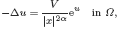
with Ω ⊂ ℝ2 open and bounded, α ∈ (0,1) and V any measurable function which satisfies 0 < a ≤ V ≤ b < + ∞.
On the van der Waals–Cahn–Hilliard phase-field model and its equilibria conditions in the sharp interface limit
-
- Journal:
- Proceedings of the Royal Society of Edinburgh. Section A: Mathematics / Volume 140 / Issue 6 / December 2010
- Published online by Cambridge University Press:
- 08 December 2010, pp. 1161-1186
- Print publication:
- December 2010
-
- Article
- Export citation
Index to Volume 140
-
- Journal:
- Proceedings of the Royal Society of Edinburgh. Section A: Mathematics / Volume 140 / Issue 6 / December 2010
- Published online by Cambridge University Press:
- 08 December 2010, pp. 1337-1341
- Print publication:
- December 2010
-
- Article
- Export citation
Geometric invariants and principal configurations on spacelike surfaces immersed in ℝ3,1
-
- Journal:
- Proceedings of the Royal Society of Edinburgh. Section A: Mathematics / Volume 140 / Issue 6 / December 2010
- Published online by Cambridge University Press:
- 08 December 2010, pp. 1141-1160
- Print publication:
- December 2010
-
- Article
- Export citation
Regularity for subquadratic parabolic systems: higher integrability and dimension estimates
-
- Journal:
- Proceedings of the Royal Society of Edinburgh. Section A: Mathematics / Volume 140 / Issue 6 / December 2010
- Published online by Cambridge University Press:
- 08 December 2010, pp. 1269-1308
- Print publication:
- December 2010
-
- Article
- Export citation
-
We consider weak solutions of parabolic systems of the type

where the structure function b is differentiable with respect to x and satisfies standard ellipticity and growth properties with polynomial growth rate p ∊ (2n/(n + 2), 2). We investigate regularity properties of the solution, including the existence of second-order spatial derivatives, the existence of the time derivative and the higher integrability of the spatial gradient. As an application, we derive dimension estimates for the singular set of solutions of homogeneous parabolic systems. More precisely, we establish the bound

provided the structure function depends Höolder continuously on the space variable with Höolder exponent β ∊(0, 1].
Global solution curves for a class of quasilinear boundary-value problems
-
- Journal:
- Proceedings of the Royal Society of Edinburgh. Section A: Mathematics / Volume 140 / Issue 6 / December 2010
- Published online by Cambridge University Press:
- 08 December 2010, pp. 1197-1215
- Print publication:
- December 2010
-
- Article
- Export citation
Unbounded delay stochastic functional Kolmogorov-type system
-
- Journal:
- Proceedings of the Royal Society of Edinburgh. Section A: Mathematics / Volume 140 / Issue 6 / December 2010
- Published online by Cambridge University Press:
- 08 December 2010, pp. 1309-1334
- Print publication:
- December 2010
-
- Article
- Export citation
-
In general, population systems are often subject to environmental noise. To examine whether the presence of such noise affects these systems significantly, we perturb the functional Kolmogorov-type system

into the stochastic functional differential equation
![$$\mathrm{d} x(t)=\mathrm{diag}(x_1(t),\dots,x_n(t))[f(x_t)\,\mathrm{d} t+g(x_t)\,\mathrm{d} w(t)].$$](//static.cambridge.org/content/id/urn%3Acambridge.org%3Aid%3Aarticle%3AS0308210509000237/resource/name/S0308210509000237_eqnU2.gif?pub-status=live)
We show that different environmental noise structures have different effects on the population system with unbounded delay. Under two classes of different environmental noise perturbations, we establish existence theorems of the global positive solution to the unbounded delay stochastic functional Kolmogorov-type system. As the desired results for population dynamics, we also examine asymptotic boundedness, including the moment boundedness, stochastically ultimate boundedness and the moment average boundedness in time. To illustrate our idea more clearly, as a special case we also discuss a Lotka–Volterra system with unbounded delay.
![$$\mathrm{d} x(t)=\mathrm{diag}(x_1(t),\dots,x_n(t))[f(x_t)\,\mathrm{d} t+g(x_t)\,\mathrm{d} w(t)].$$](http://static.cambridge.org/content/id/urn%3Acambridge.org%3Aid%3Aarticle%3AS0308210509000237/resource/name/S0308210509000237_eqnU2.gif?pub-status=live)
Existence, multiplicity and non-existence of positive solutions for two-point boundary-value problems with strong singularity
-
- Journal:
- Proceedings of the Royal Society of Edinburgh. Section A: Mathematics / Volume 140 / Issue 6 / December 2010
- Published online by Cambridge University Press:
- 08 December 2010, pp. 1187-1196
- Print publication:
- December 2010
-
- Article
- Export citation
-
We study the existence, multiplicity and non-existence of positive solutions for the singular two-point boundary-value problems

where
 λ is a non-negative real parameter and f ∈ C((0, 1) × [0,∞), (0,∞)). Here, f(t, u) may be singular at t = 0 and/or 1. To obtain the main results we use the global continuation theorem and fixed-point index theory.
 λ is a non-negative real parameter and f ∈ C((0, 1) × [0,∞), (0,∞)). Here, f(t, u) may be singular at t = 0 and/or 1. To obtain the main results we use the global continuation theorem and fixed-point index theory.
Solvability conditions for some non-Fredholm operators
- Part of
-
- Journal:
- Proceedings of the Edinburgh Mathematical Society / Volume 54 / Issue 1 / February 2011
- Published online by Cambridge University Press:
- 30 November 2010, pp. 249-271
-
- Article
-
- You have access
- Export citation
Storage allocation under processor sharing II: Further asymptotic results
-
- Journal:
- European Journal of Applied Mathematics / Volume 22 / Issue 1 / February 2011
- Published online by Cambridge University Press:
- 30 November 2010, pp. 45-82
-
- Article
- Export citation
Sensitivity analysis of linear and nonlinear lithotripter models†
-
- Journal:
- European Journal of Applied Mathematics / Volume 22 / Issue 1 / February 2011
- Published online by Cambridge University Press:
- 25 November 2010, pp. 21-43
-
- Article
- Export citation
On Barycentric Subdivision
-
- Journal:
- Combinatorics, Probability and Computing / Volume 20 / Issue 2 / March 2011
- Published online by Cambridge University Press:
- 24 November 2010, pp. 213-237
-
- Article
- Export citation
