Refine search
Actions for selected content:
26079 results in Abstract analysis
4 - An embedding theorem for subsets of ℝN in terms of the upper box-counting dimension
- from PART I - FINITE-DIMENSIONAL SETS
-
- Book:
- Dimensions, Embeddings, and Attractors
- Published online:
- 10 January 2011
- Print publication:
- 16 December 2010, pp 41-46
-
- Chapter
- Export citation
10 - Partial differential equations and nonlinear semigroups
- from PART II - FINITE-DIMENSIONAL ATTRACTIORS
-
- Book:
- Dimensions, Embeddings, and Attractors
- Published online:
- 10 January 2011
- Print publication:
- 16 December 2010, pp 105-114
-
- Chapter
- Export citation
JMJ volume 10 issue 1 Cover and Front matter
-
- Journal:
- Journal of the Institute of Mathematics of Jussieu / Volume 10 / Issue 1 / January 2011
- Published online by Cambridge University Press:
- 16 December 2010, pp. f1-f2
- Print publication:
- January 2011
-
- Article
-
- You have access
- Export citation
bvca(Σ, X) REVISITED
-
- Journal:
- Glasgow Mathematical Journal / Volume 53 / Issue 2 / May 2011
- Published online by Cambridge University Press:
- 13 December 2010, pp. 341-346
-
- Article
-
- You have access
- Export citation
ERDŐS–TURÁN WITH A MOVING TARGET, EQUIDISTRIBUTION OF ROOTS OF REDUCIBLE QUADRATICS, AND DIOPHANTINE QUADRUPLES
- Part of
-
- Journal:
- Mathematika / Volume 57 / Issue 1 / January 2011
- Published online by Cambridge University Press:
- 13 December 2010, pp. 1-29
- Print publication:
- January 2011
-
- Article
- Export citation
MAXIMUM PRINCIPLES FOR SOME HIGHER-ORDER SEMILINEAR ELLIPTIC EQUATIONS
-
- Journal:
- Glasgow Mathematical Journal / Volume 53 / Issue 2 / May 2011
- Published online by Cambridge University Press:
- 13 December 2010, pp. 313-320
-
- Article
-
- You have access
- Export citation
GENERALIZED D. H. LEHMER PROBLEM OVER SHORT INTERVALS
-
- Journal:
- Glasgow Mathematical Journal / Volume 53 / Issue 2 / May 2011
- Published online by Cambridge University Press:
- 13 December 2010, pp. 293-299
-
- Article
-
- You have access
- Export citation
-
Let n ≥ 2 be a fixed positive integer, q ≥ 3 and c, ℓ be integers with (nc, q)=1 and ℓ|n. Suppose


 The main purpose of this paper is to use the estimates of Gauss sums and Kloosterman sums to study the asymptotic properties of N(


AN EXPLICIT INCIDENCE THEOREM IN 𝔽p
- Part of
-
- Journal:
- Mathematika / Volume 57 / Issue 1 / January 2011
- Published online by Cambridge University Press:
- 13 December 2010, pp. 135-145
- Print publication:
- January 2011
-
- Article
- Export citation
-
Let P=A×A⊂𝔽p×𝔽p, p a prime. Assume that P=A×A has n elements, n<p. See P as a set of points in the plane over 𝔽p. We show that the pairs of points in P determine
 lines, where c is an absolute constant. We derive from this an incidence theorem: the number of incidences between a set of n points and a set of n lines in the projective plane over 𝔽p (n<p)is bounded by
  , where C is an absolute constant.
 lines, where c is an absolute constant. We derive from this an incidence theorem: the number of incidences between a set of n points and a set of n lines in the projective plane over 𝔽
 , where C is an absolute constant.
LOCAL MINIMALITY OF THE VOLUME-PRODUCT AT THE SIMPLEX
- Part of
-
- Journal:
- Mathematika / Volume 57 / Issue 1 / January 2011
- Published online by Cambridge University Press:
- 13 December 2010, pp. 121-134
- Print publication:
- January 2011
-
- Article
- Export citation
PARALLEL BODIES AND NORMALS OF CONVEX BODIES
- Part of
-
- Journal:
- Mathematika / Volume 57 / Issue 1 / January 2011
- Published online by Cambridge University Press:
- 13 December 2010, pp. 109-119
- Print publication:
- January 2011
-
- Article
- Export citation
EIGENVALUE PROBLEMS FOR SINGULAR ODES
-
- Journal:
- Glasgow Mathematical Journal / Volume 53 / Issue 2 / May 2011
- Published online by Cambridge University Press:
- 09 December 2010, pp. 301-312
-
- Article
-
- You have access
- Export citation
ALGEBRAIC CYCLES ON COMPACT QUATERNIONIC SHIMURA FOURFOLDS AND POLES OF L-FUNCTIONS
-
- Journal:
- Glasgow Mathematical Journal / Volume 53 / Issue 2 / May 2011
- Published online by Cambridge University Press:
- 09 December 2010, pp. 359-367
-
- Article
-
- You have access
- Export citation
THREE POSITIVE PERIODIC SOLUTIONS FOR DYNAMIC EQUATIONS WITH PIECEWISE CONSTANT ARGUMENT AND IMPULSE ON TIME SCALES*
-
- Journal:
- Glasgow Mathematical Journal / Volume 53 / Issue 2 / May 2011
- Published online by Cambridge University Press:
- 08 December 2010, pp. 369-377
-
- Article
-
- You have access
- Export citation
FINITE GROUPS WITH SOME WEAKLY S-SUPPLEMENTED SUBGROUPS
-
- Journal:
- Glasgow Mathematical Journal / Volume 53 / Issue 2 / May 2011
- Published online by Cambridge University Press:
- 08 December 2010, pp. 211-222
-
- Article
-
- You have access
- Export citation
SYMMETRY BREAKING FOR GROUND-STATE SOLUTIONS OF HÉNON SYSTEMS IN A BALL
-
- Journal:
- Glasgow Mathematical Journal / Volume 53 / Issue 2 / May 2011
- Published online by Cambridge University Press:
- 08 December 2010, pp. 245-255
-
- Article
-
- You have access
- Export citation
-
We consider in this paper the problem(1)
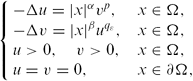 where Ω is the unit ball in ℝN centred at the origin, 0 ≤ α < pN,β > 0, N ≥ 3. Suppose qϵ → q as ϵ → 0+ and qϵ, q satisfy, respectively,
 we investigate the asymptotic estimates of the ground-state solutions (uϵ, vϵ) of (1) as β → + ∞ with p, qϵ fixed. We also show the symmetry-breaking phenomenon with α, β fixed and qϵ → q as ϵ → 0+. In addition, the ground-state solution is non-radial provided that ϵ > 0 is small or β is large enough.
ASYMPTOTIC INTEGRATION OF SECOND-ORDER NONLINEAR DIFFERENCE EQUATIONS
-
- Journal:
- Glasgow Mathematical Journal / Volume 53 / Issue 2 / May 2011
- Published online by Cambridge University Press:
- 08 December 2010, pp. 223-243
-
- Article
-
- You have access
- Export citation
VECTOR MEASURES OF BOUNDED SEMIVARIATION AND ASSOCIATED CONVOLUTION OPERATORS
-
- Journal:
- Glasgow Mathematical Journal / Volume 53 / Issue 2 / May 2011
- Published online by Cambridge University Press:
- 08 December 2010, pp. 333-340
-
- Article
-
- You have access
- Export citation
-
Let G be a compact metrizable abelian group, and let X be a Banach space. We characterize convolution operators associated with a regular Borel X-valued measure of bounded semivariation that are compact (resp; weakly compact) from L1(G), the space of integrable functions on G into L1(G)


DERIVED EQUIVALENCE CLASSIFICATION OF SYMMETRIC ALGEBRAS OF POLYNOMIAL GROWTH
-
- Journal:
- Glasgow Mathematical Journal / Volume 53 / Issue 2 / May 2011
- Published online by Cambridge University Press:
- 08 December 2010, pp. 277-291
-
- Article
-
- You have access
- Export citation
REAL HYPERSURFACES WITH φ-INVARIANT SHAPE OPERATOR IN A COMPLEX PROJECTIVE SPACE
-
- Journal:
- Glasgow Mathematical Journal / Volume 53 / Issue 2 / May 2011
- Published online by Cambridge University Press:
- 08 December 2010, pp. 347-358
-
- Article
-
- You have access
- Export citation
RATIONAL REPRESENTATIONS OF GL2
-
- Journal:
- Glasgow Mathematical Journal / Volume 53 / Issue 2 / May 2011
- Published online by Cambridge University Press:
- 08 December 2010, pp. 257-275
-
- Article
-
- You have access
- Export citation
-
Let F be an algebraically closed field of characteristic p. We fashion an infinite dimensional basic algebra


