Refine search
Actions for selected content:
26078 results in Abstract analysis
HÖLDER ESTIMATES FOR LINEAR SECOND-ORDER EQUATIONS
- Part of
-
- Journal:
- Mathematika / Volume 57 / Issue 2 / July 2011
- Published online by Cambridge University Press:
- 17 November 2010, pp. 315-327
- Print publication:
- July 2011
-
- Article
- Export citation
VARIATIONAL PRINCIPLES FOR WATER WAVES FROM THE VIEWPOINT OF A TIME-DEPENDENT MOVING MESH
- Part of
-
- Journal:
- Mathematika / Volume 57 / Issue 1 / January 2011
- Published online by Cambridge University Press:
- 17 November 2010, pp. 147-173
- Print publication:
- January 2011
-
- Article
- Export citation
DISTANCE BETWEEN ARITHMETIC PROGRESSIONS AND PERFECT SQUARES
- Part of
-
- Journal:
- Mathematika / Volume 57 / Issue 1 / January 2011
- Published online by Cambridge University Press:
- 17 November 2010, pp. 41-49
- Print publication:
- January 2011
-
- Article
- Export citation
Closed Einstein–Weyl structures on compact Sasakian and cosymplectic manifolds
- Part of
-
- Journal:
- Proceedings of the Edinburgh Mathematical Society / Volume 54 / Issue 1 / February 2011
- Published online by Cambridge University Press:
- 11 November 2010, pp. 149-160
-
- Article
-
- You have access
- Export citation
EJM volume 21 issue 6 Cover and Front matter
-
- Journal:
- European Journal of Applied Mathematics / Volume 21 / Issue 6 / December 2010
- Published online by Cambridge University Press:
- 10 November 2010, pp. f1-f2
-
- Article
-
- You have access
- Export citation
EJM volume 21 issue 6 Cover and Back matter
-
- Journal:
- European Journal of Applied Mathematics / Volume 21 / Issue 6 / December 2010
- Published online by Cambridge University Press:
- 10 November 2010, pp. b1-b2
-
- Article
-
- You have access
- Export citation
On the gaps between values of binary quadratic forms
- Part of
-
- Journal:
- Proceedings of the Edinburgh Mathematical Society / Volume 54 / Issue 1 / February 2011
- Published online by Cambridge University Press:
- 01 November 2010, pp. 25-32
-
- Article
-
- You have access
- Export citation
Notes on contact Ricci solitons
- Part of
-
- Journal:
- Proceedings of the Edinburgh Mathematical Society / Volume 54 / Issue 1 / February 2011
- Published online by Cambridge University Press:
- 28 October 2010, pp. 47-53
-
- Article
-
- You have access
- Export citation
The Lalonde–McDuff Conjecture and the fundamental group
- Part of
-
- Journal:
- Proceedings of the Edinburgh Mathematical Society / Volume 54 / Issue 1 / February 2011
- Published online by Cambridge University Press:
- 28 October 2010, pp. 125-129
-
- Article
-
- You have access
- Export citation
Solutions of perturbed Schrödinger equations with electromagnetic fields and critical nonlinearity
- Part of
-
- Journal:
- Proceedings of the Edinburgh Mathematical Society / Volume 54 / Issue 1 / February 2011
- Published online by Cambridge University Press:
- 28 October 2010, pp. 131-147
-
- Article
-
- You have access
- Export citation
-
We consider the existence and multiplicity of standing-wave solutions
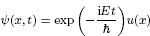
of nonlinear Schrödinger equations with electromagnetic fields and critical nonlinearity

Under suitable assumptions, we prove that it has at least one solution and that, for any m ∈ ℕ, it has at least m pairs of solutions.
Elementary operators and subhomogeneous C*-algebras
- Part of
-
- Journal:
- Proceedings of the Edinburgh Mathematical Society / Volume 54 / Issue 1 / February 2011
- Published online by Cambridge University Press:
- 28 October 2010, pp. 99-111
-
- Article
-
- You have access
- Export citation
Log canonical thresholds on Gorenstein canonical del Pezzo surfaces
- Part of
-
- Journal:
- Proceedings of the Edinburgh Mathematical Society / Volume 54 / Issue 1 / February 2011
- Published online by Cambridge University Press:
- 28 October 2010, pp. 187-219
-
- Article
-
- You have access
- Export citation
Repunit Lehmer numbers
- Part of
-
- Journal:
- Proceedings of the Edinburgh Mathematical Society / Volume 54 / Issue 1 / February 2011
- Published online by Cambridge University Press:
- 28 October 2010, pp. 55-65
-
- Article
-
- You have access
- Export citation
Diameters in Supercritical Random Graphs Via First Passage Percolation
-
- Journal:
- Combinatorics, Probability and Computing / Volume 19 / Issue 5-6 / November 2010
- Published online by Cambridge University Press:
- 05 October 2010, pp. 729-751
-
- Article
- Export citation
-
We study the diameter of


 where ε3n → ∞ and ε = o(1). This parameter was extensively studied for fixed ε > 0, yet results for ε = o(1) outside the critical window were only obtained very recently. Prior to this work, Riordan and Wormald gave precise estimates on the diameter; however, these did not cover the entire supercritical regime (namely, when ε3n → ∞ arbitrarily slowly). Łuczak and Seierstad estimated its order throughout this regime, yet their upper and lower bounds differed by a factor of
  .
.We show that throughout the emerging supercritical phase, i.e., for any ε = o(1) with ε3n → ∞, the diameter of
 , and the maximal distance in
  .
.


 where ε
 .
. , and the maximal distance in
  .
.CPC volume 19 issue 5-6 Cover and Front matter
-
- Journal:
- Combinatorics, Probability and Computing / Volume 19 / Issue 5-6 / November 2010
- Published online by Cambridge University Press:
- 05 October 2010, pp. f1-f2
-
- Article
-
- You have access
- Export citation
Introduction
-
- Journal:
- Combinatorics, Probability and Computing / Volume 19 / Issue 5-6 / November 2010
- Published online by Cambridge University Press:
- 05 October 2010, p. 641
-
- Article
- Export citation
The Diameter of Sparse Random Graphs
-
- Journal:
- Combinatorics, Probability and Computing / Volume 19 / Issue 5-6 / November 2010
- Published online by Cambridge University Press:
- 05 October 2010, pp. 835-926
-
- Article
- Export citation
On Random Betweenness Constraints
-
- Journal:
- Combinatorics, Probability and Computing / Volume 19 / Issue 5-6 / November 2010
- Published online by Cambridge University Press:
- 05 October 2010, pp. 775-790
-
- Article
- Export citation
CPC volume 19 issue 5-6 Cover and Back matter
-
- Journal:
- Combinatorics, Probability and Computing / Volume 19 / Issue 5-6 / November 2010
- Published online by Cambridge University Press:
- 05 October 2010, pp. b1-b4
-
- Article
-
- You have access
- Export citation
Dynamics of a non-local delayed reaction–diffusion equation without quasi-monotonicity
-
- Journal:
- Proceedings of the Royal Society of Edinburgh. Section A: Mathematics / Volume 140 / Issue 5 / October 2010
- Published online by Cambridge University Press:
- 01 October 2010, pp. 1081-1109
- Print publication:
- October 2010
-
- Article
- Export citation
