Refine search
Actions for selected content:
26078 results in Abstract analysis
POSITIVE SOLUTIONS TO p(x)-LAPLACIAN–DIRICHLET PROBLEMS WITH SIGN-CHANGING NON-LINEARITIES
-
- Journal:
- Glasgow Mathematical Journal / Volume 52 / Issue 3 / September 2010
- Published online by Cambridge University Press:
- 25 August 2010, pp. 505-516
-
- Article
-
- You have access
- Export citation
-
Consider the p(x)-Laplacian–Dirichlet problem with sign-changing non-linearity of the form
![\begin{linenomath}\begin{equation*} \left\{\begin{array}{@{}l@{\quad}l@{\quad}l@{}} -div(\left\vert \nabla u\right\vert ^{p(x)-2}\nabla u)+m(x)\left\vert u\right\vert ^{p(x)-2}u=\lambda a(x)f(u)&\text{in}\Omega \\[6pt] u=0 & \text{on}\ \partial \Omega,% \end{array}% \right. \end{equation*}\end{linenomath}%](//static.cambridge.org/content/id/urn%3Acambridge.org%3Aid%3Aarticle%3AS0017089510000388/resource/name/S0017089510000388_eqnU1.gif?pub-status=live) where Ω ⊂ ℝN is a bounded domain, p ∈ C0(Ω) and infx∈Ωp(x) > 1, m ∈ L∞(Ω) is non-negative, f : ℝ → ℝ is continuous and f(0) > 0, the coefficient a ∈ L∞(Ω) is sign-changing in (Ω). We give some sufficient conditions to assure the existence of a positive solution to the problem for sufficiently small λ > 0. Our results extend the corresponding results established in the p-Laplacian case to the p(x)-Laplacian case.
where Ω ⊂ ℝN is a bounded domain, p ∈ C0(Ω) and infx∈Ωp(x) > 1, m ∈ L∞(Ω) is non-negative, f : ℝ → ℝ is continuous and f(0) > 0, the coefficient a ∈ L∞(Ω) is sign-changing in (Ω). We give some sufficient conditions to assure the existence of a positive solution to the problem for sufficiently small λ > 0. Our results extend the corresponding results established in the p-Laplacian case to the p(x)-Laplacian case.
![\begin{linenomath}\begin{equation*} \left\{\begin{array}{@{}l@{\quad}l@{\quad}l@{}} -div(\left\vert \nabla u\right\vert ^{p(x)-2}\nabla u)+m(x)\left\vert u\right\vert ^{p(x)-2}u=\lambda a(x)f(u)&\text{in}\Omega \\[6pt] u=0 & \text{on}\ \partial \Omega,% \end{array}% \right. \end{equation*}\end{linenomath}%](http://static.cambridge.org/content/id/urn%3Acambridge.org%3Aid%3Aarticle%3AS0017089510000388/resource/name/S0017089510000388_eqnU1.gif?pub-status=live)
ON GENERALIZATION OF NAKAYAMA'S LEMMA
-
- Journal:
- Glasgow Mathematical Journal / Volume 52 / Issue 3 / September 2010
- Published online by Cambridge University Press:
- 25 August 2010, pp. 605-617
-
- Article
-
- You have access
- Export citation
ON THE IDEAL CLASS GROUP OF CERTAIN QUADRATIC FIELDS
-
- Journal:
- Glasgow Mathematical Journal / Volume 52 / Issue 3 / September 2010
- Published online by Cambridge University Press:
- 25 August 2010, pp. 575-581
-
- Article
-
- You have access
- Export citation
-
Let n(≥ 3) be an odd integer. Let k:=
 be the imaginary quadratic field and k′:=
  the real quadratic field. In this paper, we prove that the class number of k is divisible by 3 unconditionally, and the class number of k′ is divisible by 3 if n(≥ 9) is divisible by 3. Moreover, we prove that the 3-rank of the ideal class group of k is at least 2 if n(≥ 9) is divisible by 3.
 be the imaginary quadratic field and k′:=
  the real quadratic field. In this paper, we prove that the class number of k is divisible by 3 unconditionally, and the class number of k′ is divisible by 3 if n(≥ 9) is divisible by 3. Moreover, we prove that the 3-rank of the ideal class group of k is at least 2 if n(≥ 9) is divisible by 3.
QUASI-DETERMINANTS AND q-COMMUTING MINORS
-
- Journal:
- Glasgow Mathematical Journal / Volume 52 / Issue 3 / September 2010
- Published online by Cambridge University Press:
- 25 August 2010, pp. 663-675
-
- Article
-
- You have access
- Export citation
LINEAR WEINGARTEN HYPERSURFACES IN A REAL SPACE FORM
-
- Journal:
- Glasgow Mathematical Journal / Volume 52 / Issue 3 / September 2010
- Published online by Cambridge University Press:
- 25 August 2010, pp. 635-648
-
- Article
-
- You have access
- Export citation
-
In this paper, we investigate linear Weingarten hypersurfaces with two distinct principal curvatures in a real space form Mn+1(c), we obtain two rigidity results and give some characterization of the Riemannian product Sk(a) × Sn−k(
 ), 1 ≤ k ≤ n − 1 in Mn+1(c)(c = 1), the Riemannian product Rk × Sn−k(a), 1 ≤ k ≤ n −1 in Mn+1(c)(c = 0) and the Riemannian product Hk(tanh2 ρ−1) × Sn−k(coth2 ρ−1), 1 ≤ k ≤ n −1 in Mn+1(c)(c = −1).
 ), 1 ≤ k ≤ n − 1 in M
THE NON-ABELIAN TENSOR PRODUCT OF FINITE GROUPS IS FINITE: A HOMOLOGY-FREE PROOF
-
- Journal:
- Glasgow Mathematical Journal / Volume 52 / Issue 3 / September 2010
- Published online by Cambridge University Press:
- 25 August 2010, pp. 473-477
-
- Article
-
- You have access
- Export citation
THIRD-REGULAR BI-EMBEDDINGS OF LATIN SQUARES
-
- Journal:
- Glasgow Mathematical Journal / Volume 52 / Issue 3 / September 2010
- Published online by Cambridge University Press:
- 25 August 2010, pp. 497-503
-
- Article
-
- You have access
- Export citation
DECOMPOSITION OF JORDAN AUTOMORPHISMS OF TRIANGULAR MATRIX ALGEBRA OVER COMMUTATIVE RINGS
-
- Journal:
- Glasgow Mathematical Journal / Volume 52 / Issue 3 / September 2010
- Published online by Cambridge University Press:
- 25 August 2010, pp. 529-536
-
- Article
-
- You have access
- Export citation
ON WITTEN MULTIPLE ZETA-FUNCTIONS ASSOCIATED WITH SEMI-SIMPLE LIE ALGEBRAS IV
-
- Journal:
- Glasgow Mathematical Journal / Volume 53 / Issue 1 / January 2011
- Published online by Cambridge University Press:
- 25 August 2010, pp. 185-206
-
- Article
-
- You have access
- Export citation
Pegging Graphs Yields a Small Diameter
-
- Journal:
- Combinatorics, Probability and Computing / Volume 20 / Issue 2 / March 2011
- Published online by Cambridge University Press:
- 24 August 2010, pp. 239-248
-
- Article
- Export citation
One More Probabilistic Reformulation of the Four Colour Conjecture
-
- Journal:
- Combinatorics, Probability and Computing / Volume 19 / Issue 5-6 / November 2010
- Published online by Cambridge University Press:
- 24 August 2010, pp. 829-834
-
- Article
- Export citation
Corrigendum: amenability of ultrapowers of Banach algebras
- Part of
-
- Journal:
- Proceedings of the Edinburgh Mathematical Society / Volume 53 / Issue 3 / October 2010
- Published online by Cambridge University Press:
- 16 August 2010, pp. 633-637
-
- Article
-
- You have access
- Export citation
Bootstrap Percolation in High Dimensions
-
- Journal:
- Combinatorics, Probability and Computing / Volume 19 / Issue 5-6 / November 2010
- Published online by Cambridge University Press:
- 12 August 2010, pp. 643-692
-
- Article
- Export citation
-
In r-neighbour bootstrap percolation on a graph G, a set of initially infected vertices A ⊂ V(G) is chosen independently at random, with density p, and new vertices are subsequently infected if they have at least r infected neighbours. The set A is said to percolate if eventually all vertices are infected. Our aim is to understand this process on the grid, [n]d, for arbitrary functions n = n(t), d = d(t) and r = r(t), as t → ∞. The main question is to determine the critical probability pc([n]d, r) at which percolation becomes likely, and to give bounds on the size of the critical window. In this paper we study this problem when r = 2, for all functions n and d satisfying d ≫ log n.
The bootstrap process has been extensively studied on [n]d when d is a fixed constant and 2 ⩽ r ⩽ d, and in these cases pc([n]d, r) has recently been determined up to a factor of 1 + o(1) as n → ∞. At the other end of the scale, Balogh and Bollobás determined pc([2]d, 2) up to a constant factor, and Balogh, Bollobás and Morris determined pc([n]d, d) asymptotically if d ≥ (log log n)2+ϵ, and gave much sharper bounds for the hypercube.
Here we prove the following result. Let λ be the smallest positive root of the equation
![\[\sum_{k=0}^\infty \frac{(-1)^k \lambda^k}{2^{k^2-k} k!} = 0,\]](//static.cambridge.org/content/id/urn%3Acambridge.org%3Aid%3Aarticle%3AS0963548310000271/resource/name/S0963548310000271_eqnU1.gif?pub-status=live) so λ ≈ 1.166. Then
so λ ≈ 1.166. Then![\[ \frac{16\lambda}{d^2} \biggl(1 + \frac{\log d}{\sqrt{d}} \biggr)\: 2^{-2\sqrt{d}} \leq p_c([2]^d,2) \leq \frac{16\lambda}{d^2} \biggl(1 + \frac{5(\log d)^2}{\sqrt{d}} \biggr) \: 2^{-2\sqrt{d}}\]](//static.cambridge.org/content/id/urn%3Acambridge.org%3Aid%3Aarticle%3AS0963548310000271/resource/name/S0963548310000271_eqnU2.gif?pub-status=live) if d is sufficiently large, and moreover
if d is sufficiently large, and moreover![\[p_c\bigl([n]^d,2 \bigr) = \bigl(4\lambda + o(1) \bigr) \biggl(\frac{n}{n-1} \biggr)^2 \, \frac{1}{d^2} \, 2^{-2\sqrt{d \log_2 n}}\]](//static.cambridge.org/content/id/urn%3Acambridge.org%3Aid%3Aarticle%3AS0963548310000271/resource/name/S0963548310000271_eqnU3.gif?pub-status=live) as d → ∞, for every function n = n(d) with d ≫ log n.
as d → ∞, for every function n = n(d) with d ≫ log n.
![\[\sum_{k=0}^\infty \frac{(-1)^k \lambda^k}{2^{k^2-k} k!} = 0,\]](http://static.cambridge.org/content/id/urn%3Acambridge.org%3Aid%3Aarticle%3AS0963548310000271/resource/name/S0963548310000271_eqnU1.gif?pub-status=live)
![\[ \frac{16\lambda}{d^2} \biggl(1 + \frac{\log d}{\sqrt{d}} \biggr)\: 2^{-2\sqrt{d}} \leq p_c([2]^d,2) \leq \frac{16\lambda}{d^2} \biggl(1 + \frac{5(\log d)^2}{\sqrt{d}} \biggr) \: 2^{-2\sqrt{d}}\]](http://static.cambridge.org/content/id/urn%3Acambridge.org%3Aid%3Aarticle%3AS0963548310000271/resource/name/S0963548310000271_eqnU2.gif?pub-status=live)
![\[p_c\bigl([n]^d,2 \bigr) = \bigl(4\lambda + o(1) \bigr) \biggl(\frac{n}{n-1} \biggr)^2 \, \frac{1}{d^2} \, 2^{-2\sqrt{d \log_2 n}}\]](http://static.cambridge.org/content/id/urn%3Acambridge.org%3Aid%3Aarticle%3AS0963548310000271/resource/name/S0963548310000271_eqnU3.gif?pub-status=live)
Gray identities, canonical connection and integrability
- Part of
-
- Journal:
- Proceedings of the Edinburgh Mathematical Society / Volume 53 / Issue 3 / October 2010
- Published online by Cambridge University Press:
- 12 August 2010, pp. 657-674
-
- Article
-
- You have access
- Export citation
Orthogonally additive holomorphic functions of bounded type over C(K)
- Part of
-
- Journal:
- Proceedings of the Edinburgh Mathematical Society / Volume 53 / Issue 3 / October 2010
- Published online by Cambridge University Press:
- 12 August 2010, pp. 609-618
-
- Article
-
- You have access
- Export citation
-
It is known that all k-homogeneous orthogonally additive polynomials P over C(K) are of the form
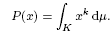
Thus, x ↦ xk factors all orthogonally additive polynomials through some linear form μ. We show that no such linearization is possible without homogeneity. However, we also show that every orthogonally additive holomorphic function of bounded type f over C(K) is of the form
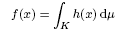
for some μ and holomorphic h : C (K) → L1(μ) of bounded type.
Norm functors and effective zero cycles
- Part of
-
- Journal:
- Proceedings of the Edinburgh Mathematical Society / Volume 53 / Issue 3 / October 2010
- Published online by Cambridge University Press:
- 12 August 2010, pp. 557-574
-
- Article
-
- You have access
- Export citation
The spectra of the Laplacians of fractal graphs not satisfying spectral decimation
- Part of
-
- Journal:
- Proceedings of the Edinburgh Mathematical Society / Volume 53 / Issue 3 / October 2010
- Published online by Cambridge University Press:
- 12 August 2010, pp. 731-746
-
- Article
-
- You have access
- Export citation
Pairs of periodic orbits with fixed homology difference
- Part of
-
- Journal:
- Proceedings of the Edinburgh Mathematical Society / Volume 53 / Issue 3 / October 2010
- Published online by Cambridge University Press:
- 12 August 2010, pp. 799-808
-
- Article
-
- You have access
- Export citation
Rationality and Sylow 2-subgroups
- Part of
-
- Journal:
- Proceedings of the Edinburgh Mathematical Society / Volume 53 / Issue 3 / October 2010
- Published online by Cambridge University Press:
- 12 August 2010, pp. 787-798
-
- Article
-
- You have access
- Export citation
An affine-invariant inequality for rational functions and applications in harmonic analysis
- Part of
-
- Journal:
- Proceedings of the Edinburgh Mathematical Society / Volume 53 / Issue 3 / October 2010
- Published online by Cambridge University Press:
- 12 August 2010, pp. 639-655
-
- Article
-
- You have access
- Export citation
