Refine search
Actions for selected content:
26076 results in Abstract analysis
The graded Cartan matrix and global dimension of 0-relations algebras
-
- Journal:
- Proceedings of the Edinburgh Mathematical Society / Volume 30 / Issue 3 / October 1987
- Published online by Cambridge University Press:
- 20 January 2009, pp. 351-362
-
- Article
-
- You have access
- Export citation
-
The Cartan matrix C of a left artinian ring A, with indecomposable projectives P1,…,Pn and corresponding simples Si=Pi/JPi, is an n×n integral matrix with entries Cij, the number of copies of the simple sj which appear as composition factors of Pi. A relationship between the invertibility of this matrix (as an integral matrix) and the finiteness of the global dimension has long been known: gl dim A < ∞⇒det C = ± 1 (Eilenberg [3]). More recently Zacharia [9] has shown that gl dim A ≦ 2⇒det C = 1, and in fact no rings of finite global dimension are known with det C = −1. The converse, det C = l⇒gl dim A < ∞, is false, as easy examples show ([[1) or [3]). However if A is left serial, gl dim A < ∞iff det C = l [1]. If A = ⊕n ≧ 0 An is ℤ-graded and the radical J = ⊕n ≧ 0 An, Wilson [8] calls such rings positively graded. Here there is a graded Cartan matrix
 with entries from ℤ[X] and gl dim A < ∞⇒det = 1 and, hence, det C = l [8, Prop. 2.2].
 with entries from ℤ[X] and gl dim A < ∞⇒det
 A Proof of the Binomial Theorem when the Exponent is a Positive Integer
-
- Journal:
- Proceedings of the Edinburgh Mathematical Society / Volume 17 / February 1898
- Published online by Cambridge University Press:
- 20 January 2009, p. 42
-
- Article
-
- You have access
- Export citation
-

Thus (1 + x)n − 1 is divisible by x.
Hence (1 + x)n = 1 + terms in x and its powers.
W. R. Bloom and H. Heyer Harmonic analysis of probability measures on hypergroups (de Gruyter Studies in Mathematics Vol. 20, de Gruyter, Berlin, New York 1995) vi + 601pp., 3 11 012105 0, about £140.
-
- Journal:
- Proceedings of the Edinburgh Mathematical Society / Volume 39 / Issue 2 / June 1996
- Published online by Cambridge University Press:
- 20 January 2009, pp. 403-405
-
- Article
-
- You have access
- Export citation
D. K. Arrowsmith and C. M. Place An Introduction to Dynamical Systems (Cambridge University Press, 1990), 433 pp., hard cover 0 521 30362 1, £50; paper 0 521 31650 2, £19.50.
-
- Journal:
- Proceedings of the Edinburgh Mathematical Society / Volume 34 / Issue 2 / June 1991
- Published online by Cambridge University Press:
- 20 January 2009, pp. 334-335
-
- Article
-
- You have access
- Export citation
Thirtieth Session, 1911–1912
-
- Journal:
- Proceedings of the Edinburgh Mathematical Society / Volume 30 / February 1911
- Published online by Cambridge University Press:
- 20 January 2009, pp. v-vi
-
- Article
-
- You have access
- Export citation
An Algebraic Problem in Control Theory
-
- Journal:
- Proceedings of the Edinburgh Mathematical Society / Volume 13 / Issue 3 / June 1963
- Published online by Cambridge University Press:
- 20 January 2009, pp. 205-218
-
- Article
-
- You have access
- Export citation
A Prüfer approach to half-linear Sturm-Liouville problems
-
- Journal:
- Proceedings of the Edinburgh Mathematical Society / Volume 41 / Issue 3 / October 1998
- Published online by Cambridge University Press:
- 20 January 2009, pp. 573-583
-
- Article
-
- You have access
- Export citation
-
We consider the half linear Sturm-Liouville problem

on the interval [0,1] subject to separated boundary conditions (which may be eigenparameter dependent at x = 1) and use Prüfer techniques to produce an oscillation theory for this problem. Both right definite (r > 0) and left definite (r of both signs) cases are discussed.
Note on Hypercomplex Numbers
-
- Journal:
- Proceedings of the Edinburgh Mathematical Society / Volume 25 / February 1906
- Published online by Cambridge University Press:
- 20 January 2009, pp. 2-4
-
- Article
-
- You have access
- Export citation
Convergence criteria for bounded sequences
-
- Journal:
- Proceedings of the Edinburgh Mathematical Society / Volume 18 / Issue 2 / December 1972
- Published online by Cambridge University Press:
- 20 January 2009, pp. 99-103
-
- Article
-
- You have access
- Export citation
-
Let {Kn} be a sequence of complex numbers, let
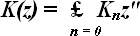
and let

Let D be the open unit disc {z: |z| <1}, let
 be its closure and let
  .
.The primary object of this paper is to prove the two theorems stated below, the first of which generalises a result of Copson (1).
 be its closure and let
  .
.Narkiewicz, W. The development of prime number theory from Euclid to Hardy and Littlewood (Monographs in Mathematics, Springer, 2000), xii+448 pp., 3 540 66289 8 (hardback), £58.50
-
- Journal:
- Proceedings of the Edinburgh Mathematical Society / Volume 44 / Issue 3 / October 2001
- Published online by Cambridge University Press:
- 20 January 2009, pp. 662-663
-
- Article
-
- You have access
- Export citation
Note on a Theorem connected with the area of a 2n-sided polygon
-
- Journal:
- Proceedings of the Edinburgh Mathematical Society / Volume 2 / February 1883
- Published online by Cambridge University Press:
- 20 January 2009, p. 8
-
- Article
-
- You have access
- Export citation
-
The theorem is:—If a1, a2, a3, …, a22 be the middle points of the sides of any convex polygon A1A2A3…A2n then as regards areas

The following proof depends only on the theorem that the line joining the points of bisection of two sides of a triangle cuts off a triangle equal in area to a quarter of the original triangle.
PEM volume 20 issue 3 Cover and Front matter
-
- Journal:
- Proceedings of the Edinburgh Mathematical Society / Volume 20 / Issue 3 / March 1977
- Published online by Cambridge University Press:
- 20 January 2009, pp. f1-f2
-
- Article
-
- You have access
- Export citation
F. W. Anderson and K. R. Fuller, Rings and Categories of Modules (Graduate Texts in Mathematics, vol. 13, Springer-Verlag, 1974), ix + 339 pp., DM.36.30, $14.80.
-
- Journal:
- Proceedings of the Edinburgh Mathematical Society / Volume 19 / Issue 4 / September 1975
- Published online by Cambridge University Press:
- 20 January 2009, p. 399
-
- Article
-
- You have access
- Export citation
On the continued fractions which represent the functions of Hermite and other functions defined by differential equations
-
- Journal:
- Proceedings of the Edinburgh Mathematical Society / Volume 32 / February 1913
- Published online by Cambridge University Press:
- 20 January 2009, pp. 65-74
-
- Article
-
- You have access
- Export citation
-
The functions of Hermite, which are the same as the functions associated with the parabolic cylinder in harmonic analysis, may be defined* by the differential equation which they satisfy, namely,

where n denotes any constant.
Whittaker's Contributions to the Theory of Relativity
-
- Journal:
- Proceedings of the Edinburgh Mathematical Society / Volume 11 / Issue 1 / June 1958
- Published online by Cambridge University Press:
- 20 January 2009, pp. 39-55
-
- Article
-
- You have access
- Export citation
Note on Whittaker's Solution of Laplace's Equation
-
- Journal:
- Proceedings of the Edinburgh Mathematical Society / Volume 44 / February 1925
- Published online by Cambridge University Press:
- 20 January 2009, pp. 22-25
-
- Article
-
- You have access
- Export citation
-
§1. Whittaker has shewn that a general solution of Laplace's Equation
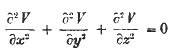
may be put in the form

where f (v, u) denotes an arbitrary function of the two variables u and v; such a representation is valid only in the neighbourhood of a regular point.
PEM volume 30 issue 3 Cover and Front matter
-
- Journal:
- Proceedings of the Edinburgh Mathematical Society / Volume 30 / Issue 3 / October 1987
- Published online by Cambridge University Press:
- 20 January 2009, pp. f1-f2
-
- Article
-
- You have access
- Export citation
On a question of Milnor concerning singularities of maps
-
- Journal:
- Proceedings of the Edinburgh Mathematical Society / Volume 43 / Issue 1 / February 2000
- Published online by Cambridge University Press:
- 20 January 2009, pp. 149-153
-
- Article
-
- You have access
- Export citation
Office-Bearers
-
- Journal:
- Proceedings of the Edinburgh Mathematical Society / Volume 34 / February 1915
- Published online by Cambridge University Press:
- 20 January 2009, p. 1
-
- Article
-
- You have access
- Export citation
A Construction for the Force, at any Point, due to Electric Point-Charges or Ideal Magnets, with an Extension to Continuous Distributions
-
- Journal:
- Proceedings of the Edinburgh Mathematical Society / Volume 20 / February 1901
- Published online by Cambridge University Press:
- 20 January 2009, pp. 73-75
-
- Article
-
- You have access
- Export citation
