Refine search
Actions for selected content:
26077 results in Abstract analysis
G. L. Watson, Integral Quadratic Forms (Cambridge, 1960), pp. viii + 143, 30s.
-
- Journal:
- Proceedings of the Edinburgh Mathematical Society / Volume 12 / Issue 3 / June 1961
- Published online by Cambridge University Press:
- 20 January 2009, p. 162
-
- Article
-
- You have access
- Export citation
A Note on the Kawada-into Theorem
-
- Journal:
- Proceedings of the Edinburgh Mathematical Society / Volume 13 / Issue 4 / December 1963
- Published online by Cambridge University Press:
- 20 January 2009, pp. 295-296
-
- Article
-
- You have access
- Export citation
-
If µ is a bounded regular Borel measure on a locally compact group G, and L1(G) denotes the class of complex-valued functions which are integrable with respect to the left Haar measure m of G, then, for each f∈L1(G),
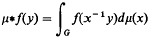
defines almost everywhere (a.e.) with respect to m a function μ*f which is again in L1(G). The measure μ will be called isotone on G mapping f→μ*f is isotone, i.e. f≧0 a.e. (m) if and only if μ*f≧0 a.e. (m).
On the Chern classes of the regular representations of some finite groups
-
- Journal:
- Proceedings of the Edinburgh Mathematical Society / Volume 25 / Issue 3 / October 1982
- Published online by Cambridge University Press:
- 20 January 2009, pp. 259-268
-
- Article
-
- You have access
- Export citation
-
In studying the cohomology of the symmetric groups and its applications in topology one is led to certain questions concerning the representation rings of special subgroups of
 . In this note we calculate the Chern classes of the regular representation of (Z/p)n where p is a fixed odd prime in terms of certain modular invariants first described by L. E. Dickson in 1911. In a later paper [9] we apply these results to study the odd primary torsion in the PL cobordism ring. Some indications of this application are given in Sections 10–12 where we apply the result above to obtain information about the cohomology of
  . After circulation of this note in preprint form we learned that H. Mui [10], has also proved Theorem 6.2.
 . In this note we calculate the Chern classes of the regular representation of (Z/p)
 . After circulation of this note in preprint form we learned that H. Mui [
Note on the Complete Jacobian Elliptic Integrals
-
- Journal:
- Proceedings of the Edinburgh Mathematical Society / Volume 37 / February 1918
- Published online by Cambridge University Press:
- 20 January 2009, pp. 26-32
-
- Article
-
- You have access
- Export citation
-
The complete elliptic integrals K and E are functions of their modulus k which satisfy the equations
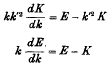
respectively.
INVOLUTION AND THE HAAGERUP TENSOR PRODUCT
-
- Journal:
- Proceedings of the Edinburgh Mathematical Society / Volume 44 / Issue 2 / June 2001
- Published online by Cambridge University Press:
- 20 January 2009, pp. 317-322
-
- Article
-
- You have access
- Export citation
Some applications of nearfields
-
- Journal:
- Proceedings of the Edinburgh Mathematical Society / Volume 23 / Issue 1 / February 1980
- Published online by Cambridge University Press:
- 20 January 2009, pp. 129-139
-
- Article
-
- You have access
- Export citation
Gauss's Theorem on the Regular Polygons which can be constructed by Euclid's Method
-
- Journal:
- Proceedings of the Edinburgh Mathematical Society / Volume 28 / February 1909
- Published online by Cambridge University Press:
- 20 January 2009, pp. 121-128
-
- Article
-
- You have access
- Export citation
-
The methods now adopted in the teaching of elementary geometry have made it most important that the teacher should have clear views upon the nature of the problems which are soluble by Euclid's methods: that is, with the aid of the ruler and compass only. With this general question I have dealt in another place. In this paper I give a short account of the argument by means of which Gauss proved that the only regular polygons of n sides, which can be constructed by Euclid's methods, are those in which n, when broken up into prime factors, takes the form

m1, m2, m3,…mr being all different.
On δ-Lie supertriple systems associated with (ε, δ)-Freudenthal-Kantor supertriple systems
-
- Journal:
- Proceedings of the Edinburgh Mathematical Society / Volume 43 / Issue 2 / June 2000
- Published online by Cambridge University Press:
- 20 January 2009, pp. 243-260
-
- Article
-
- You have access
- Export citation
Office-Bearers
-
- Journal:
- Proceedings of the Edinburgh Mathematical Society / Volume 1 / February 1883
- Published online by Cambridge University Press:
- 20 January 2009, p. 3
-
- Article
-
- You have access
- Export citation
The Co-apolars of a Cubic Curve
-
- Journal:
- Proceedings of the Edinburgh Mathematical Society / Volume 35 / February 1916
- Published online by Cambridge University Press:
- 20 January 2009, pp. 24-31
-
- Article
-
- You have access
- Export citation
The system of cubic curves circumscribing two triangles and apolar to them
-
- Journal:
- Proceedings of the Edinburgh Mathematical Society / Volume 30 / February 1911
- Published online by Cambridge University Press:
- 20 January 2009, pp. 2-12
-
- Article
-
- You have access
- Export citation
PEM volume 4 issue 2 Cover and Back matter
-
- Journal:
- Proceedings of the Edinburgh Mathematical Society / Volume 4 / Issue 2 / January 1935
- Published online by Cambridge University Press:
- 20 January 2009, pp. b1-b2
-
- Article
-
- You have access
- Export citation
Cardinal interpolation by symmetric exponential box splines on a three-direction mesh
-
- Journal:
- Proceedings of the Edinburgh Mathematical Society / Volume 33 / Issue 2 / June 1990
- Published online by Cambridge University Press:
- 20 January 2009, pp. 251-264
-
- Article
-
- You have access
- Export citation
J. F. Adams, Algebraic Topology—A Student's Guide (London Mathematical Society Lecture Note Series 4, Cambridge University Press, 1972), vi+300 pp.
-
- Journal:
- Proceedings of the Edinburgh Mathematical Society / Volume 18 / Issue 4 / December 1973
- Published online by Cambridge University Press:
- 20 January 2009, pp. 339-340
-
- Article
-
- You have access
- Export citation
Construction of regular semigroups with inverse transversals
-
- Journal:
- Proceedings of the Edinburgh Mathematical Society / Volume 32 / Issue 1 / February 1989
- Published online by Cambridge University Press:
- 20 January 2009, pp. 41-51
-
- Article
-
- You have access
- Export citation
A comparison theorem on magnetic jacobi fields
-
- Journal:
- Proceedings of the Edinburgh Mathematical Society / Volume 40 / Issue 2 / June 1997
- Published online by Cambridge University Press:
- 20 January 2009, pp. 293-308
-
- Article
-
- You have access
- Export citation
Length functions on hypercentral groups
-
- Journal:
- Proceedings of the Edinburgh Mathematical Society / Volume 28 / Issue 3 / October 1985
- Published online by Cambridge University Press:
- 20 January 2009, pp. 303-304
-
- Article
-
- You have access
- Export citation
Some maximal normal subgroups of the modular group
-
- Journal:
- Proceedings of the Edinburgh Mathematical Society / Volume 30 / Issue 1 / February 1987
- Published online by Cambridge University Press:
- 20 January 2009, pp. 97-101
-
- Article
-
- You have access
- Export citation
-
For each finite group G, let
 G denote the set of all normal subgroups of the modular group Γ = PSL2(ℤ) with quotient group isomorphic to G; since Γ is finitely generated, the number NG = |G| of such subgroups is finite. We shall be mainly concerned with the case where G is the linear fractional group PSL2(q) over the Galois field GF(q), in which case we shall write (q) and N(q) for G and NG; for q>3, PSL2(q) is simple, so the elements of (q) will be maximal normal subgroups of Γ.

On the Non-Euclidean Analogues of Tarry's Point
-
- Journal:
- Proceedings of the Edinburgh Mathematical Society / Volume 41 / February 1922
- Published online by Cambridge University Press:
- 20 January 2009, pp. 108-115
-
- Article
-
- You have access
- Export citation
Isogonals of a Triangle
-
- Journal:
- Proceedings of the Edinburgh Mathematical Society / Volume 13 / February 1894
- Published online by Cambridge University Press:
- 20 January 2009, pp. 166-178
-
- Article
-
- You have access
- Export citation
