Refine search
Actions for selected content:
26077 results in Abstract analysis
E. Nummelin General irreducible Markov chains and non-negative operators (Cambridge Tracts in Mathematics 83, Cambridge University Press, 1984), 156 pp. £20.
-
- Journal:
- Proceedings of the Edinburgh Mathematical Society / Volume 29 / Issue 2 / June 1986
- Published online by Cambridge University Press:
- 20 January 2009, pp. 283-284
-
- Article
-
- You have access
- Export citation
PEM volume 27 Cover and Front matter
-
- Journal:
- Proceedings of the Edinburgh Mathematical Society / Volume 27 / February 1909
- Published online by Cambridge University Press:
- 20 January 2009, pp. f1-f5
-
- Article
-
- You have access
- Export citation
Higher-order estimates for fully nonlinear difference equations. I
-
- Journal:
- Proceedings of the Edinburgh Mathematical Society / Volume 43 / Issue 3 / October 2000
- Published online by Cambridge University Press:
- 20 January 2009, pp. 485-510
-
- Article
-
- You have access
- Export citation
H. L. Alder, and E. B. Roessler, Introduction to Probability and Statistics (W. H. Freeman & Co., San Francisco & London, 1960), pp. 252 + xi, 20s.
-
- Journal:
- Proceedings of the Edinburgh Mathematical Society / Volume 12 / Issue 3 / June 1961
- Published online by Cambridge University Press:
- 20 January 2009, pp. 167-168
-
- Article
-
- You have access
- Export citation
Common Transversals
-
- Journal:
- Proceedings of the Edinburgh Mathematical Society / Volume 15 / Issue 2 / December 1966
- Published online by Cambridge University Press:
- 20 January 2009, pp. 147-154
-
- Article
-
- You have access
- Export citation
A Generalisation of the Stieltjes Transform
-
- Journal:
- Proceedings of the Edinburgh Mathematical Society / Volume 13 / Issue 3 / June 1963
- Published online by Cambridge University Press:
- 20 January 2009, pp. 269-270
-
- Article
-
- You have access
- Export citation
The Complete System of Linear Complexes and one Quaternary Quadric
-
- Journal:
- Proceedings of the Edinburgh Mathematical Society / Volume 2 / Issue 2 / June 1930
- Published online by Cambridge University Press:
- 20 January 2009, pp. 61-70
-
- Article
-
- You have access
- Export citation
Sir Edmund Whittaker Memorial Prize
-
- Journal:
- Proceedings of the Edinburgh Mathematical Society / Volume 37 / Issue 2 / June 1994
- Published online by Cambridge University Press:
- 20 January 2009, pp. 359-360
-
- Article
-
- You have access
- Export citation
PEM volume 5 issue 4 Cover and Back matter
-
- Journal:
- Proceedings of the Edinburgh Mathematical Society / Volume 5 / Issue 4 / September 1938
- Published online by Cambridge University Press:
- 20 January 2009, pp. b1-b2
-
- Article
-
- You have access
- Export citation
PEM volume 8 issue 1 Cover and Front matter
-
- Journal:
- Proceedings of the Edinburgh Mathematical Society / Volume 8 / Issue 1 / October 1947
- Published online by Cambridge University Press:
- 20 January 2009, pp. f1-f2
-
- Article
-
- You have access
- Export citation
On the positive roots of an equation involving modified Bessel functions
-
- Journal:
- Proceedings of the Edinburgh Mathematical Society / Volume 33 / Issue 3 / October 1990
- Published online by Cambridge University Press:
- 20 January 2009, pp. 491-493
-
- Article
-
- You have access
- Export citation
Historical Note on Wallace's Line
-
- Journal:
- Proceedings of the Edinburgh Mathematical Society / Volume 28 / February 1909
- Published online by Cambridge University Press:
- 20 January 2009, p. 179
-
- Article
-
- You have access
- Export citation
On the Pascal Hexagram
-
- Journal:
- Proceedings of the Edinburgh Mathematical Society / Volume 24 / February 1905
- Published online by Cambridge University Press:
- 20 January 2009, pp. 42-44
-
- Article
-
- You have access
- Export citation
G. H. Hardy, Collected Papers, including joint papers with J. E. Littlewood and others, Vol. II. Edited by a Committee appointed by the London Mathematical Society (Oxford, Clarendon Press, 1968), 702 pp. £6.
-
- Journal:
- Proceedings of the Edinburgh Mathematical Society / Volume 16 / Issue 4 / December 1969
- Published online by Cambridge University Press:
- 20 January 2009, p. 376
-
- Article
-
- You have access
- Export citation
A comparison of mean concentrations in a diffusion problem
-
- Journal:
- Proceedings of the Edinburgh Mathematical Society / Volume 24 / Issue 3 / October 1981
- Published online by Cambridge University Press:
- 20 January 2009, pp. 153-170
-
- Article
-
- You have access
- Export citation
PEM volume 16 Back matter and figures
-
- Journal:
- Proceedings of the Edinburgh Mathematical Society / Volume 16 / February 1897
- Published online by Cambridge University Press:
- 20 January 2009, pp. b1-b16
-
- Article
-
- You have access
- Export citation
The applicability of the Law of Extensible Minors to determinants of special form
-
- Journal:
- Proceedings of the Edinburgh Mathematical Society / Volume 20 / February 1901
- Published online by Cambridge University Press:
- 20 January 2009, pp. 44-49
-
- Article
-
- You have access
- Export citation
-
In a paper published in 1897 it was suggested that the Law of Extensible Minors was applicable to Kronecker's linear relation between the n-line minors of an axisymmetric determinant of the (2n)th order, the concluding sentence of the passage being— “For example, knowing from Kronecker that

if the terms be minors of the axisymmetric determinant
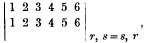
we can at once vouch for the identity

in connection with the axisymmetric determinant
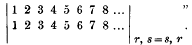
No proof was given, as the matter turned up quite incidentally, and verification of the cases made use of was all that was necessary.
A Generalisation of Jacobi's Fundamental Formulae
-
- Journal:
- Proceedings of the Edinburgh Mathematical Society / Volume 9 / Issue 1 / October 1953
- Published online by Cambridge University Press:
- 20 January 2009, pp. 17-19
-
- Article
-
- You have access
- Export citation
Asymptotic spectrum of multiparameter eigenvalue problems
-
- Journal:
- Proceedings of the Edinburgh Mathematical Society / Volume 39 / Issue 1 / February 1996
- Published online by Cambridge University Press:
- 20 January 2009, pp. 119-132
-
- Article
-
- You have access
- Export citation
A. P. Robertson W. J. Robertson, Topological Vector Spaces (Cambridge Tracts in Mathematics and Mathematical Physics no. 53, Cambridge University Press, 1964), viii + 158, 30s.
-
- Journal:
- Proceedings of the Edinburgh Mathematical Society / Volume 15 / Issue 1 / June 1966
- Published online by Cambridge University Press:
- 20 January 2009, p. 77
-
- Article
-
- You have access
- Export citation
