Refine search
Actions for selected content:
26077 results in Abstract analysis
Joseph S. Mamelak, A Textbook on Analytical Geometry (Pergamon Press, 1964), viii + 247 pp., 35s
-
- Journal:
- Proceedings of the Edinburgh Mathematical Society / Volume 15 / Issue 1 / June 1966
- Published online by Cambridge University Press:
- 20 January 2009, pp. 77-78
-
- Article
-
- You have access
- Export citation
On primeness and nilpotence in structural matrix near-rings
-
- Journal:
- Proceedings of the Edinburgh Mathematical Society / Volume 39 / Issue 2 / June 1996
- Published online by Cambridge University Press:
- 20 January 2009, pp. 345-356
-
- Article
-
- You have access
- Export citation
Obituary A. J. Macintyre F.R.S.E.
-
- Journal:
- Proceedings of the Edinburgh Mathematical Society / Volume 16 / Issue 4 / December 1969
- Published online by Cambridge University Press:
- 20 January 2009, pp. 365-372
-
- Article
-
- You have access
- Export citation
The natural partial order on a regular semigroup
-
- Journal:
- Proceedings of the Edinburgh Mathematical Society / Volume 23 / Issue 3 / October 1980
- Published online by Cambridge University Press:
- 20 January 2009, pp. 249-260
-
- Article
-
- You have access
- Export citation
On the Canonical Form of a Rational Integral Function of a Matrix
-
- Journal:
- Proceedings of the Edinburgh Mathematical Society / Volume 3 / Issue 2 / July 1932
- Published online by Cambridge University Press:
- 20 January 2009, pp. 135-143
-
- Article
-
- You have access
- Export citation
-
It is well known that the square matrix, of rank n−k + 1,
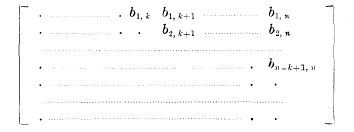
which we shall denote by B where any element to the left of, or below the nonzero diagonal b1, k, b2, k + 1, . …, bn−k + 1, n is zero, can be resolved into factors Z−1DZ; where D is a square matrix of order n having the elements d1, k, d2, k + 1, . …, dn−k + 1, n all unity and all the other elements zero, and where Z is a non-singular matrix. In this paper we shall show in a particular case that this is so, and in the case in question we shall exhibit the matrix Z explicitly. Application of this is made to find the classical canonical form of a rational integral function of a square matrix A.
Varieties of topological groups generated by Lie groups
-
- Journal:
- Proceedings of the Edinburgh Mathematical Society / Volume 18 / Issue 1 / June 1972
- Published online by Cambridge University Press:
- 20 January 2009, pp. 49-53
-
- Article
-
- You have access
- Export citation
D. J. S. Robinson, A course in the theory of groups (Graduate Texts in Mathematics Vol. 80, Springer-Verlag, Berlin-Heidelberg-New York, 1982) xvii + 481 pp., DM 98.
-
- Journal:
- Proceedings of the Edinburgh Mathematical Society / Volume 26 / Issue 3 / October 1983
- Published online by Cambridge University Press:
- 20 January 2009, pp. 401-402
-
- Article
-
- You have access
- Export citation
On some theorems in the theory of numbers
-
- Journal:
- Proceedings of the Edinburgh Mathematical Society / Volume 8 / February 1889
- Published online by Cambridge University Press:
- 20 January 2009, pp. 16-19
-
- Article
-
- You have access
- Export citation
-
The number of groups of n which may be selected from 2n is 2n(2n − l)…(n + l)/n! But make the 2n into two groups of n, and select r out of the first and n − r out of the second. This gives [n(n−l)…(n−r+l)/r!] + [n(n−l)…(r + l)/(n−r)!] ways of thus making a group of n. Hence

Properly discontinuous actions on Λ-trees
-
- Journal:
- Proceedings of the Edinburgh Mathematical Society / Volume 37 / Issue 3 / October 1994
- Published online by Cambridge University Press:
- 20 January 2009, pp. 423-444
-
- Article
-
- You have access
- Export citation
Notes on the Theorems of Menelaus and of Ceva
-
- Journal:
- Proceedings of the Edinburgh Mathematical Society / Volume 20 / February 1901
- Published online by Cambridge University Press:
- 20 January 2009, pp. 62-66
-
- Article
-
- You have access
- Export citation
PEM volume 31 issue 2 Cover and Front matter
-
- Journal:
- Proceedings of the Edinburgh Mathematical Society / Volume 31 / Issue 2 / June 1988
- Published online by Cambridge University Press:
- 20 January 2009, pp. f1-f2
-
- Article
-
- You have access
- Export citation
Homogeneous structures on Kähler submanifolds of complex projective spaces*
-
- Journal:
- Proceedings of the Edinburgh Mathematical Society / Volume 39 / Issue 2 / June 1996
- Published online by Cambridge University Press:
- 20 January 2009, pp. 381-395
-
- Article
-
- You have access
- Export citation
Breuer, T. Characters and automorphism groups of compact Riemann surfaces (LMS Lecture Note Series 280, Cambridge, 2000), xii+199 pp., 0 521 79809 4 (paperback), £24.95 (US$39.95)
-
- Journal:
- Proceedings of the Edinburgh Mathematical Society / Volume 44 / Issue 3 / October 2001
- Published online by Cambridge University Press:
- 20 January 2009, pp. 663-664
-
- Article
-
- You have access
- Export citation
On a Proof of the Fundamental Combination Theorem
-
- Journal:
- Proceedings of the Edinburgh Mathematical Society / Volume 15 / February 1896
- Published online by Cambridge University Press:
- 20 January 2009, p. 82
-
- Article
-
- You have access
- Export citation
ON ℚ-DERIVED POLYNOMIALS
-
- Journal:
- Proceedings of the Edinburgh Mathematical Society / Volume 44 / Issue 1 / February 2001
- Published online by Cambridge University Press:
- 20 January 2009, pp. 103-110
-
- Article
-
- You have access
- Export citation
A note on the zeros of the Bessel function
-
- Journal:
- Proceedings of the Edinburgh Mathematical Society / Volume 6 / Issue 1 / May 1939
- Published online by Cambridge University Press:
- 20 January 2009, pp. 17-18
-
- Article
-
- You have access
- Export citation
-
This note contains an elementary proof of the well-known result that every solution of Besse's equation
with a real parameter n has an infinite number of real positive zeros.
M. Karoubi and C. Leruste, Algebraic topology via differential geometry (London Mathematical Society Lecture Note Series 99, Cambridge University Press1987) 363 pp. 0 521 31714 2, £15.(Originally published in French as Méthodes de géométrie différentielle en topologie algébrique, Paris 1982.)
-
- Journal:
- Proceedings of the Edinburgh Mathematical Society / Volume 32 / Issue 2 / June 1989
- Published online by Cambridge University Press:
- 20 January 2009, pp. 335-336
-
- Article
-
- You have access
- Export citation
Measurable selections in normed spaces
-
- Journal:
- Proceedings of the Edinburgh Mathematical Society / Volume 19 / Issue 2 / September 1974
- Published online by Cambridge University Press:
- 20 January 2009, pp. 147-150
-
- Article
-
- You have access
- Export citation
PEM volume 36 issue 3 Cover and Front matter
-
- Journal:
- Proceedings of the Edinburgh Mathematical Society / Volume 36 / Issue 3 / October 1993
- Published online by Cambridge University Press:
- 20 January 2009, pp. f1-f2
-
- Article
-
- You have access
- Export citation
The Absolute Summability (A) of Fourier Series
-
- Journal:
- Proceedings of the Edinburgh Mathematical Society / Volume 4 / Issue 1 / March 1934
- Published online by Cambridge University Press:
- 20 January 2009, pp. 13-17
-
- Article
-
- You have access
- Export citation
