Refine search
Actions for selected content:
26077 results in Abstract analysis
On the cyclic coverings of the knot 52
-
- Journal:
- Proceedings of the Edinburgh Mathematical Society / Volume 42 / Issue 3 / October 1999
- Published online by Cambridge University Press:
- 20 January 2009, pp. 575-587
-
- Article
-
- You have access
- Export citation
J. T. Culbertson, Mathematics and Logic for Digital Devices, (D. van Nostrand Co., Ltd., London, 1958), 217 pp., 36s
-
- Journal:
- Proceedings of the Edinburgh Mathematical Society / Volume 11 / Issue 3 / May 1959
- Published online by Cambridge University Press:
- 20 January 2009, p. 191
-
- Article
-
- You have access
- Export citation
An Experiment in the Teaching of Geometry
-
- Journal:
- Proceedings of the Edinburgh Mathematical Society / Volume 5 / February 1886
- Published online by Cambridge University Press:
- 20 January 2009, pp. 94-97
-
- Article
-
- You have access
- Export citation
The pedal line of a triangle and theorems connected with it
-
- Journal:
- Proceedings of the Edinburgh Mathematical Society / Volume 9 / February 1890
- Published online by Cambridge University Press:
- 20 January 2009, pp. 50-55
-
- Article
-
- You have access
- Export citation
Spectral mapping theorem for representations of measure algebras
-
- Journal:
- Proceedings of the Edinburgh Mathematical Society / Volume 40 / Issue 2 / June 1997
- Published online by Cambridge University Press:
- 20 January 2009, pp. 261-266
-
- Article
-
- You have access
- Export citation
-
Let G be a locally compact abelian group, M0(G) be a closed regular subalgebra of the convolution measure algebra M(G) which contains the group algebra L1(G) and ω: M0(G) → B be a continuous homomorphism of M0(G) into the unital Banach algebra B (possibly noncommutative) such that ω(L1(G)) is without order with respect to B in the sense that if for all b ∈ B, b.ω(L1(G)) = {0} implies b = 0. We prove that if sp(ω) is a synthesis set for L1(G) then the equality
 holds for each μ ∈ M0(G), where sp(ω) denotes the Arveson spectrum of ω, σB(.) the usual spectrum in B,
  the Fourier-Stieltjes transform of μ.
 holds for each μ ∈ M
 the Fourier-Stieltjes transform of μ.
Simultaneous Linear Recurrence Relations with Variable Coefficients
-
- Journal:
- Proceedings of the Edinburgh Mathematical Society / Volume 9 / Issue 4 / May 1958
- Published online by Cambridge University Press:
- 20 January 2009, pp. 183-206
-
- Article
-
- You have access
- Export citation
-
Our subject is a set of equations

where the uj(n)(j = 1, 2, …, k) are k “unknown” functions of the integer variable n, the zi(n) (i = 1, 2, … h) are h “known” functions of n, and the Aij(n) are hk “known” operators

which are polynomials in E, each of fixed order pij but with coefficients which may vary with n. E is the usual operator defined by

Our first task is to determine whether the equations (1) are self-consistent. Secondly, if they are self-consistent, we ask what follows from them for a given subset of the unknowns, e.g. for (uj+1, …, uk) in other words we wish to eliminate (u1, …, uj). In particular we wish to eliminate all the variables but one, say uk. We shall in fact find that either uk is arbitrary or else that it has only to satisfy a single linear recurrence relation : and the order of that relation is of interest to us. Thirdly, we ask that reduction to standard form is possible, with or without a transformation of the unknowns themselves.
!COMMUTANT LIFTING, TENSOR ALGEBRAS, AND FUNCTIONAL CALCULUS
-
- Journal:
- Proceedings of the Edinburgh Mathematical Society / Volume 44 / Issue 2 / June 2001
- Published online by Cambridge University Press:
- 20 January 2009, pp. 389-406
-
- Article
-
- You have access
- Export citation
Long Waves on a Rotating Earth in the Presence of a Semi-Infinite Barrier
-
- Journal:
- Proceedings of the Edinburgh Mathematical Society / Volume 14 / Issue 1 / June 1964
- Published online by Cambridge University Press:
- 20 January 2009, pp. 25-31
-
- Article
-
- You have access
- Export citation
Theorem relating to the Sum of selected Binomial-Theorem Co-efficients
-
- Journal:
- Proceedings of the Edinburgh Mathematical Society / Volume 2 / February 1883
- Published online by Cambridge University Press:
- 20 January 2009, p. 5
-
- Article
-
- You have access
- Export citation
Note on Legendre's and Bertrand's Proofs of the Parallel-Postulate by Infinite Areas
-
- Journal:
- Proceedings of the Edinburgh Mathematical Society / Volume 30 / February 1911
- Published online by Cambridge University Press:
- 20 January 2009, pp. 31-36
-
- Article
-
- You have access
- Export citation
Mathematical Models, chiefly of Surfaces of the Second Degree
-
- Journal:
- Proceedings of the Edinburgh Mathematical Society / Volume 2 / February 1883
- Published online by Cambridge University Press:
- 20 January 2009, p. 5
-
- Article
-
- You have access
- Export citation
PEM volume 20 Cover and Front matter
-
- Journal:
- Proceedings of the Edinburgh Mathematical Society / Volume 20 / February 1901
- Published online by Cambridge University Press:
- 20 January 2009, pp. f1-f5
-
- Article
-
- You have access
- Export citation
H. Schwerdtfeger, Geometry of Complex Numbers (Oliver and Boyd, Edinburgh, 1962), xi + 186 pp., 30s.
-
- Journal:
- Proceedings of the Edinburgh Mathematical Society / Volume 13 / Issue 3 / June 1963
- Published online by Cambridge University Press:
- 20 January 2009, pp. 258-259
-
- Article
-
- You have access
- Export citation
On Direct and Inverse Interpolation by Divided Differences
-
- Journal:
- Proceedings of the Edinburgh Mathematical Society / Volume 38 / February 1919
- Published online by Cambridge University Press:
- 20 January 2009, pp. 34-50
-
- Article
-
- You have access
- Export citation
On Non-Associative Systems
-
- Journal:
- Proceedings of the Edinburgh Mathematical Society / Volume 8 / Issue 3 / December 1949
- Published online by Cambridge University Press:
- 20 January 2009, pp. 111-118
-
- Article
-
- You have access
- Export citation
On the condition that the straight line lx+my+nz=0 should be a normal to the conic (a, b, c, f, g, h)(x, y, z)2=0 the co-ordinates being trilinear
-
- Journal:
- Proceedings of the Edinburgh Mathematical Society / Volume 9 / February 1890
- Published online by Cambridge University Press:
- 20 January 2009, pp. 2-4
-
- Article
-
- You have access
- Export citation
-
The condition in question may be found by using the following theorem:-
If the equation in trilinear co-ordinates

The Arens irregularity of an extremal algebra
-
- Journal:
- Proceedings of the Edinburgh Mathematical Society / Volume 37 / Issue 1 / February 1994
- Published online by Cambridge University Press:
- 20 January 2009, pp. 139-141
-
- Article
-
- You have access
- Export citation
PEM volume 19 Cover and Front matter
-
- Journal:
- Proceedings of the Edinburgh Mathematical Society / Volume 19 / February 1900
- Published online by Cambridge University Press:
- 20 January 2009, pp. f1-f5
-
- Article
-
- You have access
- Export citation
Matthew Stewart's Theorem
-
- Journal:
- Proceedings of the Edinburgh Mathematical Society / Volume 10 / February 1891
- Published online by Cambridge University Press:
- 20 January 2009, pp. 90-94
-
- Article
-
- You have access
- Export citation
Corrections to a Paper
-
- Journal:
- Proceedings of the Edinburgh Mathematical Society / Volume 28 / February 1909
- Published online by Cambridge University Press:
- 20 January 2009, p. viii
-
- Article
-
- You have access
- Export citation
-
“On Factors of Numbers of the Form
 , by Professor Sanjana, in Vol. XXVI. of the Proceedings.
Page 68, last line but one, for
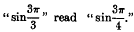
Page 70, line 20, for “15 258 501” read “15 258 358 501.”
Page 74, line 2, for

Page 77, last line but one, for “4.1.744 287” read “4.1.7.44 287.”
Page 79, line 18, for “ products ” read “ product .”
Page 83, lines 6 and 8, for “ same ” read “ some.”
Page 84, footnote, for “ right ” read “ rigid.”
 , by Professor Sanjana, in Vol. XXVI. of the Proceedings.
