Refine search
Actions for selected content:
26077 results in Abstract analysis
H. Cabannes and R. Temam (Eds) Proceedings of the Third International Conference on Numerical Methods in Fluid Mechanics1972, Volumes I and II (Springer-Verlag, Berlin).
-
- Journal:
- Proceedings of the Edinburgh Mathematical Society / Volume 19 / Issue 2 / September 1974
- Published online by Cambridge University Press:
- 20 January 2009, p. 213
-
- Article
-
- You have access
- Export citation
Sketch of the History of Mathematics in Scotland to the end of the 18th Century: Part II
-
- Journal:
- Proceedings of the Edinburgh Mathematical Society / Volume 1 / Issue 2 / March 1928
- Published online by Cambridge University Press:
- 20 January 2009, pp. 71-93
-
- Article
-
- You have access
- Export citation
PEM volume 14 issue 3 Cover and Back matter
-
- Journal:
- Proceedings of the Edinburgh Mathematical Society / Volume 14 / Issue 3 / June 1965
- Published online by Cambridge University Press:
- 20 January 2009, pp. b1-b2
-
- Article
-
- You have access
- Export citation
Sur les algebres de Bernstein V: Les algebres de Bernstein Jordan faibles*
-
- Journal:
- Proceedings of the Edinburgh Mathematical Society / Volume 35 / Issue 3 / October 1992
- Published online by Cambridge University Press:
- 20 January 2009, pp. 359-373
-
- Article
-
- You have access
- Export citation
On quasi-F-orthodox semigroups
-
- Journal:
- Proceedings of the Edinburgh Mathematical Society / Volume 38 / Issue 3 / October 1995
- Published online by Cambridge University Press:
- 20 January 2009, pp. 361-385
-
- Article
-
- You have access
- Export citation
Ruth F. Curtain and A. J. Pritchard, Functional Analysis in Modern Applied Mathematics (Academic Press, London, 1977), ix+339 pp., £10·80.
-
- Journal:
- Proceedings of the Edinburgh Mathematical Society / Volume 21 / Issue 1 / March 1978
- Published online by Cambridge University Press:
- 20 January 2009, pp. 92-93
-
- Article
-
- You have access
- Export citation
Analogues of the braid group whose graphs are stars
-
- Journal:
- Proceedings of the Edinburgh Mathematical Society / Volume 28 / Issue 1 / February 1985
- Published online by Cambridge University Press:
- 20 January 2009, pp. 35-39
-
- Article
-
- You have access
- Export citation
-
Let G be a group having presentation
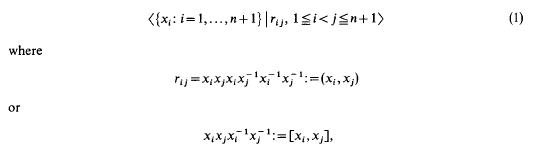
a braid relator and a commutator respectively, and define the graph of such a group as having vertices labelled x1,…, xn + 1 and such that xi and xj are joined if and only if rij = (xi, xj).
On induced permutation matrices and the symmetric group
-
- Journal:
- Proceedings of the Edinburgh Mathematical Society / Volume 5 / Issue 1 / October 1936
- Published online by Cambridge University Press:
- 20 January 2009, pp. 1-13
-
- Article
-
- You have access
- Export citation
-
The n! operations Ai of permutations upon n different ordered symbols correspond to n! matrices Ai of the nth order, which have in each row and in each column only one non-zero element, namely a unit. Such matrices Ai are called permutation matrices, since their effect in premultiplying an arbitrary column vector x = {x1x2….xn} is to impress the permutation Ai upon the elements xi. For example the six matrices of the third order

are permutation matrices. It is convenient to denote them by

where the bracketed indices refer to the permutations of natural order. Clearly the relation Ai Aj = Ak entails the matrix relation AiAj = Ak; in other words, the n! matrices Ai, give a matrix representation of the symmetric group of order n!.
Bruce C. Berndt, Ramanujan's Notebooks, Part II (Springer-Verlag, Berlin–Heidelberg–New York, 1989), 359 pp., 3 540 96794 X, £55.
-
- Journal:
- Proceedings of the Edinburgh Mathematical Society / Volume 33 / Issue 1 / February 1990
- Published online by Cambridge University Press:
- 20 January 2009, p. 166
-
- Article
-
- You have access
- Export citation
On the Quasi-periodic Solutions of Mathieu's Differential Equation
-
- Journal:
- Proceedings of the Edinburgh Mathematical Society / Volume 32 / February 1913
- Published online by Cambridge University Press:
- 20 January 2009, pp. 81-90
-
- Article
-
- You have access
- Export citation
-
Mathieu's differential equation

is the equation which arises out of those two-dimensional problems Mathematical Physics in which the boundary is an ellipse, such problems, for example, as the vibrations of an elliptic membrane, which was first discussed by Mathieu,* and the scattering electromagnetic waves by a wire of elliptic cross-section. A different use of the same equation is found in Celestial Mechanics the treatment of perturbations and oscillations about periodic orbits, and, in a more mundane connection, it has been shown to be the differential equation of the variety artiste who holds an assistant poised on a pole above his head while he himself is standing on a spherical ball rolling on the ground!
On the Fundamental Principles of Quaternions and other Vector Analyses
-
- Journal:
- Proceedings of the Edinburgh Mathematical Society / Volume 11 / February 1892
- Published online by Cambridge University Press:
- 20 January 2009, pp. 85-92
-
- Article
-
- You have access
- Export citation
Note on four circles touching a common circle
-
- Journal:
- Proceedings of the Edinburgh Mathematical Society / Volume 19 / February 1900
- Published online by Cambridge University Press:
- 20 January 2009, pp. 7-9
-
- Article
-
- You have access
- Export citation
-
One of the proofs of the theorem that the three escribed circles and the inscribed circle of a triangle touch a common circle, depends upon the following well-known property of four circles that touch a common circle:—The common tangents of four such circles satisfy the relation

where 12 denotes the common tangent to the circles 1 and 2, etc. The converse part of the theorem, however, namely, that when the above relation holds good, the four circles touch a common circle, is generally assumed; the object of this note is to supply a demonstration of that part of the theorem. It should be noted that if the circles 1 and 2 touch the fifth circle either both externally or both internally, 12 denotes the direct common tangent; while if one of them touches externally and the other internally, 12 denotes the transverse common tangent. Further, the length of the direct common tangent to two circles remains unaltered if the radius of each be diminished or be increased by the same amount; while the length of the transverse common tangent remains unaltered, if the radius of one be increased and that of the other be diminished by the same amount. It is obvious, moreover, that if two circles, 1 and 2, touch a circle A externally, and if the radii of 1 and 2 be diminished and the radius of A increased by the same amount, the contact still holds good; and all the other cases may be easily considered.
A note on convergence factors
-
- Journal:
- Proceedings of the Edinburgh Mathematical Society / Volume 7 / Issue 1 / October 1942
- Published online by Cambridge University Press:
- 20 January 2009, pp. 27-30
-
- Article
-
- You have access
- Export citation
-
In this note
 denotes a divergent series of positive, decreasing terms for which
  are real numbers (convergence factors) such that
  is convergent. We put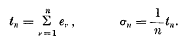
H. Rademacher has shown that
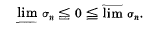
 denotes a divergent series of positive, decreasing terms for which
  are real numbers (convergence factors) such that
  is convergent. We put
Against Euler's Proof of the Binomial Theorem for Negative and Fractional Exponents
-
- Journal:
- Proceedings of the Edinburgh Mathematical Society / Volume 17 / February 1898
- Published online by Cambridge University Press:
- 20 January 2009, pp. 38-41
-
- Article
-
- You have access
- Export citation
-
In the proof of the binomial theorem for negative and fractional indices given in many text-books of algebra, and attributed to Euler, one step seems to me to involve a very gross assumption.
The symbol f(m) having been taken to denote the series

it is pointed out that whenever m and n are positive integers we know that f(x)×f(n)≡f(m + n); and the conclusion is drawn that since this is true for all positive integral values of m and n, by the “permanence of equivalent forms” (whatever that may mean) we can conclude that it is true also for negative and fractional values of m and n, whenever f(m) and f(n) are convergent.
Classifications of 2-complexes whose finite fundamental group is that of a 3-manifold
-
- Journal:
- Proceedings of the Edinburgh Mathematical Society / Volume 40 / Issue 1 / February 1997
- Published online by Cambridge University Press:
- 20 January 2009, pp. 69-84
-
- Article
-
- You have access
- Export citation
Cornelius Lanczos, Discourse on Fourier Series (University Mathematical Monographs, Oliver and Boyd, 1966), viii+255 pp., 63s.
-
- Journal:
- Proceedings of the Edinburgh Mathematical Society / Volume 16 / Issue 2 / December 1968
- Published online by Cambridge University Press:
- 20 January 2009, pp. 183-184
-
- Article
-
- You have access
- Export citation
On Integral Transform Pairs Arising from Second Order Differential Equations
-
- Journal:
- Proceedings of the Edinburgh Mathematical Society / Volume 13 / Issue 1 / June 1962
- Published online by Cambridge University Press:
- 20 January 2009, pp. 63-68
-
- Article
-
- You have access
- Export citation
A note on the fractional calculus
-
- Journal:
- Proceedings of the Edinburgh Mathematical Society / Volume 21 / Issue 1 / March 1978
- Published online by Cambridge University Press:
- 20 January 2009, pp. 79-80
-
- Article
-
- You have access
- Export citation
E. J. Mcshane, and T. Botts, Real Analysis (van Nostrand, 1959), 272 pp., 49s. 6d.
-
- Journal:
- Proceedings of the Edinburgh Mathematical Society / Volume 12 / Issue 3 / June 1961
- Published online by Cambridge University Press:
- 20 January 2009, pp. 159-160
-
- Article
-
- You have access
- Export citation
PEM volume 38 issue 2 Cover and Back matter
-
- Journal:
- Proceedings of the Edinburgh Mathematical Society / Volume 38 / Issue 2 / June 1995
- Published online by Cambridge University Press:
- 20 January 2009, pp. b1-b2
-
- Article
-
- You have access
- Export citation
