Refine search
Actions for selected content:
26077 results in Abstract analysis
On the methods of extending Dirac's equation of the electron to general relativity
-
- Journal:
- Proceedings of the Edinburgh Mathematical Society / Volume 7 / Issue 1 / October 1942
- Published online by Cambridge University Press:
- 20 January 2009, pp. 39-50
-
- Article
-
- You have access
- Export citation
Note on normals to conics
-
- Journal:
- Proceedings of the Edinburgh Mathematical Society / Volume 8 / February 1889
- Published online by Cambridge University Press:
- 20 January 2009, pp. 19-21
-
- Article
-
- You have access
- Export citation
-
1. The following condition may be new; it does not appear in any of the books:—
The condition that the straight line

should be a normal to the general conic,

referred to rectangular axes, is

where Σ is written for

and Δ, A, B, C, F, G, H have their usual meanings.
Exhaustive operators and vector measures
-
- Journal:
- Proceedings of the Edinburgh Mathematical Society / Volume 19 / Issue 3 / March 1975
- Published online by Cambridge University Press:
- 20 January 2009, pp. 291-300
-
- Article
-
- You have access
- Export citation
-
Let S be a compact Hausdorff space and let Φ: C(S)→E be a linear operator defined on the space of real-valued continuous functions on S and taking values in a (real) topological vector space E. Then Φ is called exhaustive (7) if given any sequence of functions fn ∈ C(S) such that fn ≧ 0 and

then Φ(fn)→0 If E is complete then it was shown in (7) that exhaustive maps are precisely those which possess regular integral extensions to the space of bounded Borel functions on S; this is equivalent to possessing a representation
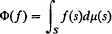
where μ is a regular countably additive E-valued measure defined on the σ-algebra of Borel subsets of S.

Disjoint conjugates of cyclic subgroups of finite groups
-
- Journal:
- Proceedings of the Edinburgh Mathematical Society / Volume 20 / Issue 3 / March 1977
- Published online by Cambridge University Press:
- 20 January 2009, pp. 229-232
-
- Article
-
- You have access
- Export citation
Generalised Euler constants
-
- Journal:
- Proceedings of the Edinburgh Mathematical Society / Volume 21 / Issue 1 / March 1978
- Published online by Cambridge University Press:
- 20 January 2009, pp. 25-32
-
- Article
-
- You have access
- Export citation
-
Let the Laurent expansion of the Riemann zeta function ξ(s) about s=1 be written in the form

It has been discovered independently by many authors that, in terms of this notation, the coefficient

On the lines which intersect three given lines in space
-
- Journal:
- Proceedings of the Edinburgh Mathematical Society / Volume 26 / February 1907
- Published online by Cambridge University Press:
- 20 January 2009, pp. 10-12
-
- Article
-
- You have access
- Export citation
The following Presents to the Library have been received, for which the Society tenders its grateful thanks
-
- Journal:
- Proceedings of the Edinburgh Mathematical Society / Volume 44 / February 1925
- Published online by Cambridge University Press:
- 20 January 2009, pp. vii-viii
-
- Article
-
- You have access
- Export citation
Asymptotic representation of Laplace transforms with an application to inverse factorial series
-
- Journal:
- Proceedings of the Edinburgh Mathematical Society / Volume 8 / Issue 1 / October 1947
- Published online by Cambridge University Press:
- 20 January 2009, pp. 20-24
-
- Article
-
- You have access
- Export citation
J. H. Conway, R. T. Curtis, S. P. Norton, R. A. Parker and R. A. Wilson, ATLAS of finite groups: maximal subgroups and ordinary characters for simple groups (Oxford University Press, 1985), xxxiii + 252 pp., £35.
-
- Journal:
- Proceedings of the Edinburgh Mathematical Society / Volume 30 / Issue 2 / June 1987
- Published online by Cambridge University Press:
- 20 January 2009, p. 325
-
- Article
-
- You have access
- Export citation
T. G. Room and P. B. Kirkpatrick, Miniquaternion Geometry (Cambridge Tracts in Mathematics and Mathematical Physics No. 60, Cambridge University Press, 1971), viii+176 pp., £4.
-
- Journal:
- Proceedings of the Edinburgh Mathematical Society / Volume 17 / Issue 4 / December 1971
- Published online by Cambridge University Press:
- 20 January 2009, pp. 373-374
-
- Article
-
- You have access
- Export citation
A diffusion equation with localized chemical reactions*
-
- Journal:
- Proceedings of the Edinburgh Mathematical Society / Volume 37 / Issue 1 / February 1994
- Published online by Cambridge University Press:
- 20 January 2009, pp. 101-118
-
- Article
-
- You have access
- Export citation
Certain Series of Basic Bessel Coefficients
-
- Journal:
- Proceedings of the Edinburgh Mathematical Society / Volume 24 / February 1905
- Published online by Cambridge University Press:
- 20 January 2009, p. 6
-
- Article
-
- You have access
- Export citation
Note on Suspension Bridge Catenaries
-
- Journal:
- Proceedings of the Edinburgh Mathematical Society / Volume 33 / February 1914
- Published online by Cambridge University Press:
- 20 January 2009, pp. 31-34
-
- Article
-
- You have access
- Export citation
On cyclic subgroups of finite groups
-
- Journal:
- Proceedings of the Edinburgh Mathematical Society / Volume 25 / Issue 1 / February 1982
- Published online by Cambridge University Press:
- 20 January 2009, pp. 19-20
-
- Article
-
- You have access
- Export citation
PEM volume 39 issue 1 Cover and Front matter
-
- Journal:
- Proceedings of the Edinburgh Mathematical Society / Volume 39 / Issue 1 / February 1996
- Published online by Cambridge University Press:
- 20 January 2009, pp. f1-f2
-
- Article
-
- You have access
- Export citation
PEM volume 13 Cover and Front matter
-
- Journal:
- Proceedings of the Edinburgh Mathematical Society / Volume 13 / February 1894
- Published online by Cambridge University Press:
- 20 January 2009, pp. f1-f5
-
- Article
-
- You have access
- Export citation
Béla Andrásfai, Introductory Graph Theory (Adam Hilger, 1977), 268pp., £800.
-
- Journal:
- Proceedings of the Edinburgh Mathematical Society / Volume 22 / Issue 1 / February 1979
- Published online by Cambridge University Press:
- 20 January 2009, pp. 69-70
-
- Article
-
- You have access
- Export citation
D. H. Fowler, Introducing Real Analysis (Transworld Student Library, 1974), 127 pp., 80p.
-
- Journal:
- Proceedings of the Edinburgh Mathematical Society / Volume 19 / Issue 3 / March 1975
- Published online by Cambridge University Press:
- 20 January 2009, p. 319
-
- Article
-
- You have access
- Export citation
Metric spaces and ideals of functions
-
- Journal:
- Proceedings of the Edinburgh Mathematical Society / Volume 32 / Issue 3 / October 1989
- Published online by Cambridge University Press:
- 20 January 2009, pp. 395-400
-
- Article
-
- You have access
- Export citation
-
In each metric space (X, d) there is defined the space Lip X of complex-valued, bounded, and uniformly Lipschitzian functions. In the algebra Lip X, it is natural to ask for ideals closed in various notions of convergence, and also to identify the invertible elements. In particular, are the invertible elements exactly those with no zero in X? Wiener's Tauberian Theorem in Fourier analysis is the first and most remarkable example of this harmonious state of affairs. A moment's reflection confirms that, for the algebra Lip X, this is true only for compact metric spaces X, the trivial examples in our investigation. We therefore introduce a type of convergence weaker than convergence in norm; it has already proved useful in some problems in descriptive set theory and reflects in a subtle way the metric properties of X. A sequence (fn) in Lip X converges strongly to g, written s – limfn=g, if ∥fn∥≦C in the Banach space Lip X and lim fn(x)=g(x) for each element x of X. In Section 3 we explain how this is really a type of convergence in the dual space of a certain Banach space
 . This brings us to the edge of some recondite questions about iterated (or even transfinite) limits, and we have adhered to the notion of strong limits to avoid these questions. To illustrate the differences between these two approaches, we mention this problem: which maximal ideals of Lip X are closed with respect to strong convergence of sequences? This is not the problem studied in Section 1.
 . This brings us to the edge of some recondite questions about iterated (or even transfinite) limits, and we have adhered to the notion of strong limits to avoid these questions. To illustrate the differences between these two approaches, we mention this problem: which maximal ideals of Lip X are closed with respect to strong convergence of sequences? This is not the problem studied in Section 1.
On certain infinite integrals involving Struve functions and parabolic cylinder functions
-
- Journal:
- Proceedings of the Edinburgh Mathematical Society / Volume 7 / Issue 4 / October 1946
- Published online by Cambridge University Press:
- 20 January 2009, pp. 171-173
-
- Article
-
- You have access
- Export citation
-
The object of the present note is to obtain a number of infinite integrals involving Struve functions and parabolic cylinder functions. 1. G. N. Watson(1) has proved that

From (1)

follows provided that the integral is convergent and term-by-term integration is permissible. A great many interesting particular cases of (2) are easily deducible: the following will be used in this paper.
