Refine search
Actions for selected content:
26077 results in Abstract analysis
A Harnack inequality for degenerate elliptic equations on minimal surfaces
-
- Journal:
- Proceedings of the Edinburgh Mathematical Society / Volume 20 / Issue 1 / March 1976
- Published online by Cambridge University Press:
- 20 January 2009, pp. 29-39
-
- Article
-
- You have access
- Export citation
-
Harnack inequalities are known to be of great importance in the theory of quasilinear elliptic partial differential equations. In the case of such equations defined over a domain Ω in Rn, inequalities of this type have been proved for solutions of second-order equations in divergence form which are of either elliptic or degenerate elliptic structure. More recently Bombieri and Giusti (2) have proved a Harnack inequality for solutions of linear elliptic equations on a minimal surface in Rn+1. The equations are of the form

where summation over i, j = 1, …, n+l is understood, and δ = (δ1, …, δn+1) is the tangential derivative on S. In (2), the inequality is used to give much simplified proofs of some classical results on minimal surfaces, and to generalise some more recent ones.
§2. Circumcentre
-
- Journal:
- Proceedings of the Edinburgh Mathematical Society / Volume 1 / February 1883
- Published online by Cambridge University Press:
- 20 January 2009, pp. 32-38
-
- Article
-
- You have access
- Export citation
On compactification of mappings
-
- Journal:
- Proceedings of the Edinburgh Mathematical Society / Volume 19 / Issue 2 / September 1974
- Published online by Cambridge University Press:
- 20 January 2009, pp. 105-108
-
- Article
-
- You have access
- Export citation
On Superposition by the Aid of Dissection
-
- Journal:
- Proceedings of the Edinburgh Mathematical Society / Volume 14 / February 1895
- Published online by Cambridge University Press:
- 20 January 2009, pp. 109-112
-
- Article
-
- You have access
- Export citation
The descending chain condition on solution sets for systems of equations in groups
-
- Journal:
- Proceedings of the Edinburgh Mathematical Society / Volume 29 / Issue 1 / February 1986
- Published online by Cambridge University Press:
- 20 January 2009, pp. 69-73
-
- Article
-
- You have access
- Export citation
Classification of limits of triangular matrix algebras
-
- Journal:
- Proceedings of the Edinburgh Mathematical Society / Volume 36 / Issue 1 / February 1993
- Published online by Cambridge University Press:
- 20 January 2009, pp. 107-121
-
- Article
-
- You have access
- Export citation
A Generalization Of Certain Properties Of Laguerre Polynomials
-
- Journal:
- Proceedings of the Edinburgh Mathematical Society / Volume 7 / Issue 2 / April 1945
- Published online by Cambridge University Press:
- 20 January 2009, p. 83
-
- Article
-
- You have access
- Export citation
PEM volume 15 issue 4 Cover and Back matter
-
- Journal:
- Proceedings of the Edinburgh Mathematical Society / Volume 15 / Issue 4 / December 1967
- Published online by Cambridge University Press:
- 20 January 2009, pp. b1-b6
-
- Article
-
- You have access
- Export citation
An elementary approach to the matricial Nevanlinna–Pick interpolation criterion
-
- Journal:
- Proceedings of the Edinburgh Mathematical Society / Volume 32 / Issue 1 / February 1989
- Published online by Cambridge University Press:
- 20 January 2009, pp. 121-126
-
- Article
-
- You have access
- Export citation
-
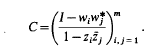
The matricial Nevanlinna–Pick interpolation criterion determines when there is an analytic matrix contraction valued function on the complex unit disc which assumes preassigned n × n matrix values w1,…,wm at preassigned interpolation points z1,…,zm. Taking ∥wi∥ < 1, for i = 1,…,m, the necessary and sufficient condition is the positivity of the nm × nm matricial Pick matrix,
W. Rindler, Special Relativity (University Mathematical Texts Series, Oliver & Boyd, 1960), x + 186 pp., 10s. 6d.
-
- Journal:
- Proceedings of the Edinburgh Mathematical Society / Volume 12 / Issue 3 / June 1961
- Published online by Cambridge University Press:
- 20 January 2009, pp. 169-170
-
- Article
-
- You have access
- Export citation
Localizations of injective modules
-
- Journal:
- Proceedings of the Edinburgh Mathematical Society / Volume 28 / Issue 3 / October 1985
- Published online by Cambridge University Press:
- 20 January 2009, pp. 289-299
-
- Article
-
- You have access
- Export citation
A note on the correlation of classes
-
- Journal:
- Proceedings of the Edinburgh Mathematical Society / Volume 1 / Issue 1 / May 1927
- Published online by Cambridge University Press:
- 20 January 2009, pp. 47-48
-
- Article
-
- You have access
- Export citation
-
Let R be a (1 — 1) relation between the members of two similar classes A, B1. It correlates the members of a subclass X of A to the members of a certain subclass Y of B1 and thus defines a relation ρ connecting X and Y. It is clear that ρ is a (1 – 1) relation and that it has the property (M). If X1ρ Y1, X2ρY2, then
 implies
 implies
The geometrical foundations of certain relativity theories
-
- Journal:
- Proceedings of the Edinburgh Mathematical Society / Volume 5 / Issue 4 / September 1938
- Published online by Cambridge University Press:
- 20 January 2009, pp. 211-220
-
- Article
-
- You have access
- Export citation
PEM volume 18 issue 2 Cover and Front matter
-
- Journal:
- Proceedings of the Edinburgh Mathematical Society / Volume 18 / Issue 2 / December 1972
- Published online by Cambridge University Press:
- 20 January 2009, pp. f1-f2
-
- Article
-
- You have access
- Export citation
PEM volume 14 issue 1 Cover and Back matter
-
- Journal:
- Proceedings of the Edinburgh Mathematical Society / Volume 14 / Issue 1 / June 1964
- Published online by Cambridge University Press:
- 20 January 2009, pp. b1-b7
-
- Article
-
- You have access
- Export citation
Elementary Considerations relating to the Absolute
-
- Journal:
- Proceedings of the Edinburgh Mathematical Society / Volume 28 / February 1909
- Published online by Cambridge University Press:
- 20 January 2009, pp. 65-72
-
- Article
-
- You have access
- Export citation
Eugene Lukacs, Stochastic Convergence (Heath Mathematical Monographs, 1968), viii + 142 pp.
-
- Journal:
- Proceedings of the Edinburgh Mathematical Society / Volume 17 / Issue 1 / June 1970
- Published online by Cambridge University Press:
- 20 January 2009, pp. 107-108
-
- Article
-
- You have access
- Export citation
R. Kannan and C. K. Krueger, Advanced analysis on the real line (Universitext, Springer-Verlag, Berlin-Heidelberg-New York-London-Paris-Tokyo-Hong Kong, 1996) 260 pp., 0 387 94642 X, softcover DM68.
-
- Journal:
- Proceedings of the Edinburgh Mathematical Society / Volume 41 / Issue 2 / June 1998
- Published online by Cambridge University Press:
- 20 January 2009, pp. 430-431
-
- Article
-
- You have access
- Export citation
On rearranging maximal functions in Rn
-
- Journal:
- Proceedings of the Edinburgh Mathematical Society / Volume 19 / Issue 4 / September 1975
- Published online by Cambridge University Press:
- 20 January 2009, pp. 363-369
-
- Article
-
- You have access
- Export citation
-
Denote by f a positive measurable function on Rn, and by λ the distribution function of
 denotes the Lebesgue measure of the set specified. We shall suppose that λ(y)<∞ for each y>0, and that λ(y)→0 as y→∞. The decreasing rearrangement f* of f is defined on (0, ∞) by
 denotes the Lebesgue measure of the set specified. We shall suppose that λ(y)<∞ for each y>0, and that λ(y)→0 as y→∞. The decreasing rearrangement f* of f is defined on (0, ∞) by
Jerome H. Manheim The Genesis of Point Set Topology (Pergamon Press, 1964),166 pp.
-
- Journal:
- Proceedings of the Edinburgh Mathematical Society / Volume 15 / Issue 1 / June 1966
- Published online by Cambridge University Press:
- 20 January 2009, pp. 78-79
-
- Article
-
- You have access
- Export citation
