Refine search
Actions for selected content:
26077 results in Abstract analysis
A boundary value problem on an infinite interval
-
- Journal:
- Proceedings of the Edinburgh Mathematical Society / Volume 19 / Issue 3 / March 1975
- Published online by Cambridge University Press:
- 20 January 2009, pp. 245-252
-
- Article
-
- You have access
- Export citation
-
We are interested here in proving the existence of solutions to the (generalised) boundary value problem

where A is a continuous n×n matrix on R+ = [0, ∞), F is a continuous n vector on R+ × S (S = a suitable subset of Rn), T is a bounded linear operator defined on (or on a subspace of) C[R+, Rn], the space of all bounded and continuous Rn-valued functions on R+, and r is a fixed vector in Rn. There is an abundance of papers dealing with the problem ((I), (II)) on finite intervals, either in its full generality (cf., for example, (1), (2), (3), (4), (6)), or for special cases of the operator T. The reader is especially referred to the work of Shreve (7), (8) for such problems on infinite intervals for scalar equations. A series representation of the solutions is given by Kravchenko and Yablonskii (5). Most of our methods are extensions of the corresponding ones on finite intervals with some variations concerning the application of fixed-point theorems. Examples of interesting operators T are
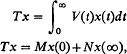
where V(t), M, N are n×n matrices with V(t) integrable.
A Determinantal Expansion for a Class of Definite Integral
-
- Journal:
- Proceedings of the Edinburgh Mathematical Society / Volume 10 / Issue 3 / January 1956
- Published online by Cambridge University Press:
- 20 January 2009, pp. 134-140
-
- Article
-
- You have access
- Export citation
-
We have shown in [1] that under certain conditions the definite integral
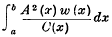 may be approximated by a determinantal ratio. It is our object now to develop the theory when C (x) is a polynomial, showing the relation to the continued fraction form for
  . In particular we shall give various forms for the approximants, and an integral form for the numerator.
 may be approximated by a determinantal ratio. It is our object now to develop the theory when C (x) is a polynomial, showing the relation to the continued fraction form for
  . In particular we shall give various forms for the approximants, and an integral form for the numerator.
Interpolation of compact operators by the methods of Calderón and Gustavsson–Peetre
-
- Journal:
- Proceedings of the Edinburgh Mathematical Society / Volume 38 / Issue 2 / June 1995
- Published online by Cambridge University Press:
- 20 January 2009, pp. 261-276
-
- Article
-
- You have access
- Export citation
PEM volume 16 issue 3 Cover and Front matter
-
- Journal:
- Proceedings of the Edinburgh Mathematical Society / Volume 16 / Issue 3 / June 1969
- Published online by Cambridge University Press:
- 20 January 2009, pp. f1-f2
-
- Article
-
- You have access
- Export citation
John Milnor, Singular Points of Complex Hypersurfaces (Annals of Mathematics Studies, no. 61, Princeton University Press. London: Oxford University Press, 1969) 30s.
-
- Journal:
- Proceedings of the Edinburgh Mathematical Society / Volume 17 / Issue 3 / June 1971
- Published online by Cambridge University Press:
- 20 January 2009, p. 286
-
- Article
-
- You have access
- Export citation
W. M. Goldman Complex hyperbolic geometry (Oxford Mathematical Monographs, Clarendon Press, 1999), xx + 316 pp., 0 19 853793 X, £65.
-
- Journal:
- Proceedings of the Edinburgh Mathematical Society / Volume 43 / Issue 2 / June 2000
- Published online by Cambridge University Press:
- 20 January 2009, pp. 443-445
-
- Article
-
- You have access
- Export citation
On Newton's Theorem in the Calculus of Variations
-
- Journal:
- Proceedings of the Edinburgh Mathematical Society / Volume 24 / February 1905
- Published online by Cambridge University Press:
- 20 January 2009, p. 44
-
- Article
-
- You have access
- Export citation
Inequalities relating to some Algebraic Means
-
- Journal:
- Proceedings of the Edinburgh Mathematical Society / Volume 19 / February 1900
- Published online by Cambridge University Press:
- 20 January 2009, pp. 36-45
-
- Article
-
- You have access
- Export citation
On the transformation and classification of Permutations
-
- Journal:
- Proceedings of the Edinburgh Mathematical Society / Volume 9 / February 1890
- Published online by Cambridge University Press:
- 20 January 2009, pp. 59-79
-
- Article
-
- You have access
- Export citation
-
Let
 represent any permutation of the first n natural numbers. If we take the first number, a1, and put it last, we get a new permutation; and if we perform this operation (n−1) times, we get the (n−1) permutations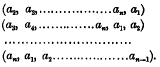
 represent any permutation of the first n natural numbers. If we take the first number, a
H. McKean and V. Moll Elliptic curves: function theory, geometry, arithmetic (Cambridge University Press, Cambridge, 1997), xiii + 280pp., 0 521 58228 8 (hardback), £40 (US$59.95).
-
- Journal:
- Proceedings of the Edinburgh Mathematical Society / Volume 42 / Issue 3 / October 1999
- Published online by Cambridge University Press:
- 20 January 2009, pp. 659-660
-
- Article
-
- You have access
- Export citation
On central traces and groups of symmetries of order unit Banach spaces
-
- Journal:
- Proceedings of the Edinburgh Mathematical Society / Volume 21 / Issue 2 / September 1978
- Published online by Cambridge University Press:
- 20 January 2009, pp. 159-166
-
- Article
-
- You have access
- Export citation
N. Bourbaki Éléments d'Histoire des Mathématiques (Hermann, Paris, 1960), 276 pp., 18 NF.
-
- Journal:
- Proceedings of the Edinburgh Mathematical Society / Volume 12 / Issue 4 / December 1961
- Published online by Cambridge University Press:
- 20 January 2009, p. 217
-
- Article
-
- You have access
- Export citation
The following Presents to the Library have been received, for which the Society tenders its grateful thanks
-
- Journal:
- Proceedings of the Edinburgh Mathematical Society / Volume 43 / February 1924
- Published online by Cambridge University Press:
- 20 January 2009, pp. vii-viii
-
- Article
-
- You have access
- Export citation
The following Presents to the Library have been received, for which the Society tenders its grateful thanks
-
- Journal:
- Proceedings of the Edinburgh Mathematical Society / Volume 8 / Issue 4 / October 1950
- Published online by Cambridge University Press:
- 20 January 2009, pp. 183-184
-
- Article
-
- You have access
- Export citation
An iteration method for the determination of an unknown boundary condition in a parabolic initial-boundary value problem
-
- Journal:
- Proceedings of the Edinburgh Mathematical Society / Volume 32 / Issue 1 / February 1989
- Published online by Cambridge University Press:
- 20 January 2009, pp. 59-71
-
- Article
-
- You have access
- Export citation
-
Consider the initial boundary value problem




In the context of the heat conduction problem, this models the case where the heat flux across the ends at the rod is a function of the temperature. If the heat exchange between the rod and its surroundings is purely by convection, then one commonly assumes that f is a linear function of the difference in temperatures between the ends of the rod and that of the surroundings, (Newton's law of cooling). For the case of purely radiative transfer of energy a fourth power law for the function f is usual, (Stefan's law).
S. G. Mikhlin, Integral Equations and their Applications to Certain Problems in Mechanics, Mathematical Physics and Technology. Translated from the Russian By A. H. Armstrong (Pergamon Press, 1964), xiv + 341 pp., 80s.
-
- Journal:
- Proceedings of the Edinburgh Mathematical Society / Volume 14 / Issue 2 / December 1964
- Published online by Cambridge University Press:
- 20 January 2009, pp. 175-176
-
- Article
-
- You have access
- Export citation
Quasigroups and cubic curves
-
- Journal:
- Proceedings of the Edinburgh Mathematical Society / Volume 14 / Issue 4 / December 1965
- Published online by Cambridge University Press:
- 20 January 2009, pp. 273-291
-
- Article
-
- You have access
- Export citation
On Transient Thermal Stresses in an Infinite Thin Plate
-
- Journal:
- Proceedings of the Edinburgh Mathematical Society / Volume 12 / Issue 2 / December 1960
- Published online by Cambridge University Press:
- 20 January 2009, pp. 69-73
-
- Article
-
- You have access
- Export citation
PEM volume 23 issue 1 Cover and Back matter
-
- Journal:
- Proceedings of the Edinburgh Mathematical Society / Volume 23 / Issue 1 / February 1980
- Published online by Cambridge University Press:
- 20 January 2009, pp. b1-b10
-
- Article
-
- You have access
- Export citation
On the (J, pn, qn) method of summation
-
- Journal:
- Proceedings of the Edinburgh Mathematical Society / Volume 28 / Issue 1 / February 1985
- Published online by Cambridge University Press:
- 20 January 2009, pp. 59-66
-
- Article
-
- You have access
- Export citation
-
In the following discussion we shall assume that pn≧0, qn≧0 for all n and that qn + 1 > qn → ∞. The (J, pn, qn) method of summation is defined as follows.
The series
 with the partial sum sn, is called summable (J, pn, qn) to s, and we write
  if the series
and
 converge to the sum functions p*(x) and p(s)(x) respectively for 0<x<1 and if τ(x) = p(s)(x)/p*(x)→s as x→1–0.
 with the partial sum s
 if the series
 converge to the sum functions p*(x) and p