Refine search
Actions for selected content:
26076 results in Abstract analysis
PEM volume 18 Cover and Fornt matter
-
- Journal:
- Proceedings of the Edinburgh Mathematical Society / Volume 18 / February 1900
- Published online by Cambridge University Press:
- 20 January 2009, pp. f1-f5
-
- Article
-
- You have access
- Export citation
The Evaluation of Probabilities in a Normal Multivariate Distribution, with Special Reference to the Correlation Ratio
-
- Journal:
- Proceedings of the Edinburgh Mathematical Society / Volume 8 / Issue 3 / December 1949
- Published online by Cambridge University Press:
- 20 January 2009, pp. 95-100
-
- Article
-
- You have access
- Export citation
-
This paper deals with the multivariate normal distribution in the symmetrical case when the frequency function may be reduced to

This is the usual distribution occurring for a series of similar independent observations or for the firing of shots at a target.
On a Proposition in Statics
-
- Journal:
- Proceedings of the Edinburgh Mathematical Society / Volume 7 / February 1888
- Published online by Cambridge University Press:
- 20 January 2009, pp. 23-25
-
- Article
-
- You have access
- Export citation
K. Itô Introduction to probability theory (Cambridge University Press, 1984), 211 pp. £18.50 cloth,£6.95 paper.
-
- Journal:
- Proceedings of the Edinburgh Mathematical Society / Volume 28 / Issue 3 / October 1985
- Published online by Cambridge University Press:
- 20 January 2009, pp. 419-420
-
- Article
-
- You have access
- Export citation
On Certain Integral Equations of Convolution Type with Bessel-Function Kernels
-
- Journal:
- Proceedings of the Edinburgh Mathematical Society / Volume 15 / Issue 2 / December 1966
- Published online by Cambridge University Press:
- 20 January 2009, pp. 111-116
-
- Article
-
- You have access
- Export citation
-
In this paper we first obtain elementary solutions of the integral equations

and

Using these solutions we then define operators of fractional integration. These operators may be regarded as a generalisation of the operators of fractional integration introduced by Sneddon (1) as a modification of Erdé1yi–Kober operators. In fact Erdélyi–Kober–Sneddon operators may be obtained by
 multiplying both sides of the equations by α-1½β and considering the limiting case α→0. We employ these operators to find a generalisation of the Mellin transform.
 multiplying both sides of the equations by α
The Asymptotic Value of the Volume of a Certain Set of Matrices
-
- Journal:
- Proceedings of the Edinburgh Mathematical Society / Volume 15 / Issue 3 / June 1967
- Published online by Cambridge University Press:
- 20 January 2009, pp. 209-213
-
- Article
-
- You have access
- Export citation
-
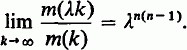
This paper is an appendix to a joint paper with Professor Macbeath. In (3), it was proved that the invariant measure, m(k), of the set of real n × nmatrices τ, with determinant 1 and norm satisfying ∥τ∥≦ k, had the property that
The f-decomposition of Artinian modules over hyperfinite groups
-
- Journal:
- Proceedings of the Edinburgh Mathematical Society / Volume 38 / Issue 1 / February 1995
- Published online by Cambridge University Press:
- 20 January 2009, pp. 117-120
-
- Article
-
- You have access
- Export citation
-
A ℤG-module A is said to have an f-decomposition if
 in which A∫ is a ℤG-submodule of A such that each irreducible ℤG-factor of A∫ as an abelian group is finite and the ℤG-submodule A∫ has no finite irreducible ℤG-factors. In this paper, we prove that: if G is a hyperfinite group then any artinian ℤG-module A has an f-decomposition, which gives a positive answer to the question raised by D.I. Zaitzev in 1986.
 in which A
PEM volume 18 Back matter and figures
-
- Journal:
- Proceedings of the Edinburgh Mathematical Society / Volume 18 / February 1900
- Published online by Cambridge University Press:
- 20 January 2009, pp. b1-b16
-
- Article
-
- You have access
- Export citation
Some algebraic properties of F(X) and K(X)
-
- Journal:
- Proceedings of the Edinburgh Mathematical Society / Volume 19 / Issue 4 / September 1975
- Published online by Cambridge University Press:
- 20 January 2009, pp. 353-361
-
- Article
-
- You have access
- Export citation
Note on Partial Fractions and Determinants
-
- Journal:
- Proceedings of the Edinburgh Mathematical Society / Volume 1 / Issue 1 / May 1927
- Published online by Cambridge University Press:
- 20 January 2009, pp. 49-54
-
- Article
-
- You have access
- Export citation
PEM volume 32 issue 3 Cover and Back matter
-
- Journal:
- Proceedings of the Edinburgh Mathematical Society / Volume 32 / Issue 3 / October 1989
- Published online by Cambridge University Press:
- 20 January 2009, pp. b1-b7
-
- Article
-
- You have access
- Export citation
A Symbolic proof of Euler's Addition Theorem for Elliptic Functions
-
- Journal:
- Proceedings of the Edinburgh Mathematical Society / Volume 44 / February 1925
- Published online by Cambridge University Press:
- 20 January 2009, pp. 13-21
-
- Article
-
- You have access
- Export citation
-
§1. Let
 be a binary quartic; then I propose to show symbolically that the solution of Euler's differential equation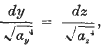
can be written in the form

where

are otherwise arbitrary.
 be a binary quartic; then I propose to show symbolically that the solution of Euler's differential equation
P. T. Johnstone, Topos Theory (L.M.S. Monograph No. 10, Academic Press, London, 1977), xxiii + 367 pp., £17–50.
-
- Journal:
- Proceedings of the Edinburgh Mathematical Society / Volume 22 / Issue 1 / February 1979
- Published online by Cambridge University Press:
- 20 January 2009, pp. 70-71
-
- Article
-
- You have access
- Export citation
T. A. Whitelaw, An Introduction to Abstract Algebra (Blackie, 1978), ix+166 pp., £4–95 (paper covers).
-
- Journal:
- Proceedings of the Edinburgh Mathematical Society / Volume 22 / Issue 1 / February 1979
- Published online by Cambridge University Press:
- 20 January 2009, p. 68
-
- Article
-
- You have access
- Export citation
PEM volume 2 Back matter and figures
-
- Journal:
- Proceedings of the Edinburgh Mathematical Society / Volume 2 / February 1883
- Published online by Cambridge University Press:
- 20 January 2009, pp. b1-b14
-
- Article
-
- You have access
- Export citation
The Conservation Theorems of a Damped Dynamical System
-
- Journal:
- Proceedings of the Edinburgh Mathematical Society / Volume 42 / February 1923
- Published online by Cambridge University Press:
- 20 January 2009, pp. 61-68
-
- Article
-
- You have access
- Export citation
An Elementary Proof of the Theorems of Cauchy and Mayer
-
- Journal:
- Proceedings of the Edinburgh Mathematical Society / Volume 4 / Issue 3 / August 1935
- Published online by Cambridge University Press:
- 20 January 2009, pp. 112-117
-
- Article
-
- You have access
- Export citation
-
Attention has recently been drawn to the obscurity of the usual presentations of Mayer's method of solution of the total differential equation

This method has the practical advantage that only a single integration is required, but its theoretical discussion is usually based on the validity of some other method of solution. Mayer's method gives a result even when the equation (1) is not integrable, but this cannot of course be a solution. An examination of the conditions under which the result is actually an integral of equation (1) leads to a proof of the existence theorem for (1) which is related to Mayer's method of solution in a natural way, and which moreover appears to be novel and of value in the presentation of the subject.
Products of derivations
-
- Journal:
- Proceedings of the Edinburgh Mathematical Society / Volume 41 / Issue 2 / June 1998
- Published online by Cambridge University Press:
- 20 January 2009, pp. 407-410
-
- Article
-
- You have access
- Export citation
Extension of Frenet's Formulae to a Curve in Flat Space of n Dimensions
-
- Journal:
- Proceedings of the Edinburgh Mathematical Society / Volume 38 / February 1919
- Published online by Cambridge University Press:
- 20 January 2009, pp. 20-23
-
- Article
-
- You have access
- Export citation
-
A curve in n dimensions may be taken as the limit to which a polygonal figure ABCDE … tends, when the sides AB, BC, CD, etc., all diminish towards the limit zero.
The curvature at A is
 .
.
 .
.A boundary value problem on an infinite interval
-
- Journal:
- Proceedings of the Edinburgh Mathematical Society / Volume 19 / Issue 3 / March 1975
- Published online by Cambridge University Press:
- 20 January 2009, pp. 245-252
-
- Article
-
- You have access
- Export citation
-
We are interested here in proving the existence of solutions to the (generalised) boundary value problem

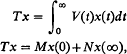
where A is a continuous n×n matrix on R+ = [0, ∞), F is a continuous n vector on R+ × S (S = a suitable subset of Rn), T is a bounded linear operator defined on (or on a subspace of) C[R+, Rn], the space of all bounded and continuous Rn-valued functions on R+, and r is a fixed vector in Rn. There is an abundance of papers dealing with the problem ((I), (II)) on finite intervals, either in its full generality (cf., for example, (1), (2), (3), (4), (6)), or for special cases of the operator T. The reader is especially referred to the work of Shreve (7), (8) for such problems on infinite intervals for scalar equations. A series representation of the solutions is given by Kravchenko and Yablonskii (5). Most of our methods are extensions of the corresponding ones on finite intervals with some variations concerning the application of fixed-point theorems. Examples of interesting operators T are
where V(t), M, N are n×n matrices with V(t) integrable.
