Refine search
Actions for selected content:
26077 results in Abstract analysis
The Maximum Idempotent-Separating Congruence on an Inverse Semigroup
-
- Journal:
- Proceedings of the Edinburgh Mathematical Society / Volume 14 / Issue 1 / June 1964
- Published online by Cambridge University Press:
- 20 January 2009, pp. 71-79
-
- Article
-
- You have access
- Export citation
Enumeration of Indices of Given Altitude and Degree
-
- Journal:
- Proceedings of the Edinburgh Mathematical Society / Volume 12 / Issue 1 / June 1960
- Published online by Cambridge University Press:
- 20 January 2009, pp. 1-5
-
- Article
-
- You have access
- Export citation
-
This note is a sequel to the article by Mine (2) on the same problem.
I described in (1) a notation for indices of powers in non-associative algebra, defined the degree † and altitude of a power or index, and observed that powers can be represented by bifurcating root-trees. For example, the power xx.x is denoted x2 + 1, with index 2 + 1, and is represented by the tree
 ; the degree (the number of factors, or free knots in the tree) is 3, and the altitude (the height of the tree) is 2. Multiplication being non-commutative or commutative, one maintains or ignores the distinction between left and right in the tree.
 ; the degree (the number of factors, or free knots in the tree) is 3, and the altitude (the height of the tree) is 2. Multiplication being non-commutative or commutative, one maintains or ignores the distinction between left and right in the tree.
Proof of a Geometrical Theorem
-
- Journal:
- Proceedings of the Edinburgh Mathematical Society / Volume 5 / February 1886
- Published online by Cambridge University Press:
- 20 January 2009, p. 51
-
- Article
-
- You have access
- Export citation
Some Aspects of Uniqueness for Solutions to Boundary Problems†
-
- Journal:
- Proceedings of the Edinburgh Mathematical Society / Volume 13 / Issue 1 / June 1962
- Published online by Cambridge University Press:
- 20 January 2009, pp. 25-35
-
- Article
-
- You have access
- Export citation
-
The solution to the boundary problem

where r is the distance of point (x, y) from the origin, and h is a given function the arc length s along the unit circle r = 1, is not necessarily unique, Boggio (1), Weinstein (2), Stoker (3), Martin (4). Indeed if h is a positive integer m is known that the only solutions regular analytic for r≦1 are

where r, θ denote polar coordinates and A, B are arbitrary constants.
Length functions and pregroups
-
- Journal:
- Proceedings of the Edinburgh Mathematical Society / Volume 30 / Issue 1 / February 1987
- Published online by Cambridge University Press:
- 20 January 2009, pp. 57-67
-
- Article
-
- You have access
- Export citation
G. D. Birkhoff and R. Beatley, Basic Geometry (Chelsea Publishing Co., New York, 1958), 294 pp., $3.95.
-
- Journal:
- Proceedings of the Edinburgh Mathematical Society / Volume 12 / Issue 1 / June 1960
- Published online by Cambridge University Press:
- 20 January 2009, p. 61
-
- Article
-
- You have access
- Export citation
PEM volume 11 issue 1 Cover and Back matter
-
- Journal:
- Proceedings of the Edinburgh Mathematical Society / Volume 11 / Issue 1 / June 1958
- Published online by Cambridge University Press:
- 20 January 2009, pp. b1-b2
-
- Article
-
- You have access
- Export citation
Zeros and Periodicity of Functions of Infinite Matrices
-
- Journal:
- Proceedings of the Edinburgh Mathematical Society / Volume 11 / Issue 4 / November 1959
- Published online by Cambridge University Press:
- 20 January 2009, pp. 225-229
-
- Article
-
- You have access
- Export citation
-
Certain functions of infinite matrices are known to exist.† This gives rise to the following questions:
1. Whether the power series of matrices

has a zero in the field ‡ of infinite matrices, and
2. If f(A) exists for a certain infinite matrix A, is there an infinite matrix B such that

In other words, is there a matrix period for f(A)?
In this paper theorems concerning zeros and periodicity of functions of semi block infinite matrices § (defined below) are established.

An Extension of Abel's Theorem on the Continuity of a Power Series
-
- Journal:
- Proceedings of the Edinburgh Mathematical Society / Volume 19 / February 1900
- Published online by Cambridge University Press:
- 20 January 2009, pp. 67-70
-
- Article
-
- You have access
- Export citation
-
When the series

is convergent, then Abel's Theorem shows that

Series of the form

are of frequent occurrence in the Analytical Theory of Heat and in other branches of Mathematical Physics, and the conditions to which f(t) is subject usually require that as t tends to zero the function f(t) should tend to the value s.
Box dimension for graphs of fractal functions
-
- Journal:
- Proceedings of the Edinburgh Mathematical Society / Volume 40 / Issue 2 / June 1997
- Published online by Cambridge University Press:
- 20 January 2009, pp. 331-344
-
- Article
-
- You have access
- Export citation
A note on the Todd-Coxeter coset enumeration algorithm
-
- Journal:
- Proceedings of the Edinburgh Mathematical Society / Volume 20 / Issue 1 / March 1976
- Published online by Cambridge University Press:
- 20 January 2009, pp. 73-79
-
- Article
-
- You have access
- Export citation
Index of Papers Published in this Volume Arranged According to Names of Authors
-
- Journal:
- Proceedings of the Edinburgh Mathematical Society / Volume 8 / Issue 4 / October 1950
- Published online by Cambridge University Press:
- 20 January 2009, p. 181
-
- Article
-
- You have access
- Export citation
The configuration determined by five generators of a quadric threefold
-
- Journal:
- Proceedings of the Edinburgh Mathematical Society / Volume 7 / Issue 4 / October 1946
- Published online by Cambridge University Press:
- 20 January 2009, pp. 183-195
-
- Article
-
- You have access
- Export citation
Sir Edmund Whittaker, F.R.S.
-
- Journal:
- Proceedings of the Edinburgh Mathematical Society / Volume 11 / Issue 1 / June 1958
- Published online by Cambridge University Press:
- 20 January 2009, pp. 1-9
-
- Article
-
- You have access
- Export citation
Generators for subgroups of wreath products
-
- Journal:
- Proceedings of the Edinburgh Mathematical Society / Volume 22 / Issue 3 / October 1979
- Published online by Cambridge University Press:
- 20 January 2009, pp. 195-199
-
- Article
-
- You have access
- Export citation
Completely reducible near-rings
-
- Journal:
- Proceedings of the Edinburgh Mathematical Society / Volume 20 / Issue 3 / March 1977
- Published online by Cambridge University Press:
- 20 January 2009, pp. 187-197
-
- Article
-
- You have access
- Export citation
Mean Value Theorems for Vector Valued Functions
-
- Journal:
- Proceedings of the Edinburgh Mathematical Society / Volume 14 / Issue 3 / June 1965
- Published online by Cambridge University Press:
- 20 January 2009, pp. 197-209
-
- Article
-
- You have access
- Export citation
-
The object of this paper is to give a generalisation to vector valued functions of the classical mean value theorem of differential calculus. In that theorem we have

for some c in the open interval a, b when f is a real valued function which is continuous on the closed interval a, b and differentiable on the open interval. The counterpart to (1) when f has values in an n-dimensional vector space turns out to be

where cka, b, 0k, and
 .
.
 .
.On the Moduluses of Elasticity of an Elastic Solid according to Boscovich's Theory
-
- Journal:
- Proceedings of the Edinburgh Mathematical Society / Volume 8 / February 1889
- Published online by Cambridge University Press:
- 20 January 2009, p. 29
-
- Article
-
- You have access
- Export citation
Some Extensions of Pincherle's Polynomials
-
- Journal:
- Proceedings of the Edinburgh Mathematical Society / Volume 39 / February 1920
- Published online by Cambridge University Press:
- 20 January 2009, pp. 21-24
-
- Article
-
- You have access
- Export citation
-
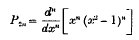
The polynomials which satisfy linear differential equations of the second order and of the hypergeometric type have been the object of extensive work, and very few properties of them remain now hidden; the student who seeks in that direction a subject for research is compelled to look, not after these functions themselves but after generalisations of them. Among these may be set in first place the polynomials connected with a differential equation of the third order and of the extended hypergeometric type, of which a general theory has been given by Goursat. The number of such polynomials of which properties have been studied in particular is rather small; in fact, Appell's polynomials
and Pincherle's polynomials, arising from the expansions

are, so far as I know, the only well-known ones. To show what can be done in these ways, I shall briefly give the definition and principal properties of some polynomials analogous to Pincherle's and of some allied functions.
On asymptotically stable sets
-
- Journal:
- Proceedings of the Edinburgh Mathematical Society / Volume 17 / Issue 2 / December 1970
- Published online by Cambridge University Press:
- 20 January 2009, pp. 181-186
-
- Article
-
- You have access
- Export citation
