Refine search
Actions for selected content:
26077 results in Abstract analysis
E. B. Davies, One-Parameter Semigroups (Academic Press, London, 1980), viii + 230 pp., £19.80.
-
- Journal:
- Proceedings of the Edinburgh Mathematical Society / Volume 26 / Issue 1 / February 1983
- Published online by Cambridge University Press:
- 20 January 2009, pp. 115-116
-
- Article
-
- You have access
- Export citation
Michael J. Collins (ed) Finite Simple Groups II (Academic Press, London, 1980), xvi + 346 pp. £25.
-
- Journal:
- Proceedings of the Edinburgh Mathematical Society / Volume 25 / Issue 1 / February 1982
- Published online by Cambridge University Press:
- 20 January 2009, pp. 111-112
-
- Article
-
- You have access
- Export citation
Absolute Riesz summability factors for Fourier series
-
- Journal:
- Proceedings of the Edinburgh Mathematical Society / Volume 17 / Issue 1 / June 1970
- Published online by Cambridge University Press:
- 20 January 2009, pp. 65-70
-
- Article
-
- You have access
- Export citation
-
Let ∑an be a given infinite series and {λn} a non-negative, strictly increasing, monotonic sequence, tending to infinity with n. We write, for w > λ0,

and, for r>0, we write
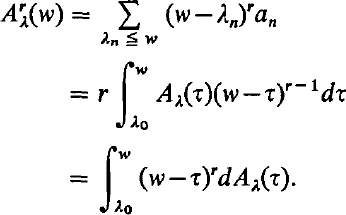
 is known as the Riesz sum of “ type ” λn and “ order ” r, and
is called the Riesz mean of type λn and order r.
 is known as the Riesz sum of “ type ” λ
N. Bourbaki, Eléments de Mathématique I. Les structures fondamentales de l'analyse, Livre II Algèbre, Chapitre 9. Formes sesquilinéaires et formes quadratiques (Actualités Scientifiques et industrielles 1272, Hermann, Paris, 1959), 218 pp., 38s.
-
- Journal:
- Proceedings of the Edinburgh Mathematical Society / Volume 12 / Issue 3 / June 1961
- Published online by Cambridge University Press:
- 20 January 2009, pp. 162-163
-
- Article
-
- You have access
- Export citation
James Gregory's Mathematical Work: A Study based chiefly on his Letters
-
- Journal:
- Proceedings of the Edinburgh Mathematical Society / Volume 41 / February 1922
- Published online by Cambridge University Press:
- 20 January 2009, pp. 2-25
-
- Article
-
- You have access
- Export citation
Distance between Hermitian operators in Schatten classes
-
- Journal:
- Proceedings of the Edinburgh Mathematical Society / Volume 39 / Issue 2 / June 1996
- Published online by Cambridge University Press:
- 20 January 2009, pp. 377-380
-
- Article
-
- You have access
- Export citation
Positive functionals and oscillation criteria for second order differential systems
-
- Journal:
- Proceedings of the Edinburgh Mathematical Society / Volume 22 / Issue 3 / October 1979
- Published online by Cambridge University Press:
- 20 January 2009, pp. 277-290
-
- Article
-
- You have access
- Export citation
-
Let ℋ be a Hilbert space, let ℬ = (ℋ, ℋ) be the B*-algebra of bounded linear operators from ℋ to ℋ with the uniform operator topology, and let ℒ be the subset of ℬ consisting of the self-adjoint operators. This article is concerned with the second order self-adjoint differential equation

PEM volume 12 issue 2 Cover and Front matter
-
- Journal:
- Proceedings of the Edinburgh Mathematical Society / Volume 12 / Issue 2 / December 1960
- Published online by Cambridge University Press:
- 20 January 2009, pp. f1-f2
-
- Article
-
- You have access
- Export citation
Embeddings into finite idempotent-generated semigroups: some arithmetical results
-
- Journal:
- Proceedings of the Edinburgh Mathematical Society / Volume 34 / Issue 2 / June 1991
- Published online by Cambridge University Press:
- 20 January 2009, pp. 259-269
-
- Article
-
- You have access
- Export citation
-
A semiband is defined as a semigroup generated by idempotents. It is known that every finite semigroup is embeddable in a finite semiband. For a class C of semigroups and an integer n≧2, the number σC (n) is defined as the smallest k with the property that every semigroup of order n in the class C is embeddable in a semiband of order not exceeding k. It is shown that for the class Gp of groups σGp(n) = nq(ρGp(n)), where

and

Estimates are known (and are quoted) for the function q. Estimates are considered for the function pC for various C
It is shown also that if C0S, CS denote respectively the classes of completely 0-simple and completely simple semigroups, then

Unique continuation at infinity of solutions to Schrödinger equations with complex-valued potentials
-
- Journal:
- Proceedings of the Edinburgh Mathematical Society / Volume 42 / Issue 1 / February 1999
- Published online by Cambridge University Press:
- 20 January 2009, pp. 143-153
-
- Article
-
- You have access
- Export citation
ON NEAR-RING IDEMPOTENTS AND POLYNOMIALS ON DIRECT PRODUCTS OF Ω-GROUPS
-
- Journal:
- Proceedings of the Edinburgh Mathematical Society / Volume 44 / Issue 2 / June 2001
- Published online by Cambridge University Press:
- 20 January 2009, pp. 379-388
-
- Article
-
- You have access
- Export citation
Office Bearers
-
- Journal:
- Proceedings of the Edinburgh Mathematical Society / Volume 8 / February 1889
- Published online by Cambridge University Press:
- 20 January 2009, p. 1
-
- Article
-
- You have access
- Export citation
The Parabolic Path of a Projectile
-
- Journal:
- Proceedings of the Edinburgh Mathematical Society / Volume 24 / February 1905
- Published online by Cambridge University Press:
- 20 January 2009, p. 34
-
- Article
-
- You have access
- Export citation
The Nine-point Circle
-
- Journal:
- Proceedings of the Edinburgh Mathematical Society / Volume 1 / February 1883
- Published online by Cambridge University Press:
- 20 January 2009, p. 129
-
- Article
-
- You have access
- Export citation
The Wallace line and the Wallace point
-
- Journal:
- Proceedings of the Edinburgh Mathematical Society / Volume 9 / February 1890
- Published online by Cambridge University Press:
- 20 January 2009, pp. 83-91
-
- Article
-
- You have access
- Export citation
PEM volume 8 Cover and Front matter
-
- Journal:
- Proceedings of the Edinburgh Mathematical Society / Volume 8 / February 1889
- Published online by Cambridge University Press:
- 20 January 2009, pp. f1-f5
-
- Article
-
- You have access
- Export citation
Some stability properties of Arens regular bilinear operators
-
- Journal:
- Proceedings of the Edinburgh Mathematical Society / Volume 34 / Issue 3 / October 1991
- Published online by Cambridge University Press:
- 20 January 2009, pp. 443-454
-
- Article
-
- You have access
- Export citation
-
In this paper we present three results about Arens regular bilinear operators. These are: (a). Let X, Y be two Banach spaces, K a compact Hausdorff space, µ a Borel measure on K and m: X × Y →ℂ a bounded bilinear operator. Then the bilinear operator
 defined by
  is regular iff m is regular, (b) Let (Xα), (Xα),(Zα) be three families of Banach spaces and let mα:Xα ×Yα→Zα, be a family of bilinear operators with supα∥mα∥<∞. Then the bilinear operator
  defined by
  is regular iff each mα, is regular, (c) Let X, Y have the Dieudonné property and let m:X × Y→Z be a bounded bilinear operator with m(X×Y) separable and such that, for each z′ in ext Z′1, z′∘m is regular. Then m is regular. Several applications of these results are also given.
 defined by
  is regular iff m is regular, (b) Let (X
 defined by
  is regular iff each m
Quantitative proofs of certain Algebraic Inequalities
-
- Journal:
- Proceedings of the Edinburgh Mathematical Society / Volume 24 / February 1905
- Published online by Cambridge University Press:
- 20 January 2009, pp. 61-77
-
- Article
-
- You have access
- Export citation
Nonlinear boundary value problems for elliptic systems
-
- Journal:
- Proceedings of the Edinburgh Mathematical Society / Volume 30 / Issue 2 / June 1987
- Published online by Cambridge University Press:
- 20 January 2009, pp. 257-272
-
- Article
-
- You have access
- Export citation
-
The purpose of this paper is to discuss non-linear boundary value problems for elliptic systems of the type

where Ak is a second order uniformly elliptic operator and
 is such that the problem
has a one-dimensional space of solutions that is generated by a non-negative function. The boundary ∂G is supposed to be smooth and the functions gk, 1≦k≦m are defined on Ḡ×Rm and are continuously differentiate (usually, Bk represents Dirichlet or Neumann conditions and
 is the first eigenvalue associated with Ak and such boundary conditions).
 is such that the problem
 is the first eigenvalue associated with A
Elementary Proof of the Formula

-
- Journal:
- Proceedings of the Edinburgh Mathematical Society / Volume 38 / February 1919
- Published online by Cambridge University Press:
- 20 January 2009, pp. 52-53
-
- Article
-
- You have access
- Export citation

