Refine search
Actions for selected content:
26077 results in Abstract analysis
Sets of Semi-Commutative Matrices
-
- Journal:
- Proceedings of the Edinburgh Mathematical Society / Volume 3 / Issue 3 / February 1933
- Published online by Cambridge University Press:
- 20 January 2009, pp. 179-188
-
- Article
-
- You have access
- Export citation
-
In a paper entitled “Sets of anticommuting matrices” Eddington proved that if El, E2, …., Eqform a set of q four-rowed square matrices satisfying the relations,
 ,
,where E is the unit matrix, then the maximum value of q is five. Later Newman showed that this result is a particular case of the general theorem that ifE1, E2, …., Eqform a set of q t-rowed square matrices satisfying (1), where t = 2Pτ and τ is odd, then the maximum value of q is 2p + 1.
The radical of the group algebra of a sub-group, of a polycyclic group and of a restricted SN-group
-
- Journal:
- Proceedings of the Edinburgh Mathematical Society / Volume 17 / Issue 2 / December 1970
- Published online by Cambridge University Press:
- 20 January 2009, pp. 165-171
-
- Article
-
- You have access
- Export citation
-
Let G be a group and let K be an algebraically closed field of characteristic p>0. The twisted group algebra Kt(G) of G over K is defined as follows: let G have elements a, b, c, … and let Kt(G) be a vector space over K with basis elements
 , …; a multiplication is defined on this basis of Kt(G) and extended by linearity to Kt(G) by letting
where α(x, y) is a non-zero element of K, subject to the condition that

which is both necessary and sufficient for associativity. If, for all x, y ∈ G, α{x, y) is the identity of K then Kt(G) is the usual group algebra K(G) of G over K. We denote the Jacobson radical of Kt(G) by JKt(G). We are interested in the relationship between JKt(G) and JKt(H) where H is a normal subgroup of G. In § 2 we show, among other results, that if certain centralising conditions are satisfied and if JK(H) is locally nilpotent then JK(H)K(G) is also locally nilpotent and thus contained in JK(G). It is observed that in the absence of some centralising conditions these conclusions are false. We show, in particular, that if H and G/C(H) are locally finite, C(H) being the centraliser of H, and if G/H has no non-trivial elements of order p, then JK(G) coincides with the locally nilpotent ideal JK(H)K(G). The latter, and probably more significant, part of this paper is concerned with particular types of groups. We introduce the notion of a restricted SN-group and show that if G is such a group and ifG has no non-trivial elements of order p then JKt(G) = {0}. It is also shown that if G is polycyclic then JKt(G) is nilpotent.
 , …; a multiplication is defined on this basis of K
A counterexample in the theory of Hermitian liftings
-
- Journal:
- Proceedings of the Edinburgh Mathematical Society / Volume 25 / Issue 2 / June 1982
- Published online by Cambridge University Press:
- 20 January 2009, pp. 141-144
-
- Article
-
- You have access
- Export citation
U. Brechtken-Manderscheid, Introduction to the calculus of variations, translated by P. G. Engstrom (Chapman and Hall, London1991), pp. viii + 200, cloth 0 412 36690 8, £27.95, paper 0 412 36700 9, £13.95.
-
- Journal:
- Proceedings of the Edinburgh Mathematical Society / Volume 35 / Issue 3 / October 1992
- Published online by Cambridge University Press:
- 20 January 2009, p. 522
-
- Article
-
- You have access
- Export citation
Notes on Everett's Interpolation Formula
-
- Journal:
- Proceedings of the Edinburgh Mathematical Society / Volume 40 / February 1921
- Published online by Cambridge University Press:
- 20 January 2009, pp. 21-26
-
- Article
-
- You have access
- Export citation
P. Wojtaszczyk, Banach spaces for analysts (Cambridge Studies in Advanced Mathematics 25, Cambridge University Press, 1991), pp. xiv + 382, 0 521 35618 0, £50.
-
- Journal:
- Proceedings of the Edinburgh Mathematical Society / Volume 35 / Issue 2 / June 1992
- Published online by Cambridge University Press:
- 20 January 2009, pp. 335-336
-
- Article
-
- You have access
- Export citation
A local characterisation of serial subgroups
-
- Journal:
- Proceedings of the Edinburgh Mathematical Society / Volume 22 / Issue 3 / October 1979
- Published online by Cambridge University Press:
- 20 January 2009, pp. 201-205
-
- Article
-
- You have access
- Export citation
-
In (2) Hickin and Phillips establish various results connecting the ideas of local systems and serial subgroups in group theory. In (4) Petty shows that if a group has a local factor system of
 -groups, then it may be embedded in an ultraproduct of -groups and he uses this result to extend some local theorems which were originally due to Mal'cev (3) and at the same time providing an elementary proof. We shall show that Petty's method may be used to prove results about seriality and local systems.
 -groups, then it may be embedded in an ultraproduct of
 Solution with Axial Symmetry of Einstein's Equations of Teleparallelism
-
- Journal:
- Proceedings of the Edinburgh Mathematical Society / Volume 2 / Issue 3 / January 1931
- Published online by Cambridge University Press:
- 20 January 2009, pp. 140-150
-
- Article
-
- You have access
- Export citation
The Operational Representations of Dn(x) and

-
- Journal:
- Proceedings of the Edinburgh Mathematical Society / Volume 4 / Issue 1 / March 1934
- Published online by Cambridge University Press:
- 20 January 2009, pp. 33-35
-
- Article
-
- You have access
- Export citation
-
1. A given function f(x) is said to be represented operationally by another function φ(p), if

provided that the integral converges.
Commuting well-bounded operators on Hilbert spaces
-
- Journal:
- Proceedings of the Edinburgh Mathematical Society / Volume 20 / Issue 2 / September 1976
- Published online by Cambridge University Press:
- 20 January 2009, pp. 167-172
-
- Article
-
- You have access
- Export citation
-
A bounded linear operator T on a complex reflexive Banach space is said to be well-bounded if it is possible to choose a compact interval J = [a, b] and a positive constant M such that

for every complex polynomial p, where ‖p‖J denotes sup {|p(t)|:t ∈ J}. Such operators were introduced and first studied by Smart (4). They are of interest principally because they admit (and in fact are characterised by) an integral representation similar to, but in general weaker than, the integral representation of a self-adjoint operator on a Hilbert space. (See (2) and (4) for details.) It is easily seen, by verifying (1) directly, that T is well-bounded if it is a scalar-type spectral operator with real spectrum.
Quaternion Note on the Theory of Confocals
-
- Journal:
- Proceedings of the Edinburgh Mathematical Society / Volume 36 / February 1917
- Published online by Cambridge University Press:
- 20 January 2009, pp. 91-93
-
- Article
-
- You have access
- Export citation
B. Fornberg A practical guide to pseudospectral methods (Cambridge University Press, Cambridge, 1996), x + 231 pp., 0 521 49582 2 (hardback), £37.50 (US$54.95).
-
- Journal:
- Proceedings of the Edinburgh Mathematical Society / Volume 42 / Issue 1 / February 1999
- Published online by Cambridge University Press:
- 20 January 2009, pp. 209-211
-
- Article
-
- You have access
- Export citation
A special case of the dissection of any two triangles into mutually similar pairs of triangles
-
- Journal:
- Proceedings of the Edinburgh Mathematical Society / Volume 18 / February 1900
- Published online by Cambridge University Press:
- 20 January 2009, pp. 28-29
-
- Article
-
- You have access
- Export citation
D. M. Bressoud Proofs and confirmations: the story of the alternating sign matrix conjecture (Spectrum Series, Mathematical Association of America/Cambridge University Press, 1999), xv + 274pp., 0 521 66646 5 (paperback), £17.95 (US$29.95).
-
- Journal:
- Proceedings of the Edinburgh Mathematical Society / Volume 43 / Issue 3 / October 2000
- Published online by Cambridge University Press:
- 20 January 2009, pp. 665-666
-
- Article
-
- You have access
- Export citation
I. N. Sneddon, Mixed Boundary Value Problems in Potential Theory (North-Holland Publishing Company—Amsterdam, 1966), viii+282 pp., 80s.
-
- Journal:
- Proceedings of the Edinburgh Mathematical Society / Volume 16 / Issue 2 / December 1968
- Published online by Cambridge University Press:
- 20 January 2009, p. 183
-
- Article
-
- You have access
- Export citation
The Frattini subalgebra of a Bernstein algebra*
-
- Journal:
- Proceedings of the Edinburgh Mathematical Society / Volume 35 / Issue 3 / October 1992
- Published online by Cambridge University Press:
- 20 January 2009, pp. 397-403
-
- Article
-
- You have access
- Export citation
PEM volume 27 issue 1 Cover and Back matter
-
- Journal:
- Proceedings of the Edinburgh Mathematical Society / Volume 27 / Issue 1 / February 1984
- Published online by Cambridge University Press:
- 20 January 2009, p. b1
-
- Article
-
- You have access
- Export citation
An Analysis of all the Inconclusive Votes possible with 15 Electors and 3 Candidates
-
- Journal:
- Proceedings of the Edinburgh Mathematical Society / Volume 16 / February 1897
- Published online by Cambridge University Press:
- 20 January 2009, p. 49
-
- Article
-
- You have access
- Export citation
On the dynamic scaling behaviour of solutions to the discrete smoluchowski equations
-
- Journal:
- Proceedings of the Edinburgh Mathematical Society / Volume 39 / Issue 3 / October 1996
- Published online by Cambridge University Press:
- 20 January 2009, pp. 547-559
-
- Article
-
- You have access
- Export citation
-
In this paper we generalize recent results of Kreer and Penrose by showing that solutions to the discrete Smoluchowski equations
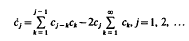
with general exponentially decreasing initial data, with density p, have the following asymptotic behaviour
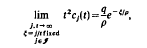
where J = {j: cj(t)>0, t>0} and q = gcd{j: cj(0)>0}.
On a Group of Parabolas associated with the Triangle
-
- Journal:
- Proceedings of the Edinburgh Mathematical Society / Volume 34 / February 1915
- Published online by Cambridge University Press:
- 20 January 2009, pp. 77-92
-
- Article
-
- You have access
- Export citation
