Refine search
Actions for selected content:
26077 results in Abstract analysis
PEM volume 38 issue 3 Cover and Front matter
-
- Journal:
- Proceedings of the Edinburgh Mathematical Society / Volume 38 / Issue 3 / October 1995
- Published online by Cambridge University Press:
- 20 January 2009, pp. f1-f2
-
- Article
-
- You have access
- Export citation
An Example of a Plane Shock of Variable Strength
-
- Journal:
- Proceedings of the Edinburgh Mathematical Society / Volume 13 / Issue 4 / December 1963
- Published online by Cambridge University Press:
- 20 January 2009, pp. 297-302
-
- Article
-
- You have access
- Export citation
Note on an “Alternant” with Factorial Elements
-
- Journal:
- Proceedings of the Edinburgh Mathematical Society / Volume 3 / Issue 4 / August 1933
- Published online by Cambridge University Press:
- 20 January 2009, pp. 296-299
-
- Article
-
- You have access
- Export citation
-
The alternant with powers of variables for its elements
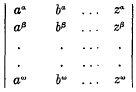
has often been investigated and its properties are well known. In the present note an “alternant” with factorial elements,
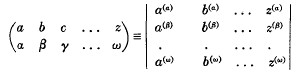
will be discussed. Here a, b, c, …, z, α, β, γ, …, ω are integers such that

and

with the convention that a(0) = 1, O(0) = 1, and that, where negative indices occur (in the reductions of §2), the factorial is to be regarded as zero.
Combinantal Forms of a Quadric Net Applied to Irreducible Concomitant Systems
-
- Journal:
- Proceedings of the Edinburgh Mathematical Society / Volume 12 / Issue 4 / December 1961
- Published online by Cambridge University Press:
- 20 January 2009, pp. 189-195
-
- Article
-
- You have access
- Export citation
Remarks on module-finite pairs
-
- Journal:
- Proceedings of the Edinburgh Mathematical Society / Volume 24 / Issue 2 / June 1981
- Published online by Cambridge University Press:
- 20 January 2009, pp. 137-139
-
- Article
-
- You have access
- Export citation
Cohomology of induced modules in rings of differential operators
-
- Journal:
- Proceedings of the Edinburgh Mathematical Society / Volume 31 / Issue 1 / February 1988
- Published online by Cambridge University Press:
- 20 January 2009, pp. 41-47
-
- Article
-
- You have access
- Export citation
-
Let K be a field of characteristic zero and let Δ ={δ1,…,δn} be a set of commuting K-derivations of the commutative Noetherian K-algebra R. Let S = R[X1,…,Xn] be the corresponding ring of differential operators, so [Xi, r] = Xir − rXi=δi(r and [Xi, Xj]=0, for 1≦i, j≦n. Let M be a maximal ideal of R with R/M of finite dimension over K. The purpose of this note is to describe the groups

The Solution of Certain Dual Integral Equations
-
- Journal:
- Proceedings of the Edinburgh Mathematical Society / Volume 12 / Issue 4 / December 1961
- Published online by Cambridge University Press:
- 20 January 2009, pp. 213-216
-
- Article
-
- You have access
- Export citation
V. Bryant, Metric spaces: iteration and application (Cambridge University Press, 1985) 105 pp., cloth £15.00, paper £4.95.
-
- Journal:
- Proceedings of the Edinburgh Mathematical Society / Volume 29 / Issue 1 / February 1986
- Published online by Cambridge University Press:
- 20 January 2009, pp. 141-142
-
- Article
-
- You have access
- Export citation
Divisible S-systems and R-modules
-
- Journal:
- Proceedings of the Edinburgh Mathematical Society / Volume 30 / Issue 2 / June 1987
- Published online by Cambridge University Press:
- 20 January 2009, pp. 187-200
-
- Article
-
- You have access
- Export citation
-
Throughout this paper S will denote a given monoid and R a given ring with unity. A set A is a right S-system if there is a map φ:A × S→A satisfying

and

for any element a of A and any elements s, t of S. For φ(a, s) we write as and we refer to right S-systems simply as S-systems. One has the obvious definitions of an S-subsystem, an S-homomorphism and a congruence on an S-system. The reader ispresumed to be familiar with the basic definitions concerning right R-modules over R. As with S-systems we will refer to right R-modules just as R-modules.

A class of nonlinear elliptic problems with nonconvex constraints and applications
-
- Journal:
- Proceedings of the Edinburgh Mathematical Society / Volume 41 / Issue 2 / June 1998
- Published online by Cambridge University Press:
- 20 January 2009, pp. 333-357
-
- Article
-
- You have access
- Export citation
C. Blatter, Analysis I, II and III (Heidelberger Taschenbücher, Springer-Verlag, Berlin-HeidelbergNew York, 1974), 204 + 180 + 184 pp., each volume $6.10.
-
- Journal:
- Proceedings of the Edinburgh Mathematical Society / Volume 20 / Issue 3 / March 1977
- Published online by Cambridge University Press:
- 20 January 2009, p. 272
-
- Article
-
- You have access
- Export citation
M. Hervé, Several Complex Variables: Local Theory (Oxford University Press, 1963), 26s. 6d.
-
- Journal:
- Proceedings of the Edinburgh Mathematical Society / Volume 14 / Issue 2 / December 1964
- Published online by Cambridge University Press:
- 20 January 2009, p. 172
-
- Article
-
- You have access
- Export citation
Multiply Perspective Polygons inscribed in a Plane Cubic Curve
-
- Journal:
- Proceedings of the Edinburgh Mathematical Society / Volume 39 / February 1920
- Published online by Cambridge University Press:
- 20 January 2009, pp. 2-6
-
- Article
-
- You have access
- Export citation
On the density of the invertible group in C*-algebras
-
- Journal:
- Proceedings of the Edinburgh Mathematical Society / Volume 20 / Issue 2 / September 1976
- Published online by Cambridge University Press:
- 20 January 2009, pp. 153-157
-
- Article
-
- You have access
- Export citation
On the Number of Ways of Colouring a Map
-
- Journal:
- Proceedings of the Edinburgh Mathematical Society / Volume 2 / Issue 2 / June 1930
- Published online by Cambridge University Press:
- 20 January 2009, pp. 83-91
-
- Article
-
- You have access
- Export citation
-
It is well known that any map of n regions on a sphere may be coloured in five or fewer colours. The purpose of the present note is to prove the following
Theorem. If Pn(λ)denotes the number of ways of colouring any ma: of n regions on the sphere in λ (or fewer) colours, then
(1)

This inequality obviously holds for λ = 1, 2, 3 so that we may confine attention to the case λ > 4. Furthermore it holds for n = 3, 4 since the first region may be coloured in λ ways, the second in at least λ — 1 ways, the third in at least λ — 2 ways, and the fourth, if there be one, in at least λ — 3 ways.
H. Hanche-Olsen and E. Stormer Jordan operator algebras (Monographs and Studies in Mathematics, Vol. 21, Pitman, 1984), 183 pp. £27.50.
-
- Journal:
- Proceedings of the Edinburgh Mathematical Society / Volume 28 / Issue 3 / October 1985
- Published online by Cambridge University Press:
- 20 January 2009, p. 424
-
- Article
-
- You have access
- Export citation
PEM volume 5 issue 3 Cover and Front matter
-
- Journal:
- Proceedings of the Edinburgh Mathematical Society / Volume 5 / Issue 3 / February 1938
- Published online by Cambridge University Press:
- 20 January 2009, pp. f1-f2
-
- Article
-
- You have access
- Export citation
Notes on the Apollonian problem and the allied theory
-
- Journal:
- Proceedings of the Edinburgh Mathematical Society / Volume 26 / February 1907
- Published online by Cambridge University Press:
- 20 January 2009, pp. 58-66
-
- Article
-
- You have access
- Export citation
Richard Bellman, Analytic Number Theory: An Introduction (The Benjamin/Cummings Publishing Company Inc., 1980), 195 pp., U.S. $19.50.
-
- Journal:
- Proceedings of the Edinburgh Mathematical Society / Volume 25 / Issue 1 / February 1982
- Published online by Cambridge University Press:
- 20 January 2009, pp. 109-110
-
- Article
-
- You have access
- Export citation
Radicals in Categories
-
- Journal:
- Proceedings of the Edinburgh Mathematical Society / Volume 21 / Issue 2 / September 1978
- Published online by Cambridge University Press:
- 20 January 2009, pp. 111-128
-
- Article
-
- You have access
- Export citation
