Refine search
Actions for selected content:
26077 results in Abstract analysis
Kusraev, A. G. Dominated operators (Mathematics and its Applications, vol. 519, Kluwer, 2000), xiii+446 pp., 0 792 36485 6 (hardback), £120
-
- Journal:
- Proceedings of the Edinburgh Mathematical Society / Volume 44 / Issue 3 / October 2001
- Published online by Cambridge University Press:
- 20 January 2009, pp. 665-666
-
- Article
-
- You have access
- Export citation
Thermal Stress in Anisotropic Cylinders
-
- Journal:
- Proceedings of the Edinburgh Mathematical Society / Volume 13 / Issue 2 / December 1962
- Published online by Cambridge University Press:
- 20 January 2009, pp. 159-164
-
- Article
-
- You have access
- Export citation
Modular Jordan nilalgebras
-
- Journal:
- Proceedings of the Edinburgh Mathematical Society / Volume 37 / Issue 1 / February 1994
- Published online by Cambridge University Press:
- 20 January 2009, pp. 1-12
-
- Article
-
- You have access
- Export citation
On Measure of Sumsets: III. The Continuous (α+β)-theorem
-
- Journal:
- Proceedings of the Edinburgh Mathematical Society / Volume 12 / Issue 4 / December 1961
- Published online by Cambridge University Press:
- 20 January 2009, pp. 209-211
-
- Article
-
- You have access
- Export citation
PEM volume 30 Cover and Front matter
-
- Journal:
- Proceedings of the Edinburgh Mathematical Society / Volume 30 / February 1911
- Published online by Cambridge University Press:
- 20 January 2009, pp. f1-f5
-
- Article
-
- You have access
- Export citation
Topologically free actions and ideals in discrete C*-dynamical systems
-
- Journal:
- Proceedings of the Edinburgh Mathematical Society / Volume 37 / Issue 1 / February 1994
- Published online by Cambridge University Press:
- 20 January 2009, pp. 119-124
-
- Article
-
- You have access
- Export citation
On the maximal monotonicity and the range of the sum of nonlinear maximal monotone operators
-
- Journal:
- Proceedings of the Edinburgh Mathematical Society / Volume 34 / Issue 1 / February 1991
- Published online by Cambridge University Press:
- 20 January 2009, pp. 143-153
-
- Article
-
- You have access
- Export citation
J. M. Sachs, R. B. Rasmussen, and W. G. Purcell, Basic College Mathematics, 2nd Edition (Allyn and Bacon), ix+331 pp., $7.50.
-
- Journal:
- Proceedings of the Edinburgh Mathematical Society / Volume 15 / Issue 4 / December 1967
- Published online by Cambridge University Press:
- 20 January 2009, p. 321
-
- Article
-
- You have access
- Export citation
Positive multipoint Padé continued fractions
-
- Journal:
- Proceedings of the Edinburgh Mathematical Society / Volume 32 / Issue 2 / June 1989
- Published online by Cambridge University Press:
- 20 January 2009, pp. 261-269
-
- Article
-
- You have access
- Export citation
Notes on James Gray
-
- Journal:
- Proceedings of the Edinburgh Mathematical Society / Volume 43 / February 1924
- Published online by Cambridge University Press:
- 20 January 2009, pp. 70-80
-
- Article
-
- You have access
- Export citation
Some inequalities involving the symmetric functions
-
- Journal:
- Proceedings of the Edinburgh Mathematical Society / Volume 20 / Issue 3 / March 1977
- Published online by Cambridge University Press:
- 20 January 2009, pp. 199-204
-
- Article
-
- You have access
- Export citation
-
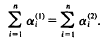
We firstly introduce some notation. Let a(t) ∈ Rn then we denote by α(t) a rearrangement of a(t) in non-decreasing order. We write a(1) ≺ a(2) if

and
B. Mates, Elementary Logic (Oxford University Press), 42s.
-
- Journal:
- Proceedings of the Edinburgh Mathematical Society / Volume 15 / Issue 4 / December 1967
- Published online by Cambridge University Press:
- 20 January 2009, pp. 325-326
-
- Article
-
- You have access
- Export citation
Generalized near-fields
-
- Journal:
- Proceedings of the Edinburgh Mathematical Society / Volume 27 / Issue 1 / February 1984
- Published online by Cambridge University Press:
- 20 January 2009, pp. 21-24
-
- Article
-
- You have access
- Export citation
On the squares of Weber's parabolic cylinder functions and certain integrals connected with them
-
- Journal:
- Proceedings of the Edinburgh Mathematical Society / Volume 4 / Issue 1 / March 1934
- Published online by Cambridge University Press:
- 20 January 2009, pp. 27-32
-
- Article
-
- You have access
- Export citation
-
The parabolic cylinder functions Dn(x) and D−(n+1) (± ix) are defined by

for all values of n and x.
The Stirling Numbers and Polynomials
-
- Journal:
- Proceedings of the Edinburgh Mathematical Society / Volume 37 / February 1918
- Published online by Cambridge University Press:
- 20 January 2009, pp. 2-25
-
- Article
-
- You have access
- Export citation
-
If we write the product

in the form

the coefficients
 have been called by Professor Nielsen (following Thiele) the Stirling Numbers of the First Species, because James Stirling, in his Methodus Differentialis (1730), was the first writer to draw attention to their use, and furnished a small table of their initial values.
 have been called by Professor Nielsen (following Thiele) the Stirling Numbers of the First Species, because James Stirling, in his Methodus Differentialis (1730), was the first writer to draw attention to their use, and furnished a small table of their initial values.
R. Hagen, S. Roch and B. Silbermann Spectral theory of approximation methods for convolution equations (Operator Theory: Advances and Applications, Vol. 74, Birkhäuser, Basel-Boston-Berlin, 1994), 392 pp., 3 7643 5112 8, (hardcover) £69.
-
- Journal:
- Proceedings of the Edinburgh Mathematical Society / Volume 40 / Issue 2 / June 1997
- Published online by Cambridge University Press:
- 20 January 2009, pp. 404-405
-
- Article
-
- You have access
- Export citation
Embedding topological semigroups in topological groups
-
- Journal:
- Proceedings of the Edinburgh Mathematical Society / Volume 17 / Issue 2 / December 1970
- Published online by Cambridge University Press:
- 20 January 2009, pp. 127-138
-
- Article
-
- You have access
- Export citation
C*-ideals generated by polynomials
-
- Journal:
- Proceedings of the Edinburgh Mathematical Society / Volume 42 / Issue 2 / June 1999
- Published online by Cambridge University Press:
- 20 January 2009, pp. 305-309
-
- Article
-
- You have access
- Export citation
Normal
 -Fitting classes
-
- Journal:
- Proceedings of the Edinburgh Mathematical Society / Volume 35 / Issue 2 / June 1992
- Published online by Cambridge University Press:
- 20 January 2009, pp. 201-212
-
- Article
-
- You have access
- Export citation
-
The authors together with M. J. Karbe [Ill. J. Math. 33 (1989) 333–359] have considered Fitting classes
 of -groups and, under some rather strong restrictions, obtained an existence and conjugacy theorem for -injectors. Results of Menegazzo and Newell show that these restrictions are, in fact, necessary.
The Fitting class
is normal if, for each  is the unique -injector of G. is abelian normal if, for each
 . For finite soluble groups these two concepts coincide but the class of Černikov-by-nilpotent -groups is an example of a nonabelian normal Fitting class of -groups. In all known examples in which -injectors exist is closely associated with some normal Fitting class (the Černikov-by-nilpotent groups arise from studying the locally nilpotent injectors).
Here we investigate normal Fitting classes further, paying particular attention to the distinctions between abelian and nonabelian normal Fitting classes. Products and intersections with (abelian) normal Fitting classes lead to further examples of Fitting classes satisfying the conditions of the existence and conjugacy theorem.
 -Fitting classes
 of
of  is the unique
  . For finite soluble groups these two concepts coincide but the class of Černikov-by-nilpotent
 Linear Hahn–Banach extension operators
-
- Journal:
- Proceedings of the Edinburgh Mathematical Society / Volume 32 / Issue 1 / February 1989
- Published online by Cambridge University Press:
- 20 January 2009, pp. 53-57
-
- Article
-
- You have access
- Export citation
