Refine search
Actions for selected content:
26076 results in Abstract analysis
Pythagoras's Theorem*
-
- Journal:
- Proceedings of the Edinburgh Mathematical Society / Volume 25 / February 1906
- Published online by Cambridge University Press:
- 20 January 2009, pp. 91-94
-
- Article
-
- You have access
- Export citation
Paul A. Fuhrmann Linear Systems and Operators in Hilbert Space (McGraw-Hill, 1981), x + 325 pp. £19.50.
-
- Journal:
- Proceedings of the Edinburgh Mathematical Society / Volume 26 / Issue 1 / February 1983
- Published online by Cambridge University Press:
- 20 January 2009, pp. 113-114
-
- Article
-
- You have access
- Export citation
Completely bounded isomorphisms of injective von Neumann algebras
-
- Journal:
- Proceedings of the Edinburgh Mathematical Society / Volume 32 / Issue 2 / June 1989
- Published online by Cambridge University Press:
- 20 January 2009, pp. 317-327
-
- Article
-
- You have access
- Export citation
-
Milutin's Theorem states that if X and Y are uncountable metrizable compact Hausdorff spaces, then C(X) and C(Y) are isomorphic as Banach spaces [15, p. 379]. Thus there is only one isomorphism class of such Banach spaces. There is also an extensive theory of the Banach–Mazur distance between various classes of classical Banach spaces with the deepest results depending on probabilistic and asymptotic estimates [18]. Lindenstrauss, Haagerup and possibly others know that as Banach spaces
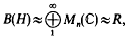
where H is the infinite dimensional separable Hilbert space, R is the injective II 1-factor on H, and ≈ denotes Banach space isomorphism. Haagerup informed us of this result, and suggested considering completely bounded isomorphisms; it is a pleasure to acknowledge his suggestion. We replace Banach space isomorphisms by completely bounded isomorphisms that preserve the linear structure and involution, but not the product. One of the two theorems of this paper is a strengthened version of the above result: if N is an injective von Neumann algebra with separable predual and not finite type I of bounded degree, then N is completely boundedly isomorphic to B(H). The methods used are similar to those in Banach space theory with complete boundedness needing a little care at various points in the argument. Extensive use is made of the conditional expectation available for injective algebras, and the methods do not apply to the interesting problems of completely bounded isomorphisms of non-injective von Neumann algebras (see [4] for a study of the completely bounded approximation property).
Jordan algebras arising in population genetics
-
- Journal:
- Proceedings of the Edinburgh Mathematical Society / Volume 15 / Issue 4 / December 1967
- Published online by Cambridge University Press:
- 20 January 2009, pp. 291-294
-
- Article
-
- You have access
- Export citation
On the automorphisms of the group ring of a unique product group
-
- Journal:
- Proceedings of the Edinburgh Mathematical Society / Volume 30 / Issue 2 / June 1987
- Published online by Cambridge University Press:
- 20 January 2009, pp. 201-205
-
- Article
-
- You have access
- Export citation
K. Yano, Differential Geometry on Complex and almost Complex Spaces (Pergamon Press, 1965), xii+323 pp., 90s.
-
- Journal:
- Proceedings of the Edinburgh Mathematical Society / Volume 15 / Issue 2 / December 1966
- Published online by Cambridge University Press:
- 20 January 2009, pp. 156-157
-
- Article
-
- You have access
- Export citation
Sunder, V. S. Functional analysis: spectral theory (Birkhäuser Advanced Texts, Basel, 1998), ix+241 pp., 3 7643 5892 0 (hardback), DM78
-
- Journal:
- Proceedings of the Edinburgh Mathematical Society / Volume 44 / Issue 2 / June 2001
- Published online by Cambridge University Press:
- 20 January 2009, pp. 447-448
-
- Article
-
- You have access
- Export citation
Hideyuki Matsumura, Commutative ring theory (Cambridge studies in advanced mathematics 8, Cambridge University Press, 1986), pp. 320, £30.
-
- Journal:
- Proceedings of the Edinburgh Mathematical Society / Volume 31 / Issue 1 / February 1988
- Published online by Cambridge University Press:
- 20 January 2009, pp. 167-168
-
- Article
-
- You have access
- Export citation
Some characterizations of π-regular rings with no infinite trivial subring
-
- Journal:
- Proceedings of the Edinburgh Mathematical Society / Volume 34 / Issue 1 / February 1991
- Published online by Cambridge University Press:
- 20 January 2009, pp. 1-5
-
- Article
-
- You have access
- Export citation
G. Segal (Editor), New developments in Topology (London Mathematical Society Lecture Note Series 11, Cambridge University Press, 1974), 128 pp., £2·60.
-
- Journal:
- Proceedings of the Edinburgh Mathematical Society / Volume 19 / Issue 3 / March 1975
- Published online by Cambridge University Press:
- 20 January 2009, pp. 318-319
-
- Article
-
- You have access
- Export citation
On the strong maximum principle for parabolic differential equations
-
- Journal:
- Proceedings of the Edinburgh Mathematical Society / Volume 29 / Issue 1 / February 1986
- Published online by Cambridge University Press:
- 20 January 2009, pp. 93-96
-
- Article
-
- You have access
- Export citation
-
In a recent paper [2], D. Colton has given a new proof for the strong maximum principle with regard to the heat equation ut = Δu. His proof depends on the analyticity (in x) of solutions. For this reason it does not carry over to the equation

or to more general equations. But in order to tread mildly nonlinear equations such asut = Δu + f(u) which are important in many applications, it is essential to have the strong maximum principle at least for equation (*). It should also be said that this proof uses nontrivial facts about the heat equation.
Z. I. Borevich and I. R. Shafarevich, Number Theory (Academic Pres, New York and London, 1966), x+435 pp., 104s.
-
- Journal:
- Proceedings of the Edinburgh Mathematical Society / Volume 16 / Issue 3 / June 1969
- Published online by Cambridge University Press:
- 20 January 2009, p. 269
-
- Article
-
- You have access
- Export citation
On the Locus of the Foci of a System of Similar Conics through three Points
-
- Journal:
- Proceedings of the Edinburgh Mathematical Society / Volume 27 / February 1909
- Published online by Cambridge University Press:
- 20 January 2009, pp. 37-50
-
- Article
-
- You have access
- Export citation
Jordan Subalgebras of Banach algebras
-
- Journal:
- Proceedings of the Edinburgh Mathematical Society / Volume 21 / Issue 2 / September 1978
- Published online by Cambridge University Press:
- 20 January 2009, pp. 103-110
-
- Article
-
- You have access
- Export citation
Sur les algèbres gamétiques
-
- Journal:
- Proceedings of the Edinburgh Mathematical Society / Volume 29 / Issue 2 / June 1986
- Published online by Cambridge University Press:
- 20 January 2009, pp. 187-197
-
- Article
-
- You have access
- Export citation
-
Soient K un anneau commutatif à élémént unité, P un K-module unitaire, SK(P) l'algèbre symétrique de P et
 le sous-K-module de SK(P) des éléments homogénes de degré m≧0. Rappelons que si P est un K-module libre de rang n + 1, l'algèbre SK(P) est isomorphe à l'algèbre des polynômes K[X0,X1,…,Xn] en les indéterminéesX0,X1,…,Xn à coefficients dans K et est le K-module libre dont une base est formée par les monômes
  tels que
  ie., Par les moôomes homogènes de degré m.
 le sous-K-module de S
 tels que
  ie., Par les moôomes homogènes de degré m.
On Lambe's infinite integral formula
-
- Journal:
- Proceedings of the Edinburgh Mathematical Society / Volume 6 / Issue 3 / August 1940
- Published online by Cambridge University Press:
- 20 January 2009, pp. 147-148
-
- Article
-
- You have access
- Export citation
-
In a recent paper (these Proceedings (2), 6 (1939), 75–8), C. G. Lambe established, and gave some applications of, the formula

in which Ds is the symbol for the derivative of fractional order s. Lambe's proof of (1) is not quite rigorous and it does not bring out the conditions which have to be imposed upon f(x) in order to make (1) true. Furthermore this proof does not give any evidence as to the definition of fractional derivative which is to be used in connection with (1).
An Integral Transform Solution of the Differential Equation for the Transverse Motion of an Elastic Beam
-
- Journal:
- Proceedings of the Edinburgh Mathematical Society / Volume 11 / Issue 2 / November 1958
- Published online by Cambridge University Press:
- 20 January 2009, pp. 87-93
-
- Article
-
- You have access
- Export citation
PEM volume 12 Cover and Front matter
-
- Journal:
- Proceedings of the Edinburgh Mathematical Society / Volume 12 / February 1893
- Published online by Cambridge University Press:
- 20 January 2009, pp. f1-f5
-
- Article
-
- You have access
- Export citation
On the Φ-Invariant of Two Quadrics
-
- Journal:
- Proceedings of the Edinburgh Mathematical Society / Volume 10 / Issue 1 / January 1953
- Published online by Cambridge University Press:
- 20 January 2009, pp. 25-36
-
- Article
-
- You have access
- Export citation
Epis are onto for finite regular semigroups
-
- Journal:
- Proceedings of the Edinburgh Mathematical Society / Volume 26 / Issue 2 / June 1983
- Published online by Cambridge University Press:
- 20 January 2009, pp. 151-162
-
- Article
-
- You have access
- Export citation
