Refine search
Actions for selected content:
26076 results in Abstract analysis
A Method for Successive Graphic Integrations
-
- Journal:
- Proceedings of the Edinburgh Mathematical Society / Volume 29 / February 1910
- Published online by Cambridge University Press:
- 20 January 2009, pp. 78-82
-
- Article
-
- You have access
- Export citation
PEM volume 6 issue 2 Cover and Back matter
-
- Journal:
- Proceedings of the Edinburgh Mathematical Society / Volume 6 / Issue 2 / October 1939
- Published online by Cambridge University Press:
- 20 January 2009, pp. b1-b2
-
- Article
-
- You have access
- Export citation
The extraordinary higher tangent spaces of certain quadric intersections
-
- Journal:
- Proceedings of the Edinburgh Mathematical Society / Volume 35 / Issue 3 / October 1992
- Published online by Cambridge University Press:
- 20 January 2009, pp. 437-447
-
- Article
-
- You have access
- Export citation
-
Let Cr, be the intersection of n — r quadrics with a common self-polar simplex S in projective n-space [n]. Let Γr be a Cr that can be taken in coordinate form as
 Every C1 is a Γ1, and its points of hyperosculation have special properties: they are the points of intersection of C1 with the faces of S each counting (n—1)(n — 2)/2 times, and the osculating [s], for s≦n–1, has 2s-point contact. Here we show that if r≧2 and n>2r then every point of Γ, has exceptional higher tangent spaces: the s-tangent space at a point P of an r-dimensional variety V is the intersection of all primes that cut V in a variety having an (s + l)-fold point (at least) at P, and normally has dimension
  if this is less than n. The s-tangent space to Γ, at a point not in a face of S is an [rs] (provided rs <n). Usually it is the existence of lines on V through P that cause a lower than expected s-tangent dimension. Not so on Γr, since its lines form a subvariety. If n≧5 not every C2 is a Γ2. Take n≧5. We show that C2 is Γ2 if and only if C2 contains a line. Also C2 is a Γ2 if and only if at some one point of C2 off the faces of S the second-tangent space is a [4]. Thus, unexpectedly, we have: if one point of C2 off the faces of S has a [4] for second-tangent space, then so do all such points of C2. We obtain results for points of Γ, in the faces of S.
 Every C
 if this is less than n. The s-tangent space to Γ, at a point not in a face of S is an [rs] (provided rs <n). Usually it is the existence of lines on V through P that cause a lower than expected s-tangent dimension. Not so on Γ
H. Hermes, Enumerability, Decidability, Computability. An Introduction to the Theory of Recursive Functions (Mathematischen Wissenschaften Band 127, Springer-Verlag, 1965), x + 245 pp., DM39.
-
- Journal:
- Proceedings of the Edinburgh Mathematical Society / Volume 16 / Issue 1 / June 1968
- Published online by Cambridge University Press:
- 20 January 2009, p. 80
-
- Article
-
- You have access
- Export citation
A mechanism for solving equations of the nth degree
-
- Journal:
- Proceedings of the Edinburgh Mathematical Society / Volume 30 / February 1911
- Published online by Cambridge University Press:
- 20 January 2009, pp. 69-74
-
- Article
-
- You have access
- Export citation
-
The proposed mechanism explained here is based on the geometrical properties of Fig. 1.
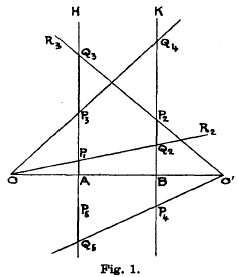
0ABO′ is a straight line having 0A = BO′ = 1, and OB = AO′ = x and AH, BK are lines perpendicular to AB.
PEM volume 12 issue 1 Cover and Back matter
-
- Journal:
- Proceedings of the Edinburgh Mathematical Society / Volume 12 / Issue 1 / June 1960
- Published online by Cambridge University Press:
- 20 January 2009, pp. b1-b2
-
- Article
-
- You have access
- Export citation
On a class of Differential Equations whose solutions satisfy Integral Equations
-
- Journal:
- Proceedings of the Edinburgh Mathematical Society / Volume 33 / February 1914
- Published online by Cambridge University Press:
- 20 January 2009, pp. 14-23
-
- Article
-
- You have access
- Export citation
-
The science of the solution of Differential Equations has been in great measure systematized by the aid of ideas borrowed from the Theory of Functions, the equations being classified according to the singularities possessed by their solutions. In the case of linear Differential Equations of the second order
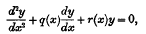
the solutions can have no singularities except at the singularities of the functions q(x) and r(x) (and possibly also at x = ∞ ): these equations may therefore be classified simply according to the number and nature of these singularities.
B. A. Fuchs and V. I. Levin, Functions of a complex variable and some of their applications, translated by J. Berry and edited by T. Kövari (International series of monographs on pure and applied mathematics Volume 21, Pergamon Press, 1961), 296 pp., 50s.
-
- Journal:
- Proceedings of the Edinburgh Mathematical Society / Volume 13 / Issue 2 / December 1962
- Published online by Cambridge University Press:
- 20 January 2009, p. 194
-
- Article
-
- You have access
- Export citation
Multiparameter spectral theory of singular differential operators
-
- Journal:
- Proceedings of the Edinburgh Mathematical Society / Volume 31 / Issue 1 / February 1988
- Published online by Cambridge University Press:
- 20 January 2009, pp. 49-66
-
- Article
-
- You have access
- Export citation
Near-rings of compatible functions
-
- Journal:
- Proceedings of the Edinburgh Mathematical Society / Volume 23 / Issue 1 / February 1980
- Published online by Cambridge University Press:
- 20 January 2009, pp. 87-95
-
- Article
-
- You have access
- Export citation
On a simple theodolite suitable for use in schools
-
- Journal:
- Proceedings of the Edinburgh Mathematical Society / Volume 24 / February 1905
- Published online by Cambridge University Press:
- 20 January 2009, p. 58
-
- Article
-
- You have access
- Export citation
PEM volume 24 issue 3 Back matter
-
- Journal:
- Proceedings of the Edinburgh Mathematical Society / Volume 24 / Issue 3 / October 1981
- Published online by Cambridge University Press:
- 20 January 2009, pp. b1-b5
-
- Article
-
- You have access
- Export citation
Operator norms determined by their numerical ranges
-
- Journal:
- Proceedings of the Edinburgh Mathematical Society / Volume 17 / Issue 3 / June 1971
- Published online by Cambridge University Press:
- 20 January 2009, pp. 249-255
-
- Article
-
- You have access
- Export citation
Summation and uncountable bi-orthogonal systems in locally convex spaces
-
- Journal:
- Proceedings of the Edinburgh Mathematical Society / Volume 19 / Issue 1 / March 1974
- Published online by Cambridge University Press:
- 20 January 2009, pp. 1-10
-
- Article
-
- You have access
- Export citation
A. D. Michal, Le Calcul Différentiel dans les Espaces de Banach, Tome I (Gauthier-Villars, Paris, 1958), translated by E. Mourier, xiv + 150 pp., 70 F.
-
- Journal:
- Proceedings of the Edinburgh Mathematical Society / Volume 12 / Issue 1 / June 1960
- Published online by Cambridge University Press:
- 20 January 2009, pp. 58-59
-
- Article
-
- You have access
- Export citation
Further elementary techniques using the miracle octad generator
-
- Journal:
- Proceedings of the Edinburgh Mathematical Society / Volume 32 / Issue 3 / October 1989
- Published online by Cambridge University Press:
- 20 January 2009, pp. 345-353
-
- Article
-
- You have access
- Export citation
Syllabus of Papers read during Session 1922–23
-
- Journal:
- Proceedings of the Edinburgh Mathematical Society / Volume 41 / February 1922
- Published online by Cambridge University Press:
- 20 January 2009, pp. v-vi
-
- Article
-
- You have access
- Export citation
Existence of solutions in a singular biharmonic nonlinear problem
-
- Journal:
- Proceedings of the Edinburgh Mathematical Society / Volume 36 / Issue 3 / October 1993
- Published online by Cambridge University Press:
- 20 January 2009, pp. 537-546
-
- Article
-
- You have access
- Export citation
-
In this work we prove the existence and uniqueness of positive solutions of the nonlinear singular boundary value problem
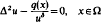

where 0<σ<1.
Extensions of the above results to the case of Δ2u−f(x, u) = 0 with appropriate singularity built into f are also given.

Near-rings with identities on dihedral groups
-
- Journal:
- Proceedings of the Edinburgh Mathematical Society / Volume 18 / Issue 3 / June 1973
- Published online by Cambridge University Press:
- 20 January 2009, pp. 219-228
-
- Article
-
- You have access
- Export citation
Kusraev, A. G. Dominated operators (Mathematics and its Applications, vol. 519, Kluwer, 2000), xiii+446 pp., 0 792 36485 6 (hardback), £120
-
- Journal:
- Proceedings of the Edinburgh Mathematical Society / Volume 44 / Issue 3 / October 2001
- Published online by Cambridge University Press:
- 20 January 2009, pp. 665-666
-
- Article
-
- You have access
- Export citation
